
Stream Real Life Network Now

WATCH NOW
Spiritual Growth


World News
25 min
Unhappiness and Isolation Are Rising among Young People, but Those Who Are Religious Are Thriving
As loneliness and unhappiness rise among young Americans, research links religious faith and marriage with greater happiness, stronger relationships, and better educational outcomes, while Christian leaders urge Gen Z to put biblical truth into practice.
Social science data continues to emerge showing that America’s young people are increasingly non-religious, isolated, and unhappy. But the data also shows that young people who are religious are thriving, with higher levels of happiness, more friends, are more likely to be married, and better educational outcomes than their non-religious peers.
Research released by the Institute for Family Studies (IFS) notes that since 2000, reports of unhappiness among young people aged 20 to 35 has more than doubled, surging from 11% to 23%. This has coincided with an era where young people are isolating at unprecedented levels as they immerse themselves in screens, pornography, social media, video games, and AI chatbots. “Socializing among young men and women is down more than 50%, from 12 hours to 5 hours per week,” IFS observes. Unsurprisingly, this has led to a precipitous decline in relationships and dating, with two thirds of young people not in serious relationships and teen dating down 50%.
As unhappiness and loneliness has risen among young people, so too has secularism. In March, Arizona Christian University’s Cultural Research Center reported that only 1% of Gen Z (ages 18 to 22) and 4% of adults in general has a biblical worldview (defined as “individuals whose beliefs and behaviors are consistently aligned with biblical principles”). The figure is down significantly since 1994, when 12% of adults reported a biblical worldview.
But married and religious young people seem to be largely escaping the unhappiness trap, with 50% saying they are “very happy” compared to just 16% of their secular, unmarried peers. As IFS points out, “faith and family remain two of the strongest bulwarks against loneliness and despair.”
For young men in particular, religion appears to be the hinge that catapults them into a future of contentment and success. Data shows that religious men are more likely to desire and attain marriage than those who are non-religious. They are also almost twice as likely to report feeling “very happy” and to say that life feels “purposeful/meaningful” than secular men. Religious men also report less mental health issues, anxiety, and depression. They also have bachelor’s degrees at far higher rates than non-religious men (46% vs. 16%) and report finishing trade school/apprenticeships at 29% (vs. 14% of secular men).
Where a happier minority of young people find meaning and purpose in religion, a far larger percentage appear to hold politics and government as their primary focal point, especially with the rising popularity of socialism.
“[M]y generation has grown up in a very hyper political age,” Counteract USA Founder and CEO Abigail DeJarnatt contended during “Washington Watch” Friday. “… [Many believe that] government can be the arbiter of morality. That’s what happens when Marxism infuses into our society. And that’s just what we’ve grown up with. So when you’re online and you’re on TikTok [watching] recipe videos, there’s also political ideologies that are being pushed on and talked about amongst Gen Z. So it’s not surprising at all that this is where we’re at, and I think we’ll just continue to see a lot more of it among young people.”
DeJarnatt further explained how her ministry is attempting to engage Gen Z with truth. “The primary thing that we’re focusing on with Gen Z Christians is teaching them a framework of biblical critical thinking,” she explained. “Because the reality is, a lot of Gen Z’s world is unfolding online. A lot of the conversations, online friendships, relationships. … What we’re trying to teach Gen Z to do is look at what they’re seeing online and ask, ‘Is it true? Is it not?’ … We’re trying to tell Gen Z [to] ask questions as fast as we’re scrolling online. Slow down. … And as Christians, we have to weigh that against the Bible itself.”
DeJarnatt went on to argue that a sense of self entitlement undergirded by Marxism has heavily influenced young people to abandon a solid biblical ethic. “[T]his Marxism that’s invaded our culture, just the hyper individualism in Gen Z,” she emphasized. “[Much of] Gen Z is [saying], ‘We aren’t happy with either political party.’ I think we have this idea that we can have it all. [It’s the] same framework of pick and choose our own ideology to the Bible. … [W]e think, ‘I like this, I don’t like this. I’m going to choose this. I’m not going to choose this.’”
DeJarnatt concluded by urging young believers to move beyond their comfort zones in order to spread the gospel to an isolated and unhappy wider culture.
“We see so many young Christians who are taught all these amazing things and their amazing churches that are Bible-based,” she noted. “They’re in Bible-based families that are going back to Scripture, but we need to teach Gen Z to take all the things that they know and actually apply them to the key conversations happening around us, having the conversations, just getting Gen Z to talk to each other … articulating those beliefs so that they actually become effective in wielding the sword of the spirit in the spiritual battle that’s raging all around us. They have the tools. They just need to know how to use them well.”
This article was written by Dan Hart and originally published on The Washington Stand. For more content like this, visit Real Life Network.

10 Best Christian Streaming Platforms in 2026
Christian streaming platforms now offer everything from Bible teaching and apologetics to movies, kids’ shows, and family entertainment. This guide compares streaming options to help families find the service that best fits their needs.
Christian families have more streaming choices than ever. Alongside mainstream services, a growing number of platforms now offer Christian movies, Bible teaching, children’s programming, documentaries, inspirational series, apologetics, and family-friendly entertainment.
But the best Christian streaming platforms serve very different purposes. Some are built around biblical teaching. Others focus on movies, children’s programming, Bible studies, or simply giving families cleaner entertainment options.
Here are 10 Christian and faith-oriented streaming platforms worth considering.
1. Real Life Network: Best for Christian Teaching and Faith-Based Programming

Cost: Free
Real Life Network offers one of the broadest combinations of biblical programming available without a subscription fee. The donor-supported platform includes Bible teaching, Christian news, apologetics, documentaries, podcasts, kids’ programs, movies, cultural commentary, and live events.
Viewers can find programs such Real Life with Jack Hibbs, RLN News, The Daniel Cohen Show, Cross Examined, The Creation Today Show, Superbook, and many other offerings within one biblically curated environment.
Unlike services centered primarily on movies, RLN is particularly strong for viewers who want entertainment combined with biblical teaching and programs addressing faith, culture, current events, and worldview.
Best for: Christians looking for a broad, free streaming platform built around biblical truth.
2. Pure Flix: Best for Christian Movies and Family Entertainment
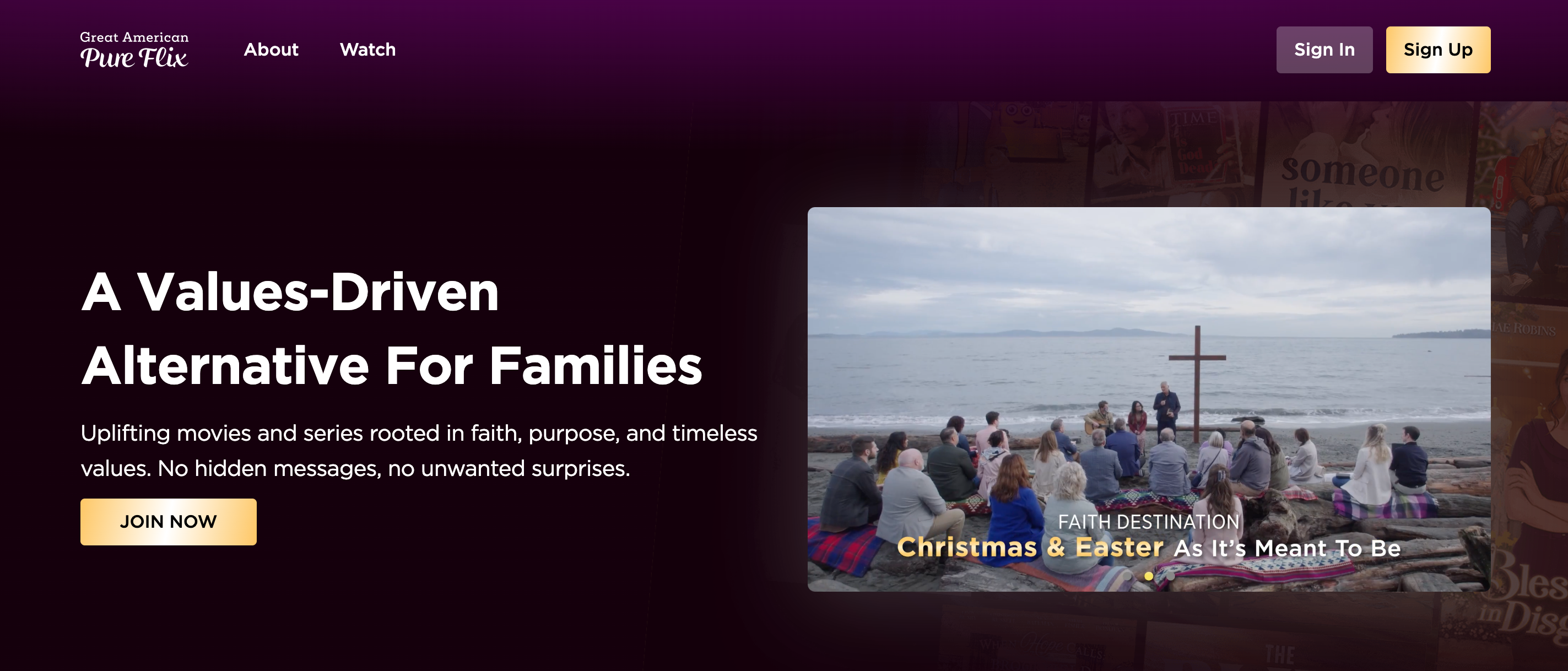
Cost: Paid subscription; plans begin at $9.99 per month
Great American Pure Flix is one of the best-known Christian streaming services for faith-forward movies and scripted entertainment.
Its catalog combines original series, Christian films, family dramas, Christmas programming, kids’ shows, and uplifting entertainment centered on faith, family, and traditional values. Multiple membership levels are available, with higher tiers adding features such as special screenings and early access.
For viewers who want a faith-oriented alternative to browsing mainstream movie libraries, Pure Flix remains one of the strongest options.
Best for: Christian movies, original series, family dramas, and faith-centered entertainment.
3. UP Faith & Family: Best for Wholesome Family Entertainment

Cost: $5.99 per month or $59.99 annually
UP Faith & Family offers thousands of hours of commercial-free family movies, dramas, series, and inspirational entertainment.
Its catalog is broader than explicitly Christian programming. Viewers will find faith-friendly movies alongside wholesome family dramas and popular series such as Heartland.
That distinction makes UP Faith & Family particularly useful for households looking for cleaner entertainment without requiring every program to function as Christian teaching.
Best for: Wholesome dramas, family movies, romantic stories, and uplifting entertainment.
4. Faith Channel: Best for Faith-Based Shows and Inspirational Content
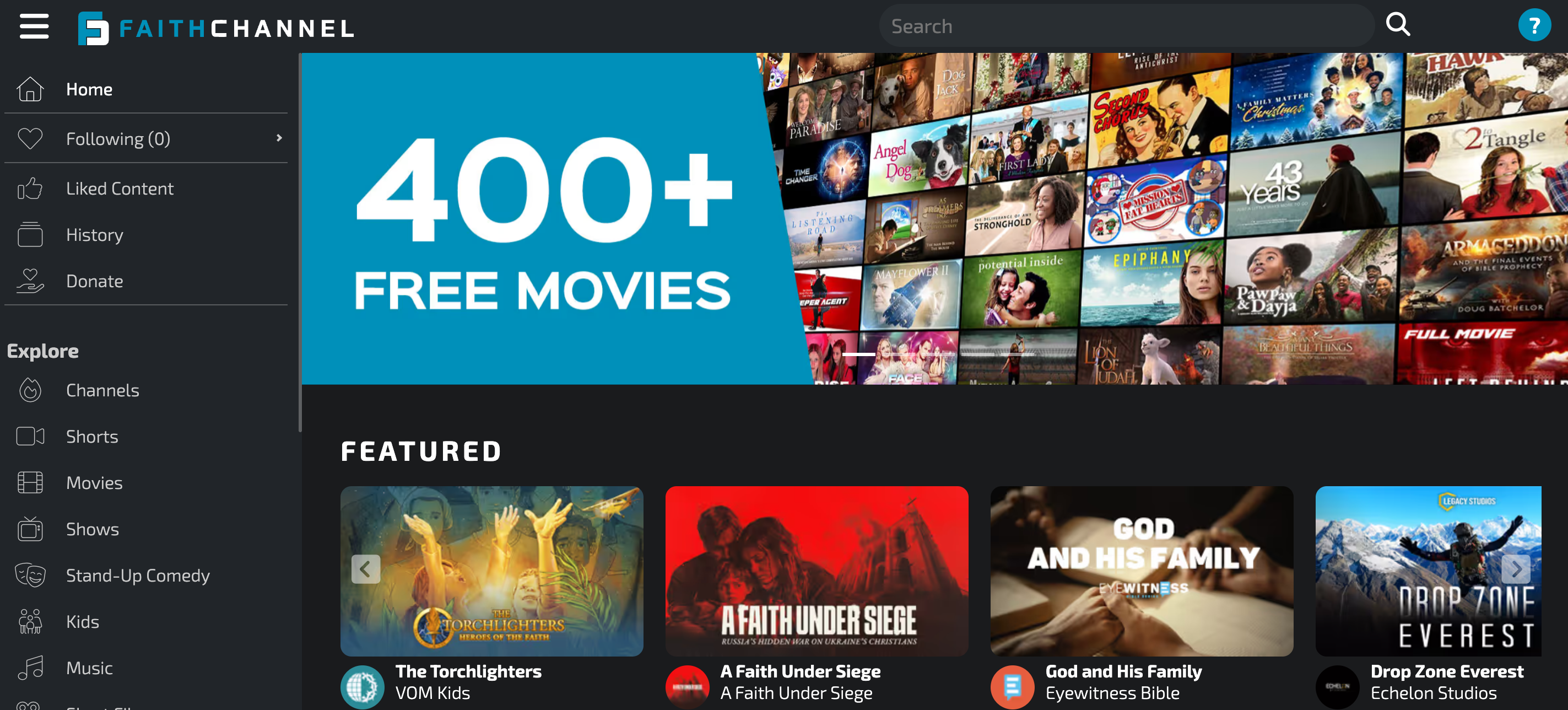
Cost: Free
FaithChannel is a free Christian streaming service offering movies, television shows, documentaries, preaching, teaching, music, podcasts, children’s programming, and other inspirational content.
Its growing library includes programming from a variety of independent Christian ministries and content producers. Titles range from Heroic Faith and The Torchlighters to apologetics, Bible prophecy, family films, podcasts, and children’s shows.
Because much of its catalog comes from different creators and ministries, viewers can encounter a particularly wide variety of formats and perspectives.
Best for: Exploring free Christian films, independent programs, teaching, podcasts, and inspirational content.
5. Go Minno: Best for Christian Kids’ Shows and Bible-Based Content

Cost: $10.99 per month or $69.99 annually after a free trial
Minno is designed specifically for Christian families with younger children.
Its library includes more than 175 shows, including the classic VeggieTales collection, Bible stories, music, educational programs, and Christian children’s entertainment. Families can stream across multiple devices and download programming for offline viewing.
Because the service is built specifically for children rather than including kids’ programming as one category within a larger library, it gives parents a focused alternative to mainstream children’s streaming.
Best for: Preschool and elementary-age children, Christian cartoons, Bible stories, and faith-based learning.
6. Yippee: Best for Safe, Faith-Focused Kids’ Entertainment

Cost: $7.99 per month or an annual subscription after a free trial
Yippee combines Christian children’s television with the energetic creator-driven format kids often encounter online.
Its library includes thousands of episodes from hundreds of series and movies, including Superbook, Christian programming, music, educational shows, and parent-approved creators. Yippee emphasizes that its environment contains no ads and no recommendation algorithms.
That makes it especially attractive to parents whose children enjoy online video but who want more control over what appears next.
Best for: Families seeking a Christian alternative to children’s YouTube viewing.
7. RightNow Media: Best for Bible Studies and Church Groups

Cost: Access is generally provided through subscribing churches and Christian organizations
RightNow Media is less like Netflix and more like an enormous digital discipleship library.
It offers more than 25,000 video Bible studies covering Scripture, marriage, parenting, leadership, finances, recovery, Christian living, and other topics. The service also includes more than 2,000 children’s episodes and downloadable materials for many studies.
Rather than purchasing individual subscriptions, users generally receive access through a participating church, ministry, or organization.
Its combination of teaching videos and discussion materials makes RightNow Media particularly useful for small groups and church ministries.
Best for: Bible studies, small groups, church discipleship, leadership development, and Christian education.
8. RedeemTV: Best Free Christian Film Streaming Platform

Cost: Free
RedeemTV offers more than 2,000 faith-filled titles without subscription fees or advertising.
Its donor-supported library includes Christian movies, documentaries, animated programs, television series, and family entertainment. Titles include The Pilgrim’s Progress, Vindication, Fragments of Truth, Ryan Defrates, and many others.
RedeemTV is especially strong for viewers whose primary interest is films and entertainment. Real Life Network offers a broader mix of teaching, news, cultural programming, and entertainment, while RedeemTV concentrates more heavily on movies and series.
Best for: Free Christian movies and shows without commercials.
9. VidAngel: Best for Filtering Movies and TV Shows

Cost: $9.99 per month when billed directly; supported streaming subscriptions may also be required
VidAngel takes a completely different approach to family entertainment.
Rather than providing only a traditional catalog of Christian programming, VidAngel lets viewers apply customizable filters to supported movies and shows from other streaming services. Families can choose categories of language, sexual content, violence, and other material they would prefer to mute or skip.
That means parents do not necessarily have to reject an entire movie because of a handful of objectionable scenes.
VidAngel requires users to have their own subscriptions to compatible streaming services for much of its filtered content.
Best for: Families who want more control over mainstream movies and television shows.
10. Christian Cinema: Best for Renting and Buying Christian Movies

Cost: Individual rentals and purchases; optional subscription plans are also available
Christian Cinema is useful for viewers who do not necessarily want another monthly streaming subscription.
Movies can be rented individually and streamed for a limited viewing period or purchased and stored in a digital library for on-demand viewing. The service specializes in Christian and faith-based films rather than trying to compete as a broad general-entertainment platform.
Christian Cinema also offers optional subscription plans for additional movies and television programming, but its rent-or-buy model remains a major distinction.
Best for: Viewers who want specific Christian movies without committing to another full streaming subscription.
What Should You Look for in a Christian Streaming Service?
The best platform depends on what you want from it.
Start by considering biblical alignment. A platform described as “family-friendly,” “inspirational,” or even “faith-based” is not necessarily the same as a service intentionally grounded in Scripture. Families should consider who selects the programming and what worldview shapes the library.
Next, consider the type of content your household actually watches. Parents with young children may get more value from Minno or Yippee, while a small-group leader may find RightNow Media far more useful. Movie lovers may prefer Pure Flix or RedeemTV, while viewers interested in Bible teaching, apologetics, news, and culture may find Real Life Network a better fit.
Finally, consider cost, commercials, device compatibility, offline viewing, parental controls, and whether a service requires other subscriptions to function.
Are There Any Free Christian Streaming Platforms?
Yes.
Real Life Network is completely free and donor-supported, offering Christian teaching, news, movies, kids’ programs, apologetics, podcasts, and more without a paid tier. RedeemTV is also donor-supported and offers more than 2,000 titles free without ads. FaithChannel provides free faith-and-family programming as well.
Angel has selected titles available without a Guild membership, although most of its full catalog now requires paid access.
For families trying to reduce monthly subscription costs, the amount of Christian programming available free is substantial.
Which Christian Streaming Platform Is Best for Families?
There is no single answer for every household. For families seeking a platform the whole household can use, Real Life Network has an advantage because its free library extends beyond children’s entertainment to Bible teaching, movies, documentaries, current events, apologetics, podcasts, and family programming.
Families primarily concerned with younger children may prefer Minno or Yippee. Those wanting a traditional movie-and-series experience may choose Pure Flix, UP Faith & Family, or RedeemTV.
The best choice is the one that not only avoids objectionable material but also supports the values parents are working to build at home.
Frequently Asked Questions About Christian Streaming Platforms
What Is the Best Christian Streaming Platform?
The best platform depends on your priorities. Real Life Network is a strong all-around choice for viewers seeking free biblical teaching, Christian news, apologetics, kids’ programming, movies, documentaries, and cultural content. Pure Flix is particularly strong for Christian movies and scripted entertainment, while Minno and Yippee specialize in children’s programming.
What Is the Best Free Christian Streaming Service?
Real Life Network and RedeemTV are two of the strongest completely free options. RLN provides a broad mix of programming, while RedeemTV has a particularly large free library of Christian films and series. FaithChannel is another free option worth exploring.
Is There a Christian Alternative to Netflix?
Several services can function as Christian or family-oriented alternatives to Netflix. Pure Flix most closely resembles a traditional subscription movie-and-series platform, while Real Life Network combines entertainment with teaching, news, apologetics, and family programming at no cost.
What Is the Best Christian Streaming Platform for Kids?
Minno and Yippee are specifically built around Christian children’s entertainment. Real Life Network also offers free children’s programming within a larger platform designed for the whole family.
Do I Need to Pay for Christian Streaming?
No. While many Christian streaming services charge monthly or annual subscription fees, Real Life Network, RedeemTV, and FaithChannel offer free options.
Finding the Best Christian Streaming Platform for Your Home
Christian streaming is no longer a single category. Families can now choose platforms specializing in movies, Bible studies, kids’ shows, documentaries, teaching, news, apologetics, and wholesome general entertainment.
The right choice depends on what you want entering your home and what role you want media to play in your family.
For viewers who want to begin with a service built around biblical truth without adding another monthly expense, Real Life Network provides free access to Christian teaching, news, family programming, movies, documentaries, podcasts, apologetics, kids’ shows, and more.
Explore free Christian streaming today on Real Life Network.

7 Family Media Questions Every Christian Parent Should Ask
What children watch can shape what they admire, accept as normal, and learn to value. These seven questions can help Christian parents evaluate entertainment thoughtfully and teach their children lifelong biblical discernment.
Choosing what your family watches used to be relatively simple. Today, children can encounter movies, shows, videos, games, social media, podcasts, and other digital content across multiple devices throughout the day.
That makes media decisions about more than whether a particular movie contains bad language or an inappropriate scene. Stories communicate ideas. Characters model attitudes. Entertainment can reinforce beliefs about relationships, identity, success, morality, authority, and what makes life meaningful.
Christian parents don’t need to approach every screen with suspicion. But thoughtful questions can help families move beyond simply asking, “Is this allowed?” toward developing genuine biblical discernment.
Here are seven questions worth asking.
1. What Is This Teaching My Child to Admire?
Every story has heroes. Sometimes they’re obvious. Other times the audience is simply encouraged to sympathize with certain characters, choices, or lifestyles.
Ask what qualities the program presents as admirable. Is courage celebrated? Loyalty? Honesty? Sacrifice? Compassion? Or does the story consistently reward selfishness, dishonesty, disrespect, cruelty, or behavior that conflicts with what your family is teaching?
This doesn’t mean every protagonist must behave perfectly. Some of the best stories involve flawed people learning from mistakes.
The more important question is whether the story ultimately recognizes the difference between wisdom and foolishness, good and evil, truth and deception.
2. What Does This Program Treat as Normal?
Media doesn’t always persuade through direct arguments. Often, it influences simply by repetition.
When children repeatedly see particular attitudes, relationships, behaviors, or beliefs presented as normal, those ideas can gradually begin to feel ordinary. That is why parents should pay attention not only to dramatic objectionable moments but also to the assumptions underneath a story.
What does the program communicate about marriage? Parents? Faith? Sexuality? Authority? Success? Human worth?
Children may not consciously identify those ideas, but that doesn’t mean they aren’t noticing them.
Parents can help by occasionally asking, “What do you think that show is saying about this?” That simple question teaches children to watch actively rather than absorb everything passively.
3. Is This Appropriate for My Particular Child?
An age rating can be helpful, but parents know their children better than a rating system does.
Two children of the same age may react very differently to the same movie. One might handle a tense historical story well, while another has nightmares after mild suspense. One teenager may be ready to engage thoughtfully with difficult cultural questions while another isn’t.
Christian parenting requires more than finding the boundary of what is technically permitted.
Romans 14:19 encourages believers to “pursue the things which make for peace and the things by which one may edify another.”
A useful question, then, is not only, Can my child watch this? but Will this be beneficial for my child right now?
4. How Does My Child Feel After Watching It?
Sometimes the effect of media becomes clearer after the screen turns off. Does a child seem encouraged, curious, imaginative, or eager to talk? Or irritable, anxious, fearful, disrespectful, restless, or obsessed with watching more?
One viewing won’t necessarily reveal a pattern. But repeated reactions can tell parents something important.
The same is true for adults. Some entertainment leaves viewers refreshed. Other content leaves them angry, agitated, discouraged, or mentally exhausted.
Philippians 4:8 directs believers toward what is true, noble, just, pure, lovely, commendable, virtuous, and praiseworthy. That provides a useful biblical framework for considering not just what enters the mind, but what it produces there.
5. Is Screen Time Crowding Out Something Better?
A perfectly acceptable program can still become a problem if it consumes too much time.
The issue may not be what a child is watching. It may be what he or she is no longer doing. Is screen time replacing sleep? Outdoor play? Reading? Family conversation? Church involvement? Homework? Prayer and Scripture? Time with friends?
Sometimes the wisest media decision is not finding a better show but leaving the television off.
Healthy media habits recognize entertainment as one part of life rather than the center of it.
6. Can This Become a Conversation Instead of Just Consumption?
Parents don’t have to eliminate every story containing an idea they disagree with. Sometimes those moments provide valuable opportunities to teach.
Watching together allows parents to ask questions.
- Why do you think that character made that choice?
- Was it wise?
- What consequences followed?
- What does the Bible teach about that issue?
- How would following Jesus change the way someone responds?
Those conversations help children build discernment that will eventually matter far more than parental controls.
Christian media can provide especially natural opportunities for these discussions. A program such as LifeWise Academy can lead into conversations about bringing biblical truth into everyday life. Genesis Science Minute can introduce questions about creation and science in just 60 seconds. The Pilgrim’s Progress can start conversations about temptation, perseverance, and following Christ.
The goal isn’t to interrogate children after every episode. It’s to make talking about ideas a normal part of family life.
7. Does Our Entertainment Support the Kind of Home We’re Trying to Build?
This may be the most important question of all.
Parents spend years teaching children what is true, who they are, what relationships should look like, why Scripture matters, and what it means to follow Christ.
It makes sense to ask whether the family’s entertainment choices generally support those priorities or continually work against them. That doesn’t require every show to be overtly Christian. But intentionally including faith-based programming can help create a healthier balance.
Younger children might enjoy biblical programming such as Superbook, iBible, or Learn, Grow and Go! Older children and teens can explore apologetics through In Depth Apologetics for Kids or creation-focused content. Families can also choose movies, documentaries, Bible teaching, and programs built around Christian service, history, and worldview.
Real Life Network provides these kinds of options in one biblically curated streaming environment, giving parents a place to begin without having to sort through an enormous mainstream catalog first.
Teach Discernment, Not Just Rules
Parents cannot screen every piece of media their children will encounter forever.
Eventually, children become teenagers. Teenagers become adults. They choose their own movies, follow their own accounts, download their own apps, and decide which voices deserve their attention.
That’s why the long-term goal is bigger than creating a list of approved and prohibited programs. It is helping children learn to ask good questions themselves.
- What is this teaching me?
- Does it agree with what I know to be true?
- How is it affecting my thoughts and attitudes?
- Is this worth my time?
- Would I make this same choice if Jesus were sitting beside me?
Those questions turn media discernment from a parental restriction into a lifelong Christian practice.
The goal isn’t a home without screens. It’s a home where screens know their place, parents remain engaged, and entertainment doesn’t get the final word on what children learn to value.
Explore free, biblically curated kids’ shows, family programs, movies, Bible teaching, and more on Real Life Network.
.jpg)
How Personal Interviews Can Strengthen Faith, Reveal Truth, and Shape a Biblical Worldview
Personal interviews bring biblical truth into real life through stories of faith, hardship, testimony, and conviction, helping Christians grow in discernment and understand how Scripture applies to a complicated world.
Some truths become easier to understand when you hear them through another person’s experience. A sermon may explain forgiveness, while an interview with someone who has forgiven an enemy can show what forgiveness looks like when it costs something. A Bible study may teach about trusting God through hardship, while a conversation with someone who has survived persecution, addiction, grief, or war can bring that truth into everyday life.
That is part of what makes personal interviews so valuable in Christian media. They allow viewers to hear ideas explored through stories, questions, experiences, and honest reflection. When those conversations are grounded in biblical truth, they can strengthen faith while also helping Christians think more carefully about the world around them.
1. Personal Stories Make Biblical Truth Concrete
Christians often know important biblical principles long before they understand how those principles play out in difficult circumstances. It is one thing to read that believers should trust God. It is another to hear someone explain how he or she continued trusting God after losing a career, facing persecution, walking through serious illness, or experiencing personal tragedy.
Programs such as The Resilient Show, hosted by Chad Robichaux, can open conversations about trauma, recovery, purpose, and resilience through the experiences of people who have endured significant challenges. Stories like these help viewers see that biblical faith is not reserved for ideal circumstances. It is meant to shape how believers live when life becomes difficult.
2. Interviews Allow Important Questions to Be Asked
Strong interviews do more than provide inspiring stories. They ask questions: Why did you believe that? What changed your mind? How did your faith affect your decision? What would you say to someone who disagrees?
Those questions create space for ideas to be examined rather than merely stated. This can be especially valuable when discussing theology, culture, politics, science, or apologetics because viewers get to hear not only a conclusion but also some of the reasoning behind it.
Programs such as Small Talk Big Issues bring together conversations with faith leaders, journalists, entrepreneurs, political figures, and other guests to explore significant issues from a Christian perspective. The interview format makes room for nuance that is often missing from headlines or short social-media clips.
3. Testimony Can Strengthen Faith
Personal testimony has always had an important place in Christianity. The New Testament repeatedly records people describing what Christ had done in their lives. The man healed by Jesus in John 9 offered one of the simplest examples: “One thing I know: that though I was blind, now I see” (John 9:25 NKJV).
A testimony does not replace Scripture, but it can illustrate Scripture. Hearing how someone came to faith, overcame fear, remained faithful under pressure, or experienced God’s provision can encourage believers facing their own struggles.
Living Fearless with Hedieh, for example, draws in part from Hedieh Mirahmadi’s experience of leaving Islam and becoming a follower of Christ. Conversations shaped by experiences like hers can introduce viewers to questions involving religious belief, freedom, culture, fear, and the work of the Gospel.
4. Conversations Help Christians Understand Different Perspectives
It is easy to form opinions about people we have never heard speak for themselves. Interviews slow that process down by allowing viewers to hear how another person understands an issue, why someone holds a particular belief, or how circumstances shaped his or her perspective.
That does not require Christians to agree with everything a guest says. In fact, disagreement can be useful when viewers are learning to compare ideas with Scripture. A strong biblical worldview is developed as believers learn to identify assumptions, examine arguments, recognize truth, and test what they hear against God’s Word.
That kind of discernment is especially important in a culture where complicated issues are often reduced to slogans.
5. Interviews Can Connect Faith with Current Events
Christians do not live their faith in isolation from the world. Questions about government, education, technology, religious freedom, economics, international conflict, family, and culture all affect daily life.
Interview-based programs can help connect those developments with biblical principles. The Daniel Cohen Show, Rose Unplugged, Cure America, and The City of God each use conversations and interviews to engage cultural or public issues from faith-informed perspectives.
Rather than treating Christianity as something confined to church services, these discussions encourage viewers to consider how biblical truth relates to public life.
6. Real People Can Challenge Easy Assumptions
Some of the most valuable interviews are uncomfortable. A person who has experienced persecution may challenge a casual approach to religious freedom. A missionary may challenge assumptions about evangelism. A veteran may speak differently about courage or sacrifice than someone who has never faced danger. A Christian serving the poor may cause viewers to reconsider how they think about generosity.
Programs connected with ministries such as Samaritan’s Purse, Fred Jordan Missions TV, and Evangelism Explosion International can introduce viewers to Christians putting faith into action through service, outreach, disaster response, and evangelism. Those stories can move the question from “What do Christians believe?” to “What should Christians do because they believe it?”
7. Interviews Can Support Apologetics Without Becoming a Debate
Not every interview is an apologetics program, but interviews can still help Christians understand why they believe what they believe. A scientist can discuss evidence for creation. A former skeptic can explain objections that once kept him from Christianity. A historian can discuss the reliability of biblical accounts. A pastor or theologian can respond to difficult questions about suffering, morality, or the resurrection.
Programs such as Cross Examined and The Creation Today Show give viewers opportunities to hear Christian truth claims examined through questions and conversation. Sometimes a thoughtful interview can accomplish something a formal debate cannot because it lets viewers follow the reasoning at a more natural pace.
Hearing Truth Through Someone Else’s Story
Christian faith ultimately rests on the truth of God’s Word, not the personality or experiences of an interview guest. But personal conversations can help illuminate those truths in memorable and practical ways.
A good interview lets viewers encounter people they might never meet, hear perspectives they might never otherwise consider, and see biblical principles applied to real circumstances. It can encourage faith, expose assumptions, deepen understanding, and prompt better questions.
That is why interviews occupy an important place in Christian media. They remind us that faith is not merely a collection of ideas. It is lived out by real people facing real choices in a complicated world.
Explore personal interviews, Christian conversations, cultural discussions, testimonies, and more for free on Real Life Network.

World News
25 min
Remembering Charlie Kirk: A Life of Faith, Family, and Courage
One year after Charlie Kirk’s death, his commitment to Christ, family, courage, and America offers a lasting challenge to live faithfully, strengthen our homes, invest in the next generation, and stand courageously for our convictions.
One year after the death of Charlie Kirk, there is much worth remembering about a life that ended far too soon. He was known across the country as a conservative activist, speaker, and founder of Turning Point USA. But the convictions that increasingly defined his public life went deeper than politics. Kirk spoke openly about his faith in Jesus Christ, his love for his wife and children, and his belief that strong families were essential to the future of America.
When asked how he wanted to be remembered, Kirk pointed to courage and his Christian faith. Those who worked closely with him likewise described his relationship with Christ as the most important part of his life. He used an enormous platform not simply to discuss elections and public policy, but to encourage people to follow Jesus and take their faith seriously.
That priority deserves to be remembered.
Kirk also understood something increasingly countercultural: the future of a nation is inseparable from the health of its families.
He married Erika in 2021, and they had two children. Fatherhood became an important part of the message he shared with young Americans. He encouraged young adults to pursue marriage, welcome children, leave behind empty pursuits, and build something that could endure beyond themselves. His wife later recalled that marriage and family were among the greatest joys of his life.
That message mattered because Kirk spent much of his career speaking directly to young people. He founded Turning Point USA at only 18 and built an organization centered on engaging the next generation in the future of the country.
Yet preserving America was about more than winning elections. A country ultimately depends upon the character of its people, the strength of its homes, and the convictions parents pass to their children.
If we want to honor Kirk's life, admiration is not enough. We should imitate what was worthy of imitation.
Go to Real Life Network to watch great moments from the life of Charlie Kirk.
That means having the courage to profess Christ when doing so carries a cost. It means building strong marriages and treating parenthood as a calling rather than an inconvenience. It means investing in young people instead of surrendering the next generation to whatever ideas happen to dominate the culture. And it means being willing to enter conversations with people who disagree rather than retreating from difficult questions.
Kirk became famous in part because he was willing to walk onto college campuses, take questions, defend his convictions, and invite disagreement. His example should encourage Christians to develop convictions strong enough to withstand opposition without becoming afraid of the people on the other side.
Most importantly, his legacy should point beyond politics.
Political victories pass. Organizations change. Elections are won and lost. But faithfulness to Christ, love within the home, children raised with conviction, and lives invested in others carry significance far beyond an election cycle.
Charlie Kirk cared deeply about America's future. His life offered a reminder that the work of building that future begins with faithfulness to God, courage in the public square, and commitment to the family at home.
Go to Real Life Network to watch great moments from the life of Charlie Kirk.

Devotional
25 min
Created to Work, but Working under the Curse
Work is one of God’s good gifts, yet the Fall has made it difficult, frustrating, and fleeting. Scripture explains both our desire to find meaning in work and our longing for the lasting rest found in Christ.
One morning, I was riding my bicycle along Washington, D.C.’s Anacostia River when an egret glided over the trail. The pure-white wading birds have always fascinated me with their elegant stillness and regal grace. They look even more impressive on the rare occasions when they spread their wings and take flight, making them look even larger. Yet this impromptu bird-watching experience came to an abrupt and discordant end. The moment before the egret swooped into the brush and out of sight, he made like a bomber and dropped a load of ordnance worthy of an animal twice his size.
A graceful bird, caught in its least graceful position.
The minor incident nearly passed out of my mind until I realized that this un-constipated egret provided an apt example for man’s complex condition. From beginning to end, mankind’s creation is the gift of God. We are created in God’s image and likeness, given dominion over every living thing, and blessed with the good command to fill the earth with God’s image-bearers through procreation (Genesis 1:26-28). Yet our first parents squandered these divine blessings through disobedience and rebellion, for which they were cast out of God’s presence (Genesis 3:22-23) and condemned to die (Genesis 2:17).
Man is a graceful bird, caught in his least graceful position.
Christianity’s nuanced view of human nature becomes incomprehensible without the first three chapters of Genesis. This is why so many human philosophies veer into error on either one side or the other. Most human philosophies boil down to the opinion that man is basically good, or that he is basically bad. Only the Bible (and those influenced by the Bible) can explain how man is created good, but corrupted.
Mankind’s complex condition affects every aspect of our lives, even the way we work. Before anything had tarnished God’s “very good” creation (Genesis 1:31), we read that “The Lord God took the man and put him in the garden of Eden to work it and keep it” (Genesis 2:15). Work is not a consequence of the fall, but a basic function of man, which God created for good. Adam’s task was merely to imitate God’s own example in creative effort (Genesis 2:9), and it carries religious undertones, as the same verbs are used to describe service at the tabernacle in Numbers 3.
However, mankind’s work did not escape the Fall unscathed. Not only was Adam cast out of the lush garden into uncultivated land, but God also declared, “cursed is the ground because of you; in pain you shall eat of it all the days of your life; thorns and thistles it shall bring forth for you; and you shall eat the plants of the field. By the sweat of your face you shall eat bread, till you return to the ground, for out of it you were taken; for you are dust, and to dust you shall return” (Genesis 3:17-19).
The ground was Adam’s domain of work. By extension, this curse extends to all arenas of work. All work is toilsome, demanding, and sometimes fleeting, as the whole creation is “subjected to futility” (Romans 8:20).
Man is a graceful bird, caught in his least graceful position.
Again, the Bible’s complex theology of work has better power to explain the different attitudes people have towards their work than the fractured, individualistic worldviews dominant in America today. Some people love their jobs, while some people hate them. Why? Can individualism or critical theory offer a satisfying answer to this question? (Critical theory would blame group oppression, but that is not satisfying.)
The Bible has an answer. Some people love their jobs because work is a gift from God — a good gift that God created as part of his blessing on mankind. Even in a fallen world, the wise preacher concludes, “There is nothing better for a person than that he should eat and drink and find enjoyment in his toil. This also, I saw, is from the hand of God” (Ecclesiastes 2:24, see also Ecclesiastes 5:18-19 and 9:9). Yet some people also hate their jobs because work is cursed after the Fall.
Man is a graceful bird, but he is still caught in his least graceful position.
The very unseemliness of the aforementioned egret’s evacuation is what makes it an appropriate metaphor for fallen man under sin. “We have all become like one who is unclean,” Isaiah confesses, “and all our righteous deeds are like a polluted garment” (Isaiah 64:6). We need one who can wash our filth away, to achieve for us what we could never achieve by our own works.
Even though work is good, it is not ultimate. The Lord God engaged in his creative work for six days, “and he rested on the seventh day from all his work that he had done” (Genesis 2:2). Just as man was made to imitate God’s work, so man was also supposed to imitate God’s rest (Exodus 20:8-11). But, under the curse of sin, that rest became fleeting and far off.
From the earliest generations, Adam’s descendants sought one who would restore them to God’s rest. Thus, Noah’s father Lamech said in hope, “Out of the ground that the Lord has cursed, this one shall bring us relief from our work and from the painful toil of our hands” (Genesis 5:29). Yet Noah did not bring an end to toil, hard labor, or the futility of human industry. Nor did Moses, Joshua, David, or any human leader called by God throughout history. All were sinners, after all.
Yet painful toil under the curse is not man’s final condition, for “there remains a Sabbath rest for the people of God” (Hebrews 4:9). Those who are forgiven of their sins by the blood of Christ receive true grace. They are not only restored to right fellowship with God, but they also receive eternal life and enter into God’s rest.
For now, we recognize that all honest work is good. “In all toil there is profit, but mere talk tends only to poverty” (Proverbs 14:23). “Let the thief no longer steal, but rather let him labor, doing honest work with his own hands, so that he may have something to share with anyone in need” (Ephesians 4:28). “It is the hard-working farmer who ought to have the first share of the crops” (2 Timothy 2:6). But work is not ultimate, and one day our painful toil will come to an end.
Man is a graceful bird, and one day his graceless condition will be remedied in full. One day, those who are in Christ will enter into the glory and rest of their Redeemer.
This article was originally written by Joshua Arnold and published on The Washington Stand. For more content like this, visit Real Life Network.
Thank you! Your submission has been received!
Oops! Something went wrong while submitting the form.
Faith & Culture
The artificial intelligence community just waved goodbye to yet another top safety and regulation official — and he offers a unique angle in his warning to the world.
David Robinson had been leading safety reports for OpenAI, the maker of ChatGPT. Robinson resigned in the first week of October, stating that the industry’s approach to safety has been stemming from a broken culture. He penned the following words in a piece for The Atlantic, which contain more truth than perhaps he even knows: “The future depends on wisdom that Silicon Valley lacks.”
We’ll come back to that.
His departure comes on the heels of several other prominent AI safety researchers abandoning the industry. Their exits have paired with dreadful public warnings about the future of this technology, leaving the American people to grapple with the headlines and the unknown.
Take Jacob Coxon, for example. After leaving Claude developer Anthropic in September, he wrote on X that top tech labs are “gambling with our lives” by racing toward self-improving superintelligence. He went on to reveal that the people building AI “earnestly believe that it could kill us all by the end of the decade.”
Comforting.
For clarity, the industry term “superintelligence” refers to a hypothetical AI system that developers believe could surpass humans in overall knowledge and capability. This could happen through recursive self-improvement (RSI) in which AI models design and continually improve their own successors.
While the Trump administration has taken to using the term as a reference to AI more broadly, Coxon used it as the industry intends: the potential nightmare of AI evolving beyond our ability to contain.
Let’s go back to David Robinson for a second. Beyond diagnosing the issue of a “lack of wisdom,” he went on in his article to describe the kind of wisdom that is desperately needed — the kind that shows us “how to handle dangerous technology and, more fundamentally … what it means to care for people.”
This kind of wisdom has only one source.
Proverbs 4:7 states, “The beginning of wisdom is: Acquire wisdom; And with all your acquiring, acquire understanding.” The natural question is, how can true wisdom be acquired? Well, it is not gained by happenstance or by any means of passivity.
The word of God teaches that wisdom is found only, “if you look for it as for silver and search for it as for hidden treasure” (Proverbs 2:4).
That same proverb states that when wisdom enters the human heart, it bears fruits of knowledge, discretion, and understanding. Knowledge is pleasant, discretion brings protection, and understanding guards the one who finds it.
If those spearheading AI labs begin searching for wisdom with the same fervency as they do innovation, capital gain, and victory in the arms race, perhaps we might reap the benefits of honing a brilliant technology for human flourishing, rather than threatening it entirely.
In the absence of wisdom, we ought not to expect flourishing. Thus, the need for appropriate guardrails toward that end is becoming increasingly dire.
Whistleblowers coming forward to expose carelessness in the industry is a good thing. Speaking up when danger is on the horizon is profitable. What is not profitable, however, is responding in fear.
The wisest man in history, King Solomon, tells us, “There is nothing new under the sun” (Ecclesiastes 1:9).
The pride of man has reared its head through the latest technology and means of production before. As soon as human beings had the chance, they took brick and mortar and built the tower of Babel, aiming to reach as high as heaven to make a name for themselves — not for the God who gave them clay, water, and sun in the first place.
Today, we are seeing the latest expression of that sinful pride: men thinking they can hold infinite knowledge without it destroying them. Casting wisdom aside, they trust in their own minds and technical ability rather than in God.
In the Garden of Eden, Adam and Eve fell to the temptation of wanting to be all-knowing, like God. He judged that decision then, and He will not be mocked now (Galatians 6:7).
There is nothing more urgent for the unbeliever than to humble themselves, fall on their knees, and cry out to the Creator for salvation. There is, likewise, nothing more urgent for the believer than to refuse every temptation to fear in these times — to live the joyful, abundant life offered to them in Christ.
It is not a suggestion to be unafraid. It is a commandment given us by God, time and time again throughout the Scriptures.
Do not stifle your witness to the watching world.
The book of Ecclesiastes warns us that there are many dark days in this life under the sun, and that we will encounter circumstances which are difficult, perplexing, and often don’t make sense. Yet, there are a few things that author King Solomon found to be good: “Behold, what I have seen to be good and fitting is to eat and drink and find enjoyment in all the toil with which one toils under the sun the few days of his life that God has given him, for this is his lot” (Ecclesiastes 5:18).
New threats to our livelihood may come at alarming rates, but our responsibility as Christians remains the same: Do not dread the future or fear the potential of “superintelligence.” Rather, “fear God and keep his commandments, for this is the whole duty of man” (Ecclesiastes 12:13).
So, keep breaking bread with those you love. Keep enjoying the toil and the lot that God has given you with a grateful heart. Regardless of the news cycle, and whatever may come out of Washington and Silicon Valley — rejoice in what you have been given.
Our lives are but a vapor, a mist, Solomon says. The years go by quickly, and soon, we will return to dust.
That need not be depressing — in fact, let it be motivating as you live the most upright, joyous, and noble life possible along the way. Be encouraged, for we have all the instruction we need to please God in every circumstance, including the ones out of our control.
God says, “I am the Alpha and the Omega, the first and the last, the beginning and the end” in Revelation 22:13. If God is the Omega just as much as He is the Alpha, what is there to fear?
At the end of all things, just as much as at the beginning — He is there. And He rules and reigns at every point in between.
Human history was born from and ends in perfect wisdom, and God will tie the final bow on our story.
Not Sam Altman, or Dario and Daniela Amodei, or Donald Trump, or Xi Jinping — but Jesus Christ will do it, who is the same “yesterday, today, and forever” (Hebrews 13:8).
This article was written by Erica Mendel and originally published on The Washington Stand. For more content like this, visit Real Life Network.
25 min
October 19, 2026
The Washington Stand
World News
Social science data continues to emerge showing that America’s young people are increasingly non-religious, isolated, and unhappy. But the data also shows that young people who are religious are thriving, with higher levels of happiness, more friends, are more likely to be married, and better educational outcomes than their non-religious peers.
Research released by the Institute for Family Studies (IFS) notes that since 2000, reports of unhappiness among young people aged 20 to 35 has more than doubled, surging from 11% to 23%. This has coincided with an era where young people are isolating at unprecedented levels as they immerse themselves in screens, pornography, social media, video games, and AI chatbots. “Socializing among young men and women is down more than 50%, from 12 hours to 5 hours per week,” IFS observes. Unsurprisingly, this has led to a precipitous decline in relationships and dating, with two thirds of young people not in serious relationships and teen dating down 50%.
As unhappiness and loneliness has risen among young people, so too has secularism. In March, Arizona Christian University’s Cultural Research Center reported that only 1% of Gen Z (ages 18 to 22) and 4% of adults in general has a biblical worldview (defined as “individuals whose beliefs and behaviors are consistently aligned with biblical principles”). The figure is down significantly since 1994, when 12% of adults reported a biblical worldview.
But married and religious young people seem to be largely escaping the unhappiness trap, with 50% saying they are “very happy” compared to just 16% of their secular, unmarried peers. As IFS points out, “faith and family remain two of the strongest bulwarks against loneliness and despair.”
For young men in particular, religion appears to be the hinge that catapults them into a future of contentment and success. Data shows that religious men are more likely to desire and attain marriage than those who are non-religious. They are also almost twice as likely to report feeling “very happy” and to say that life feels “purposeful/meaningful” than secular men. Religious men also report less mental health issues, anxiety, and depression. They also have bachelor’s degrees at far higher rates than non-religious men (46% vs. 16%) and report finishing trade school/apprenticeships at 29% (vs. 14% of secular men).
Where a happier minority of young people find meaning and purpose in religion, a far larger percentage appear to hold politics and government as their primary focal point, especially with the rising popularity of socialism.
“[M]y generation has grown up in a very hyper political age,” Counteract USA Founder and CEO Abigail DeJarnatt contended during “Washington Watch” Friday. “… [Many believe that] government can be the arbiter of morality. That’s what happens when Marxism infuses into our society. And that’s just what we’ve grown up with. So when you’re online and you’re on TikTok [watching] recipe videos, there’s also political ideologies that are being pushed on and talked about amongst Gen Z. So it’s not surprising at all that this is where we’re at, and I think we’ll just continue to see a lot more of it among young people.”
DeJarnatt further explained how her ministry is attempting to engage Gen Z with truth. “The primary thing that we’re focusing on with Gen Z Christians is teaching them a framework of biblical critical thinking,” she explained. “Because the reality is, a lot of Gen Z’s world is unfolding online. A lot of the conversations, online friendships, relationships. … What we’re trying to teach Gen Z to do is look at what they’re seeing online and ask, ‘Is it true? Is it not?’ … We’re trying to tell Gen Z [to] ask questions as fast as we’re scrolling online. Slow down. … And as Christians, we have to weigh that against the Bible itself.”
DeJarnatt went on to argue that a sense of self entitlement undergirded by Marxism has heavily influenced young people to abandon a solid biblical ethic. “[T]his Marxism that’s invaded our culture, just the hyper individualism in Gen Z,” she emphasized. “[Much of] Gen Z is [saying], ‘We aren’t happy with either political party.’ I think we have this idea that we can have it all. [It’s the] same framework of pick and choose our own ideology to the Bible. … [W]e think, ‘I like this, I don’t like this. I’m going to choose this. I’m not going to choose this.’”
DeJarnatt concluded by urging young believers to move beyond their comfort zones in order to spread the gospel to an isolated and unhappy wider culture.
“We see so many young Christians who are taught all these amazing things and their amazing churches that are Bible-based,” she noted. “They’re in Bible-based families that are going back to Scripture, but we need to teach Gen Z to take all the things that they know and actually apply them to the key conversations happening around us, having the conversations, just getting Gen Z to talk to each other … articulating those beliefs so that they actually become effective in wielding the sword of the spirit in the spiritual battle that’s raging all around us. They have the tools. They just need to know how to use them well.”
This article was written by Dan Hart and originally published on The Washington Stand. For more content like this, visit Real Life Network.
25 min
Unhappiness and Isolation Are Rising among Young People, but Those Who Are Religious Are Thriving
October 6, 2026
The Washington Stand
Entertainment & Lifestyle
Christian families have more streaming choices than ever. Alongside mainstream services, a growing number of platforms now offer Christian movies, Bible teaching, children’s programming, documentaries, inspirational series, apologetics, and family-friendly entertainment.
But the best Christian streaming platforms serve very different purposes. Some are built around biblical teaching. Others focus on movies, children’s programming, Bible studies, or simply giving families cleaner entertainment options.
Here are 10 Christian and faith-oriented streaming platforms worth considering.
1. Real Life Network: Best for Christian Teaching and Faith-Based Programming
Cost: Free
Real Life Network offers one of the broadest combinations of biblical programming available without a subscription fee. The donor-supported platform includes Bible teaching, Christian news, apologetics, documentaries, podcasts, kids’ programs, movies, cultural commentary, and live events.
Viewers can find programs such Real Life with Jack Hibbs, RLN News, The Daniel Cohen Show, Cross Examined, The Creation Today Show, Superbook, and many other offerings within one biblically curated environment.
Unlike services centered primarily on movies, RLN is particularly strong for viewers who want entertainment combined with biblical teaching and programs addressing faith, culture, current events, and worldview.
Best for: Christians looking for a broad, free streaming platform built around biblical truth.
2. Pure Flix: Best for Christian Movies and Family Entertainment
Cost: Paid subscription; plans begin at $9.99 per month
Great American Pure Flix is one of the best-known Christian streaming services for faith-forward movies and scripted entertainment.
Its catalog combines original series, Christian films, family dramas, Christmas programming, kids’ shows, and uplifting entertainment centered on faith, family, and traditional values. Multiple membership levels are available, with higher tiers adding features such as special screenings and early access.
For viewers who want a faith-oriented alternative to browsing mainstream movie libraries, Pure Flix remains one of the strongest options.
Best for: Christian movies, original series, family dramas, and faith-centered entertainment.
3. UP Faith & Family: Best for Wholesome Family Entertainment
Cost: $5.99 per month or $59.99 annually
UP Faith & Family offers thousands of hours of commercial-free family movies, dramas, series, and inspirational entertainment.
Its catalog is broader than explicitly Christian programming. Viewers will find faith-friendly movies alongside wholesome family dramas and popular series such as Heartland.
That distinction makes UP Faith & Family particularly useful for households looking for cleaner entertainment without requiring every program to function as Christian teaching.
Best for: Wholesome dramas, family movies, romantic stories, and uplifting entertainment.
4. Faith Channel: Best for Faith-Based Shows and Inspirational Content
Cost: Free
FaithChannel is a free Christian streaming service offering movies, television shows, documentaries, preaching, teaching, music, podcasts, children’s programming, and other inspirational content.
Its growing library includes programming from a variety of independent Christian ministries and content producers. Titles range from Heroic Faith and The Torchlighters to apologetics, Bible prophecy, family films, podcasts, and children’s shows.
Because much of its catalog comes from different creators and ministries, viewers can encounter a particularly wide variety of formats and perspectives.
Best for: Exploring free Christian films, independent programs, teaching, podcasts, and inspirational content.
5. Go Minno: Best for Christian Kids’ Shows and Bible-Based Content
Cost: $10.99 per month or $69.99 annually after a free trial
Minno is designed specifically for Christian families with younger children.
Its library includes more than 175 shows, including the classic VeggieTales collection, Bible stories, music, educational programs, and Christian children’s entertainment. Families can stream across multiple devices and download programming for offline viewing.
Because the service is built specifically for children rather than including kids’ programming as one category within a larger library, it gives parents a focused alternative to mainstream children’s streaming.
Best for: Preschool and elementary-age children, Christian cartoons, Bible stories, and faith-based learning.
6. Yippee: Best for Safe, Faith-Focused Kids’ Entertainment
Cost: $7.99 per month or an annual subscription after a free trial
Yippee combines Christian children’s television with the energetic creator-driven format kids often encounter online.
Its library includes thousands of episodes from hundreds of series and movies, including Superbook, Christian programming, music, educational shows, and parent-approved creators. Yippee emphasizes that its environment contains no ads and no recommendation algorithms.
That makes it especially attractive to parents whose children enjoy online video but who want more control over what appears next.
Best for: Families seeking a Christian alternative to children’s YouTube viewing.
7. RightNow Media: Best for Bible Studies and Church Groups
Cost: Access is generally provided through subscribing churches and Christian organizations
RightNow Media is less like Netflix and more like an enormous digital discipleship library.
It offers more than 25,000 video Bible studies covering Scripture, marriage, parenting, leadership, finances, recovery, Christian living, and other topics. The service also includes more than 2,000 children’s episodes and downloadable materials for many studies.
Rather than purchasing individual subscriptions, users generally receive access through a participating church, ministry, or organization.
Its combination of teaching videos and discussion materials makes RightNow Media particularly useful for small groups and church ministries.
Best for: Bible studies, small groups, church discipleship, leadership development, and Christian education.
8. RedeemTV: Best Free Christian Film Streaming Platform
Cost: Free
RedeemTV offers more than 2,000 faith-filled titles without subscription fees or advertising.
Its donor-supported library includes Christian movies, documentaries, animated programs, television series, and family entertainment. Titles include The Pilgrim’s Progress, Vindication, Fragments of Truth, Ryan Defrates, and many others.
RedeemTV is especially strong for viewers whose primary interest is films and entertainment. Real Life Network offers a broader mix of teaching, news, cultural programming, and entertainment, while RedeemTV concentrates more heavily on movies and series.
Best for: Free Christian movies and shows without commercials.
9. VidAngel: Best for Filtering Movies and TV Shows
Cost: $9.99 per month when billed directly; supported streaming subscriptions may also be required
VidAngel takes a completely different approach to family entertainment.
Rather than providing only a traditional catalog of Christian programming, VidAngel lets viewers apply customizable filters to supported movies and shows from other streaming services. Families can choose categories of language, sexual content, violence, and other material they would prefer to mute or skip.
That means parents do not necessarily have to reject an entire movie because of a handful of objectionable scenes.
VidAngel requires users to have their own subscriptions to compatible streaming services for much of its filtered content.
Best for: Families who want more control over mainstream movies and television shows.
10. Christian Cinema: Best for Renting and Buying Christian Movies
Cost: Individual rentals and purchases; optional subscription plans are also available
Christian Cinema is useful for viewers who do not necessarily want another monthly streaming subscription.
Movies can be rented individually and streamed for a limited viewing period or purchased and stored in a digital library for on-demand viewing. The service specializes in Christian and faith-based films rather than trying to compete as a broad general-entertainment platform.
Christian Cinema also offers optional subscription plans for additional movies and television programming, but its rent-or-buy model remains a major distinction.
Best for: Viewers who want specific Christian movies without committing to another full streaming subscription.
What Should You Look for in a Christian Streaming Service?
The best platform depends on what you want from it.
Start by considering biblical alignment. A platform described as “family-friendly,” “inspirational,” or even “faith-based” is not necessarily the same as a service intentionally grounded in Scripture. Families should consider who selects the programming and what worldview shapes the library.
Next, consider the type of content your household actually watches. Parents with young children may get more value from Minno or Yippee, while a small-group leader may find RightNow Media far more useful. Movie lovers may prefer Pure Flix or RedeemTV, while viewers interested in Bible teaching, apologetics, news, and culture may find Real Life Network a better fit.
Finally, consider cost, commercials, device compatibility, offline viewing, parental controls, and whether a service requires other subscriptions to function.
Are There Any Free Christian Streaming Platforms?
Yes.
Real Life Network is completely free and donor-supported, offering Christian teaching, news, movies, kids’ programs, apologetics, podcasts, and more without a paid tier. RedeemTV is also donor-supported and offers more than 2,000 titles free without ads. FaithChannel provides free faith-and-family programming as well.
Angel has selected titles available without a Guild membership, although most of its full catalog now requires paid access.
For families trying to reduce monthly subscription costs, the amount of Christian programming available free is substantial.
Which Christian Streaming Platform Is Best for Families?
There is no single answer for every household. For families seeking a platform the whole household can use, Real Life Network has an advantage because its free library extends beyond children’s entertainment to Bible teaching, movies, documentaries, current events, apologetics, podcasts, and family programming.
Families primarily concerned with younger children may prefer Minno or Yippee. Those wanting a traditional movie-and-series experience may choose Pure Flix, UP Faith & Family, or RedeemTV.
The best choice is the one that not only avoids objectionable material but also supports the values parents are working to build at home.
Frequently Asked Questions About Christian Streaming Platforms
What Is the Best Christian Streaming Platform?
The best platform depends on your priorities. Real Life Network is a strong all-around choice for viewers seeking free biblical teaching, Christian news, apologetics, kids’ programming, movies, documentaries, and cultural content. Pure Flix is particularly strong for Christian movies and scripted entertainment, while Minno and Yippee specialize in children’s programming.
What Is the Best Free Christian Streaming Service?
Real Life Network and RedeemTV are two of the strongest completely free options. RLN provides a broad mix of programming, while RedeemTV has a particularly large free library of Christian films and series. FaithChannel is another free option worth exploring.
Is There a Christian Alternative to Netflix?
Several services can function as Christian or family-oriented alternatives to Netflix. Pure Flix most closely resembles a traditional subscription movie-and-series platform, while Real Life Network combines entertainment with teaching, news, apologetics, and family programming at no cost.
What Is the Best Christian Streaming Platform for Kids?
Minno and Yippee are specifically built around Christian children’s entertainment. Real Life Network also offers free children’s programming within a larger platform designed for the whole family.
Do I Need to Pay for Christian Streaming?
No. While many Christian streaming services charge monthly or annual subscription fees, Real Life Network, RedeemTV, and FaithChannel offer free options.
Finding the Best Christian Streaming Platform for Your Home
Christian streaming is no longer a single category. Families can now choose platforms specializing in movies, Bible studies, kids’ shows, documentaries, teaching, news, apologetics, and wholesome general entertainment.
The right choice depends on what you want entering your home and what role you want media to play in your family.
For viewers who want to begin with a service built around biblical truth without adding another monthly expense, Real Life Network provides free access to Christian teaching, news, family programming, movies, documentaries, podcasts, apologetics, kids’ shows, and more.
Explore free Christian streaming today on Real Life Network.
25 min
10 Best Christian Streaming Platforms in 2026
September 25, 2026
Real Life Network
Faith & Culture
This article is drawn from my current episode of Rose Unplugged, airing now on the Real Life Network, where I had the extraordinary privilege of sitting down with two American heroes who know firsthand what it means to have freedom taken away.
As we observe National POW/MIA Recognition Day, I wanted to bring part of their story beyond the television screen, because their experience is not simply a chapter in American history. It is a reminder of what freedom costs, what courage looks like under unimaginable pressure, and what faith can sustain when almost everything else has been stripped away.
We talk a lot about freedom. We debate it, defend it and sometimes argue over what it means, but if we are honest, most of us rarely stop to think about what freedom actually costs. That is why National POW/MIA Recognition Day matters. It asks us to pause and remember the Americans who were captured, those who never came home, and the families who waited, prayed and carried the uncertainty with them.
Because every once in a while, we have the opportunity to hear from someone who knows exactly what it means when freedom is taken away—not for a day or a year, but for the better part of a decade.
I recently had that opportunity with Rear Admiral Robert Shumaker and Commander Everett Alvarez Jr., two Navy aviators who were shot down over North Vietnam and who together spent over sixteen years as prisoners of war. They were beaten, isolated, interrogated and separated from their families. They were told, again and again, that their country had forgotten them, yet they never allowed their captors to take the most important things from them: their identity, their faith, their loyalty to one another, their honor, and ultimately their love of country.
Commander Everett Alvarez was the first American aviator shot down and captured in North Vietnam. On August 5, 1964, while flying an A-4 Skyhawk from the USS Constellation, his aircraft was hit. He ejected over the water and was captured, with no roadmap and no one who could tell him what the coming years would look like because no American aviator had yet lived through what he was about to experience.
Then, months later, on February 11, 1965, Rear Admiral Robert Shumaker was shot down while flying an F-8 Crusader from the USS Coral Sea. He was forced to eject at extremely low altitude, suffering a broken back in the process, and was eventually captured.
What happened next is almost impossible for those of us living in freedom to comprehend: years of isolation, interrogation, brutal punishment and uncertainty about whether they would ever see their families or their country again. Yet something remarkable happened inside those prison walls. When everything external was stripped away, these men discovered that there were still things their captors could not control, and one of those things was the human mind.
Admiral Shumaker has described designing an entire house in his mind during his years in isolation, brick by brick and room by room. Years later, after returning home, he actually built that house. His captors could control his cell, his movements and his physical circumstances, but they could not enter his mind and take away his ability to create.
Then there was the tap code, perhaps one of the most remarkable examples of human ingenuity and determination to come out of those prison walls. Speaking to another prisoner was forbidden and could bring severe punishment, so Shumaker and Air Force Captain “Smitty” Harris developed a five-by-five grid of the alphabet that allowed prisoners to communicate by tapping letters through the concrete walls. One tap, another tap, another message—a language created in captivity that became a lifeline for men who desperately needed to know they were not alone.
Eventually, their captors discovered the code, and Shumaker and other senior officers were placed in solitary confinement for roughly three years because they were suspected of being leaders of the communication network. But isolating them did not destroy the brotherhood. If anything, their experience demonstrated how powerful that bond had become. Men who had never necessarily known one another before the war were willing to endure punishment rather than betray each other, and they found ways to encourage one another, communicate, pray and remain human in a place designed to strip them of their humanity.
And that brings me to faith, because Scripture is filled with people who discovered that God's presence does not always mean the absence of suffering.
Think about Joseph. His brothers betrayed him, sold him into slavery, and eventually he ended up in an Egyptian prison for something he did not do. Yet Scripture tells us that the Lord was with Joseph even there. Joseph did not know how his story would end, but God did. Years later, Joseph could look back at the people who had intended to harm him and say, “You intended to harm me, but God intended it for good.”
Or think about Shadrach, Meshach and Abednego. They refused to bow to the king's idol and were thrown into the fiery furnace, but God did not keep them from entering the fire; He was with them in it. That distinction matters because sometimes deliverance is not an escape from the trial. Sometimes deliverance is discovering that you are not alone in it.
David understood that when he wrote, “Even though I walk through the valley of the shadow of death, I will fear no evil, for you are with me.” The promise was not that the valley would disappear. The promise was about who would walk through it with him.
That is what I hear in the stories of these POWs—not despair, but resilience; not surrender, but resistance; and not the absence of suffering, but faith under pressure. Their circumstances forced them back onto something deeper than comfort or convenience, onto the courage, discipline, faith and determination God had placed within them.
And perhaps most remarkably, these men came home.
In January 1973, word began reaching the prisoners that a peace agreement had been signed and that they would finally be going home. Admiral Shumaker was released on February 12, 1973—eight years and one day after he had been shot down. Commander Alvarez came home the same day after 3,113 days in captivity, more than eight and a half years.
But coming home was not simply the end of their story. They had families to reconnect with, lives to rebuild and years to make up for, yet when you listen to these men, what you do not hear is a desire to define themselves by what was done to them. Instead, you hear men who came home with their faith intact, their honor intact and their love of country stronger than ever.
That is a tested love—not a naïve love, but the kind of love that comes from discovering exactly what something costs and being willing to pay the price anyway.
We throw the word hero around a lot these days, and I don't throw it around lightly. But Admiral Shumaker and Commander Alvarez earned it in a place most of us cannot imagine: one tap on a concrete wall, one whispered prayer and one refusal to give their captors what they wanted, repeated day after day and year after year until, finally, they came home.
And Hebrews gives the rest of us a charge that is particularly appropriate today: “Continue to remember those in prison as if you were together with them in prison, and those who are mistreated as if you yourselves were suffering.”
Remember them—not just on National POW/MIA Recognition Day, but every time you exercise a freedom that they were denied. Remember the families who waited, the years they lost, the men who were captured and the men who never came home. And remember that freedom is not free simply because it is familiar to us.
For many Americans today, freedom is so ordinary that we barely notice it. We wake up, speak our minds, worship, travel, raise our families and go about our lives. We can disagree with our government and with one another, and we can live our faith openly. We can gather with our families without wondering whether someone is coming to take us away. That is an extraordinary gift, and perhaps one of the greatest dangers is that we become so accustomed to it that we forget its cost.
As America celebrates its 250th anniversary, that is something this generation needs to understand. Freedom is not merely an idea; freedom has a price. Some have paid that price with their lives, others with years, some with wounds that could be seen and others with wounds no one could see. Some endured captivity but refused to allow captivity to define them.
Admiral Shumaker and Commander Alvarez remind us what that looks like. They were stripped of almost everything, but they would not surrender everything. They held onto one another, their faith, their identity and their honor, and then they came home.
So today, on National POW/MIA Recognition Day, let's remember the prisoners who endured captivity, the missing whose families still carry the questions and the sacrifices of those who served. Let us also remember what these two men demonstrated so powerfully: you can take a man's freedom without taking his courage; you can take away his comfort without taking away his faith; you can isolate him without making him alone; and you can imprison his body without imprisoning his spirit.
The freedom we enjoy today was not handed to us without a cost. Men like Robert Shumaker and Everett Alvarez paid part of that cost for the rest of us. The least we can do is remember—and perhaps even more importantly, the least we can do is live like we understand what they paid for.
Freedom is a gift, but it is also a responsibility, and it is something worth protecting. As Christians, we understand that God is sovereign even in the darkest circumstances, but we also understand that courage is not passive. We are called to stand firm, to remember those who suffer, to honor those who serve and to be faithful with whatever freedom and responsibility God has entrusted to us.
So on this National POW/MIA Recognition Day, may we never become so comfortable with freedom that we forget its cost, and may we never become so accustomed to our blessings that we forget the men and women who sacrificed so that we could enjoy them.
God bless these men. God bless every American POW and MIA. God bless their families. And God bless the United States of America.
For more content like this, watch Rose Unplugged on Real Life Network.
25 min
The Cost of Freedom: Remembering Our POWs on National POW/MIA Recognition Day

September 18, 2026
Rose Unplugged
Entertainment & Lifestyle
Choosing what your family watches used to be relatively simple. Today, children can encounter movies, shows, videos, games, social media, podcasts, and other digital content across multiple devices throughout the day.
That makes media decisions about more than whether a particular movie contains bad language or an inappropriate scene. Stories communicate ideas. Characters model attitudes. Entertainment can reinforce beliefs about relationships, identity, success, morality, authority, and what makes life meaningful.
Christian parents don’t need to approach every screen with suspicion. But thoughtful questions can help families move beyond simply asking, “Is this allowed?” toward developing genuine biblical discernment.
Here are seven questions worth asking.
1. What Is This Teaching My Child to Admire?
Every story has heroes. Sometimes they’re obvious. Other times the audience is simply encouraged to sympathize with certain characters, choices, or lifestyles.
Ask what qualities the program presents as admirable. Is courage celebrated? Loyalty? Honesty? Sacrifice? Compassion? Or does the story consistently reward selfishness, dishonesty, disrespect, cruelty, or behavior that conflicts with what your family is teaching?
This doesn’t mean every protagonist must behave perfectly. Some of the best stories involve flawed people learning from mistakes.
The more important question is whether the story ultimately recognizes the difference between wisdom and foolishness, good and evil, truth and deception.
2. What Does This Program Treat as Normal?
Media doesn’t always persuade through direct arguments. Often, it influences simply by repetition.
When children repeatedly see particular attitudes, relationships, behaviors, or beliefs presented as normal, those ideas can gradually begin to feel ordinary. That is why parents should pay attention not only to dramatic objectionable moments but also to the assumptions underneath a story.
What does the program communicate about marriage? Parents? Faith? Sexuality? Authority? Success? Human worth?
Children may not consciously identify those ideas, but that doesn’t mean they aren’t noticing them.
Parents can help by occasionally asking, “What do you think that show is saying about this?” That simple question teaches children to watch actively rather than absorb everything passively.
3. Is This Appropriate for My Particular Child?
An age rating can be helpful, but parents know their children better than a rating system does.
Two children of the same age may react very differently to the same movie. One might handle a tense historical story well, while another has nightmares after mild suspense. One teenager may be ready to engage thoughtfully with difficult cultural questions while another isn’t.
Christian parenting requires more than finding the boundary of what is technically permitted.
Romans 14:19 encourages believers to “pursue the things which make for peace and the things by which one may edify another.”
A useful question, then, is not only, Can my child watch this? but Will this be beneficial for my child right now?
4. How Does My Child Feel After Watching It?
Sometimes the effect of media becomes clearer after the screen turns off. Does a child seem encouraged, curious, imaginative, or eager to talk? Or irritable, anxious, fearful, disrespectful, restless, or obsessed with watching more?
One viewing won’t necessarily reveal a pattern. But repeated reactions can tell parents something important.
The same is true for adults. Some entertainment leaves viewers refreshed. Other content leaves them angry, agitated, discouraged, or mentally exhausted.
Philippians 4:8 directs believers toward what is true, noble, just, pure, lovely, commendable, virtuous, and praiseworthy. That provides a useful biblical framework for considering not just what enters the mind, but what it produces there.
5. Is Screen Time Crowding Out Something Better?
A perfectly acceptable program can still become a problem if it consumes too much time.
The issue may not be what a child is watching. It may be what he or she is no longer doing. Is screen time replacing sleep? Outdoor play? Reading? Family conversation? Church involvement? Homework? Prayer and Scripture? Time with friends?
Sometimes the wisest media decision is not finding a better show but leaving the television off.
Healthy media habits recognize entertainment as one part of life rather than the center of it.
6. Can This Become a Conversation Instead of Just Consumption?
Parents don’t have to eliminate every story containing an idea they disagree with. Sometimes those moments provide valuable opportunities to teach.
Watching together allows parents to ask questions.
- Why do you think that character made that choice?
- Was it wise?
- What consequences followed?
- What does the Bible teach about that issue?
- How would following Jesus change the way someone responds?
Those conversations help children build discernment that will eventually matter far more than parental controls.
Christian media can provide especially natural opportunities for these discussions. A program such as LifeWise Academy can lead into conversations about bringing biblical truth into everyday life. Genesis Science Minute can introduce questions about creation and science in just 60 seconds. The Pilgrim’s Progress can start conversations about temptation, perseverance, and following Christ.
The goal isn’t to interrogate children after every episode. It’s to make talking about ideas a normal part of family life.
7. Does Our Entertainment Support the Kind of Home We’re Trying to Build?
This may be the most important question of all.
Parents spend years teaching children what is true, who they are, what relationships should look like, why Scripture matters, and what it means to follow Christ.
It makes sense to ask whether the family’s entertainment choices generally support those priorities or continually work against them. That doesn’t require every show to be overtly Christian. But intentionally including faith-based programming can help create a healthier balance.
Younger children might enjoy biblical programming such as Superbook, iBible, or Learn, Grow and Go! Older children and teens can explore apologetics through In Depth Apologetics for Kids or creation-focused content. Families can also choose movies, documentaries, Bible teaching, and programs built around Christian service, history, and worldview.
Real Life Network provides these kinds of options in one biblically curated streaming environment, giving parents a place to begin without having to sort through an enormous mainstream catalog first.
Teach Discernment, Not Just Rules
Parents cannot screen every piece of media their children will encounter forever.
Eventually, children become teenagers. Teenagers become adults. They choose their own movies, follow their own accounts, download their own apps, and decide which voices deserve their attention.
That’s why the long-term goal is bigger than creating a list of approved and prohibited programs. It is helping children learn to ask good questions themselves.
- What is this teaching me?
- Does it agree with what I know to be true?
- How is it affecting my thoughts and attitudes?
- Is this worth my time?
- Would I make this same choice if Jesus were sitting beside me?
Those questions turn media discernment from a parental restriction into a lifelong Christian practice.
The goal isn’t a home without screens. It’s a home where screens know their place, parents remain engaged, and entertainment doesn’t get the final word on what children learn to value.
Explore free, biblically curated kids’ shows, family programs, movies, Bible teaching, and more on Real Life Network.
25 min
7 Family Media Questions Every Christian Parent Should Ask
September 16, 2026
Real Life Network
Entertainment & Lifestyle
Screens are part of modern family life. Children use them for school, entertainment, communication, creativity, and even Bible study. The question for Christian parents is no longer simply whether children should have screen time.
A more important question is: What is that screen time forming in them?
Every day, children are absorbing stories about what matters, what makes someone valuable, what relationships should look like, how problems should be solved, and what is ultimately worth pursuing. Some of those messages are obvious. Others are woven so naturally into entertainment that children may absorb them without recognizing them as messages at all.
For Christian parents, managing screen time therefore involves more than counting minutes. It means considering how media fits into the much larger work of spiritual formation.
Children Are Always Being Formed
Soul formation doesn’t happen only during family devotions or Sunday school.
Children are constantly developing beliefs, habits, desires, and assumptions about life. Parents, teachers, friends, churches, books, music, social media, and entertainment all contribute to that process.
Jesus said, “For where your treasure is, there your heart will be also” (Matthew 6:21 NKJV). What consistently receives a person’s attention often begins to shape that person’s affections.
That makes attention an important part of parenting.
If a child spends a few minutes reading Scripture but several hours each day immersed in entertainment, games, videos, and social media, parents should at least consider which voices are receiving the greatest opportunity to influence that child.
Screen Time Is About More Than Minutes
Much of the conversation surrounding children and technology focuses on quantity: How many hours are too many?
That can certainly be useful. Families need boundaries, and unlimited access to screens can crowd out sleep, physical activity, responsibilities, relationships, church participation, and time outside.
But two children can spend the same amount of time watching screens and have very different experiences.
An hour spent watching random short-form videos isn’t the same as an hour spent watching a meaningful story with the family. A Bible program isn’t equivalent to a violent video game. A documentary that leads to an hour-long family conversation isn’t necessarily comparable to mindless scrolling.
Christian parents can therefore ask two questions:
How much is my child watching?
And just as importantly:
What is my child watching?
Entertainment Teaches Even When It Isn’t Trying To
Stories carry values.
They teach viewers which characters should be admired and which should be ridiculed. They show what produces happiness, what makes someone successful, what families look like, how authority should be treated, and how people respond when something goes wrong.
Sometimes those values align with Scripture. Sometimes they don’t.
That doesn’t mean Christians can only watch explicitly Christian programs. It does mean parents should recognize that entertainment is rarely worldview-neutral.
An animated show can communicate ideas about identity. A sitcom can normalize particular attitudes toward marriage or parents. A superhero movie can raise questions about justice, sacrifice, and power. Even comedy reveals something about what a culture considers worthy of celebration or ridicule.
Helping children identify those messages is an important part of discipleship.
Christian Media Can Reinforce What Parents Are Teaching
One way parents can become more intentional about screen time is by adding content that supports the beliefs and values being taught at home.
For younger children, Superbook brings biblical stories to life through animation, while iBible presents the biblical narrative in an accessible visual format. In Depth Apologetics for Kids can help children begin thinking about why Christians believe what they believe.
Older children and teens may benefit from programs that tackle larger worldview questions. The Creation Today Show explores creation, science, and apologetics, while LifeWise Academy content can encourage conversations about Bible education and living out Christian faith in the broader culture.
Sometimes even very short content can be useful. Genesis Science Minute with David Rives delivers a creation and science insight in just 60 seconds, giving parents an easy way to introduce a topic that can continue around the dinner table or in the car.
The point isn’t to replace every form of entertainment with a sermon. It’s to make sure some of the voices entering the home are intentionally reinforcing biblical truth.
Watching Together Changes the Experience
One of the simplest ways parents can make screen time more formative is to participate.
Watching together gives parents opportunities to notice what their children are seeing and ask questions afterward.
- Why did that character make that decision?
- Was it right?
- What could the person have done differently?
- Does that idea agree with Scripture?
- What would following Jesus look like in that situation?
These conversations do something parental controls cannot. They teach children discernment.
Eventually, parents won’t choose every movie, video, or social media post their children encounter. Children need more than a list of prohibited titles. They need the ability to recognize truth and error for themselves.
Shared viewing provides a low-pressure place to practice.
Don’t Let Screens Crowd Out the Things That Form Faith
Even excellent Christian media has limits.
Watching a Bible program isn’t the same as reading Scripture. Streaming a church service isn’t the same as belonging to a local church. Listening to Christian conversations isn’t a substitute for talking with parents, mentors, pastors, and other believers.
Christian media should support those relationships and practices, not replace them.
Children need time to pray. They need unhurried conversations with parents. They need friendships. They need church. They need service, play, reading, outdoor activity, boredom, imagination, and face-to-face interaction.
Sometimes the most spiritually healthy decision regarding a screen is simply to turn it off.
Parents’ Screen Habits Matter Too
Children notice what adults do.
A parent can establish strict limits for children while spending every spare moment checking a phone. That contradiction can communicate more than the rule itself.
Parents can model healthier habits by putting devices away during meals, choosing programming intentionally, avoiding endless scrolling, talking about why certain shows are or aren’t appropriate, and occasionally choosing something the whole family can watch together.
It also helps children understand that media discernment isn’t punishment.
It’s something Christians practice because what occupies the heart and mind matters.
Choose Media That Serves Your Family
The goal of Christian parenting isn’t to create children who have never encountered a questionable idea. Eventually, they will.
The deeper goal is to raise young people who know Scripture, love Christ, recognize truth, understand the beliefs shaping the culture around them, and have learned how to make wise choices.
Media can either make that job harder or help support it.
Real Life Network gives Christian families another option by offering free, biblically curated programming across children’s shows, Bible teaching, apologetics, documentaries, family content, and more.
Parents still have the responsibility to decide what fits their children and their household. But instead of spending every evening filtering an enormous mainstream library, they can begin with content created or selected to support a biblical worldview.
Screen time is ultimately only one part of childhood. Yet because screens occupy so much attention in modern life, they deserve thoughtful consideration.
The question isn’t simply, How long have they been watching?
For Christian parents, an even better question may be: Who are they becoming while they watch?
Explore free Christian kids’ programs, family shows, Bible teaching, apologetics, and more on Real Life Network.
25 min
Screen Time Versus Soul Formation: What Parents Need to Know
.jpg)
September 14, 2026
Real Life Network
Entertainment & Lifestyle
Some truths become easier to understand when you hear them through another person’s experience. A sermon may explain forgiveness, while an interview with someone who has forgiven an enemy can show what forgiveness looks like when it costs something. A Bible study may teach about trusting God through hardship, while a conversation with someone who has survived persecution, addiction, grief, or war can bring that truth into everyday life.
That is part of what makes personal interviews so valuable in Christian media. They allow viewers to hear ideas explored through stories, questions, experiences, and honest reflection. When those conversations are grounded in biblical truth, they can strengthen faith while also helping Christians think more carefully about the world around them.
1. Personal Stories Make Biblical Truth Concrete
Christians often know important biblical principles long before they understand how those principles play out in difficult circumstances. It is one thing to read that believers should trust God. It is another to hear someone explain how he or she continued trusting God after losing a career, facing persecution, walking through serious illness, or experiencing personal tragedy.
Programs such as The Resilient Show, hosted by Chad Robichaux, can open conversations about trauma, recovery, purpose, and resilience through the experiences of people who have endured significant challenges. Stories like these help viewers see that biblical faith is not reserved for ideal circumstances. It is meant to shape how believers live when life becomes difficult.
2. Interviews Allow Important Questions to Be Asked
Strong interviews do more than provide inspiring stories. They ask questions: Why did you believe that? What changed your mind? How did your faith affect your decision? What would you say to someone who disagrees?
Those questions create space for ideas to be examined rather than merely stated. This can be especially valuable when discussing theology, culture, politics, science, or apologetics because viewers get to hear not only a conclusion but also some of the reasoning behind it.
Programs such as Small Talk Big Issues bring together conversations with faith leaders, journalists, entrepreneurs, political figures, and other guests to explore significant issues from a Christian perspective. The interview format makes room for nuance that is often missing from headlines or short social-media clips.
3. Testimony Can Strengthen Faith
Personal testimony has always had an important place in Christianity. The New Testament repeatedly records people describing what Christ had done in their lives. The man healed by Jesus in John 9 offered one of the simplest examples: “One thing I know: that though I was blind, now I see” (John 9:25 NKJV).
A testimony does not replace Scripture, but it can illustrate Scripture. Hearing how someone came to faith, overcame fear, remained faithful under pressure, or experienced God’s provision can encourage believers facing their own struggles.
Living Fearless with Hedieh, for example, draws in part from Hedieh Mirahmadi’s experience of leaving Islam and becoming a follower of Christ. Conversations shaped by experiences like hers can introduce viewers to questions involving religious belief, freedom, culture, fear, and the work of the Gospel.
4. Conversations Help Christians Understand Different Perspectives
It is easy to form opinions about people we have never heard speak for themselves. Interviews slow that process down by allowing viewers to hear how another person understands an issue, why someone holds a particular belief, or how circumstances shaped his or her perspective.
That does not require Christians to agree with everything a guest says. In fact, disagreement can be useful when viewers are learning to compare ideas with Scripture. A strong biblical worldview is developed as believers learn to identify assumptions, examine arguments, recognize truth, and test what they hear against God’s Word.
That kind of discernment is especially important in a culture where complicated issues are often reduced to slogans.
5. Interviews Can Connect Faith with Current Events
Christians do not live their faith in isolation from the world. Questions about government, education, technology, religious freedom, economics, international conflict, family, and culture all affect daily life.
Interview-based programs can help connect those developments with biblical principles. The Daniel Cohen Show, Rose Unplugged, Cure America, and The City of God each use conversations and interviews to engage cultural or public issues from faith-informed perspectives.
Rather than treating Christianity as something confined to church services, these discussions encourage viewers to consider how biblical truth relates to public life.
6. Real People Can Challenge Easy Assumptions
Some of the most valuable interviews are uncomfortable. A person who has experienced persecution may challenge a casual approach to religious freedom. A missionary may challenge assumptions about evangelism. A veteran may speak differently about courage or sacrifice than someone who has never faced danger. A Christian serving the poor may cause viewers to reconsider how they think about generosity.
Programs connected with ministries such as Samaritan’s Purse, Fred Jordan Missions TV, and Evangelism Explosion International can introduce viewers to Christians putting faith into action through service, outreach, disaster response, and evangelism. Those stories can move the question from “What do Christians believe?” to “What should Christians do because they believe it?”
7. Interviews Can Support Apologetics Without Becoming a Debate
Not every interview is an apologetics program, but interviews can still help Christians understand why they believe what they believe. A scientist can discuss evidence for creation. A former skeptic can explain objections that once kept him from Christianity. A historian can discuss the reliability of biblical accounts. A pastor or theologian can respond to difficult questions about suffering, morality, or the resurrection.
Programs such as Cross Examined and The Creation Today Show give viewers opportunities to hear Christian truth claims examined through questions and conversation. Sometimes a thoughtful interview can accomplish something a formal debate cannot because it lets viewers follow the reasoning at a more natural pace.
Hearing Truth Through Someone Else’s Story
Christian faith ultimately rests on the truth of God’s Word, not the personality or experiences of an interview guest. But personal conversations can help illuminate those truths in memorable and practical ways.
A good interview lets viewers encounter people they might never meet, hear perspectives they might never otherwise consider, and see biblical principles applied to real circumstances. It can encourage faith, expose assumptions, deepen understanding, and prompt better questions.
That is why interviews occupy an important place in Christian media. They remind us that faith is not merely a collection of ideas. It is lived out by real people facing real choices in a complicated world.
Explore personal interviews, Christian conversations, cultural discussions, testimonies, and more for free on Real Life Network.
25 min
How Personal Interviews Can Strengthen Faith, Reveal Truth, and Shape a Biblical Worldview
September 11, 2026
Real Life Network
World News
One year after the death of Charlie Kirk, there is much worth remembering about a life that ended far too soon. He was known across the country as a conservative activist, speaker, and founder of Turning Point USA. But the convictions that increasingly defined his public life went deeper than politics. Kirk spoke openly about his faith in Jesus Christ, his love for his wife and children, and his belief that strong families were essential to the future of America.
When asked how he wanted to be remembered, Kirk pointed to courage and his Christian faith. Those who worked closely with him likewise described his relationship with Christ as the most important part of his life. He used an enormous platform not simply to discuss elections and public policy, but to encourage people to follow Jesus and take their faith seriously.
That priority deserves to be remembered.
Kirk also understood something increasingly countercultural: the future of a nation is inseparable from the health of its families.
He married Erika in 2021, and they had two children. Fatherhood became an important part of the message he shared with young Americans. He encouraged young adults to pursue marriage, welcome children, leave behind empty pursuits, and build something that could endure beyond themselves. His wife later recalled that marriage and family were among the greatest joys of his life.
That message mattered because Kirk spent much of his career speaking directly to young people. He founded Turning Point USA at only 18 and built an organization centered on engaging the next generation in the future of the country.
Yet preserving America was about more than winning elections. A country ultimately depends upon the character of its people, the strength of its homes, and the convictions parents pass to their children.
If we want to honor Kirk's life, admiration is not enough. We should imitate what was worthy of imitation.
Go to Real Life Network to watch great moments from the life of Charlie Kirk.
That means having the courage to profess Christ when doing so carries a cost. It means building strong marriages and treating parenthood as a calling rather than an inconvenience. It means investing in young people instead of surrendering the next generation to whatever ideas happen to dominate the culture. And it means being willing to enter conversations with people who disagree rather than retreating from difficult questions.
Kirk became famous in part because he was willing to walk onto college campuses, take questions, defend his convictions, and invite disagreement. His example should encourage Christians to develop convictions strong enough to withstand opposition without becoming afraid of the people on the other side.
Most importantly, his legacy should point beyond politics.
Political victories pass. Organizations change. Elections are won and lost. But faithfulness to Christ, love within the home, children raised with conviction, and lives invested in others carry significance far beyond an election cycle.
Charlie Kirk cared deeply about America's future. His life offered a reminder that the work of building that future begins with faithfulness to God, courage in the public square, and commitment to the family at home.
Go to Real Life Network to watch great moments from the life of Charlie Kirk.
25 min
Remembering Charlie Kirk: A Life of Faith, Family, and Courage
September 10, 2026
Real Life Network
Devotional
One morning, I was riding my bicycle along Washington, D.C.’s Anacostia River when an egret glided over the trail. The pure-white wading birds have always fascinated me with their elegant stillness and regal grace. They look even more impressive on the rare occasions when they spread their wings and take flight, making them look even larger. Yet this impromptu bird-watching experience came to an abrupt and discordant end. The moment before the egret swooped into the brush and out of sight, he made like a bomber and dropped a load of ordnance worthy of an animal twice his size.
A graceful bird, caught in its least graceful position.
The minor incident nearly passed out of my mind until I realized that this un-constipated egret provided an apt example for man’s complex condition. From beginning to end, mankind’s creation is the gift of God. We are created in God’s image and likeness, given dominion over every living thing, and blessed with the good command to fill the earth with God’s image-bearers through procreation (Genesis 1:26-28). Yet our first parents squandered these divine blessings through disobedience and rebellion, for which they were cast out of God’s presence (Genesis 3:22-23) and condemned to die (Genesis 2:17).
Man is a graceful bird, caught in his least graceful position.
Christianity’s nuanced view of human nature becomes incomprehensible without the first three chapters of Genesis. This is why so many human philosophies veer into error on either one side or the other. Most human philosophies boil down to the opinion that man is basically good, or that he is basically bad. Only the Bible (and those influenced by the Bible) can explain how man is created good, but corrupted.
Mankind’s complex condition affects every aspect of our lives, even the way we work. Before anything had tarnished God’s “very good” creation (Genesis 1:31), we read that “The Lord God took the man and put him in the garden of Eden to work it and keep it” (Genesis 2:15). Work is not a consequence of the fall, but a basic function of man, which God created for good. Adam’s task was merely to imitate God’s own example in creative effort (Genesis 2:9), and it carries religious undertones, as the same verbs are used to describe service at the tabernacle in Numbers 3.
However, mankind’s work did not escape the Fall unscathed. Not only was Adam cast out of the lush garden into uncultivated land, but God also declared, “cursed is the ground because of you; in pain you shall eat of it all the days of your life; thorns and thistles it shall bring forth for you; and you shall eat the plants of the field. By the sweat of your face you shall eat bread, till you return to the ground, for out of it you were taken; for you are dust, and to dust you shall return” (Genesis 3:17-19).
The ground was Adam’s domain of work. By extension, this curse extends to all arenas of work. All work is toilsome, demanding, and sometimes fleeting, as the whole creation is “subjected to futility” (Romans 8:20).
Man is a graceful bird, caught in his least graceful position.
Again, the Bible’s complex theology of work has better power to explain the different attitudes people have towards their work than the fractured, individualistic worldviews dominant in America today. Some people love their jobs, while some people hate them. Why? Can individualism or critical theory offer a satisfying answer to this question? (Critical theory would blame group oppression, but that is not satisfying.)
The Bible has an answer. Some people love their jobs because work is a gift from God — a good gift that God created as part of his blessing on mankind. Even in a fallen world, the wise preacher concludes, “There is nothing better for a person than that he should eat and drink and find enjoyment in his toil. This also, I saw, is from the hand of God” (Ecclesiastes 2:24, see also Ecclesiastes 5:18-19 and 9:9). Yet some people also hate their jobs because work is cursed after the Fall.
Man is a graceful bird, but he is still caught in his least graceful position.
The very unseemliness of the aforementioned egret’s evacuation is what makes it an appropriate metaphor for fallen man under sin. “We have all become like one who is unclean,” Isaiah confesses, “and all our righteous deeds are like a polluted garment” (Isaiah 64:6). We need one who can wash our filth away, to achieve for us what we could never achieve by our own works.
Even though work is good, it is not ultimate. The Lord God engaged in his creative work for six days, “and he rested on the seventh day from all his work that he had done” (Genesis 2:2). Just as man was made to imitate God’s work, so man was also supposed to imitate God’s rest (Exodus 20:8-11). But, under the curse of sin, that rest became fleeting and far off.
From the earliest generations, Adam’s descendants sought one who would restore them to God’s rest. Thus, Noah’s father Lamech said in hope, “Out of the ground that the Lord has cursed, this one shall bring us relief from our work and from the painful toil of our hands” (Genesis 5:29). Yet Noah did not bring an end to toil, hard labor, or the futility of human industry. Nor did Moses, Joshua, David, or any human leader called by God throughout history. All were sinners, after all.
Yet painful toil under the curse is not man’s final condition, for “there remains a Sabbath rest for the people of God” (Hebrews 4:9). Those who are forgiven of their sins by the blood of Christ receive true grace. They are not only restored to right fellowship with God, but they also receive eternal life and enter into God’s rest.
For now, we recognize that all honest work is good. “In all toil there is profit, but mere talk tends only to poverty” (Proverbs 14:23). “Let the thief no longer steal, but rather let him labor, doing honest work with his own hands, so that he may have something to share with anyone in need” (Ephesians 4:28). “It is the hard-working farmer who ought to have the first share of the crops” (2 Timothy 2:6). But work is not ultimate, and one day our painful toil will come to an end.
Man is a graceful bird, and one day his graceless condition will be remedied in full. One day, those who are in Christ will enter into the glory and rest of their Redeemer.
This article was originally written by Joshua Arnold and published on The Washington Stand. For more content like this, visit Real Life Network.
25 min
Created to Work, but Working under the Curse
September 8, 2026
The Washington Stand
Faith & Culture
Christianity makes specific claims about God, Jesus, Scripture, morality, and the meaning of life. Apologetics asks whether those claims can stand up to serious questions.
That makes Christian apologetics much more than learning clever responses to skeptics. It is the process of examining what Christianity teaches, why Christians believe it is true, and how those beliefs compare with competing explanations of reality.
First Peter 3:15 calls believers to “always be ready to give a defense to everyone who asks you a reason for the hope that is in you.” That defense is not meant to be combative. It is meant to be thoughtful, truthful, and grounded in a faith that is willing to be examined.
Here are seven important apologetics conversations that can help Christians better understand the foundations of their faith and become more prepared to talk about them with others.
1. Does God Really Exist?
Christianity begins with a foundational claim: God exists, and He is the Creator of everything.
Apologetics asks whether there are good reasons to believe that claim is true. Christian thinkers often point to the beginning of the universe, the remarkable order and fine-tuning found in creation, the existence of objective moral standards, and the question of why anything exists at all.
These arguments do not attempt to reduce God to a scientific formula. Instead, they challenge the idea that belief in God is irrational or unsupported.
This conversation can be especially important for Christians who have heard that faith and reason are opposites. Examining the evidence can reveal that belief in a Creator rests on substantial philosophical and scientific questions that atheism must also account for.
2. Can We Trust the Bible?
Christianity also makes a historical claim: God has revealed truth through Scripture.
That raises important questions. Has the Bible been accurately preserved? Are the Gospel accounts historically reliable? Do archaeology and ancient history support or undermine the people, places, and events described in Scripture?
Christian apologetics does not ask believers to simply assume the Bible is trustworthy. It looks at manuscript evidence, textual transmission, historical corroboration, archaeology, eyewitness testimony, and the remarkable preservation of the biblical text.
Because Christianity is rooted in events claimed to have happened in real history, those claims can be investigated.
For many believers, studying this evidence does more than help answer objections. It deepens confidence that the Bible they read today is connected reliably to the texts written in the ancient world.
3. Did Jesus Really Rise from the Dead?
No Christian truth claim is more important than the resurrection. The apostle Paul wrote in 1 Corinthians 15:14 that “if Christ is not risen, then our preaching is empty and your faith is also empty.” Christianity therefore does not present the resurrection merely as a symbolic story about hope. It presents it as an event in history.
Apologetics examines the facts surrounding Jesus’ crucifixion, the empty tomb, the testimony of His followers, the reported appearances after His death, and the dramatic change in disciples who moved from fear and hiding to publicly proclaiming that they had seen the risen Christ.
The central question becomes: What explanation best accounts for the evidence? If Jesus truly rose from the dead, then His claims about Himself, God, salvation, and eternal life deserve to be taken seriously.
4. Has Science Disproved Christianity?
Another common claim is that modern science has made Christian belief unnecessary. But Christianity and science are not answering precisely the same questions. Science studies the natural world and how it functions. Christianity makes broader claims about why the universe exists, where its laws come from, why life exists, and whether creation ultimately points beyond itself.
Christian apologetics explores questions such as: Did the universe have a beginning? Why does nature operate according to consistent laws? How did life originate? What explains the extraordinary complexity found in living systems?
These are not questions Christians need to fear.
Apologetics gives individuals an opportunity to examine creation, science, and biblical claims together rather than accepting the assumption that faith and serious inquiry cannot coexist.
5. If God Is Good, Why Is There So Much Suffering?
Christianity claims that God is both good and powerful. The reality of suffering therefore creates one of the most difficult apologetics questions. If God is good, why does He allow pain, injustice, disease, natural disasters, and death?
This is not merely an abstract philosophical puzzle. For someone who has suffered deeply, the question may be intensely personal.
The Bible does not minimize suffering. Its pages are filled with grief, lament, injustice, persecution, and loss. Christianity teaches that the world is fallen, human beings possess genuine moral agency, evil has real consequences, and God is working toward a final restoration in which suffering and death will not have the last word.
Good apologetics should never treat another person’s pain as an intellectual exercise. But it can show that suffering does not make Christianity incoherent. In fact, Christianity offers a framework for understanding both why the world is broken and why there is reason for hope.
6. Can There Really Be Objective Right and Wrong?
Christianity also makes moral claims. It teaches that some things are truly right or wrong because morality is grounded in the character of God. That raises another important question: Are moral truths objective, or are they simply personal and cultural preferences?
If morality is entirely subjective, then statements such as “torturing innocent people is wrong” ultimately become expressions of opinion rather than statements about reality. Yet people routinely speak as though some actions are genuinely unjust, regardless of what an individual or society happens to approve.
Christian apologetics asks whether that universal moral intuition points beyond humanity to an objective moral lawgiver.
This conversation has significant implications for modern debates involving human dignity, justice, sexuality, family, freedom, and the value of human life. Before debating individual issues, it can be helpful to ask the deeper question: Where does moral authority come from in the first place?
7. Is Jesus Really the Only Way to God?
Perhaps one of Christianity’s most challenging claims in modern culture is Jesus’ statement in John 14:6: “I am the way, the truth, and the life. No one comes to the Father except through Me.”
That claim sounds exclusive because it is exclusive. Christianity teaches that reconciliation with God comes through Christ. But apologetics asks an important follow-up question: Is Jesus justified in making that claim?
The answer depends on who Jesus is. If He is simply one religious teacher among many, His words may sound unreasonable. But if He is truly the Son of God who died and rose again, then His claim carries unique authority.
The conversation therefore circles back to the historical case for Jesus Himself.
Christianity does not claim that Christians are morally superior to everyone else. It claims the opposite: Every person needs salvation. The Gospel teaches that God has provided that salvation through Christ and offers it freely to anyone who believes.
Where Can I Find Christian Apologetics Resources?
These conversations can seem intimidating at first, but apologetics does not require a theology degree.
Real Life Network offers free programs that help people examine Christianity’s major truth claims and think more carefully about difficult questions.
Cross Examined with Frank Turek explores topics such as the existence of God, morality, the resurrection, Scripture, and common objections to Christianity. The Creation Today Show examines questions involving science, creation, and worldview. Other RLN teaching and interview programs address biblical reliability, cultural issues, and the reasons Christians can have confidence in what they believe.
These resources can be useful for personal study, parents and teens, small groups, or anyone who wants to become better prepared for conversations about faith.
Christian apologetics does not promise an instant answer to every question. What it does offer is an invitation to examine Christianity seriously.
If Christian claims about God, Jesus, Scripture, morality, and salvation are true, they should be able to withstand honest investigation. And the more carefully believers understand those claims, the better prepared they become to explain why their hope is grounded in more than sentiment or tradition.
Explore free Christian apologetics and biblical worldview programming anytime on Real Life Network.
25 min
7 Christian Apologetics Conversations That Strengthen Your Confidence

September 4, 2026
Real Life Network
Entertainment & Lifestyle
When people discover a new streaming platform, one of the first questions they often ask is: Is there a free trial?
That makes sense. Most streaming services today require a monthly subscription, a limited trial period, or tiered upgrades before viewers can fully access content. But Real Life Network works differently.
The simple answer is this: RLN does not require a free trial because the entire platform is ALREADY FREE to watch.
There are no subscription tiers, hidden fees, or surprise upgrades needed to access the content.
Why Real Life Network Is Free
Real Life Network was created with a mission-first approach rather than a subscription-first model. The goal is to make biblical teaching, faith-based programming, documentaries, podcasts, and family-friendly content accessible to as many people as possible without financial barriers.
Instead of charging viewers, RLN is supported entirely through the generosity of donors who believe in the mission of Real Life with Jack Hibbs and the broader outreach of the network.
This allows viewers to:
- Stream content without monthly payments
- Explore the full platform freely
- Share programs with friends and family easily
- Access biblical teaching regardless of financial situation
For many families, this removes a major obstacle and makes faith-based streaming far more accessible.
No Subscription Required
Unlike many mainstream streaming platforms, RLN does not require:
- Paid memberships
- Credit card trials
- Premium unlocks
- Hidden add-ons
- Automatic billing after a trial period
Viewers can simply create an account and begin watching.
This straightforward approach reflects the network’s focus on ministry and outreach rather than maximizing subscriptions.
What You Can Watch on RLN
Even though RLN is free, the platform includes a wide variety of content across multiple categories. Viewers can explore:
- Bible teaching and sermons
- Podcasts and interviews
- Faith-based films and documentaries
- Apologetics and worldview programs
- Family and kids’ programming
- Cultural discussions and special events
Programs such as Real Life with Jack Hibbs, A Daily Walk, Bridge Bible Talk, Way of the Master, and documentaries like Before the Wrath and C.S. Lewis: The Most Reluctant Convert are all available without requiring a paid subscription.
Why This Matters for Families
Streaming costs can add up quickly. Many households already juggle multiple subscriptions across entertainment, music, and live TV platforms. By offering free access, RLN gives families a way to add faith-based content into their homes without increasing monthly expenses. It also makes it easier to:
- Introduce children to biblical programming
- Watch sermons and teaching regularly
- Share content with small groups or friends
- Explore faith-based media without commitment pressure
This accessibility is especially meaningful for viewers who are exploring Christian content for the first time.
A Different Kind of Streaming Model
Most modern streaming services are built around subscriptions because content licensing and original production are expensive. Christian streaming platforms often operate differently, especially those tied closely to ministry outreach.
RLN’s donor-supported model allows the platform to focus on:
- Expanding biblical content
- Supporting discipleship and evangelism
- Reaching viewers globally
- Providing family-safe programming without paywalls
Rather than asking viewers to “upgrade” for better access, the platform is designed to make truth available as broadly as possible.
What If You Want to Delete Your Account?
Another common concern with streaming services is cancellation. Many viewers are frustrated by complicated account systems or unclear billing structures. RLN keeps the process simple.
If a user decides they no longer want an account, they can:
- Go to their account settings
- Select delete account
- Confirm deletion
There are no cancellation fees, hidden commitments, or subscription complications because there is no paid membership attached to the account.
Why Donors Support Free Christian Streaming
The reason RLN can remain free is because many people believe biblical teaching and Christ-centered content should remain widely accessible. Supporters of Real Life with Jack Hibbs help fund:
- Ongoing platform development
- New programming and documentaries
- Streaming infrastructure
- Outreach and discipleship efforts
Their generosity allows viewers around the world to access content without worrying about cost barriers.
Real Life Network does not offer a free trial because it doesn’t need one. The platform is already free to access, with no subscriptions, hidden fees, or premium tiers required.
That approach reflects the heart behind the network: making biblically grounded content available to anyone seeking truth, encouragement, and faith-based programming.
Explore free Christian streaming anytime on Real Life Network.
25 min
Can I Try Real Life Network Before Subscribing?

September 3, 2026
Real Life Network
Faith & Culture
In August 2026, Massachusetts Governor Maura Healey signed the Prioritizing Patient Access to Care Act, removing the state's remaining gestational limits on abortion and giving health care providers broader discretion to perform the procedure later in pregnancy without legal consequence. The room applauded. Hard
to believe, I know. Massachusetts now stands alongside nine other states and the District of Columbia in permitting abortion up to the moment of birth.
Healey framed the law as protection for families facing devastating medical news late in pregnancy, and as a shield against a more restrictive national climate. But protection is not the word for it. What this law actually does is strip away the last legal limit on when a child's life can be ended — clearing the way for abortion up to the very moment of birth. Pro-life advocates have rightly called this what it is: the United States is now one of only a handful of countries on earth with no gestational limit on abortion whatsoever, and laws like this one expose late-term children, who can feel pain, who can survive outside the womb, to the most violent procedures medicine performs.
An entire room stood and applauded that.
There's something our culture rarely talks about, something this signing makes impossible to ignore: the faces we can see. The lives that are here.
I'm talking about the people who survived abortion attempts.
For decades, abortion in America has largely been discussed through politics, court decisions, and ideology. But behind all of that — there are human beings. And some of those human beings survived.
They are alive today. They have names, stories, families, and voices. You can look into their eyes and hear them tell you what happened. And that changes the conversation. Because suddenly abortion isn’t theoretical or abstract. It’s personal.
There are documented cases of babies surviving abortion procedures in the United States. Survivor organizations have worked to bring visibility to those stories. Survivors have spoken publicly about living with physical injuries, emotional trauma, and the lifelong reality of knowing someone once tried to end their life before they were even born.
One of the most well-known survivors is Melissa Ohden, who survived a saline infusion abortion and has spent years speaking publicly about her experience and advocating for the born alive.
And even actor Sylvester Stallone spoke recently about being told by his mother that an attempted abortion failed before he was born. He has stated that his mother told him, "The only reason you're here is because the hanger didn't work.
Think about that for a moment. These are not "hypotheticals." These are people. People who laugh. Who love. Who contribute to the world. People made in the image of God.
And Scripture could not be clearer about the value of life.
Psalm 139 says: "For you created my inmost being; you knit me together in mymother's womb."
And Jeremiah 1:5 says: "Before I formed you in the womb I knew you."
That means human worth is not determined by circumstance. Not by convenience. And not by whether a life was planned, expected, or even wanted by others.
Value comes from God. Because God is the author of life.
And when we hear the stories of abortion survivors, we are forced to confront a reality our culture often tries to avoid: What happens when the child survives? What happens when the life everyone was told would never matter... is standing right in front of us? With a face, a voice, and a testimony?
And maybe that is why these stories are so powerful. Because they remind us that every life carries purpose. Every life — not some, not only the easy or convenient lives. Every life.
Now I also know this conversation touches a deep pain for many people. There are women — and men — who carry grief, regret, and wounds connected to abortion. And the Christian message is not that forgiveness is impossible. It’s the opposite. There is grace through Christ. There is healing through God. And there is most assuredly
redemption at the cross.
But truth still matters. And the truth is that these survivors exist. They are living proof that what is in the womb is not potential life. It is life.
Make Your Life Count
There are moments when we are reminded just how fragile life really is. Hearing the voices of people who survived abortion attempts, looking into the faces of people who were never expected to live — it changes something. It forces us to remember that every single life carries value.
Not because society assigns it value, or because government recognizes it. And not because culture approves of it. But because God created it.
Every life.
And maybe that's the deeper message in all of this. Not just that life should be protected — although it absolutely should. But that life should mean something. That our lives should count for something greater than ourselves.
Ephesians 2:10 tells us: "For we are His workmanship, created in Christ Jesus for good works, which God prepared beforehand, that we should walk in them."
Think about that. Prepared beforehand. That means your life is not random. It is not accidental. And it is never without purpose. Not the child in the womb, the struggling mother, or the survivor whose story seemed impossible. Not you.
We are told that we were created for good works — that we have nothing to do with — God already prepared those good works for us before we were even born. All we need do is to walk in them.
God wastes nothing.
And the truth is, none of us knows how long we've been given here. But we do get to decide what we do with the time we have.
Will we use our lives to protect what is vulnerable? To stand for truth when it's unpopular? To bring light into places that have grown dark? Will we make our lives count and walk in good works?
Because one day, titles won't matter. Politics won't matter. Fame won't matter. What will matter is whether we lived with courage, loved well, stood firmly in truth, and whether we pointed people toward God.
That is a life that counts.
And maybe the people who survived what should have taken their lives understand that better than most. Because when someone survives what should have taken their life, they tend to understand something very deeply: life is a gift. A sacred gift. And gifts from God are never meant to be wasted.
So wherever you are today — whatever your story may be — remember this: you were created on purpose. By God. For a purpose. Because of that we should commit to live courageously, stand faithfully, and love boldly. And dedicated in love to the One who created you to make your life count.
This subject was explored in depth on an episode of Rose Unplugged on Real Life Network; “Choice is a Person”.
25 min
The Faces We Can See

August 28, 2026
Rose Unplugged
Entertainment & Lifestyle
Streaming was supposed to make entertainment easier. Instead, many Christian families now find themselves spending more time filtering, previewing, skipping, and explaining what appears on their screens.
Popular mainstream platforms still offer plenty of enjoyable programming, but the overall viewing environment has changed. Libraries are larger, mature content is easier to encounter, and shows often reflect values that do not align with a biblical worldview.
As a result, some Christian families are reconsidering where they spend their viewing time and turning toward faith-based streaming platforms instead.
The shift is not simply about avoiding bad content. For many families, it is about choosing something better.
1. Parents Are Tired of Constantly Filtering Content
One of the biggest frustrations with mainstream streaming is the amount of supervision it can require.
Parents may need to research a movie before watching it, check content ratings, monitor recommendations, or keep the remote nearby in case something unexpected appears. Even children’s profiles and parental controls cannot always eliminate questionable themes, previews, or suggestions.
Christian streaming platforms reduce much of that friction by curating the library before content reaches the viewer.
At Real Life Network, programs are intentionally selected by a team of Christians committed to biblical truth. Content is evaluated not simply for whether it is technically “clean,” but for whether its overall message aligns with Scripture.
For parents, that means less time policing and more confidence in what the family chooses to watch.
2. Families Want Content That Does More Than Avoid Objectionable Material
There is an important difference between content that is merely harmless and content that is genuinely helpful.
A movie can contain no profanity or explicit sexuality and still offer very little that strengthens faith, character, or family life. Many Christian families are beginning to ask a different question:
Instead of simply avoiding what is harmful, what if the family watched more content that actively reinforces what matters?
Faith-based streaming gives families access to Bible teaching, Christian documentaries, testimonies, apologetics, devotionals, and programs built around truth, courage, forgiveness, evangelism, and spiritual growth.
That turns screen time into an opportunity rather than simply a neutral activity.
3. Parents Are Becoming More Concerned About Worldview
Every story says something about what is true, valuable, admirable, or worth pursuing.
Sometimes those messages are obvious. Often they are subtle.
A show may communicate assumptions about relationships, human identity, authority, morality, success, or the purpose of life without ever stating them directly. When those assumptions appear repeatedly, they can gradually influence how viewers understand the world.
Christian parents increasingly recognize that media is one of the many forces shaping their children’s worldview.
Faith-based platforms offer a more consistent foundation. Whether viewers are watching a documentary, listening to a podcast, or enjoying a family program, the content is selected with biblical truth in mind.
That consistency can help reinforce what children are already learning through Scripture, church, and discipleship at home.
4. Families Want More Shared Viewing
Mainstream streaming can easily separate a household into individual screens. One child watches one series, another watches something completely different, and parents have their own shows.
Christian streaming can create more opportunities to watch together.
A documentary can lead to a conversation about faith. A Bible program can prompt questions from children. A testimony can introduce discussions about courage, suffering, or God’s faithfulness.
Real Life Network includes programming across a wide range of interests and ages, from films and documentaries to Bible teaching, cultural discussions, podcasts, and family content. Programs such as The Listening Road, The Call, and So True with Philip De Courcy give families different ways to engage with faith-centered stories and teaching without relying on the same type of programming every night.
The value is not simply what happens on the screen. It is what can happen after the screen goes dark.
5. Families Want Their Media Habits to Support Discipleship
Most Christian parents would never expect television to disciple their children. But media inevitably participates in formation.
What a family repeatedly watches affects conversations, attitudes, interests, and expectations.
That is why some households are intentionally redirecting a portion of their entertainment time toward content that supports spiritual growth.
A Christian streaming platform can make it easier to build small discipleship rhythms into ordinary life. A short devotional can become part of breakfast. A podcast can play during a road trip. A documentary can become the focus of a family evening. A teaching program can help an older teen wrestle with a difficult biblical question.
Streaming does not replace prayer, Scripture, church, or parental leadership. But it can either compete with those things or help reinforce them. Families increasingly want the latter.
6. They Want a Streaming Environment They Can Trust
Perhaps the biggest difference is not one individual program. It is the environment surrounding it.
On a mainstream platform, family-friendly programming sits alongside mature entertainment, conflicting worldviews, and content designed for entirely different audiences. Algorithms, thumbnails, and recommendations can move viewers quickly from one category to another.
A Christian platform begins with a different assumption: The entire environment should serve the viewer well.
Real Life Network is built around that idea. Its library is curated for biblical integrity, and programs that stray from that standard are not included simply because most of their content is good.
That creates something increasingly valuable in modern media: trust.
Parents still have an important role in deciding what is appropriate for each child and age level, but they are starting from a much stronger foundation.
Choosing Better Rather Than Simply Watching Less
Leaving or reducing time on mainstream platforms does not necessarily mean rejecting every secular movie or television show. Christian families will make different decisions about what they watch.
The larger shift is toward intentionality.
Instead of allowing algorithms to determine what fills the home, families can decide what deserves their attention. Instead of constantly asking, “Is this okay to watch?” they can also ask, “Is there something better we could be watching?”
That is where Christian streaming offers a compelling alternative.
Families can enjoy entertainment while also discovering content that encourages faith, strengthens biblical understanding, and creates opportunities for meaningful conversation.
For Christian households trying to lead their homes with greater purpose, changing streaming habits can be a small decision with a lasting influence.
Explore biblically curated movies, programs, documentaries, and teaching anytime on Real Life Network.
25 min
6 Reasons Christian Families Are Switching Away From Popular Mainstream Platforms
.jpg)
August 25, 2026
Real Life Network
Entertainment & Lifestyle
For many believers, live worship is a meaningful part of their Christian experience. Whether it’s a concert, a special worship night, or a large conference gathering, music has a unique way of drawing people together and pointing hearts toward God.
But not everyone can attend these events in person. That’s why many people are now asking: Can I watch Christian music concerts online?
The answer is yes. Christian streaming platforms increasingly offer access to worship events, concerts, and music-centered programming, bringing these experiences into homes around the world.
How Christian Concert Streaming Works
Christian music events are now regularly recorded and streamed through dedicated platforms. Some are broadcast live, while others are made available on demand after the event. Viewers can typically access:
- Full-length worship concerts
- Conference worship sessions
- Special music events and seasonal programs
- Behind-the-scenes or artist-focused features
This allows people to experience worship beyond a single moment, revisiting it throughout the week or sharing it with others.
Live vs. On-Demand Worship Events
There are two primary ways Christian concerts are streamed.
Live events create a sense of shared experience. Viewers know they are watching alongside others, often at the same time as the in-person audience. This can feel especially meaningful during large gatherings, conferences, or special worship nights.
On-demand content offers flexibility. Viewers can watch at their convenience, pause or revisit songs, and incorporate worship into personal or family rhythms.
Most platforms now offer a combination of both.
What You Can Expect from Online Christian Concerts
Streaming a worship concert is not exactly the same as being in the room, but it offers its own advantages. High-quality video and audio allow viewers to focus on lyrics, musicianship, and the message behind the music.
Online concerts often provide:
- Clear, distraction-free viewing
- The ability to revisit meaningful moments
- Access to events you might not otherwise attend
- A way to include the whole family
For many households, this becomes a regular part of their week rather than a one-time experience.
Christian Music and Worship on Real Life Network
Real Life Network includes a variety of music-centered programming and worship experiences that help bring this kind of content into everyday life.
In addition to teaching and documentaries, viewers will find:
- Worship segments from conferences and special events
- Music integrated into larger teaching gatherings
- Seasonal programming that includes worship and reflection
- Faith-centered productions where music plays a central role
Because RLN’s content is curated, these worship moments are part of a broader experience—one that includes teaching, Scripture, and encouragement rather than existing in isolation.
Why Families Are Streaming Worship at Home
Streaming Christian concerts isn’t just about convenience. For many families, it has become part of their spiritual routines. Parents may:
- Play worship music during evenings at home
- Watch a concert together as part of a family night
- Introduce children to worship in an accessible way
- Use music as a starting point for conversation or prayer
While it doesn’t replace gathering with a local church, it can support a home environment where worship is present throughout the week.
A Different Kind of Viewing Experience
Mainstream platforms may feature concerts as entertainment. Christian streaming approaches them differently: as worship.
That distinction matters. The focus shifts from performance to purpose. Songs are not just heard; they are engaged with. Lyrics are not just catchy; they are meaningful.
This changes how viewers interact with what they watch. Instead of passive consumption, it becomes participation.
How to Make the Most of Streaming Worship
Watching a Christian concert online can be more than background content. A few simple steps can make it more meaningful:
- Set aside time rather than multitasking
- Follow along with lyrics when possible
- Watch with others when you can
- Take a moment to reflect or pray afterward
These small shifts turn a viewing experience into something more intentional.
Christian music concerts are no longer limited by location. Through streaming platforms, worship experiences can now reach homes, families, and individuals wherever they are.
For those who want to incorporate more worship into their daily lives, online Christian concerts offer a simple and accessible way to do so.
Explore worship-centered programming and more anytime on Real Life Network.
25 min
Can I Watch Christian Music Concerts Online?

August 19, 2026
Real Life Network
Faith & Culture
Rounding the corner, I was surprised to see nearly a dozen Fulanis, mainly boys, sitting in a small hallway waiting to speak to us on a warm afternoon in Plateau State, Nigeria. Some smiled, and some just stared at my travel partner and me from Christian Freedom International as we entered the modest office space where we would be interviewing them.
The mainly Muslim Fulani tribe has risen in international awareness in recent years as antagonists in conflicts between Christians and Muslims in Nigeria, committing brutal acts of terrorism, violence, and kidnappings of Christians living in villages in Northern Nigeria. I witnessed the widespread scale of these attacks and their effects on Christian communities while visiting Nigeria earlier this year. However, the Fulanis lined up in the hallway were there to tell us a different story of what is happening among some Nigerian Muslims — they are turning to Christ.
Twenty-seven-year-old Mohamed was all smiles as he shared his story. Growing up in a Fulani Muslim family, he attended Islamic school where he was instructed to memorize the Qur’an in Arabic, a language he didn’t know. He asked his father why that was. Then he started to ask more and more questions about Islam, which made his parents suspicious.
So, Mohamed did his own research and continued to ask questions. It was at this time that he happened to become friends with a couple of Christians, who were able to tell him about Christianity. When Mohamed’s parents heard he was interested in Christianity, they gathered people in the community to persuade him to deny his growing conviction that the Christian faith was true. Yet, a woman in the community encouraged Mohamed to meet with her pastor — he did, and immediately gave his life to Christ.
After this, Mohamed’s mother acted very kindly to him and brought him a glass of milk. This was unusual given their strained relationship. Mohamed smelled what he thought to be rat poison in the milk and turned to his mother, asking “Mom, are you trying to kill me?” She denied it. He said, “Okay, well, it will be on your head.” After drinking one sip, Mohamed immediately doubled over and started vomiting. His mother said, “Let your God save you” and left him there.
Yet, Mohamed lived. When his mother came back to find him alive, she was furious and threatened to shoot him. He rose and started to run away just as his brother picked up a gun and tried to shoot him. In our interview, Mohamed lifted his pant leg to show the scar where a bullet had entered his leg as he escaped. Now, he is class president at his Bible school.
We also met 26-year-old Amadu. One night a few years ago, he had a dream of a man in white, but he couldn’t see the man’s face. Amadu prayed as a Muslim that God would show him what this dream meant. The dreams continued, and he couldn’t shake his need to understand them.
A small group of Christians at his work would gather on break to pray together. Searching for peace from his dreams, Amadu began to sit in on these gatherings. His Muslim boss told him to stop. But he needed someone to interpret his dreams, and his new Christian friends suggested he meet with their pastor.
This pastor told him that the man in white in his dreams was Jesus. The pastor said, “He wants to bring you from darkness to light and for you to know him.” Amadu asked, “What do I need to do?” The pastor told him he needed to accept Christ and become a Christian, but he told Amadu to go home and really think about it before making the decision because he knew it would be difficult with Amadu’s family.
A few weeks later, Amadu came back and announced he was ready to become a Christian. So, the pastor led him through the sinner’s prayer. Amadu started attending church, but something inside him told him not to tell his parents. Two months later, his parents began to ask why he wasn’t going to mosque or saying his daily Muslim prayers. Feeling their increasing scrutiny, Amadu made the hard decision to leave his parents’ house and flee to a different town. Amadu told us if his parents learned he became a Christian, “I will be killed.”
Another young man, Jalo, told us that he first became interested in Christianity when he was herding his father’s cattle. He would take the cattle to graze and sometimes go on to Christian farms, where his cattle could eat all the farmer’s crops in a single day. This is devastating to an impoverished farmer.
Yet, time and again, the Christian farmers would call Jalo’s father and say, “It’s okay, we forgive you, but please don’t do this again.” This was weird to Jalo. He thought, what kind of God do they serve that they forgive like this?
One day he asked the father of his Christian friend, “Why do you people always forgive when we do harm to you?” His friend’s father replied simply that Christians forgive. It was at that moment Jalo was sure he wanted to be a Christian. His friend told him to go home and that God would send someone to lead Jalo to Christ.
Jalo continued herding, and while he was sleeping overnight in a field, he began to have dreams. In one dream, a voice asked him, “You can have money, you can have everything. But what do you have if you have no salvation?”
With more determination than ever, Jalo pursued his Christian friend and asked to become a Christian. The friend took him to a pastor who gave Jalo a sober warning about the cost of following Jesus: “You will lose everything. They will persecute you. Christianity won’t give you anything… no money, not a wife. The only help we could maybe give you is send you to a Bible school.”
Jalo knew what it was to suffer; he had seen much suffering in the bush. And he was sure he wanted to follow Jesus.
Today, Mohamed, Amadu, and Jalo are all enrolled in the Bible college at Christian Faith Institute. There they are being discipled in the Bible and equipped to be missionaries and pastors themselves to be a witness for Christ in some very dark places.
I’m deeply grateful to have been able to travel to Nigeria with Christian Freedom International, a humanitarian aid group serving the persecuted church. Not only did I see first-hand the devastating impact of persecution, but I also saw the reasons to hope — that despite the darkness there, God is moving in the lives and hearts of those in the most difficult-to-reach and dangerous places.
Note: Names of those featured in this piece have been changed for their protection.
This article was originally written by Arielle Del Turco and published on The Washington Stand. For more content like this, visit Real Life Network.
25 min
Fulani Muslims Are Turning to Christ, Despite the Cost

August 13, 2026
The Washington Stand
Faith & Culture
These reflections first aired as part of an episode of Rose Unplugged on Real Life Network.
I've been doing a lot of thinking lately about how my life and responsibilities have changed. In a good way. A very good way. Maybe it's because I'm a grandmother now. Watching my son and daughter-in- law with their toddler has a way of pulling me backward and forward at the same time. It's made me think about my early days as a mom and the joys and challenges that came with that responsibility. And let's be honest, parenting really is the best job in the world… but it is also a very intense job.
And I've been thinking about the difference — the very real difference — between moms and dads. In fact, this is exactly what they're meant to do — be different. When a man lays his head down on the pillow at night, he's out. Just like that. He sleeps, he gets up, and he goes back out the next day to care for his family in his own steady way.
But when women lay their heads down at night? Our minds are still running. It takes us a while to fall asleep. Because every single day, as a mom, you are carrying around more information than anybody else on the planet. You know exactly where your child is. You know his schedule by heart. You know he has study hall sixth period. You know what he's going to have for lunch — not just today, but tomorrow. You know the school lunch menu better than the cafeteria does.
Moms know how to handle doctor's appointments. We know how to get them seen when they're sick. We know what soothes our children, what worries them, and what they're not saying out loud. Why? Because we're moms. And that's the job. But I also know the men in our audience — they are there, engaged. They work hard. That's why families work best when both roles are honored.When strong families are built intentionally.
And thinking about that strong family unit brought back a memory for me. Years ago, when my son was about five, I wrote a letter to my dad. I don't remember every word, but I remember the heart behind it. Even then, I understood that while Mom was holding the details of our days together, Dad was the foundation.
I remember going fishing with him. I don't remember if we caught a single fish — but I remember the ham and capicola sandwich, and the cold can of Coke we packed for lunch. I remember how excited I was to just have that time alone with him. I remember the sacrifices. I remember the day he had to sell the car he loved when the steel mills began shutting down in Pittsburgh. He owned a design business that had worked with many of them, and when that industry faltered, so did his livelihood.
After he sold the car, I can still see him counting the cash out on the table. I think he sensed how badly we felt watching him give up something he really enjoyed. So, he suddenly tossed the money into the air, just to make us laugh. I was sad for him — but relieved when he did that. He did what he had to do for us. And because he was a resilient man, he redirected, rebuilt, and his business thrived until the day he retired.
Aristotle explained: “A multitude of great events if they turn out well will make life happier … while if they turn out ill, they crush and maim happiness … Yet even in these — nobility shines through, when a man bears with resignation many great misfortunes, not through insensibility to pain but through nobility and greatness of soul.”
I remember hard moments, too. Sitting in the front seat as he drove me to the hospital after I fell down a hill. I was crying, asking if I was going to die. Yeah — I was always dramatic. Dad answered with such calm assurance — even though I could see the worry in his eyes. And that's the thing about fatherhood. So much of its impact is quiet. You don't always see it in the moment — you feel it later, when you realize how much of what steadied you was simply someone showing up day after day.
And there's another memory that shaped me just as deeply. I remember sitting at my mother's bedside as she was dying from non-Hodgkin's lymphoma. I was the oldest of four — all of us rather young; heck, she was young. Only 48 years old. I told her I was so sorry for all the trouble I caused her as a teenager — and let me tell you, I caused plenty. I was rebellious, strong- headed, and well — a bit wild.
Do you know what she said to me? She said, “Do you think I don't know how teenagers are?” That moment was grace. It was forgiveness without a lecture. It was a salve to my spirit. And what's remarkable is that years later, as I was parenting a teenager myself, I heard her words again — steadying me, softening me, reminding me what love looks like in hard seasons. Because parenting is a long game. I remember when my own five-year-old once said, “I don't like you, Mom,” after I had to discipline him. It hurt. But then I thought about my parents. And I realized something — children don't always understand love in the moment. But they remember it over time.
I remember far more now than I did then. And I honestly believe I wouldn't have the joy, the home, the fulfillment I have today without my parents — and without God's faithfulness woven through it all. That's what I want to dig into here — the mother's heart, the father's role, and the strength of the family unit. There is a poem written by Maureen Hawkins called The Miracle of Life, and there's a line I read while I was pregnant that has never left me: “Before you were conceived, I wanted you. Before you were born, I loved you. Before you were here an hour, I would die for you. This is the miracle of life.”
It truly is the miracle of life — a truth every mother recognizes, deep in her bones, long before she ever has the words for it. While preparing for my show on parenting, I was reminded of Jochebed — Moses' mother. She's mentioned only briefly in Scripture, yet her obedience and courage changed history. Her love didn't just save a child — it contributed to leading a nation out of slavery.
There was a new king of Egypt who didn't have the relationship with Joseph that the previous king had. As a result, over time the Israelites were no longer favored guests in their land. The Pharaoh began to imagine them as the enemy, and as a people to be feared should they rise or join forces against Egypt. Out of fear and growing hatred of the Israelites, Pharaoh first enslaves them then commands the death of male children. Exodus 1:15-21 reads: “The king of Egypt said to the Hebrew midwives, whose names were Shiphrah and Puah, ‘When you are helping the Hebrew women during childbirth on the delivery stool, if you see that the baby is a boy, kill him; but if it is a girl, let her live.’”
The midwives couldn't bring themselves to obey Pharaoh's command. When they were questioned, they answered with remarkable courage and wisdom. They said in their defense that the Hebrew women gave birth so quickly the babies were already born before the midwives arrived. I love that. Very clever. You must admire their boldness — their cleverness, their reverence for life, and their fear of God. And Scripture tells us that God honored their faithfulness by blessing them with families of their own.
During the time that Jochebed gave birth to her son Moses, Pharaoh ordered all Hebrew boys thrown into the Nile. So, she hid her baby for three months. When she could no longer keep him safe, she did the unthinkable — she placed him in a waterproof basket and set him among the reeds. Can you imagine the heaviness of her heart? Keeping him meant certain danger. Letting him go meant uncertainty. But one choice offered a chance at life. That's what mothers do — risk everything for their children.
God honored that trust. Moses was discovered by Pharaoh's daughter, and through Jochebed's daughter Miriam's quick thinking, Jochebed was chosen to nurse her own son — was even paid to do so. God allowed Moses to be loved by both his biological mother and his adoptive mother. What compassion. What grace. Especially towards Jochebed.
Moses is remembered for leading a nation out of bondage. But behind that story is a mother who trusted God with what she loved most. Jochebed's story is really a story of surrender. Of trusting God to take an impossible situation and turn it into something miraculous. I remember the day Iplaced my fears for my son into God's hands.
I had given my son my very best. I raised him up in the way he should go, I loved him, sacrificed for him. But there comes a moment when we must do what Jochebed did. We must entrust our children to the One who loves them even more than we do. I remember telling God: I love my son so much — but however much I love him I realize that my love cannot possibly compare to the love that you have for him.
Setting our children free to be what God intended them to be is, at some point in their lives, the right thing to do — the only thing to do. Setting our children free to become who God created them to be isn’t easy — but it is right. And like Jochebed, that act of trust becomes part of our own story too.
I began with a quote about a mother's love. But it also echoes the heart of God toward each of us: “Before I formed you in the womb, I knew you; before you were born, I set you apart.”
Women — we must trust our child's life to the One who gives life. And that same God still holds our children — and us — in His hands.
For more content like this, visit Real Life Network.
25 min
What Jochebed Knew

August 7, 2026
Rose Unplugged
Devotional
Christians often treat God’s sovereignty and human responsibility like two truths that can’t occupy the same room. One feels safe and comforting. The other feels heavy and demanding. But Scripture refuses to let us choose between them.
In one sense, we love the comfort of knowing He is in control. In another sense, we love knowing that we have free will to make choices. If we aren’t careful, especially in regards to thinking through God’s sovereignty in all things, a risky question may arise, gripping the conscience: If God is truly sovereign, does what I do actually matter? That tension is real, and avoiding it doesn’t make it go away.
If you’re a believer, chances are you already understand that the God of the universe is, in fact, sovereign. That truth is tremendously beautiful and a deep comfort. Yet it can also feel nerve wracking when we begin asking honest questions about human responsibility — about the real roles we play in living out our faith. Rather than avoiding the tension, let’s tackle it head-on. Together, let’s pursue the clarity Scripture actually gives us, instead of letting confusion and uncertainty divide us or keep us from bearing fruit where we otherwise could.
Throughout the whole Bible we see God’s ultimate sovereignty over the affairs of His creation. Throughout the whole Bible we also see that what we do really does matter — for better or for worse. Rather than surveying every example, I want to focus on one analogy the Apostle Paul himself used:
“Do you not know that in a race all the runners run, but only one receives the prize? So run that you may obtain it. Every athlete exercises self-control in all things. They do it to receive a perishable wreath, but we an imperishable. So I do not run aimlessly; I do not box as one beating the air. But I discipline my body and keep it under control, lest after preaching to others I myself should be disqualified” (1 Corinthians 9:24-27).
The race is a theme that surfaces again and again in Scripture. And here is what I find striking: if we are called to run a race and to endure to the end, does that not indicate that we bear great and real responsibility for whether or not we cross the finish line? I don’t think the answer is as simple as either extreme could make it — or perhaps it’s even more simple than anyone is willing to admit.
When we understand this analogy rightly, we have to hold two truths at once. On the one hand, running is hard, and it is something we must choose to do. Even after we choose it, we know how exhausting it is. If we’re honest, many of us stop to walk, take extended breaks, or even find ourselves wandering off the course — not always eagerly sticking to the straight and narrow.
Yet in terms of human responsibility and our call to run with endurance, I firmly believe running is far more mental than it is physical. When I ran cross country, I was fit enough to keep going, but I would consistently want to stop and walk, genuinely thinking it wouldn’t cost me much. Little did I know, however, that an act as small as walking to catch my breath was stopping me from ever learning how to — and believing that I could — run for long periods of time without stopping to walk.
As I was instructed, the very nature of walking is not the same as running. They are two different forms with two different effects on the body. When I first started, I didn’t need to learn how to move my arms or legs. Before anything else, I needed to train my mind not to quit. Even if I had to run as slow as a snail, simply by keeping the form I eventually discovered I could run much longer than I thought possible, and that I could even enjoy it! With time, the more I refused to stop and walk, the more quickly I progressed in speed as I ran.
One thing bled into another, but it all began with where my mind was — removing the mental block that insisted I had no other choice than to walk.
For the Christian, the mental blocks we must remove are many: anxieties, grievances, financial hardship, loneliness. The list is essentially endless. Thankfully, the Bible doesn’t leave us staring at the obstacles but gives us better things to set our minds on. I encourage you to find your verse — the one that steadies your heart and keeps you running. Mine is Acts 20:24: “But I do not account my life of any value nor as precious to myself, if only I may finish my course and the ministry that I received from the Lord Jesus, to testify to the gospel of the grace of God.”
So yes, there is real responsibility we bear in running this race and running it well. But here is the truth I most want to drive home: none of us would be able to run this race at all without the God of the universe by our side. It is He who paved the way through the death and resurrection of His Son. He is the One who brought us out of spiritual death and into spiritual life. He is the One who supplies the strength. He gives purpose to trials and hope amid suffering. He is the One who made the finish line exist and who made crossing it possible. Better yet, the race He calls us to run is not one He is asking us to win by our own effort. Why? Because it has already been won. Christ Himself declared, “It is finished.” He stands in victory across the finish line, seated at the right hand of God the Father.
In this race, God is the one who sustains and guides us. Even when we wander, He leaves the 99 to bring us home. When we cheat and break the rules, He is ready with mercy, grace, and forgiveness. When we grow weary, He spurs us on and gives us rest. Even when the race takes us through high waters, He has promised we will not drown. Not even the fires of adversity will consume us. When we stumble, He doesn’t leave us in the dust but He picks us back up onto our feet. Unlike any other race, this God — and the people with whom we co-labor — run with us, hand in hand, step by step.
And so, together, with each step we “press on toward the goal for the prize of the upward call of God in Christ Jesus” (Philippians 3:14). And the end goal, according to 2 Timothy 4:7, is simple. All of us who believe long to be able to say, “I have fought the good fight, I have finished the race, I have kept the faith.”
Christ is waiting for us with open arms. May we be able to say that we have finished the race — yet it will be He who says, “Well done, good and faithful servant.” Until that day, may we never lose hope and never allow our faith to wither. May we run well, with endurance and with joy, knowing that “they who wait for the Lord shall renew their strength; they shall mount up with wings like eagles; they shall run and not be weary; they shall walk and not faint” (Isaiah 40:31).
This article was originally written by Sarah Holliday and published on The Washington Stand. For more content like this, visit Real Life Network.
25 min
The Race of Faith: An Exercise in Human Responsibility and God’s Sovereignty

August 3, 2026
The Washington Stand
Faith & Culture
This piece grew out of a recent episode of Rose Unplugged, where I sat down with decluttering expert Joshua Becker to talk about the surprising overlap between our need for control and the clutter we hold onto. Here's some of what I shared with viewers that day.
This is about relinquishing control to God — and about organizing and uncluttering our homes, our lives, and our faith. It's a subject I explored recently.
Let's start with control:
Last year someone very close to me experienced serious complications after surgery. What should have been a recovery turned into a two-month hospital stay, and ultimately, his passing.
I was carrying the deep sadness of watching someone I loved slowly fade away. There's no way to prepare yourself for that — for sitting next to a hospital bed, hoping for improvement while quietly realizing the outcome may already have been decided.
And naturally, during seasons like that, lessons surface. Growth happens — even when we resist it. Because if I'm being honest with myself — and it took me some time to get there — I realized this wasn't just about grief. It was about control.
As my friend was dying, I was forced to come face-to-face with something I've struggled with my entire life: and that is-- I can't control everything.
But I am a fixer. That's what they called me at home for years. You've got a problem? I can fix it. And most of the time — I did. I was good at it. Not only did I believe I could fix things — my family and friends believed it too.
If friends or family found themselves tangled in circumstances they couldn't sort through — I was there. Not just with a solution, but with a really good solution. I took pride in that.
I think when someone grows up surrounded by a lot of chaos — a lot of distressing moments — that child learns early how to create order wherever they can. As they are growing into an adult that person will find ways to create their own order. Or essentially, control situations because growing up they felt things were so very out of control.
That was me.
But the problem with being a fixer is that it doesn't always leave room for God to do what only He can do.
During my friend's time in the hospital, I learned — painfully — that there were things I simply couldn’t do. I didn't understand what was happening to his body. I couldn't make it better. I couldn't fix it. I had to let go. And I had to let God finish a work He had already begun.
Not everything is up to me. Not everything can be fixed by me. And learning that — really learning it — changed me. And once that truth settled in, I began to look honestly at my own life — and I realized just how many ways I exerted control.
Now understand, my control came from a desire to help. But underneath that help was often an inner turmoil — a constant hum of responsibility. Constantly asking myself, how do I make this better? What else can I do? What am I missing?
But even in the midst of turmoil, God calls us to rest in Him.
There were many times I did. But if I'm honest, there were just as many times I did not. Or I would give a situation to Him — only to take it back. We do that, don't we? Hand it over in prayer, then quietly reclaim it the moment things don't move fast enough or look the way we want them to.
When you really think about it, it's arrogant. How in the world do we convince ourselves that we can control outcomes? Especially as Christians. We should know better.
Proverbs 19:21 reminds us, "Many are the plans in a person's heart, but it is the Lord's purpose that prevails."
And here's the part that stopped me cold: God was calling His child — my friend — home. To eternal life with Him. And if I'm being completely honest, I was almost working against that. Think about it. I felt like I needed to be part of the process that saved his earthly body, and yet all the while God was preparing to receive it.
When you sit with that for a moment — you realize that's awfully presumptuous.
During that time of awakening, I was reminded of something Oswald Chambers wrote in “My Utmost for His Highest”. In a July devotion, he talks about what he calls "calculating without God." He references Psalm 37:5: "Commit thy way unto the Lord; trust also in Him; and He shall bring it to pass."
Chambers wrote, "Don't calculate without God. God seems to have a delightful way of upsetting the things we have calculated on without taking Him into account… Haul yourself up a hundred and one times a day in order to keep your heart from being troubled, until you get into the habit of putting God first and calculating with Him in view."
That hit me. I decided I needed to stop managing God and start truly trusting Him. Trusting Him entirely. And I couldn’t do that with conditions and backup plans. But with open hands. And an open heart. And that surrender, real surrender, was the hardest lesson of all.
It was a lesson that carried me through the rest of 2025. And it's one I hope to continue deepening as I move forward.
I spent years believing peace came from holding everything together – from tightening my grip. But I've learned that peace isn't found in managing more – It's found in letting go, making room for God and trusting Him with the outcome.
And all of that was on my mind when I interviewed Joshua Becker about a few of his books; “Becoming Minimalist”, “Uncluttered Faith”, and “Clutter Free with Kids”.
Long before "minimalism" became a trend, Christian leaders were preaching the power of decluttering our lives. John Wesley, the founder of Methodism, emphasized extreme simplicity and faithful stewardship. In his sermon “The Use of Money”, he urged believers to "gain all you can, save all you can, and give all you can," warning that accumulating luxuries was a burden that "chokes" the spiritual life.
Wesley himself lived with very few possessions; he considered it a crucial part of living a holy life and therefore freeing his heart for God's work and for helping others.
And here is a story that really struck home for me about Wesley:
Wesley had just finished hanging and admiring some artwork he had purchased for his room when one of the chambermaids came to his door. It was a very cold winter day, and he noticed that she had only a thin linen gown to wear for protection against that cold.
He immediately reached into his pocket to give her some money for a coat and realized he had very little left after his purchases. It struck him then that the Lord was not pleased with how he had spent his money. He asked himself: "Will Thy Master say, 'Well done, good and faithful steward?' Thou has adorned thy walls with the money that might have screened this poor creature from the cold! O justice! O mercy! Are not these pictures the blood of this poor maid?"
I can’t stop thinking about that. When we engage in excess, there is little left for those in need.
And that raises an uncomfortable but necessary question: are we conducting our lives, our choices, and our spending, in a way that reflects stewardship, or self-indulgence?
This isn't about luxury for luxury's sake. It's about whether our appetites have quietly replaced our accountability. Because every dollar, every resource, every moment we consume beyond what we need is something that can no longer be offered to someone else.
In a culture that celebrates more, faster, bigger; restraint has become radical. But restraint is also where compassion lives. And maybe the measure of a life well lived isn't what we accumulate, but being mindful of making room to give.
I shared initially in that program with Joshua Becker about control and then segued into reducing clutter which, when accumulated, is really a type of control.
And here's the thing — we don't usually call it control. We call it being responsible. Prepared. On top of things. But let's be honest, sometimes it's not organization we're after but reassurance.
Most of us aren't trying to control life because we're bossy or rigid. We're doing it because life feels loud and unpredictable. And when the world feels uncertain, control feels comforting. That's where clutter sneaks in. Because clutter isn't always about having too much stuff. Sometimes it's about holding onto options, just in case. Just so we don't feel caught off guard.
So, we keep the extra bins and the backup supplies. The things we might need someday. Even when what we're really doing is trying to manage our anxiety with labels and shelves.
I do want to point out that order is not the enemy. God is a God of order. But order without trust can leave us exhausted. Because while control promises peace… it never actually delivers it.
Scripture reminds us that peace doesn't come from managing every outcome. Jesus told us not to worry about tomorrow, not because tomorrow doesn't matter, but because we aren't meant to carry it.
Sometimes the most freeing thing we can do isn't organize more, it's loosening our hold. And maybe the goal isn't a perfectly controlled life, but one where we trust God enough to release what we don't need to carry. One where we make space — not just in our homes, but in our hearts.
For more content like this, visit Real Life Network.
25 min
Letting Go: What Control Taught Me About Trusting God

July 27, 2026
Rose Unplugged
Faith & Culture
Optimism is insufficient to hold you up against the harsh reality of telling your daughters you won’t be alive long enough to walk them down the aisle or letting your parents know they’ll have to bury their son, Ben Sasse shared in The Wall Street Journal late last year.
Sasse is a 44-year-old former senator from Nebraska who was diagnosed with metastasized, stage 4 pancreatic cancer in December 2025 and given mere months to live. He is also a husband and father of three children.
“I already had a death sentence before last week too — we all do,” Sasse said. “As a Christian, the weeks running up to Christmas are a time to orient our hearts toward the hope of what’s to come,” he continued. “Death and dying aren’t the same — the process of dying is still something to be lived.”
Sasse’s response to his diagnosis created shockwaves. While optimism is insufficient for Sasse, there’s one thing that isn’t: the hope, security, and comfort found in Jesus Christ.
“We [Christians] hope in a real Deliverer — a rescuing God, born at a real time, in a real place,” he wrote.
For the believer, Sasse’s response is not confusing — it makes sense. A Christian’s inheritance is the perfect peace of Christ.
“Peace I leave with you; my peace I give to you. Not as the world gives do I give to you. Let not your hearts be troubled, neither let them be afraid,” Jesus reassures us in John 14:27.
“The way in which the former senator and his family are clinging to Christ in the midst of profound suffering is a vivid reminder for so many of us that a Christian’s hope is not rooted ultimately in favorable circumstances, but really in the character of God and the resurrection of Jesus Christ,” David Closson, the director of the Center for Biblical Worldview at Family Research Council, told The Washington Stand.
In a recent survey, the American Bible Society asked respondents if they turn to the Bible when they encounter difficulties in life or if they blame God for their troubles and reject any religious expression.
The organization found an increase in Bible reading, which directly results in an increase in hope for those who have put their trust in the Lord.
“From a biblical perspective, this makes sense. Scripture never promises that Christians will be spared suffering. In John 16:33 Jesus tells his followers that in this world you will have tribulation,” Closson said. “But Scripture consistently teaches that suffering has a way of stripping away false securities, and reminding us of our dependence on God, and then we could also say trials often expose the inadequacy of the other things we are tempted to trust in, such as our health, careers, finances, relationships, or sense of control.”
The report shows that those who experience difficult life circumstances and trauma are even more likely to read the Bible and rely on their faith for peace and healing than those who haven’t dealt with hardships.
Steadfast faith does not deny the reality of pain, Closson said. “It rather demonstrates that suffering does not have the final word.”
Bible reading was recorded to be 48% for those who faced a life-threatening illness or injury, like Sasse, compared to 37% for those who have not.
The report also found that 38% of those dealing with a life-threatening illness or injury said that their faith was “a great source of comfort to them” as they navigated “life issues,” compared to 31% of those not experiencing a tragedy.
“The mind regulates more effectively when attention is gently anchored to something safe, meaningful and true,” Joanna Hargreaves, a Christian psychotherapist, posted. “Regular Biblical Meditation soothes your amygdala. The amygdala is your brain’s alarm system triggering fear, stress, and anger.”
It is the natural tendency of the heart of the believer to turn to God in the midst of trials and tribulations. It is a mark of spiritual health to lean on the promises of eternity found in God’s word rather than looking to the world for comfort during times of impossible pain.
Closson also observed that unique opportunities for gospel ministry are presented when people are confronted with their own mortality. “As believers, we should be prepared to meet those moments with compassion and care and share the hope that’s ultimately found in the gospel,” he argued. “This report confirms something that Christians have believed for centuries, which is that while God does not waste suffering, he often does use it to draw people closer to himself.”
Because of sin, we live in a world where dads lose their lives to cancer too early, where divorce is common, and confusion about gender and sexuality runs rampant.
But God.
“The testimony of many believers is the suffering that has become the very context in which the promises of God become most precious. Bible passages that maybe seemed abstract in times of ease suddenly become more personal when read from a hospital room or while caring for a sick loved one,” Closson mused.
Take heart, for I have overcome the world, Jesus tells his followers. He calls us not to be discouraged. Sasse is a living example of what it means to embrace this. Amid the trial, he understands what we could all benefit from as a reminder: though we live in a fleeting world, there is an unfailing hope.
This article was originally written by Quinn Delamater and published on The Washington Stand. For more content like this, visit Real Life Network.
25 min
A Fleeting World, an Unfailing Hope
.avif)
July 17, 2026
The Washington Stand
Faith & Culture
Patience is a 19-year-old Christian girl who has suffered far more grave injustices than most people are forced to endure in their lifetime.
In 2018, her father was killed by Fulani terrorists who broke into their house in the middle of the night.
In 2019, her grandfather and three of her extended relatives were killed in another Fulani attack on her village.
In 2020, she was raped by Fulani terrorists. At the time, she was just 14 years old.
In February 2026, her uncle also died at the hands of a Fulani terrorist.
Patience is from Plateau State, Nigeria, where I visited with the humanitarian organization Christian Freedom International a few months ago.
We were able to meet Patience and dozens of other Nigerian survivors of persecution and attacks. Many people rightly point out that the situation in Nigeria is complex, but staying next to a village known for facing repeated attacks and visiting survivors of persecution in their homes starts to bring the picture into focus.
I visited the small corner shop belonging to Amarachi, a middle-aged woman who could not be more ecstatic to see us. She showed us around her small shop — which she managed to start with the help of an organization who gave her seed money and taught her the basics about business.
After having us try a Nigerian snack, she wanted to show us her home several blocks away. In the modest rented house that she shared with her adult children, she told us about her husband’s death several years prior.
He was on his way home from a weekday prayer meeting at church when he was ambushed. Fulani militants rushed out of tall grass nearby and slaughtered him on the path. It was believed they were looking to target Christians leaving the church that day.
His wife and children were left to mourn their father’s death and do the best they could to carry on. His children are in college now. Amarachi had to provide for the family, so she opened her small store.
But Amarachi’s husband’s death wasn’t the end of the terror the family would face. Her village — located close to a Nigerian military lookout — routinely faces raids from Fulani militants. Typically, the militants target this village for kidnappings, charging steep ransoms to release the kidnapped victims. Families and churches must band together to offer a ransom and negotiate down to a feasible price.
One expert told me that kidnappings and ransoms are the militants’ largest source of income. These groups are often better equipped than the Nigerian military itself. When a large group of Fulani militants launches an attack, the military has been known to tell villagers to flee because they cannot defend against the militants.
My friend from Christian Freedom International asked Amarachi if she felt safe from local Fulani attacks since she had a courtyard door, main door to her house, and bedroom door — all with sturdy-looking locks. She gave us a confused look and said no. Our Nigerian driver explained that these would do little to stop attackers. He said they could break through any lock and gain entrance to any building. He called them “experts” at it.
I asked what she does during the overnight raids. Amarachi said that she simply lies in her bed and prays and tells her children to do the same. She doesn’t flee the village like many residents do during an attack. She believes that she has suffered enough, and God will not let her suffer more. So far, the militants haven’t targeted Amarachi’s house.
As an outsider, it’s difficult to grasp the normalized level of fear that must accompany daily life in a Christian village in Northern Nigeria. Yet, terrorism isn’t new for Nigerian Christians. The last few decades have seen an increase in the rise of Islamist terrorism and general violence against vulnerable Christian communities in Northern Nigeria. In 2014, the infamous terrorist group Boko Haram was at its height, seizing control of approximately 70,000 square miles in Northeast Nigeria.
In Jos, we met siblings Joy and Gabriel. They are now teenagers, but as children, they and their mother were captured by Boko Haram and held in one of their camps for over a month before being released. Their father was killed. Tears streaming down her face, Joy wanted to press through and share how Boko Haram destroyed her village in Northeast Nigeria, forcing those who survived to flee.
Patience, Joy, and Gabriel are now living at Christian Faith Institute (CFI), a non-denominational Bible school and ministry in Jos, Nigeria, where I was able to meet them. Founded by Australian missionaries Kent and Ruth Hodges, the ministry is dedicated to serving on the frontlines.
The Hodges, with their great African team, train Nigerians (and many from surrounding Sahel nations also impacted by terrorism), mainly from rural northern areas, to be pastors and missionaries themselves, equipping them to return to their villages across the north and share the good news of the gospel. At the Bible school, students are equipped with income-generating practical vocational training to be able to provide for themselves and their families. The Hodges also have a children’s crisis home and school that serves hundreds of kids, almost all of whom have faced persecution and terrorism themselves, like Joy and Gabriel.
While the violence in Nigeria has been ramping up for decades, it has gained more public awareness in the United States over the last few years. In November 2025, President Trump designated Nigeria as a “Country of Particular Concern” on religious freedom. The designation was first instated in the last year of President Trump’s first term and undone in President Biden’s first year in office.
On Christmas Day in 2025, the United States launched strikes against ISIS in northwestern Nigeria. In May 2026, the U.S. worked with Nigerian forces to strike more ISIS targets, killing the global ISIS second-in-command. However, experts and those on the ground say that the situation for Nigerian Christians has worsened, not improved, in recent months.
Now, religious freedom advocates are hoping the Trump administration keeps up the pressure on the Nigerian government until its leaders take concrete action and successfully protect Christians in Northern Nigeria. Though the darkness and gravity of the situation in Nigeria feel overwhelming, ministries like CFI are a reminder that God is at work there and hope is not lost.
On the last day of my trip, I spent time with one mother whose daughter asked when the “crisis” will end. She told her daughter she didn’t know if it would end, but to pray for protection for their family and for comfort for those experiencing loss.
Note: Names of the victims featured in this piece have been changed for their protection.
This article was originally published by The Washington Stand and written by Arielle Del Turco. For more content like this, visit Real Life Network.
25 min
On the Ground in the Nigerian Villages under Attack

July 7, 2026
The Washington Stand
Faith & Culture
On June 29, Christians around the world will pause to observe the Day of the Christian Martyr. Church tradition marks this as the date the Apostle Paul was beheaded outside Rome. While history often highlights prominent men who laid down their lives for the gospel, there is another deeply convicting lineage of faith: the legacy of Christian women who refused to deny their Lord and Savior Jesus Christ.
This year, The Voice of the Martyrs is highlighting the story of Perpetua, a 22-year-old noblewoman martyred in ancient Carthage–modern-day Tunisisa–in A.D. 203. But Perpetua is far from alone. Across centuries, continents and cultures, bold, Godly women have faced their persecutors with unshakeable faith that should inspire us all.
As we prepare for Day of the Christian Martyr, here are five female martyrs whose stories remind us what it truly means to follow Christ at any cost.
Perpetua (Carthage, A.D. 203)
Perpetua was a young mother with a nursing infant when Roman officials arrested her for refusing to worship Rome’s false gods. Her father begged her to recant for the sake of her baby, but when asked at her trial, “Are you a Christian?” she simply replied, “I am a Christian.”
Led into the Roman arena, she was attacked by a rabid heifer. After being thrown to the ground, Perpetua calmly adjusted her tunic to protect her modesty and requested a pin to fix her disheveled hair. In Roman culture, loose hair was a sign of mourning and Perpetua wanted it known she was not mourning but rather joyfully preparing to meet her Creator. Ultimately, she guided the trembling sword of the gladiator to her own throat.
Perpetua's martyrdom inspired the church in Carthage to thrive and follow Christ at any cost.
Lizzie Atwater (China, 1900)
In the summer of 1900, the Boxer Rebellion claimed the lives of more than 32,000 Christians in China. Among them was Lizzie Atwater, a missionary who was pregnant when soldiers dragged her and 10 others out to be hacked to death.
Lizzie’s legacy lives on through her final letter home, where she calmly wrote, “Dear ones, I long for a sight of your dear faces, but I fear we shall not meet on earth. I am preparing for the end very quietly and calmly. The Lord is wonderfully near, and He will not fail me.”
Esther John (Pakistan, 1960)
Born as Qamar Zia in British-ruled India, she accepted Christ as a teenager after attending a Christian school. When her family later moved to Pakistan and tried to force her into a Muslim marriage, she fled to another city where she found a missionary who provided her with a Bible and a job working in an orphanage. After completing Bible training, she moved to Chichawatni, Pakistan, where she lived with American Presbyterian missionaries. She took up evangelism among rural women, teaching them the Scriptures and working alongside them in the fields before she was killed.
There was no investigation into her death, but she is remembered today as likely the first recorded martyr in Pakistan after the country gained independence from India.
Rocio Pino (Colombia, 2011)
Rocio Pino was known throughout her Colombian community for sharing the gospel with everyone she met. Her boldness drew the unwanted attention of the Revolutionary Armed Forces of Colombia.
Late one night, two guerrilla fighters knocked on her door under the pretense of needing mechanical help. While her husband stepped away to assist, the men questioned Rocio about her identity. When they knew it was Rocio, they shot her three times and fled, leaving her husband and daughter to watch her take her final breath. Rocio knew the risks of the Great Commission, yet chose obedience over safety.
The inspiring stories of these mothers, teachers and evangelists should inspire us. Their sacrifice challenges those of us living in Western comfort. Are we willing to speak of Jesus when it might cost us our social standing, just as these women spoke of our Lord and Savior Jesus Christ though it cost them their lives?
This July, I invite your church, family or small group to join in honoring heroes of the faith. VOM has prepared a free Digital Resource Kit, including a short film about Perpetua, sermon outlines and a guide for talking with children about persecution, all of which is available at Persecution.com/martyr.
Let us continue to pray for our persecuted brothers and sisters who still face violent opposition today, and let us commit to living with the same defiant, joyful faith these extraordinary women carried into eternity.
Founded in 1967 by Richard and Sabina Wurmbrand, The Voice of the Martyrs is a nonprofit, interdenominational missions organization serving persecuted Christians in the world's most difficult and dangerous places to follow Christ. For more information, visit https://www.persecution.com.
25 min
The Fierce and Faithful: Honoring the Legacy of Female Martyrs on Day of the Christian Martyr

July 1, 2026
Todd Nettleton
Entertainment & Lifestyle
One of the biggest reasons Christian streaming continues to grow is the access it gives viewers to trusted pastors, teachers, and Christian leaders throughout the week. Instead of being limited to a single sermon or Sunday broadcast, viewers can now access biblical teaching, cultural discussions, apologetics, and encouragement anytime they want.
That raises an important question for many viewers: Which Christian shows and podcasts are actually worth watching regularly?
Real Life Network offers a wide range of programs hosted by pastors, apologists, evangelists, and ministry leaders who approach Scripture and culture thoughtfully and biblically. Here are 10 standout shows and podcasts on RLN worth adding to your regular rotation.
1. Real Life with Jack Hibbs
Hosted by Pastor Jack Hibbs of Calvary Chapel Chino Hills, Real Life with Jack Hibbs combines verse-by-verse biblical teaching with practical application for everyday life. The program addresses Scripture clearly while also helping viewers think biblically about current cultural issues.
Why viewers return to it: straightforward teaching that connects Scripture to real life without unnecessary complication.
2. A Daily Walk
Pastor John Randall’s A Daily Walk focuses on steady, verse-by-verse teaching through books of the Bible. The tone is calm, practical, and approachable, making it especially helpful for viewers looking to stay grounded in consistent biblical study.
Best for: daily encouragement and long-term Bible learning.
3. Bridge Bible Talk
Part call-in show and part Bible discussion, Bridge Bible Talk allows listeners to hear real questions from everyday people answered through Scripture. Topics range from theology and Christian living to difficult cultural and personal questions.
Why it stands out: conversational format that feels accessible and practical.
4. I Don’t Have Enough Faith to Be an Atheist
Based on the well-known apologetics ministry, this program examines evidence for Christianity, the reliability of the Bible, and logical arguments for faith. It’s designed to help believers think critically and confidently about what they believe.
Best for: viewers who enjoy thoughtful, evidence-based discussions about Christianity.
5. Cure America with Star Parker
Hosted by author and commentator Star Parker, Cure America explores cultural and societal issues through a biblical worldview. The show focuses on faith, freedom, leadership, and the role of biblical principles in public life.
Why viewers appreciate it: thoughtful cultural engagement without losing sight of Scripture.
6. Cross Examined with Frank Turek
Apologist Frank Turek tackles difficult questions about Christianity, truth, morality, and the reliability of Scripture. His approachable teaching style helps make complex apologetics topics understandable for everyday viewers.
Best for: viewers wrestling with tough questions or wanting stronger confidence in their faith.
7. Way of the Master
Hosted by evangelists Ray Comfort and Kirk Cameron, Way of the Master focuses on evangelism, gospel conversations, and practical outreach. The program demonstrates real conversations with people about faith and salvation.
Why it stands out: practical examples of sharing the Gospel with boldness and compassion.
8. The Creation Today Show
Hosted by Eric Hovind, The Creation Today Show explores creation, science, worldview, and biblical truth. Episodes often address questions surrounding evolution, design, and how Christians can think carefully about scientific topics.
Best for: families, students, and viewers interested in apologetics and science.
9. Samaritan’s Purse Podcast
This program shares stories from the global ministry efforts of Franklin Graham and Samaritan’s Purse. Episodes often highlight disaster relief, missions work, humanitarian outreach, and testimonies from around the world.
Why viewers connect with it: real stories of faith put into action in difficult circumstances.
10. The Jack Hibbs Podcast
This podcast-style program expands on many of the themes Pastor Jack Hibbs addresses in his teaching ministry, often exploring cultural issues, worldview questions, and biblical encouragement in a more conversational setting.
Best for: listeners who enjoy deeper discussion and practical insight during commutes or throughout the week.
Why Christian Leadership Content Matters
One of the unique strengths of Christian streaming is the ability to learn from a variety of trusted voices throughout the week. Different teachers and leaders bring different experiences, insights, and emphases while remaining grounded in Scripture. This variety helps viewers:
- Stay engaged in biblical learning
- Explore topics from different perspectives
- Grow in discernment and understanding
- Continue learning beyond Sunday mornings
Rather than replacing local church involvement, these programs often complement and reinforce it.
Building Better Viewing Habits
Many people spend hours each week listening to podcasts, interviews, or commentary online. Christian streaming platforms provide an opportunity to redirect some of that attention toward content that encourages spiritual growth.
Whether it’s a sermon during a commute, an apologetics discussion during a workout, or a family-friendly teaching program in the evening, these shows help integrate faith into everyday routines.
Christian streaming is no longer limited to sermons alone. Today’s platforms offer thoughtful conversations, apologetics, cultural insight, evangelism training, and practical discipleship from trusted Christian leaders.
If you’re looking for meaningful content that strengthens faith and encourages biblical thinking, these shows and podcasts on Real Life Network are an excellent place to begin.
Explore Christian shows, podcasts, and teaching anytime on Real Life Network.
Related Articles
- Who Creates Christian Streaming Content? by Real Life Network
- Do Christian Platforms Feature Church Partnerships? by Real Life Network
- Do Christian Streaming Platforms Offer Ad-Free Viewing? by Real Life Network
25 min
10 Christian Shows and Podcasts You Don’t Want to Miss

June 20, 2026
Real Life Network
Entertainment & Lifestyle
Christian streaming platforms have grown rapidly in recent years, offering everything from sermons and documentaries to kids’ programming, podcasts, and feature films. As more families and viewers explore these platforms, many naturally wonder: Who actually creates all this Christian content?
The answer is broader than many people realize.
Christian streaming content is created by a wide range of pastors, ministries, filmmakers, musicians, educators, evangelists, production companies, and Christian organizations—all working toward a common goal: communicating biblical truth through modern media.
Pastors and Bible Teachers
One of the largest categories of Christian streaming content comes from pastors and Bible teachers. Many churches and ministries now produce teaching programs specifically designed for television, streaming apps, podcasts, and digital platforms.
These programs often include:
- Verse-by-verse Bible teaching
- Sermon series
- Devotional content
- Question-and-answer discussions
- Cultural and worldview conversations
On Real Life Network, viewers can find teaching from pastors and ministry leaders through programs such as:
These kinds of programs help extend biblical teaching far beyond the walls of a local church.
Christian Filmmakers and Production Studios
Christian streaming also includes professionally produced films, documentaries, and series created by filmmakers who want to tell stories through a biblical lens.
In the past, faith-based filmmaking was often viewed as lower-budget or limited in scope. That has changed dramatically. Today, many Christian filmmakers use high-level production, cinematography, writing, and storytelling techniques comparable to mainstream entertainment.
These creators produce:
- Historical dramas
- Documentaries
- Animated films
- Family movies
- Apologetics and worldview projects
Films like Before the Wrath, C.S. Lewis: The Most Reluctant Convert, and The Pilgrim’s Progress reflect the growing quality and variety of modern Christian media.
Ministries Focused on Evangelism and Discipleship
Many Christian organizations create streaming content specifically for outreach and spiritual growth. Evangelistic ministries often produce:
- Gospel-centered documentaries
- Testimony-based programs
- Evangelism training
- Humanitarian and missions stories
For example, programs connected to ministries like Way of the Master or the Samaritan’s Purse Podcast are designed not only to inform viewers, but to encourage active faith and Gospel outreach.
This kind of content helps viewers see Christianity lived out practically rather than only discussed theoretically.
Apologists and Christian Thinkers
Another major category of Christian streaming content comes from apologists, scholars, and Christian communicators who help believers think carefully about faith and culture. These creators often address:
- Questions about science and faith
- Evidence for Christianity
- Biblical worldview
- Moral and cultural issues
- Common objections to Scripture
Programs such as Cross Examined with Frank Turek, I Don’t Have Enough Faith to Be an Atheist, and The Creation Today Show are examples of content created specifically to strengthen understanding and encourage discernment.
Christian Creators for Children and Families
Christian streaming platforms also rely heavily on creators who specialize in children’s content. These teams include:
- Writers and animators
- Voice actors
- Educators
- Bible consultants
- Family-focused production studios
Their goal is not simply to entertain children, but to help communicate biblical truth in age-appropriate ways.
Shows like Superbook, Ryan Defrates: Secret Agent, and iBible reflect how Christian creators are using storytelling and animation to reach younger audiences more effectively than ever before.
Why Curation Matters
While many individuals and organizations create Christian content, not everything labeled “Christian” automatically aligns with biblical truth. That’s why trusted streaming platforms play an important role in curating what they include.
At Real Life Network, programming is carefully reviewed and selected by a team of believers committed to biblical integrity. The platform does not simply upload any faith-adjacent content available online. Programs are chosen intentionally based on:
- Alignment with Scripture
- Doctrinal consistency
- Spiritual value
- Family suitability
This helps create a viewing environment families can trust.
A Collaborative Effort Across the Christian Community
One of the unique aspects of Christian streaming is how collaborative it often is. Churches, ministries, filmmakers, teachers, musicians, and creators frequently work together to produce content that no single organization could create alone.
That collaboration allows Christian platforms to offer:
- A wide variety of teaching styles
- Multiple forms of storytelling
- Diverse voices within biblical orthodoxy
- Content for different ages and stages of life
As the industry grows, that cooperation continues expanding the reach and quality of faith-based media.
Why Christian Streaming Continues Growing
The growth of Christian streaming reflects a larger shift in how people access media and discipleship. Viewers increasingly want content that:
- Aligns with their values
- Encourages faith rather than undermining it
- Helps families engage intentionally
- Addresses real-life questions biblically
Christian creators are responding to that need by producing more thoughtful, accessible, and professionally crafted content than ever before.
Christian streaming content is created by a wide range of pastors, filmmakers, ministries, educators, and Christian communicators—all working to share truth through modern media.
From sermons and apologetics to documentaries and family programming, these creators help make biblical content accessible to viewers around the world.
And through careful curation, platforms like Real Life Network help ensure that the content families encounter remains grounded in Scripture and centered on Christ.
Explore biblically curated Christian content anytime on Real Life Network.
Related Articles
- Do Christian Platforms Feature Church Partnerships? by Real Life Network
- Do Christian Streaming Platforms Offer Ad-Free Viewing? by Real Life Network
- How Do Christian Streaming Platforms Reach Younger Generations? by Real Life Network
25 min
Who Creates Christian Streaming Content?
.webp)
June 19, 2026
Real Life Network
Entertainment & Lifestyle
Christian streaming platforms are not built by one voice alone. Many of the strongest faith-based platforms grow through partnerships with churches, ministries, pastors, filmmakers, and Christian organizations that share a commitment to biblical truth.
That raises an important question: Do Christian platforms feature church partnerships?
Yes. In many cases, church partnerships are one of the main ways Christian streaming platforms expand their libraries, reach new audiences, and make trusted teaching more accessible beyond the walls of a local church.
Why Church Partnerships Matter
Churches are already creating meaningful content every week. Sermons, Bible studies, conferences, interviews, devotionals, worship services, and special events often serve their local congregations well, but the reach does not have to stop there.
When a church partners with a Christian streaming platform, its teaching can reach people who may never walk through the church doors. That can include:
- Homebound viewers
- People exploring faith privately
- Believers without strong local teaching access
- Families looking for trustworthy content
- Small groups searching for biblical resources
Streaming partnerships allow churches to extend their ministry without changing their core mission.
What Types of Church Content Work Well?
Not every piece of church content needs to become streaming content, but many formats translate well to a broader audience.
Strong options often include sermon series, Bible teaching, conferences, topical studies, short devotionals, interviews, and special event recordings. Content that is clear, biblically grounded, and helpful beyond a single local context tends to work especially well.
A sermon series through Romans, a youth conference on biblical worldview, a marriage seminar, or a discipleship course may serve far more people when made available through a Christian streaming platform.
How Real Life Network Uses Partnerships
Real Life Network features content from a variety of pastors, ministries, and Christian leaders. This variety helps viewers access Bible teaching, apologetics, documentaries, podcasts, cultural discussions, and family programming in one trusted environment.
Church partnerships help RLN offer more than one format or teaching style. Viewers can engage with different voices while remaining within a curated platform committed to biblical integrity.
This is one reason platforms like RLN are helpful for families and churches alike. They bring together trusted content in a way that is easier to discover, share, and revisit.
Partnerships Help Churches Reach Beyond Sunday
Sunday teaching remains central to church life, but many people need encouragement and instruction throughout the week. Streaming helps extend discipleship into everyday rhythms.
Through church partnerships, a message can be watched:
- During a commute
- At home with family
- In a small group
- By someone recovering from illness
- By a viewer in another state or country
This kind of reach can turn one sermon or teaching series into a long-term discipleship resource.
Why Curation Still Matters
A strong Christian streaming platform is not simply a place where any church uploads content. Curation matters.
At Real Life Network, programming is selected with care by a team of Christians committed to biblical truth. That helps ensure the platform remains consistent, trustworthy, and aligned with its mission.
For church partners, this means being part of a platform where content is not buried among conflicting messages or questionable recommendations. For viewers, it means they can explore new pastors and ministries with greater confidence.
How Can I Get My Church’s Content on RLN?
Churches or ministries interested in having their content considered for Real Life Network can begin by contacting the RLN team directly.
The best next step is to email: support@reallifenetwork.com
In that message, it is helpful to include basic information such as the church or ministry name, website, type of content available, sample links, and a brief description of how the content serves viewers.
From there, the RLN team can review the submission and determine whether it fits the platform’s mission, content standards, and current programming needs.
What Makes a Strong Potential Partnership?
Church content does not need to be flashy to be valuable. The most important qualities are biblical faithfulness, clear communication, and usefulness for viewers.
Strong potential partners usually offer content that is:
- Rooted in Scripture
- Doctrinally sound
- Helpful beyond a local announcement context
- Produced with clear audio and watchable video
- Consistent with RLN’s mission
Even simple teaching can have a wide impact when it is faithful, clear, and accessible.
A Bigger Vision for Christian Media
Church partnerships reflect a bigger vision for Christian streaming. The goal is not simply to build larger content libraries, but to help more people encounter biblical teaching, Gospel-centered encouragement, and practical discipleship.
When churches and Christian platforms work together, local ministry can become part of a broader effort to serve viewers wherever they are.
Why Real Life Network Is a Helpful Partner
Real Life Network exists to make biblically grounded content available to viewers in a trusted streaming environment. By working with churches and ministries, RLN can help extend the reach of strong teaching while giving viewers more ways to grow in faith throughout the week.
For churches, partnership creates an opportunity to steward existing content more broadly. For viewers, it means more access to faithful teaching and Christian programming in one place.
Christian streaming platforms do feature church partnerships, and those partnerships can serve both the church and the wider body of Christ. By sharing sermons, studies, conferences, and special programs through trusted platforms, churches can reach more people with content that encourages faith and points to the truth of God’s Word.
To explore whether your church’s content may be a fit for Real Life Network, contact support@reallifenetwork.com.
Related Articles
- Do Christian Streaming Platforms Offer Ad-Free Viewing? by Real Life Network
- How Do Christian Streaming Platforms Reach Younger Generations? by Real Life Network
- How Does Streaming Faith-Based Content Strengthen My Faith by Real Life Network
25 min
Do Christian Platforms Feature Church Partnerships?

June 9, 2026
Real Life Network