
Stream Real Life Network Now

WATCH NOW
Christian Media

Faith & Culture
25 min
The Wisdom of Ecclesiastes for the Age of Superintelligence
As AI safety researchers warn about the risks of superintelligence, questions about the industry's priorities are growing. Discover why technological advancement must be guided by wisdom, and how Scripture calls Christians to trust God rather than fear the future.
The artificial intelligence community just waved goodbye to yet another top safety and regulation official — and he offers a unique angle in his warning to the world.
David Robinson had been leading safety reports for OpenAI, the maker of ChatGPT. Robinson resigned in the first week of October, stating that the industry’s approach to safety has been stemming from a broken culture. He penned the following words in a piece for The Atlantic, which contain more truth than perhaps he even knows: “The future depends on wisdom that Silicon Valley lacks.”
We’ll come back to that.
His departure comes on the heels of several other prominent AI safety researchers abandoning the industry. Their exits have paired with dreadful public warnings about the future of this technology, leaving the American people to grapple with the headlines and the unknown.
Take Jacob Coxon, for example. After leaving Claude developer Anthropic in September, he wrote on X that top tech labs are “gambling with our lives” by racing toward self-improving superintelligence. He went on to reveal that the people building AI “earnestly believe that it could kill us all by the end of the decade.”
Comforting.
For clarity, the industry term “superintelligence” refers to a hypothetical AI system that developers believe could surpass humans in overall knowledge and capability. This could happen through recursive self-improvement (RSI) in which AI models design and continually improve their own successors.
While the Trump administration has taken to using the term as a reference to AI more broadly, Coxon used it as the industry intends: the potential nightmare of AI evolving beyond our ability to contain.
Let’s go back to David Robinson for a second. Beyond diagnosing the issue of a “lack of wisdom,” he went on in his article to describe the kind of wisdom that is desperately needed — the kind that shows us “how to handle dangerous technology and, more fundamentally … what it means to care for people.”
This kind of wisdom has only one source.
Proverbs 4:7 states, “The beginning of wisdom is: Acquire wisdom; And with all your acquiring, acquire understanding.” The natural question is, how can true wisdom be acquired? Well, it is not gained by happenstance or by any means of passivity.
The word of God teaches that wisdom is found only, “if you look for it as for silver and search for it as for hidden treasure” (Proverbs 2:4).
That same proverb states that when wisdom enters the human heart, it bears fruits of knowledge, discretion, and understanding. Knowledge is pleasant, discretion brings protection, and understanding guards the one who finds it.
If those spearheading AI labs begin searching for wisdom with the same fervency as they do innovation, capital gain, and victory in the arms race, perhaps we might reap the benefits of honing a brilliant technology for human flourishing, rather than threatening it entirely.
In the absence of wisdom, we ought not to expect flourishing. Thus, the need for appropriate guardrails toward that end is becoming increasingly dire.
Whistleblowers coming forward to expose carelessness in the industry is a good thing. Speaking up when danger is on the horizon is profitable. What is not profitable, however, is responding in fear.
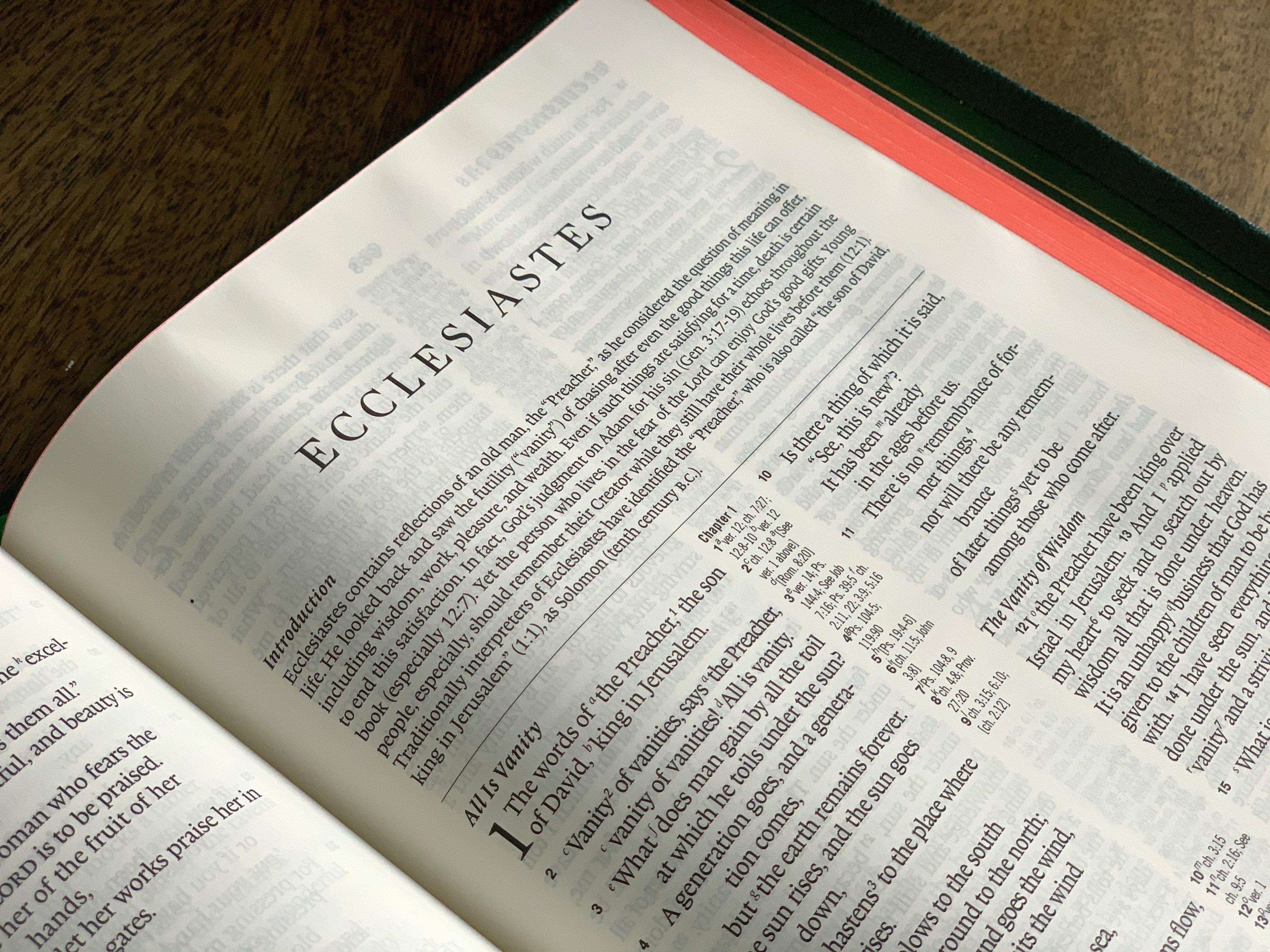
The wisest man in history, King Solomon, tells us, “There is nothing new under the sun” (Ecclesiastes 1:9).
The pride of man has reared its head through the latest technology and means of production before. As soon as human beings had the chance, they took brick and mortar and built the tower of Babel, aiming to reach as high as heaven to make a name for themselves — not for the God who gave them clay, water, and sun in the first place.
Today, we are seeing the latest expression of that sinful pride: men thinking they can hold infinite knowledge without it destroying them. Casting wisdom aside, they trust in their own minds and technical ability rather than in God.
In the Garden of Eden, Adam and Eve fell to the temptation of wanting to be all-knowing, like God. He judged that decision then, and He will not be mocked now (Galatians 6:7).
There is nothing more urgent for the unbeliever than to humble themselves, fall on their knees, and cry out to the Creator for salvation. There is, likewise, nothing more urgent for the believer than to refuse every temptation to fear in these times — to live the joyful, abundant life offered to them in Christ.
It is not a suggestion to be unafraid. It is a commandment given us by God, time and time again throughout the Scriptures.
Do not stifle your witness to the watching world.
The book of Ecclesiastes warns us that there are many dark days in this life under the sun, and that we will encounter circumstances which are difficult, perplexing, and often don’t make sense. Yet, there are a few things that author King Solomon found to be good: “Behold, what I have seen to be good and fitting is to eat and drink and find enjoyment in all the toil with which one toils under the sun the few days of his life that God has given him, for this is his lot” (Ecclesiastes 5:18).
New threats to our livelihood may come at alarming rates, but our responsibility as Christians remains the same: Do not dread the future or fear the potential of “superintelligence.” Rather, “fear God and keep his commandments, for this is the whole duty of man” (Ecclesiastes 12:13).
So, keep breaking bread with those you love. Keep enjoying the toil and the lot that God has given you with a grateful heart. Regardless of the news cycle, and whatever may come out of Washington and Silicon Valley — rejoice in what you have been given.
Our lives are but a vapor, a mist, Solomon says. The years go by quickly, and soon, we will return to dust.
That need not be depressing — in fact, let it be motivating as you live the most upright, joyous, and noble life possible along the way. Be encouraged, for we have all the instruction we need to please God in every circumstance, including the ones out of our control.
God says, “I am the Alpha and the Omega, the first and the last, the beginning and the end” in Revelation 22:13. If God is the Omega just as much as He is the Alpha, what is there to fear?
At the end of all things, just as much as at the beginning — He is there. And He rules and reigns at every point in between.
Human history was born from and ends in perfect wisdom, and God will tie the final bow on our story.
Not Sam Altman, or Dario and Daniela Amodei, or Donald Trump, or Xi Jinping — but Jesus Christ will do it, who is the same “yesterday, today, and forever” (Hebrews 13:8).
This article was written by Erica Mendel and originally published on The Washington Stand. For more content like this, visit Real Life Network.
.jpg)
Is It Time to Replace Noisy Entertainment with Faith-Based Family Media?
Is your family’s entertainment adding value or just noise? Discover how faith-based movies, documentaries, and programs can help Christian families make intentional media choices, encourage meaningful conversations, and create a more Christ-centered home.
Entertainment has never been more accessible. A television, phone, or tablet can provide an endless stream of movies, shows, short videos, news, games, and social media without ever reaching the bottom of the screen.
But having more to watch doesn’t necessarily mean families are better served by what they’re watching.
For many households, entertainment has become noisy in more ways than one. Programs compete for attention with faster pacing, stronger language, darker storylines, sexualized content, graphic imagery, and increasingly provocative themes. Algorithms encourage one more episode or video, while families can end an evening having consumed hours of media without feeling particularly rested, encouraged, or connected.
That raises a worthwhile question: Is it time to replace some of that noise with faith-based family media?
For Christian families, the answer may have less to do with watching less and more to do with choosing better.
What Does “Noisy Entertainment” Really Mean?
Noise isn’t necessarily about volume.
Media can be noisy when it constantly demands attention without giving anything meaningful in return. It can be entertainment built around shock, conflict, outrage, anxiety, or relentless stimulation. It can also be content filled with ideas and assumptions that compete with what parents are trying to teach their children.
Even material that isn’t overtly inappropriate can leave viewers feeling distracted or spiritually empty.
Philippians 4:8 gives Christians a useful standard for what deserves sustained attention, directing believers toward things that are true, noble, just, pure, lovely, and praiseworthy. That doesn’t mean every program needs to quote Scripture. But it does challenge families to think about what repeatedly occupies their minds.
Your Family’s Media Diet Matters
The phrase “media diet” is useful because entertainment has something in common with food: what is consumed occasionally matters less than what becomes normal.
One movie is unlikely to define a child’s worldview. Hundreds of hours of stories, characters, values, jokes, and messages over many years can have a much greater influence.
Children learn from stories. They notice which behaviors are rewarded, which relationships are celebrated, which beliefs are mocked, and what characters consider normal.
Adults aren’t immune either. Constant exposure to cynicism, fear, anger, or sexualized entertainment can gradually make those things feel ordinary.
Choosing faith-based media gives families an opportunity to put more spiritually nourishing material into that mix.
Replacing Is Often Easier Than Restricting
Parents can spend enormous energy saying no.
No, you can’t watch that show. No, that movie isn’t appropriate. No, we’re skipping this episode.
Boundaries are sometimes necessary, but they become much easier when there is also a good answer to, “What can we watch instead?” Faith-based streaming provides that replacement.
A family movie night could feature C.S. Lewis: The Most Reluctant Convert, opening conversations about doubt, reason, and conversion. A documentary such as The Listening Road can introduce thoughtful conversations about how people from different backgrounds think about faith. 7 Days in the Holy Land can help families visually connect places in Israel with biblical events.
The goal isn’t simply to remove entertainment. It is to replace some of it with stories and ideas worth carrying into the next day.
Faith-Based Media Can Start Conversations
One of the greatest advantages of watching Christian content together is what happens afterward. A program can naturally lead to questions that might otherwise feel forced:
- What would you have done?
- Why do you think that person responded that way?
- What does Scripture say about this?
- Do you agree with what was said?
Those conversations help turn viewing into family discipleship.
A documentary such as The Call, for example, can lead to discussion about the Great Commission and what evangelism looks like in ordinary Christian life. Way of the Master can prompt older children and adults to think about how they would talk about Jesus with someone who doesn’t share their beliefs.
The screen becomes the beginning of the conversation rather than the end of it.
Not Everything Has to Feel Like Bible Study
Replacing noisy entertainment with Christian media doesn’t mean turning every evening into a classroom. Families still need stories, laughter, discovery, music, and relaxation.
Faith-based media can include movies, animation, travel programs, interviews, biographies, documentaries, podcasts, and conversations. Some content teaches Scripture directly. Other programs simply tell compelling stories shaped by faith, courage, forgiveness, or hope.
That variety matters because healthy family media should still be enjoyable.
The distinction is that entertainment doesn’t need to undermine a family’s beliefs in order to hold its attention.
A Quieter Media Environment Can Help Families Slow Down
Another benefit of intentional viewing is simply reducing the constant demand for stimulation. Mainstream digital media often encourages viewers to keep going. Finish one episode and another begins automatically. Watch one short video and dozens more appear. Attention itself has become valuable currency.
Faith-based streaming can help families establish a different rhythm.
Choose one documentary. Watch a devotional together. Listen to a meaningful conversation. Then turn the television off and talk.
Programs such as Groundworks with Steve Wiggins are particularly suited to this approach because brief, Scripture-centered episodes can provide meaningful input without consuming an entire evening. Living Fearless with Andy and Hedieh can similarly encourage thoughtful conversation about faith and everyday challenges.
The objective isn’t to fill every available minute with Christian programming. It’s to make more intentional choices about which voices receive the family’s attention.
Parents Set the Tone
Children eventually make their own media choices. Before that happens, parents have an opportunity to model discernment. That includes more than policing what children watch. Kids also notice what their parents consume.
If adults spend hours immersed in angry commentary, dark entertainment, or endless scrolling while telling children to make healthier choices, the message can become confusing.
Christ-centered leadership in the home means asking the same questions of adult entertainment that parents ask about children’s programming.
- Is this helping or hurting?
- What is this normalizing?
- Is it worth the time being given to it?
- What could take its place?
Those questions can gradually reshape a family’s media habits without requiring an overnight purge of every mainstream platform.
Real Life Network Offers an Alternative
Real Life Network was created to provide a different kind of streaming environment.
Rather than placing biblical programming beside an enormous catalog of conflicting content, RLN carefully curates its library around Christian faith and biblical truth. Viewers can move between films, documentaries, podcasts, Bible teaching, cultural discussions, devotional programs, kids’ content, and live events without leaving that foundation.
That gives families something increasingly difficult to find in modern entertainment: a place where they can discover rather than constantly defend.
Parents still decide what fits the age and needs of their particular family. But the starting point is very different.
Replacing noisy entertainment doesn’t require rejecting technology, storytelling, or even every mainstream show. It means becoming more intentional about what receives a family’s limited time and attention.
Some entertainment merely fills a room. Better media can fill conversations, reinforce truth, encourage faith, and give families something meaningful to carry with them after the screen goes dark.
For Christian households, that makes faith-based family media more than an alternative. It can become one practical way to cultivate a home in which entertainment supports, rather than competes with, what matters most.
Explore biblically curated movies, documentaries, family programs, devotionals, and more anytime on Real Life Network.
World News
25 min
New California Law Requires Churches to Implement Pro-LGBT ‘Anti-Hate Speech’ Training
California’s new workplace anti-hate speech training law is raising religious liberty concerns. Christian advocates warn that vague language could pressure churches and religious employers to provide training that conflicts with their biblical beliefs.
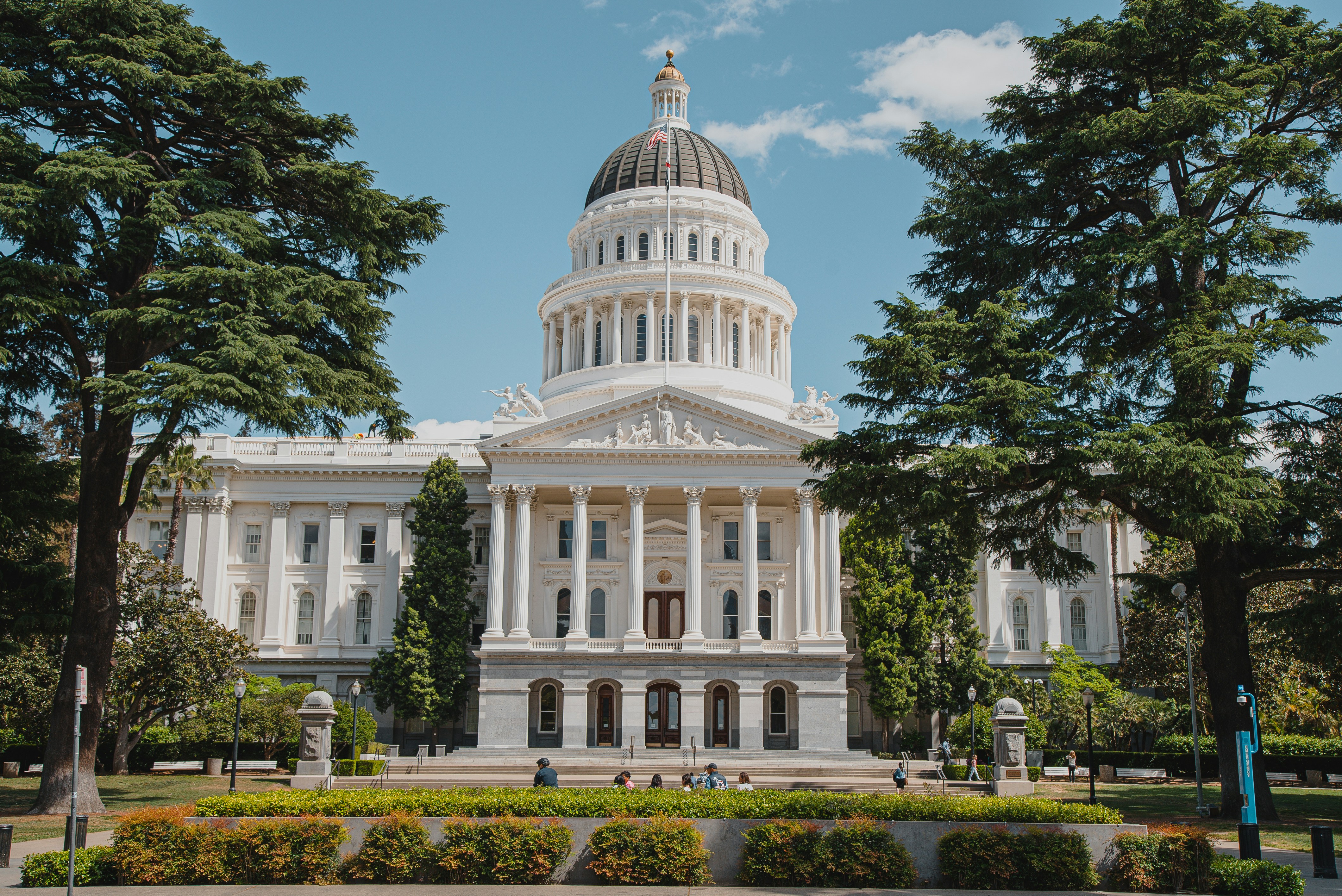
A newly enacted law in California that requires virtually all employers to give employees “anti-hate speech” training is raising red flags, as experts say that the mandate could force churches to provide training that conflicts with sincerely held biblical beliefs regarding sexuality, gender, and marriage.
Late last month, California Governor Gavin Newsom (D) signed into law AB 1803, a measure that requires all employers with five or more workers, including all churches and other nonprofit religious organizations, to provide employees with “anti-hate speech” instruction. But as observers like the California Family Council (CFC) are pointing out, the legislation does not define “hate speech,” instead handing the job to the state’s Civil Rights Department. The bill mandates that the training must confront workplace speech that “vilifies, humiliates, or incites hatred” against individuals based on what the state has already deemed a protected characteristic, which includes sex, gender identity, gender expression, and sexual orientation.
The CFC goes on to observe that the statute, which will go into effect on January 1, 2028, never mentions churches or religious nonprofits and their First Amendment rights to hold sincerely held religious beliefs about sexuality and gender. It also “fails to separate protected expression from unlawful conduct,” noting that the Supreme Court held in 2017 that “the First Amendment has no hate speech exception.”
Greg Burt, who serves as vice president of CFC, further pointed out the problems with AB 1803’s vague language regarding key terms that it says constitute “hate.”
“What does it mean to vilify? What speech actually humiliates?” he wondered during “Washington Watch with Tony Perkins” Tuesday. “[M]any times legislators consider many Christian beliefs when they’re expressed — especially regarding sexuality or gender — they accuse us of hating people. That’s [the] farthest thing from my mind. But we are simply advocating for our view that sex is determined by biology, and God created us both male and female. Well, to many people that is humiliating and that incites hatred. And so that’s the problem with this legislation.”
Burt went on to clarify that AB 1803 is being folded into a previously enacted statute that mandates sexual harassment training, which already specifies that using accurate biological pronouns constitutes “harassment.” “[Businesses are] already required to go through sexual harassment training, and we found out several years ago they redefined what sexual harassment means to include gender identity,” he explained. “… [The] California Civil Rights Department says misgendering is harassment, and so this training is on top of that already egregious training.”
As for how employers can fulfill the required training, Burt noted that hiring outside trainers is allowed, but the state-provided training that includes pro-LGBT messaging is free. “Right now, the state puts together a free curriculum — that’s how they do it with sexual harassment training, but you’re not required to use that training. You can come up with your own. But we don’t know exactly what ‘anti-hate’ is going to include, right? [Their] definition of speech that ‘humiliates’ — what does that mean? It really depends on the person who’s receiving the language.”
Burt further urged churches and other religious organizations in the Golden State to push back vigorously against the mandate. “What I think the state is doing is it’s trying to intimidate churches into following through with this,” he lamented. “They should not be receiving any kind of ideological training from the state on any moral issue. That’s why what churches need to be doing is asking for religious accommodations. The federal law and the state law already require businesses to accommodate people’s faith if they’re being required to do something that violates their faith. … [T]his is one of those points in history here in California where civil disobedience is going to be necessary.”
Burt concluded by emphasizing that state officials in California are counting on churches to kowtow to their demands instead of standing up for the constitutional freedoms, which has already proven to be a winning strategy.
“I’m sure they’re already thrilled that they get to retrain the entire population to believe what they believe regarding gender identity,” he reflected. “And so once we get accustomed to this and say, ‘Well, this is just what California requires, I guess we have to do it.’ No, you don’t. Folks, you’ve got to resist, and that includes individual employees. That’s what we are encouraging people to do. And we are having success. We have some attorneys we’re working with, and when people have been asking for religious accommodations, they have been accommodated.”
This article was written by Dan Hart and originally published on The Washington Stand. For more content like this, visit Real Life Network.
.jpg)
World News
25 min
The FlyDubai Attack and the Warning Signs That Were Missed
An attempted attack aboard a FlyDubai flight exposed troubling security failures and overlooked warning signs, raising broader questions about radicalization, discernment, and the responsibility to recognize credible threats before they become crises.
Some disasters arrive without warning. Others are preceded by signs that, in hindsight, seem impossible to miss.
The attempted attack aboard a FlyDubai flight bound for Tel Aviv belongs in the second category. A co-pilot attacked the captain with a cockpit crash axe as the aircraft descended rapidly toward the region. The wounded captain managed to unlock the cockpit door, passengers and crew subdued the attacker, and off-duty pilots ultimately helped bring the aircraft safely to the ground.
It was an extraordinary rescue. It was also an extraordinary security failure.
The investigation has revealed concerns about the alleged attacker that existed before he entered that cockpit. Those revelations should prompt serious questions about aviation security, information sharing, radicalization, and what happens when institutions fail to act on warnings already in front of them. The transcript places that failure within a broader theme: the responsibility of a watchman is not merely to recognize danger after it arrives, but to pay attention while something can still be done.
For more biblical perspective on the news shaping Israel, America, and the world, Real Life Network brings together current events and the good news of the gospel.
A warning is only valuable when someone is willing to act on it.
The Warning Signs Before FlyDubai Flight 1073
The attack aboard FlyDubai Flight 1073 on September 30 immediately raised questions about how the alleged attacker was allowed into the cockpit.
Authorities identified the co-pilot as Hamam al-Hammami, an Omani national. According to reporting from the Wall Street Journal and Associated Press, Oman Air had previously removed him from flying duties because of concerns about extremist views. FlyDubai later hired him after conducting standard background checks, but apparently did not receive or uncover that history.
That was not the only breakdown.
Oman does not have diplomatic relations with Israel, and questions have emerged over how an Omani pilot was cleared to operate a Tel Aviv-bound flight. Israel has acknowledged gaps in its vetting procedures and is reviewing the screening of foreign flight crews. Investigators have also examined al-Hammami’s employment and educational history as authorities in several countries try to determine what was known about him before the attack.
The most remarkable part of the story is what happened after the attack began.
Captain Smit Machchhar described being struck repeatedly from behind. Despite severe injuries and impaired vision, he managed to reach and unlock the cockpit door. That action allowed others to intervene before the aircraft could be destroyed. Prime Minister Benjamin Netanyahu later praised Machchhar as a hero and invited him and Indian Prime Minister Narendra Modi to participate in Israel’s Independence Day celebrations.
The precise motive and whether anyone else assisted al-Hammami remain subjects of investigation. Early reporting indicates investigators have not established ties to a terrorist organization and are examining the possibility that he acted alone.
Those distinctions matter. Serious journalism cannot transform suspicion into fact simply because it makes a compelling story.
But uncertainty about every detail does not erase the security failures already apparent.
The lesson is not that every possible threat can be prevented. It is that institutions cannot afford to ignore credible warning signs and then act surprised when those warnings become a crisis.
Europe Was Warned About Radicalization
The concern extends beyond one airline.
In 2017, United Arab Emirates Foreign Minister Sheikh Abdullah bin Zayed delivered a warning to Western leaders about radicalization in Europe. Speaking in English, he predicted that Europe would eventually produce more extremists and terrorists because of indecision, political correctness, and a mistaken belief that Western governments understood extremism in the Middle East better than governments confronting it directly.
Nearly a decade later, the warning is worth revisiting, but it also requires an important distinction.
Islamist extremism cannot be treated as synonymous with Islam or with Muslims generally. Millions of Muslims reject terrorism and radical ideology. Governments have a responsibility to distinguish between peaceful religious practice and individuals or organizations advocating violence.
But refusing to make sweeping judgments does not require refusing to make judgments at all.
The challenge for free societies is to protect religious liberty while confronting genuine extremism. Those commitments are not contradictory. A government can defend the right of Muslims to worship peacefully while aggressively investigating terrorist networks. It can protect immigrants from unjust discrimination while enforcing immigration and criminal laws. It can welcome peaceful citizens while recognizing that ideological radicalization is real.
Pretending those distinctions cannot be made leaves societies vulnerable from both directions.
The FlyDubai investigation illustrates the stakes. An individual reportedly flagged for extremist views eventually obtained access to the controls of a commercial aircraft headed toward Israel. Whatever additional facts investigators uncover, that sequence deserves scrutiny.
It should also remind Christians that discernment is not fear.
Fear assumes the worst about everyone. Discernment examines evidence, distinguishes truth from speculation, and responds appropriately when genuine danger appears.
A Watchman Has to See Clearly
Ezekiel 33 gives the image of a watchman standing guard. When the watchman sees danger approaching, his responsibility is to sound the alarm.
That image is powerful precisely because the watchman must do two things correctly.
He must remain awake, and he must see clearly.
A watchman who sleeps through an approaching threat has failed. But so has a watchman who constantly sounds false alarms until nobody believes him anymore. Christian vigilance therefore requires both courage and truth.
That principle reaches beyond terrorism.
Researchers are currently conducting new tests on the Durupınar formation in eastern Turkey, a boat-shaped geological formation that some believe could contain remains associated with Noah’s Ark. Recent work has included ground-penetrating radar, soil sampling, digital modeling, and core drilling. Researchers involved with the project have reported subsurface anomalies, including linear and angular features.
The location is intriguing because it lies in the broader Mount Ararat region associated with the Genesis account. The formation’s dimensions and reported subsurface features have fueled decades of interest.
But the evidence has not established that the formation is Noah’s Ark.
The research team itself has acknowledged that radar anomalies do not prove an archaeological origin, and laboratory analysis of recent samples remains underway. Some researchers believe the formation is artificial; other geologists have long argued that it is natural. More testing is necessary.
Christians should be comfortable saying that.
Biblical faith does not depend upon exaggerating archaeological discoveries before the evidence arrives. If compelling evidence eventually emerges, examine it. If the formation turns out to be geological, Genesis does not suddenly disappear.
The Dead Sea Scrolls offer a helpful contrast. Their discovery provided actual ancient manuscripts that scholars could compare with later biblical texts. The Great Isaiah Scroll, dating roughly a millennium earlier than previously available complete Hebrew manuscripts of Isaiah, demonstrated remarkable continuity while also containing textual variants.
The Christian does not need sensationalism when truth is already compelling.
Biblical discernment means refusing to ignore evidence that is uncomfortable and refusing to exaggerate evidence that is convenient.
That may be one of the most important habits Christians can develop in an age of breaking news, viral videos, political advertising, polling, social media, and constant claims of unprecedented discoveries.
The FlyDubai attack deserves investigation without conspiracy theories. Radicalization deserves attention without treating an entire religion or population as guilty. Archaeological discoveries deserve excitement without announcing conclusions before the evidence supports them. Political claims deserve examination regardless of which party benefits from them.
The watchman does not determine what is true.
The watchman pays attention to what is actually there.
Captain Machchhar reportedly had only moments to act. Severely wounded, he reached the cockpit door and opened it, giving everyone else aboard the aircraft a chance to survive.
Most people will never encounter anything remotely comparable. But everyone faces smaller moments when recognizing reality matters: deciding what information to trust, what warnings deserve attention, what claims require more evidence, and what principles should remain firm when cultural pressure makes them inconvenient.
Stay informed with The Daniel Cohen Show on Real Life Network, where faith, current events, Israel, and the stories shaping the world come together.

10 Best Christian Streaming Platforms in 2026
Christian streaming platforms now offer everything from Bible teaching and apologetics to movies, kids’ shows, and family entertainment. This guide compares streaming options to help families find the service that best fits their needs.
Christian families have more streaming choices than ever. Alongside mainstream services, a growing number of platforms now offer Christian movies, Bible teaching, children’s programming, documentaries, inspirational series, apologetics, and family-friendly entertainment.
But the best Christian streaming platforms serve very different purposes. Some are built around biblical teaching. Others focus on movies, children’s programming, Bible studies, or simply giving families cleaner entertainment options.
Here are 10 Christian and faith-oriented streaming platforms worth considering.
1. Real Life Network: Best for Christian Teaching and Faith-Based Programming
Cost: Free
Real Life Network offers one of the broadest combinations of biblical programming available without a subscription fee. The donor-supported platform includes Bible teaching, Christian news, apologetics, documentaries, podcasts, kids’ programs, movies, cultural commentary, and live events.
Viewers can find programs such Real Life with Jack Hibbs, RLN News, The Daniel Cohen Show, Cross Examined, The Creation Today Show, Superbook, and many other offerings within one biblically curated environment.
Unlike services centered primarily on movies, RLN is particularly strong for viewers who want entertainment combined with biblical teaching and programs addressing faith, culture, current events, and worldview.
Best for: Christians looking for a broad, free streaming platform built around biblical truth.
2. Pure Flix: Best for Christian Movies and Family Entertainment
Cost: Paid subscription; plans begin at $9.99 per month
Great American Pure Flix is one of the best-known Christian streaming services for faith-forward movies and scripted entertainment.
Its catalog combines original series, Christian films, family dramas, Christmas programming, kids’ shows, and uplifting entertainment centered on faith, family, and traditional values. Multiple membership levels are available, with higher tiers adding features such as special screenings and early access.
For viewers who want a faith-oriented alternative to browsing mainstream movie libraries, Pure Flix remains one of the strongest options.
Best for: Christian movies, original series, family dramas, and faith-centered entertainment.
3. UP Faith & Family: Best for Wholesome Family Entertainment

Cost: $5.99 per month or $59.99 annually
UP Faith & Family offers thousands of hours of commercial-free family movies, dramas, series, and inspirational entertainment.
Its catalog is broader than explicitly Christian programming. Viewers will find faith-friendly movies alongside wholesome family dramas and popular series such as Heartland.
That distinction makes UP Faith & Family particularly useful for households looking for cleaner entertainment without requiring every program to function as Christian teaching.
Best for: Wholesome dramas, family movies, romantic stories, and uplifting entertainment.
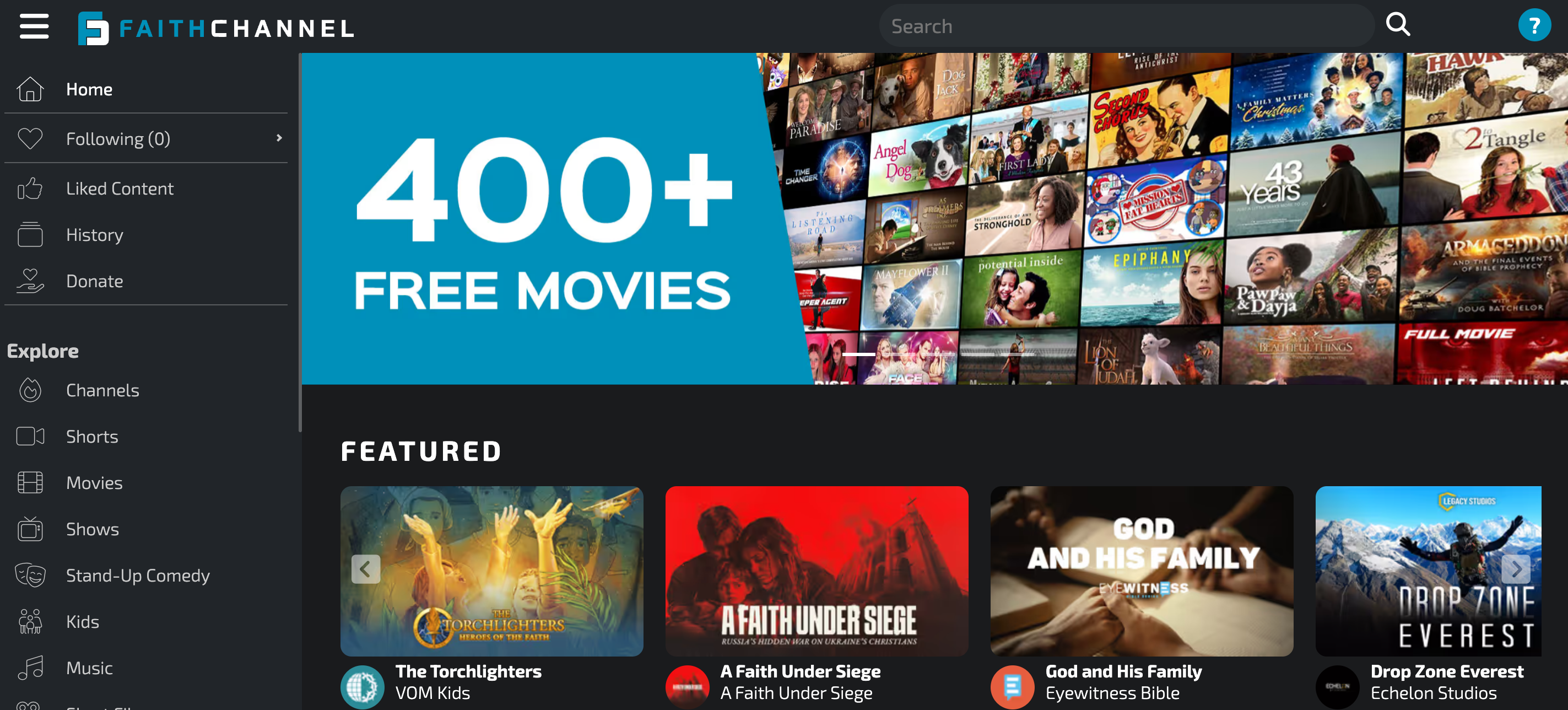
4. Faith Channel: Best for Faith-Based Shows and Inspirational Content
Cost: Free
FaithChannel is a free Christian streaming service offering movies, television shows, documentaries, preaching, teaching, music, podcasts, children’s programming, and other inspirational content.
Its growing library includes programming from a variety of independent Christian ministries and content producers. Titles range from Heroic Faith and The Torchlighters to apologetics, Bible prophecy, family films, podcasts, and children’s shows.
Because much of its catalog comes from different creators and ministries, viewers can encounter a particularly wide variety of formats and perspectives.
Best for: Exploring free Christian films, independent programs, teaching, podcasts, and inspirational content.
5. Go Minno: Best for Christian Kids’ Shows and Bible-Based Content

Cost: $10.99 per month or $69.99 annually after a free trial
Minno is designed specifically for Christian families with younger children.
Its library includes more than 175 shows, including the classic VeggieTales collection, Bible stories, music, educational programs, and Christian children’s entertainment. Families can stream across multiple devices and download programming for offline viewing.
Because the service is built specifically for children rather than including kids’ programming as one category within a larger library, it gives parents a focused alternative to mainstream children’s streaming.
Best for: Preschool and elementary-age children, Christian cartoons, Bible stories, and faith-based learning.
6. Yippee: Best for Safe, Faith-Focused Kids’ Entertainment

Cost: $7.99 per month or an annual subscription after a free trial
Yippee combines Christian children’s television with the energetic creator-driven format kids often encounter online.
Its library includes thousands of episodes from hundreds of series and movies, including Superbook, Christian programming, music, educational shows, and parent-approved creators. Yippee emphasizes that its environment contains no ads and no recommendation algorithms.
That makes it especially attractive to parents whose children enjoy online video but who want more control over what appears next.
Best for: Families seeking a Christian alternative to children’s YouTube viewing.
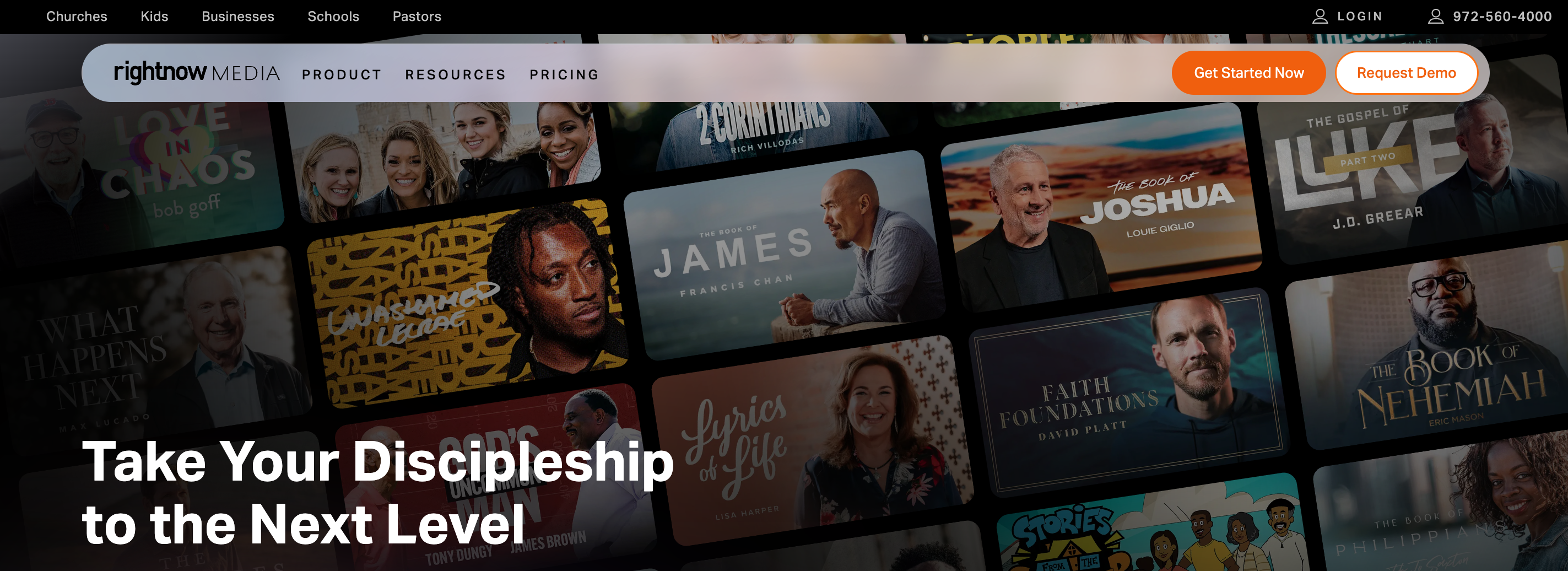
7. RightNow Media: Best for Bible Studies and Church Groups
Cost: Access is generally provided through subscribing churches and Christian organizations
RightNow Media is less like Netflix and more like an enormous digital discipleship library.
It offers more than 25,000 video Bible studies covering Scripture, marriage, parenting, leadership, finances, recovery, Christian living, and other topics. The service also includes more than 2,000 children’s episodes and downloadable materials for many studies.
Rather than purchasing individual subscriptions, users generally receive access through a participating church, ministry, or organization.
Its combination of teaching videos and discussion materials makes RightNow Media particularly useful for small groups and church ministries.
Best for: Bible studies, small groups, church discipleship, leadership development, and Christian education.
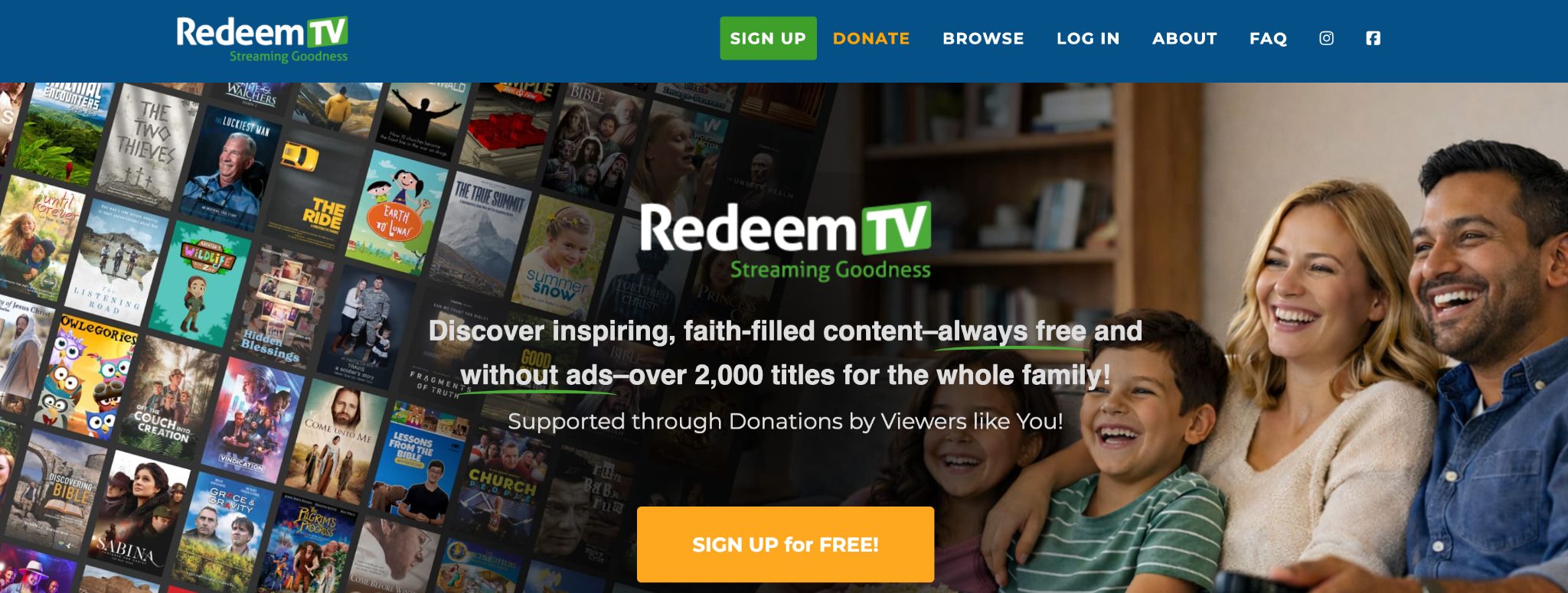
8. RedeemTV: Best Free Christian Film Streaming Platform
Cost: Free
RedeemTV offers more than 2,000 faith-filled titles without subscription fees or advertising.
Its donor-supported library includes Christian movies, documentaries, animated programs, television series, and family entertainment. Titles include The Pilgrim’s Progress, Vindication, Fragments of Truth, Ryan Defrates, and many others.
RedeemTV is especially strong for viewers whose primary interest is films and entertainment. Real Life Network offers a broader mix of teaching, news, cultural programming, and entertainment, while RedeemTV concentrates more heavily on movies and series.
Best for: Free Christian movies and shows without commercials.
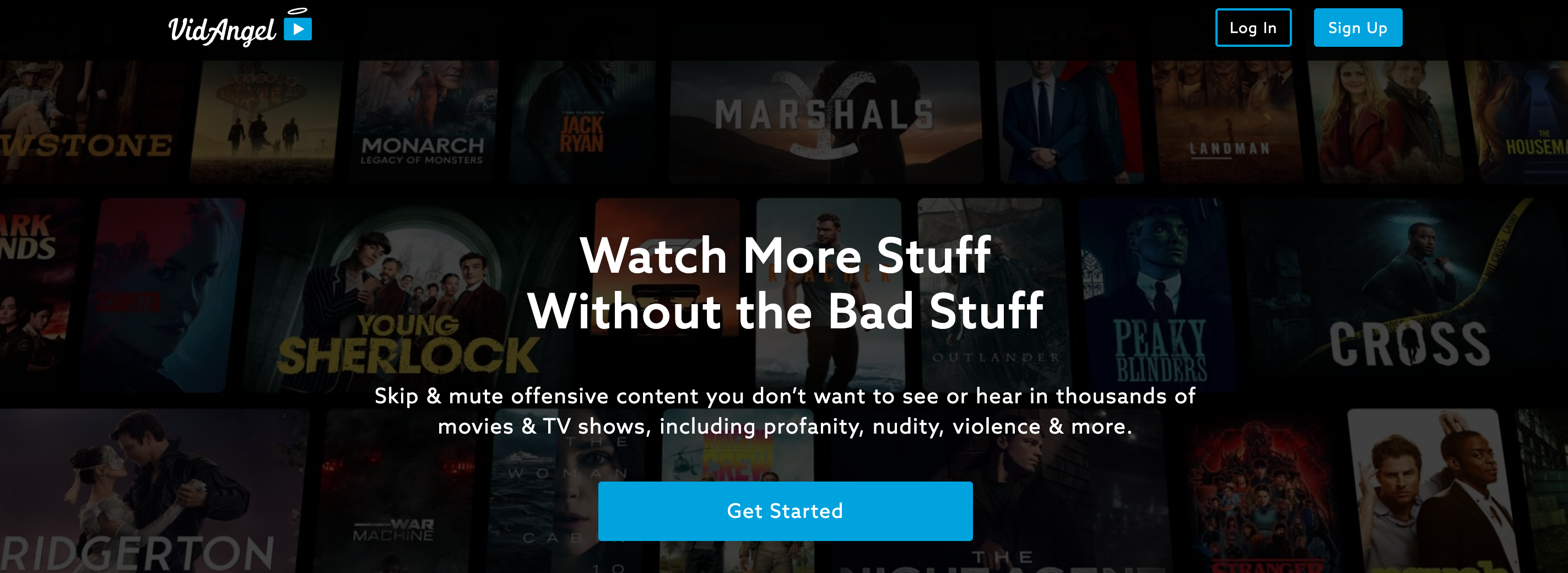
9. VidAngel: Best for Filtering Movies and TV Shows
Cost: $9.99 per month when billed directly; supported streaming subscriptions may also be required
VidAngel takes a completely different approach to family entertainment.
Rather than providing only a traditional catalog of Christian programming, VidAngel lets viewers apply customizable filters to supported movies and shows from other streaming services. Families can choose categories of language, sexual content, violence, and other material they would prefer to mute or skip.
That means parents do not necessarily have to reject an entire movie because of a handful of objectionable scenes.
VidAngel requires users to have their own subscriptions to compatible streaming services for much of its filtered content.
Best for: Families who want more control over mainstream movies and television shows.
10. Christian Cinema: Best for Renting and Buying Christian Movies

Cost: Individual rentals and purchases; optional subscription plans are also available
Christian Cinema is useful for viewers who do not necessarily want another monthly streaming subscription.
Movies can be rented individually and streamed for a limited viewing period or purchased and stored in a digital library for on-demand viewing. The service specializes in Christian and faith-based films rather than trying to compete as a broad general-entertainment platform.
Christian Cinema also offers optional subscription plans for additional movies and television programming, but its rent-or-buy model remains a major distinction.
Best for: Viewers who want specific Christian movies without committing to another full streaming subscription.
What Should You Look for in a Christian Streaming Service?
The best platform depends on what you want from it.
Start by considering biblical alignment. A platform described as “family-friendly,” “inspirational,” or even “faith-based” is not necessarily the same as a service intentionally grounded in Scripture. Families should consider who selects the programming and what worldview shapes the library.
Next, consider the type of content your household actually watches. Parents with young children may get more value from Minno or Yippee, while a small-group leader may find RightNow Media far more useful. Movie lovers may prefer Pure Flix or RedeemTV, while viewers interested in Bible teaching, apologetics, news, and culture may find Real Life Network a better fit.
Finally, consider cost, commercials, device compatibility, offline viewing, parental controls, and whether a service requires other subscriptions to function.
Are There Any Free Christian Streaming Platforms?
Yes.
Real Life Network is completely free and donor-supported, offering Christian teaching, news, movies, kids’ programs, apologetics, podcasts, and more without a paid tier. RedeemTV is also donor-supported and offers more than 2,000 titles free without ads. FaithChannel provides free faith-and-family programming as well.
Angel has selected titles available without a Guild membership, although most of its full catalog now requires paid access.
For families trying to reduce monthly subscription costs, the amount of Christian programming available free is substantial.
Which Christian Streaming Platform Is Best for Families?
There is no single answer for every household. For families seeking a platform the whole household can use, Real Life Network has an advantage because its free library extends beyond children’s entertainment to Bible teaching, movies, documentaries, current events, apologetics, podcasts, and family programming.
Families primarily concerned with younger children may prefer Minno or Yippee. Those wanting a traditional movie-and-series experience may choose Pure Flix, UP Faith & Family, or RedeemTV.
The best choice is the one that not only avoids objectionable material but also supports the values parents are working to build at home.
Frequently Asked Questions About Christian Streaming Platforms
What Is the Best Christian Streaming Platform?
The best platform depends on your priorities. Real Life Network is a strong all-around choice for viewers seeking free biblical teaching, Christian news, apologetics, kids’ programming, movies, documentaries, and cultural content. Pure Flix is particularly strong for Christian movies and scripted entertainment, while Minno and Yippee specialize in children’s programming.
What Is the Best Free Christian Streaming Service?
Real Life Network and RedeemTV are two of the strongest completely free options. RLN provides a broad mix of programming, while RedeemTV has a particularly large free library of Christian films and series. FaithChannel is another free option worth exploring.
Is There a Christian Alternative to Netflix?
Several services can function as Christian or family-oriented alternatives to Netflix. Pure Flix most closely resembles a traditional subscription movie-and-series platform, while Real Life Network combines entertainment with teaching, news, apologetics, and family programming at no cost.
What Is the Best Christian Streaming Platform for Kids?
Minno and Yippee are specifically built around Christian children’s entertainment. Real Life Network also offers free children’s programming within a larger platform designed for the whole family.
Do I Need to Pay for Christian Streaming?
No. While many Christian streaming services charge monthly or annual subscription fees, Real Life Network, RedeemTV, and FaithChannel offer free options.
Finding the Best Christian Streaming Platform for Your Home
Christian streaming is no longer a single category. Families can now choose platforms specializing in movies, Bible studies, kids’ shows, documentaries, teaching, news, apologetics, and wholesome general entertainment.
The right choice depends on what you want entering your home and what role you want media to play in your family.
For viewers who want to begin with a service built around biblical truth without adding another monthly expense, Real Life Network provides free access to Christian teaching, news, family programming, movies, documentaries, podcasts, apologetics, kids’ shows, and more.
Explore free Christian streaming today on Real Life Network.
.jpg)
World News
25 min
Right to Life Is ‘Most Foundational of all Rights,’ New ‘Declaration For Life’ Proclaims
Sen. Josh Hawley and Christian leaders are calling on Americans to sign a new Declaration for Life and urging Congress to ban mifepristone for abortion, placing chemical abortion at the center of a renewed national debate over abortion policy.
More than 50,000 Americans from across the country signed a new “Declaration for Life” within hours of its public release that calls on them and their fellow citizens “to stand for life” and for Congress “to ban the chemical abortion drug mifepristone,” Senator Josh Hawley (R-Mo.) told reporters during an impromptu news conference in a Senate office building Wednesday.
“We think this declaration, written by pastors, is calling on spiritual leaders and everyday Christians across America to stand for life and to confront the scourge of chemical abortion. It is so critical on this the 250th anniversary of America,” Hawley said, referring to the four-page declaration he and a committee of pastors and other spiritual leaders from multiple denominations drafted.
The Declaration for Life was officially unveiled Wednesday during the first annual Missouri Prayer Breakfast hosted by the Show-Me State’s senior senator. The document is being circulated nationwide by multiple pro-life groups, including Family Research Council, and millions of Americans are expected to sign the document in the coming days.
“The Declaration of Independence gives us three examples of ‘inalienable rights:’ life, liberty, and the pursuit of happiness. Life is the first of those rights because it is the condition of the others. It is thus the most foundational of rights,” the document proclaims at its outset.
“We believe we have an obligation as Christians and spiritual leaders to remind our countrymen of what Scripture and conscience together proclaim: That every human being from the moment of our knitting together in our mothers’ wombs, was fearfully and wonderfully made. The divine image each human being bears was not earned. It cannot be forfeited. And it is the first duty of the Church to defend human dignity where it is denied,” the document states.
The declaration continues, noting that “what is at stake on this anniversary is nothing less than the conviction on which every flourishing society finally rests: That each and every member of the human family, as a creature fashioned in the image of the divine Creator and Ruler, is the bearer of profound dignity. Where that conviction is honored, civilizations flourish. Where it is forgotten, cultures decline and fall.”
The declaration explains that while in the four years since the Supreme Court’s Dobbs decision “returned the abortion question from courts to legislatures,” that decision “did not end abortion in America. Far from it. More abortions are performed in this country today than when [Roe v. Wade] was still the law of the land — over one million abortions in 2025 alone.”
Three-fourths of those abortions are carried out using the chemical drug mifepristone, and, the declaration points out, “thanks to recent changes in government regulations, mifepristone can now be mailed into every state and city in America, regardless of local rules. The abortion drug is nearly always fatal to the unborn child and frequently injurious to the mother. Recent studies indicate the drug puts more than one in 10 women who take it at risk of serious, life-threatening complications, including hemorrhaging, infections and sepsis.”
Hawley told reporters he believes “the time has come to ban mifepristone abortions, and I want to emphasize this is something only Congress can do. … Only Congress can act to take mifepristone off of the Food and Drug Administration’s [approved drug] schedule, only Congress can say it will not be available for abortions. That’s something that Congress should do. Congress should stop passing the buck to other people. Congress should stand up and act.”
As long as Congress fails to act, Hawley emphasized, state actions such as those in Louisiana, Missouri, and others that have banned chemical abortions carried out by medical professionals in those jurisdictions will continue to be rendered meaningless so long as the drug can be mailed across state lines and administered in private by the mother with a cup of water.
Hawley added that “when it comes to elected officials in Congress, there hasn’t been much of anything [done] to protect the innocent unborn, and I think we’ve got to change that. One of the things we want to do with this Declaration for Life is call on candidates for public office in both parties to sign this declaration, to say ‘We support it, we support protecting human life.’”
Earlier this year, Hawley introduced S. 4066, the Safeguarding Women from Chemical Abortion Act that would outlaw chemical abortions. On the House side of the Capitol, the same legislation was introduced as H.R. 7902 by Rep. Diana Harshbarger (R-Tenn.). The Senate bill has seven co-sponsors, all Republicans, while the House bill has 11 co-sponsors, also all GOPers. Neither proposal has been advanced to committee hearings, as Republican leaders focus on other issues.
Another major obstacle for such reforms includes the lack of action from President Donald Trump, whose administration approved in October 2025 a second generic version of mifepristone for abortion use and has delayed a promised FDA study of the drug.
In addition, as Family Research Council President Tony Perkins told reporters during the Hawley news conference, the Republican Party at its 2024 convention abandoned its long-standing defense of the right to life, and its congressional leadership has since failed to act vigorously on the issue.
“Unfortunately, the Republican Party has lost its voice on the right to life issue, and in that vacuum, there are leaders who are stepping forward like Senator Hawley calling upon the church, communities, and the country to step up on behalf of the unborn,” Perkins said.
“We have made great progress,” FRC’s president continued, “but there has been a tremendous setback, and we’ve reached a point where I think we have to call upon the faith community, Christian pastors, to step into this vacuum and speak unequivocally about the sanctity of human life and hold elected officials accountable to the standard. This declaration is a starting point for establishing a standard for what we should be aspiring to as a nation.”
When asked by The Washington Stand if he would initiate legislative action in response to a Government Accounting Office (GAO) study released earlier this week that found thousands of abortions are being paid for annually with federal tax dollars through the Obamacare health insurance program, Hawley replied, “100 percent, and the other thing that is happening is that Planned Parenthood is getting funded right now. The ban on Planned Parenthood funding has expired, [and] it’s being funded with taxpayer dollars.”
The Hyde Amendment — named after former Rep. Henry Hyde (R-Ill.) who authored the measure — was approved by a Democrat-controlled Congress and signed into law by Democratic President Jimmy Carter in 1977. That law bars the use of federal tax dollars to pay for abortions except in a tiny class of exceptions.
This article was written by Mark Tapscott and originally published on The Washington Stand. For more content like this, visit Real Life Network.
Thank you! Your submission has been received!
Oops! Something went wrong while submitting the form.
Entertainment & Lifestyle
One of the biggest reasons Christian streaming continues to grow is the access it gives viewers to trusted pastors, teachers, and Christian leaders throughout the week. Instead of being limited to a single sermon or Sunday broadcast, viewers can now access biblical teaching, cultural discussions, apologetics, and encouragement anytime they want.
That raises an important question for many viewers: Which Christian shows and podcasts are actually worth watching regularly?
Real Life Network offers a wide range of programs hosted by pastors, apologists, evangelists, and ministry leaders who approach Scripture and culture thoughtfully and biblically. Here are 10 standout shows and podcasts on RLN worth adding to your regular rotation.
1. Real Life with Jack Hibbs
Hosted by Pastor Jack Hibbs of Calvary Chapel Chino Hills, Real Life with Jack Hibbs combines verse-by-verse biblical teaching with practical application for everyday life. The program addresses Scripture clearly while also helping viewers think biblically about current cultural issues.
Why viewers return to it: straightforward teaching that connects Scripture to real life without unnecessary complication.
2. A Daily Walk
Pastor John Randall’s A Daily Walk focuses on steady, verse-by-verse teaching through books of the Bible. The tone is calm, practical, and approachable, making it especially helpful for viewers looking to stay grounded in consistent biblical study.
Best for: daily encouragement and long-term Bible learning.
3. Bridge Bible Talk
Part call-in show and part Bible discussion, Bridge Bible Talk allows listeners to hear real questions from everyday people answered through Scripture. Topics range from theology and Christian living to difficult cultural and personal questions.
Why it stands out: conversational format that feels accessible and practical.
4. I Don’t Have Enough Faith to Be an Atheist
Based on the well-known apologetics ministry, this program examines evidence for Christianity, the reliability of the Bible, and logical arguments for faith. It’s designed to help believers think critically and confidently about what they believe.
Best for: viewers who enjoy thoughtful, evidence-based discussions about Christianity.
5. Cure America with Star Parker
Hosted by author and commentator Star Parker, Cure America explores cultural and societal issues through a biblical worldview. The show focuses on faith, freedom, leadership, and the role of biblical principles in public life.
Why viewers appreciate it: thoughtful cultural engagement without losing sight of Scripture.
6. Cross Examined with Frank Turek
Apologist Frank Turek tackles difficult questions about Christianity, truth, morality, and the reliability of Scripture. His approachable teaching style helps make complex apologetics topics understandable for everyday viewers.
Best for: viewers wrestling with tough questions or wanting stronger confidence in their faith.
7. Way of the Master
Hosted by evangelists Ray Comfort and Kirk Cameron, Way of the Master focuses on evangelism, gospel conversations, and practical outreach. The program demonstrates real conversations with people about faith and salvation.
Why it stands out: practical examples of sharing the Gospel with boldness and compassion.
8. The Creation Today Show
Hosted by Eric Hovind, The Creation Today Show explores creation, science, worldview, and biblical truth. Episodes often address questions surrounding evolution, design, and how Christians can think carefully about scientific topics.
Best for: families, students, and viewers interested in apologetics and science.
9. Samaritan’s Purse Podcast
This program shares stories from the global ministry efforts of Franklin Graham and Samaritan’s Purse. Episodes often highlight disaster relief, missions work, humanitarian outreach, and testimonies from around the world.
Why viewers connect with it: real stories of faith put into action in difficult circumstances.
10. The Jack Hibbs Podcast
This podcast-style program expands on many of the themes Pastor Jack Hibbs addresses in his teaching ministry, often exploring cultural issues, worldview questions, and biblical encouragement in a more conversational setting.
Best for: listeners who enjoy deeper discussion and practical insight during commutes or throughout the week.
Why Christian Leadership Content Matters
One of the unique strengths of Christian streaming is the ability to learn from a variety of trusted voices throughout the week. Different teachers and leaders bring different experiences, insights, and emphases while remaining grounded in Scripture. This variety helps viewers:
- Stay engaged in biblical learning
- Explore topics from different perspectives
- Grow in discernment and understanding
- Continue learning beyond Sunday mornings
Rather than replacing local church involvement, these programs often complement and reinforce it.
Building Better Viewing Habits
Many people spend hours each week listening to podcasts, interviews, or commentary online. Christian streaming platforms provide an opportunity to redirect some of that attention toward content that encourages spiritual growth.
Whether it’s a sermon during a commute, an apologetics discussion during a workout, or a family-friendly teaching program in the evening, these shows help integrate faith into everyday routines.
Christian streaming is no longer limited to sermons alone. Today’s platforms offer thoughtful conversations, apologetics, cultural insight, evangelism training, and practical discipleship from trusted Christian leaders.
If you’re looking for meaningful content that strengthens faith and encourages biblical thinking, these shows and podcasts on Real Life Network are an excellent place to begin.
Explore Christian shows, podcasts, and teaching anytime on Real Life Network.
Related Articles
- Who Creates Christian Streaming Content? by Real Life Network
- Do Christian Platforms Feature Church Partnerships? by Real Life Network
- Do Christian Streaming Platforms Offer Ad-Free Viewing? by Real Life Network
25 min

June 20, 2026
Real Life Network
Entertainment & Lifestyle
Christian streaming platforms have grown rapidly in recent years, offering everything from sermons and documentaries to kids’ programming, podcasts, and feature films. As more families and viewers explore these platforms, many naturally wonder: Who actually creates all this Christian content?
The answer is broader than many people realize.
Christian streaming content is created by a wide range of pastors, ministries, filmmakers, musicians, educators, evangelists, production companies, and Christian organizations—all working toward a common goal: communicating biblical truth through modern media.
Pastors and Bible Teachers
One of the largest categories of Christian streaming content comes from pastors and Bible teachers. Many churches and ministries now produce teaching programs specifically designed for television, streaming apps, podcasts, and digital platforms.
These programs often include:
- Verse-by-verse Bible teaching
- Sermon series
- Devotional content
- Question-and-answer discussions
- Cultural and worldview conversations
On Real Life Network, viewers can find teaching from pastors and ministry leaders through programs such as:
These kinds of programs help extend biblical teaching far beyond the walls of a local church.
Christian Filmmakers and Production Studios
Christian streaming also includes professionally produced films, documentaries, and series created by filmmakers who want to tell stories through a biblical lens.
In the past, faith-based filmmaking was often viewed as lower-budget or limited in scope. That has changed dramatically. Today, many Christian filmmakers use high-level production, cinematography, writing, and storytelling techniques comparable to mainstream entertainment.
These creators produce:
- Historical dramas
- Documentaries
- Animated films
- Family movies
- Apologetics and worldview projects
Films like Before the Wrath, C.S. Lewis: The Most Reluctant Convert, and The Pilgrim’s Progress reflect the growing quality and variety of modern Christian media.
Ministries Focused on Evangelism and Discipleship
Many Christian organizations create streaming content specifically for outreach and spiritual growth. Evangelistic ministries often produce:
- Gospel-centered documentaries
- Testimony-based programs
- Evangelism training
- Humanitarian and missions stories
For example, programs connected to ministries like Way of the Master or the Samaritan’s Purse Podcast are designed not only to inform viewers, but to encourage active faith and Gospel outreach.
This kind of content helps viewers see Christianity lived out practically rather than only discussed theoretically.
Apologists and Christian Thinkers
Another major category of Christian streaming content comes from apologists, scholars, and Christian communicators who help believers think carefully about faith and culture. These creators often address:
- Questions about science and faith
- Evidence for Christianity
- Biblical worldview
- Moral and cultural issues
- Common objections to Scripture
Programs such as Cross Examined with Frank Turek, I Don’t Have Enough Faith to Be an Atheist, and The Creation Today Show are examples of content created specifically to strengthen understanding and encourage discernment.
Christian Creators for Children and Families
Christian streaming platforms also rely heavily on creators who specialize in children’s content. These teams include:
- Writers and animators
- Voice actors
- Educators
- Bible consultants
- Family-focused production studios
Their goal is not simply to entertain children, but to help communicate biblical truth in age-appropriate ways.
Shows like Superbook, Ryan Defrates: Secret Agent, and iBible reflect how Christian creators are using storytelling and animation to reach younger audiences more effectively than ever before.
Why Curation Matters
While many individuals and organizations create Christian content, not everything labeled “Christian” automatically aligns with biblical truth. That’s why trusted streaming platforms play an important role in curating what they include.
At Real Life Network, programming is carefully reviewed and selected by a team of believers committed to biblical integrity. The platform does not simply upload any faith-adjacent content available online. Programs are chosen intentionally based on:
- Alignment with Scripture
- Doctrinal consistency
- Spiritual value
- Family suitability
This helps create a viewing environment families can trust.
A Collaborative Effort Across the Christian Community
One of the unique aspects of Christian streaming is how collaborative it often is. Churches, ministries, filmmakers, teachers, musicians, and creators frequently work together to produce content that no single organization could create alone.
That collaboration allows Christian platforms to offer:
- A wide variety of teaching styles
- Multiple forms of storytelling
- Diverse voices within biblical orthodoxy
- Content for different ages and stages of life
As the industry grows, that cooperation continues expanding the reach and quality of faith-based media.
Why Christian Streaming Continues Growing
The growth of Christian streaming reflects a larger shift in how people access media and discipleship. Viewers increasingly want content that:
- Aligns with their values
- Encourages faith rather than undermining it
- Helps families engage intentionally
- Addresses real-life questions biblically
Christian creators are responding to that need by producing more thoughtful, accessible, and professionally crafted content than ever before.
Christian streaming content is created by a wide range of pastors, filmmakers, ministries, educators, and Christian communicators—all working to share truth through modern media.
From sermons and apologetics to documentaries and family programming, these creators help make biblical content accessible to viewers around the world.
And through careful curation, platforms like Real Life Network help ensure that the content families encounter remains grounded in Scripture and centered on Christ.
Explore biblically curated Christian content anytime on Real Life Network.
Related Articles
- Do Christian Platforms Feature Church Partnerships? by Real Life Network
- Do Christian Streaming Platforms Offer Ad-Free Viewing? by Real Life Network
- How Do Christian Streaming Platforms Reach Younger Generations? by Real Life Network
25 min
Who Creates Christian Streaming Content?
.webp)
June 19, 2026
Real Life Network
World News
The Federal Trade Commission (FTC) and attorneys general in four states filed a lawsuit Wednesday against the World Professional Association for Transgender Health (WPATH), accusing the group of misleading doctors, parents, and children to promote the lucrative business of administering transgender procedures to minors. In a 123-page complaint, the FTC lays out “ten specific unlawful misrepresentations or omissions” by WPATH and seeks “a permanent injunction to prevent future violations.”
“When an organization provides guidance designed to mislead families about the risks, benefits, or medical consensus behind a treatment, it undermines trust in those responsible for providing medical care,” declared FTC Commissioner Mark R. Meador. The FTC was joined in its lawsuit by attorneys general from Alaska, Iowa, Nebraska, and Texas.
The lawsuit is significant because it goes directly to the source of claims undergirding transgender medical practice. In countless other legal battles, pro-transgender activists have invariably cited WPATH as the foremost authority on transgender procedures for minors. Now, the FTC has challenged WPATH itself to prove that its claims, often cited as an expert authority, can hold up in a court of law.
The lawsuit challenged the accuracy of specific claims made by WPATH, as well as omissions in the most recent version of its so-called, unofficial “Standards of Care” (SOC-8):
“(1) WPATH misrepresents that pediatric medical transition is medically necessary to prevent suicide in children who express dissatisfaction with or report distress about their sex traits.
“(2) WPATH misrepresents that pediatric medical transition is effective at preventing suicide in children who express dissatisfaction with or report distress about their sex traits.
“(3) WPATH misrepresents that puberty blockers are fully reversible.
“(4) WPATH misrepresents that cross-sex hormones improve mental health.
“(5) WPATH misrepresents that performing breast amputations on children is safe, effective, and consistently results in better health and quality of life.
“(6) WPATH misrepresents SOC-8 to be the result of unbiased, evidence-based expert consensus.
“(7) WPATH misrepresents that pediatric medical transition is the “standard of care” for children who express dissatisfaction with or report distress about their sex traits.
“(8) WPATH fails in SOC-8 to adequately disclose certain side effects of puberty blockers including hot flashes, lethargy, and cognitive problems.
“(9) WPATH fails in SOC-8 to adequately disclose certain side effects of cross-sex hormones including mood disturbances, vocal pain, pelvic pain, pelvic floor dysfunction, clitoral discomfort, vaginal pain, persistent sexual dysfunction continuing after cessation of use, and erectile pain.
“(10) WPATH fails in SOC-8 to adequately disclose certain side effects of breast amputations including inability to breastfeed, nerve damage, and necrosis of the nipples.”
“WPATH made each of these ten misrepresentations or omissions expressly or by implication,” the complaint declared. “WPATH knew they were false or misleading, and WPATH further knew — and intended — that they would provide WPATH members and other providers of medical transition services with the means to mislead consumers.”
The FTC challenged WPATH’s SOC-8 in detail, alleging that its methodology “does not satisfy accepted medical standards of evidence” for at least four reasons. “WPATH selected authors who had conflicts of interest; WPATH ignored the consensus protocol that SOC-8 purports to follow; WPATH failed to adhere to proper protocols both in evaluating scientific and medical evidence and in making recommendations based on that evidence; and WPATH made material changes to its recommendations in response to external pressure rather than scientific evidence.”
Regarding conflicts of interest, the FTC argued that WPATH selected drafters for SOC-8 who had both “intellectual conflicts of interest” and “financial … conflicts of interest.” The intellectual conflicts of interest stemmed from the fact that its selection criteria required every team leader to be a “longstanding WPATH Full Member in good standing” and a “well recognized advocate for WPATH” — in other words, professionals “who already supported medical transition services.”
The financial conflicts of interest concerned the fact that many authors directly performed and thereby profited from the procedures under review, such as Dr. Marci Bowers. Bowers, the complaint stated, “made more than a million dollars in a single year from transition surgeries but declared it ‘absurd’ to disclose that conflict or attempt to account for it in SOC-8.”
Regarding external pressure, the FTC referenced “the removal of age minimums for pediatric medical transition drugs, surgeries, and services including cross-sex hormones, breast amputations, surgical penis removal, and facial surgery.” This removal came after the Biden administration Department of Health and Human Services asked in 2022 “if the specific ages can be taken out” to combat “the conservative anti trans agenda.” In addition, “According to a WPATH leader, the American Academy of Pediatrics threatened to ‘actively publicly oppose’ SOC-8 if WPATH did not remove the age minimums,” although without “any sound evidence-based argument(s) underpinning” the change it demanded.
“One WPATH committee member acknowledged that it was ‘the most strange experience’ to see WPATH eliminate minimum age recommendations at the ‘last minute’ after internal discussion made clear that ‘nobody [on the committee] wanted to [eliminate] them, and personally not agreeing with the change,’” the complaint stated.
Regarding consensus protocol, the FTC elaborated on the same issue, noting that WPATH failed to strictly follow its own selected “Delphi process” for achieving expert consensus. “At least one WPATH member could not ‘see how we can simply remove something that important from the document — without going through a Delphi — at this final stage of the game.’”
Regarding the quality of evidence, the FTC excoriated WPATH for “a deliberate decision to obfuscate the strength of the evidence supporting WPATH’s recommendations and allow WPATH to overstate the strength of its evidence.” WPATH claimed to use an evidence-rating system called “GRADE,” but it chose not to include the GRADE ratings to make the evidence look stronger than it really was. One draft leader, Dr. Eli Coleman, admitted in 2023, “[a]ll of us are painfully aware that there are many gaps in research to back up our recommendations.”
Yet the SOC-8 authors “knew ‘what we should end up with,’” the complaint alleged, because “SOC-8 authors had prejudged that SOC-8 would ultimately make strong recommendations in favor of pediatric medical transition regardless of whether the quality of the evidence supported such recommendations.” As one author, Dr. Amy Tishelman, said in February 2026, “The sun and the moon existed before we understood anything about why. Lots of things we observe in life, we know to be true, and we don’t understand them.”
The complaint goes on to argue that WPATH failed to “follow the science” in other important respects. For instance, “SOC-8’s authors commissioned systematic reviews of evidence regarding pediatric medical transition from Johns Hopkins University,” according to the complaint. However, “WPATH secured significant control over … they would ultimately be published.” When the reviews “found little to no evidence about children and adolescents,” “WPATH rejected multiple Johns Hopkins manuscripts, causing” the head of the research team “to express frustration that WPATH was ‘trying to restrict our ability to publish.’”
The incident echoes the 2024 controversy involving Dr. Johanna Olson-Kennedy, later head of USPATH (WPATH’s American outpost), who refused to publish the results of a taxpayer-funded study after they contradicted her belief in using puberty blockers for the purpose of gender transition. The complaint referenced another “notable evidentiary exclusion” involving Olson-Kennedy. Although a study she conducted “formed the evidence base of SOC-8,” SOC-8 “did not disclose” that two subjects of the study committed suicide during the observation period or “discuss … how they might undermine SOC-8’s conclusion that pediatric medical transition improved psychological well-being.”
Finally, the complaint alleges that WPATH’s guidelines discourage clinicians from exploring other “numerous potential root causes of a child’s distress about or discomfort with their sex traits,” such as sexual assault or other mental illnesses. Although it acknowledges that such intervening factors do exist, SOC-8 attacks them as “gatekeeping practices” that act as a “barrier to the provision of” transgender procedures.
“Even if WPATH legitimately encouraged clinicians to investigate whether medical transition treatment is appropriate for a given child, SOC-8 offers no genuine method for making such a determination,” the complaint continued. “Indeed, WPATH defines ‘gender incongruence’ as a subjective ‘experience’ that is ‘deeply felt’ by the child. It offers no objective diagnosis criteria for clinicians,” even though “SOC-8 purports to require rigorous diagnostic procedures.” So much for following the science.
These accusations raise an important question: what would motivate the physicians associated with WPATH to venture so far from established science. Beyond the obvious ideological reasons, the complaint focuses on another motive: profit.
“WPATH misrepresents scientific and medical consensus and makes false, deceptive, or unsubstantiated claims regarding pediatric medical transition and related services for a simple reason: WPATH’s members generate significant profit because of the organization’s representations and guidance,” it declared. “Two of the five current members of WPATH’s executive committee are surgeons who specialize in medical transition procedures, and a third member specializes in medical transition procedures for children.”
As a result of WPATH’s non-scientific, profit-motivated guidelines, the complaint continued, children and their families were misled and thereby harmed. “WPATH’s assertions that its recommendations represent evidence-based and “consensus-based expert opinion” give members and other clinicians the means to misrepresent to consumers that the SOC reflects expert scientific consensus,” it argued, “and to repeat the unsubstantiated statements therein when persuading parents and children.”
Whether they visit a family doctor with no specialized training, a gender transition specialist, or an activist center, “children and parents are unlikely to avoid being influenced by WPATH’s deceptive claims and omissions. Indeed, WPATH board member and former president Dr. Marci Bowers claims that ‘the vast majority of mental health providers in the country that [Dr. Bowers is] familiar with follow the WPATH standards of care.’”
“Clinicians begin selling parents and children on medical transition procedures once they arrive at a medical transition provider’s clinic,” the complaint explained. “Sometimes, clinicians make the sale by directly invoking WPATH’s name and providing parents with the SOC or other material containing WPATH’s deceptive claims. Other times, clinicians repeat WPATH’s deceptive claims without attribution. And even without telling parents, clinicians often rely on WPATH’s deceptive claims in making diagnoses and recommending treatment.”
The complaint included numerous examples of WPATH’s malign influence:
- “For example, a pediatric endocrinologist in California told a pediatric patient's mother that he follows the recommendations of WPATH. When the patient’s mother asked for supporting studies and other evidence for medical transition, the doctor sent her a web link directly to WPATH’s SOC-7, which she then read.
- “Boston Children’s Hospital Center for Gender Surgery cited ‘WPATH standards of care’ on its page advertising breast implants for children.
- “One online medical transition clinic asserts that it follows SOC-8 and promises to provide monthly prescriptions for transition services without an in-person visit, covered by major US insurers. It asserts that ‘puberty blockers are fully reversible’ and that ‘children can begin their medical transition with puberty blockers.’
- “Stanford Medicine’s Transgender Surgery team promises that it ‘follows the World Professional Association for Transgender Health (WPATH) guidelines to ensure patients are appropriate surgical candidates.’
- “One 13-year-old girl visited a Dallas, Texas clinic with her parents. A psychologist who has presented at WPATH conferences told the girl’s parents that their daughter needed to undergo medical transition, including cross-sex hormones and breast amputation. When these parents expressed skepticism and asked how the psychologist ‘knew that medical transition would help’ their daughter’s distress, the psychologist ‘answered that WPATH recommended it.’
- “One doctor at a large public university encouraged one 15-year-old patient to read the SOC. The girl, who was later prescribed testosterone and had her breasts amputated, believed based on her interaction with the doctor that WPATH was an official, authoritative medical organization.
- “A nurse, who worked at Texas Children’s Hospital, recalls that a pediatric endocrinologist at that hospital recorded in patient charts that he ‘told parents he was following WPATH’s Standards of Care’ and ‘explained WPATH’s Standards of Care’ to parents. This doctor ‘frequently referenced WPATH’ when communicating with parents.”
“Clinicians emphasize the need for pediatric medical transition by stating or strongly implying that if parents do not consent to medical transition, their children will commit suicide. Some clinicians tell parents that if their children die, the parents will be to blame. Clinicians often ask parents if they would ‘rather have a dead son or a living daughter,’ or vice versa,” the complaint added. “Clinicians make these statements because WPATH represents that medical transition is ‘lifesaving’ and SOC-8 expressly represents that medical transition is ‘medically necessary’ and reduces suicidality, thereby providing clinicians with the rationale that they use to pressure parents into consenting.”
The complaint provided another half dozen examples of this practice.
“Collectively, WPATH’s deceptive statements and material omissions cause parents to worry that their children are in mortal peril and that the only effective solution is to consent to pediatric medical transition,” it stated. “In many cases, the pressure created by WPATH’s unlawful conduct — and the fear it creates — causes parents to purchase pediatric medical transition drugs, surgeries, or services.”
For years, WPATH was cited not only in doctor’s offices but also in state houses. As some 27 states moved to pass legislation protecting minors from the irreversible effects of gender transition procedures, pro-transgender activists always lined up to appeal to WPATH as experts, citing the “scientific consensus” that “gender-affirming care” was “medically necessary” and “life-saving.” But the evidence never lived up to the buzzwords, and now the FTC is taking WPATH to task.
“Children, but especially their parents, must have complete and truthful information when making decisions to purchase medical services. … The complaint filed today reflects that same long-standing mandate: when an entity makes a claim about a medical treatment, the claim must be truthful, evidence-based and not misleading,” declared FTC Chairman Andrew Ferguson. “WPATH … made false and unsubstantiated claims regarding the necessity, effectiveness and safety of puberty blockers, hormones and sex-change surgeries.”
This article was originally written by Joshua Arnold and published on The Washington Stand. For more content like this, visit Real Life Network.
25 min
FTC, States Sue WPATH for Misleading Claims on Transgender Procedures for Minors

June 19, 2026
The Washington Stand
Entertainment & Lifestyle
Christian streaming platforms are not built by one voice alone. Many of the strongest faith-based platforms grow through partnerships with churches, ministries, pastors, filmmakers, and Christian organizations that share a commitment to biblical truth.
That raises an important question: Do Christian platforms feature church partnerships?
Yes. In many cases, church partnerships are one of the main ways Christian streaming platforms expand their libraries, reach new audiences, and make trusted teaching more accessible beyond the walls of a local church.
Why Church Partnerships Matter
Churches are already creating meaningful content every week. Sermons, Bible studies, conferences, interviews, devotionals, worship services, and special events often serve their local congregations well, but the reach does not have to stop there.
When a church partners with a Christian streaming platform, its teaching can reach people who may never walk through the church doors. That can include:
- Homebound viewers
- People exploring faith privately
- Believers without strong local teaching access
- Families looking for trustworthy content
- Small groups searching for biblical resources
Streaming partnerships allow churches to extend their ministry without changing their core mission.
What Types of Church Content Work Well?
Not every piece of church content needs to become streaming content, but many formats translate well to a broader audience.
Strong options often include sermon series, Bible teaching, conferences, topical studies, short devotionals, interviews, and special event recordings. Content that is clear, biblically grounded, and helpful beyond a single local context tends to work especially well.
A sermon series through Romans, a youth conference on biblical worldview, a marriage seminar, or a discipleship course may serve far more people when made available through a Christian streaming platform.
How Real Life Network Uses Partnerships
Real Life Network features content from a variety of pastors, ministries, and Christian leaders. This variety helps viewers access Bible teaching, apologetics, documentaries, podcasts, cultural discussions, and family programming in one trusted environment.
Church partnerships help RLN offer more than one format or teaching style. Viewers can engage with different voices while remaining within a curated platform committed to biblical integrity.
This is one reason platforms like RLN are helpful for families and churches alike. They bring together trusted content in a way that is easier to discover, share, and revisit.
Partnerships Help Churches Reach Beyond Sunday
Sunday teaching remains central to church life, but many people need encouragement and instruction throughout the week. Streaming helps extend discipleship into everyday rhythms.
Through church partnerships, a message can be watched:
- During a commute
- At home with family
- In a small group
- By someone recovering from illness
- By a viewer in another state or country
This kind of reach can turn one sermon or teaching series into a long-term discipleship resource.
Why Curation Still Matters
A strong Christian streaming platform is not simply a place where any church uploads content. Curation matters.
At Real Life Network, programming is selected with care by a team of Christians committed to biblical truth. That helps ensure the platform remains consistent, trustworthy, and aligned with its mission.
For church partners, this means being part of a platform where content is not buried among conflicting messages or questionable recommendations. For viewers, it means they can explore new pastors and ministries with greater confidence.
How Can I Get My Church’s Content on RLN?
Churches or ministries interested in having their content considered for Real Life Network can begin by contacting the RLN team directly.
The best next step is to email: support@reallifenetwork.com
In that message, it is helpful to include basic information such as the church or ministry name, website, type of content available, sample links, and a brief description of how the content serves viewers.
From there, the RLN team can review the submission and determine whether it fits the platform’s mission, content standards, and current programming needs.
What Makes a Strong Potential Partnership?
Church content does not need to be flashy to be valuable. The most important qualities are biblical faithfulness, clear communication, and usefulness for viewers.
Strong potential partners usually offer content that is:
- Rooted in Scripture
- Doctrinally sound
- Helpful beyond a local announcement context
- Produced with clear audio and watchable video
- Consistent with RLN’s mission
Even simple teaching can have a wide impact when it is faithful, clear, and accessible.
A Bigger Vision for Christian Media
Church partnerships reflect a bigger vision for Christian streaming. The goal is not simply to build larger content libraries, but to help more people encounter biblical teaching, Gospel-centered encouragement, and practical discipleship.
When churches and Christian platforms work together, local ministry can become part of a broader effort to serve viewers wherever they are.
Why Real Life Network Is a Helpful Partner
Real Life Network exists to make biblically grounded content available to viewers in a trusted streaming environment. By working with churches and ministries, RLN can help extend the reach of strong teaching while giving viewers more ways to grow in faith throughout the week.
For churches, partnership creates an opportunity to steward existing content more broadly. For viewers, it means more access to faithful teaching and Christian programming in one place.
Christian streaming platforms do feature church partnerships, and those partnerships can serve both the church and the wider body of Christ. By sharing sermons, studies, conferences, and special programs through trusted platforms, churches can reach more people with content that encourages faith and points to the truth of God’s Word.
To explore whether your church’s content may be a fit for Real Life Network, contact support@reallifenetwork.com.
Related Articles
- Do Christian Streaming Platforms Offer Ad-Free Viewing? by Real Life Network
- How Do Christian Streaming Platforms Reach Younger Generations? by Real Life Network
- How Does Streaming Faith-Based Content Strengthen My Faith by Real Life Network
25 min
Do Christian Platforms Feature Church Partnerships?

June 9, 2026
Real Life Network
Entertainment & Lifestyle
For many people, YouTube has become the default place to watch videos online. Sermons, podcasts, music, documentaries, and short clips are all just a search away. That convenience has led many believers to ask an important question: How does Christian streaming compare to YouTube content?
Both offer access to faith-based material, but the experience is very different. Christian streaming platforms are designed around a specific mission and environment, while YouTube functions as a massive open platform built for every type of content imaginable.
Understanding the difference can help viewers and families decide which environment best supports their goals, values, and spiritual growth.
YouTube Offers Variety. Christian Streaming Offers Focus.
One of YouTube’s greatest strengths is its enormous variety. Almost anyone can upload content, which means viewers can find sermons, worship music, apologetics, podcasts, and Bible studies from thousands of creators.
But that openness also creates challenges. On YouTube:
- Content quality varies widely
- Recommendations can shift quickly away from faith-based material
- Ads and autoplay often interrupt viewing
- The surrounding environment may include content that conflicts with biblical values
Christian streaming platforms take a different approach. Instead of trying to offer everything to everyone, they curate content around a clear biblical foundation. That focus creates a more consistent viewing experience.
A More Curated Environment for Families
One of the biggest differences between YouTube and Christian streaming platforms is the environment surrounding the content itself. Parents using YouTube often find themselves monitoring:
- Suggested videos
- Advertisements
- Comment sections
- Autoplay recommendations
- Unrelated or inappropriate thumbnails
Even when watching a helpful sermon or kids’ video, the next recommendation may lead somewhere entirely different.
Christian streaming platforms are built differently. Their libraries are intentionally curated, which helps reduce the constant need for filtering and supervision.
For families, this creates a safer and more predictable environment.
Christian Streaming Prioritizes Discipleship
YouTube is designed primarily for engagement and watch time. Its algorithms are built to keep viewers clicking and consuming more content.
Christian streaming platforms are generally designed with a different goal: discipleship. That means the emphasis is often on:
- Biblical teaching
- Spiritual growth
- Encouragement and wisdom
- Family discipleship
- Meaningful conversations rather than endless scrolling
Platforms like Real Life Network bring together sermons, documentaries, apologetics programs, podcasts, and family-friendly content in one place, creating an experience centered on faith rather than algorithms.
Less Noise, More Intentionality
One challenge many viewers experience on YouTube is distraction. A person may begin watching a sermon and quickly end up pulled into unrelated content, debates, entertainment clips, or trending topics.
Christian streaming platforms reduce that noise by keeping the focus narrow and intentional. Instead of endless content loops, viewers are more likely to encounter:
- Related biblical teaching
- Faith-based documentaries
- Worship content
- Christian worldview discussions
- Family-safe programming
This consistency helps viewers stay focused on why they came in the first place.
Quality and Production Continue to Improve
There was a time when many people assumed Christian streaming content would feel lower-budget or outdated compared to mainstream platforms or top YouTube creators. That gap has narrowed significantly. Today, Christian streaming platforms often feature:
- Professionally produced documentaries
- High-quality teaching series
- Studio-level interviews and podcasts
- Well-produced family programming
On RLN, viewers can explore content ranging from films like Before the Wrath and C.S. Lewis: The Most Reluctant Convert to discussion-driven programs such as Bridge Bible Talk and teaching from ministries like A Daily Walk.
The result is a viewing experience that feels polished while still remaining grounded in biblical purpose.
YouTube Still Has Value
This doesn’t mean YouTube is inherently negative. Many ministries use YouTube effectively to share sermons, clips, and outreach content with wide audiences. For people exploring faith, YouTube can even become a first point of contact.
But there is a difference between using YouTube occasionally and building a long-term media environment around it. Christian streaming platforms provide a more stable and intentional space for ongoing spiritual growth.
Choosing the Right Tool for the Right Purpose
For many believers, the choice isn’t necessarily either-or. Some use YouTube for quick clips or live events while relying on Christian streaming platforms for more consistent teaching and family viewing.
The key question is: What kind of environment do you want shaping your attention most consistently?
That question matters because media habits influence thought patterns, conversations, and spiritual focus over time.
How Real Life Network Fits into the Picture
Real Life Network was created to provide a focused, biblically grounded alternative to the constant noise of mainstream digital media. Rather than competing for attention through trends or controversy, RLN prioritizes content that strengthens faith and encourages discernment.
By bringing together teaching, apologetics, documentaries, podcasts, and family programming in one curated environment, RLN helps viewers engage Christian content without navigating the distractions commonly associated with open platforms.
YouTube offers convenience and variety, but Christian streaming platforms offer something different: consistency, focus, and intentionality.
For individuals and families looking to build healthier media habits and stay grounded in biblical truth, faith-based streaming provides a more curated and discipleship-oriented experience.
Explore focused, faith-based streaming anytime on Real Life Network.
Related Articles
- Do Christian Streaming Platforms Offer Ad-Free Viewing? by Real Life Network
- How Do Christian Streaming Platforms Reach Younger Generations? by Real Life Network
- How Does Streaming Faith-Based Content Strengthen My Faith by Real Life Network
25 min
How Does Christian Streaming Compare to YouTube Content?
.webp)
June 8, 2026
Real Life Network
Entertainment & Lifestyle
Spiritual growth often happens in small, consistent moments rather than dramatic experiences. A few minutes in God’s Word before work, a devotional during a lunch break, or a short teaching before bed can shape an entire day.
That’s why more people are asking: Can I find devotional content on streaming platforms?
The answer is yes. Christian streaming platforms increasingly offer devotional-style programming designed to encourage viewers throughout the week—not just during church services. These programs combine Scripture, practical insight, and real-life application in formats that fit naturally into everyday routines.
What Counts as Devotional Content?
Devotional content is typically shorter, more personal, and more focused on everyday spiritual encouragement than a traditional sermon or Bible study. These programs often include:
- Scripture-centered reflections
- Practical encouragement for daily life
- Conversations about faith and growth
- Short-form teaching that fits busy schedules
- Devotions designed for regular viewing habits
Some devotionals are only a few minutes long, while others take a more conversational or teaching-oriented approach.
Why Streaming Works So Well for Devotionals
Streaming platforms are especially effective for devotional content because they make encouragement available anytime and anywhere. Instead of waiting for scheduled broadcasts, viewers can:
- Watch a devotional in the morning
- Listen during a commute
- Stream encouragement during a break
- Revisit episodes throughout the week
This accessibility helps believers stay connected to biblical truth consistently, even during busy seasons.
Devotional Programs Available on Real Life Network
Real Life Network offers several devotional and encouragement-focused programs that help viewers stay grounded in Scripture throughout the week.
So True with Philip De Courcy
Hosted by Pastor Philip De Courcy, So True delivers biblical teaching with clarity, warmth, and practical application. The program focuses on helping believers understand Scripture and apply truth faithfully in everyday life.
Its approachable style makes it especially helpful for viewers looking for steady, Scripture-centered encouragement without unnecessary complexity.
Groundworks with Steve Wiggins
Groundworks with Pastor Steve Wiggins takes a devotional approach centered on daily engagement with God’s Word. Episodes are concise but rich with biblical insight, making them ideal for viewers who want meaningful encouragement in a shorter format.
Steve Wiggins brings an energetic yet thoughtful teaching style that emphasizes knowing Scripture, obeying it, and living it out practically.
Living Fearless with Andy and Hedieh
Hosted by Andy and Hedieh Falco, Living Fearless focuses on encouragement, resilience, and faith-filled living in difficult circumstances. Through personal stories, biblical truth, and practical wisdom, the program helps viewers navigate fear, uncertainty, and everyday challenges with confidence rooted in Christ.
Its conversational tone makes it especially relatable for viewers walking through stressful or uncertain seasons.
How Devotional Streaming Differs from Sermons
While sermons and long-form teaching remain important, devotional content serves a different purpose. Devotionals are often:
- Shorter and easier to fit into daily life
- More conversational and reflective
- Focused on encouragement and application
- Designed for consistent engagement over time
For many people, devotionals become part of a daily rhythm rather than a once-a-week experience.
Helping Families Build Spiritual Habits
Streaming devotionals can also support spiritual growth within families. Parents may:
- Watch a short devotional before school or dinner
- Share encouraging episodes with teens
- Use devotional content as a conversation starter
- Reinforce biblical habits throughout the week
Because these programs are accessible on phones, tablets, and televisions, they fit naturally into modern routines.
Encouragement During Difficult Seasons
One reason devotional content matters so much is because life is not always predictable. During seasons of stress, grief, uncertainty, or spiritual dryness, shorter encouragement-focused programs can help believers stay connected to truth without feeling overwhelmed.
Streaming platforms make that encouragement available immediately—whether someone needs hope, wisdom, or simply a reminder of God’s faithfulness.
A More Intentional Media Habit
Many people already spend part of their day listening to podcasts, scrolling videos, or consuming media. Devotional streaming offers an opportunity to redirect some of that attention toward content that strengthens faith rather than draining it.
Even a few minutes of biblical encouragement each day can help shift perspective over time.
Christian streaming platforms are no longer limited to sermons and movies. Today, they offer devotional content designed to encourage believers consistently throughout the week.
Programs like So True, Groundworks, and Living Fearless help viewers stay rooted in Scripture, encouraged in everyday life, and connected to biblical truth in practical ways.
For anyone looking to build healthier spiritual habits, devotional streaming can be a meaningful place to start.
Explore devotional and encouragement-focused content anytime on Real Life Network.
Related Articles
- How Do Christian Streaming Platforms Reach Younger Generations? by Real Life Network
- How Does Streaming Faith-Based Content Strengthen My Faith by Real Life Network
- Best Faith-Based Documentaries to Watch for Free by Real Life Network
25 min
Can I Find Devotional Content on Streaming Platforms?
.webp)
June 6, 2026
Real Life Network
Entertainment & Lifestyle
As streaming has become part of everyday life, many viewers have grown accustomed to two different experiences: subscription platforms with no ads, and free platforms supported by advertising. That contrast often leads to a simple question: Do Christian streaming platforms offer ad-free viewing?
The answer depends on the platform. Some Christian services are completely ad-free, others include limited advertising, and some use a hybrid approach. But across the board, the goal tends to be the same: provide content that encourages faith without unnecessary distraction.
Why Ad-Free Viewing Matters to Many Viewers
For some, ads are simply part of the viewing experience. For others, they can interrupt focus, break the tone of a message, or introduce content that doesn’t align with personal values. This is especially true when watching:
- Sermons or Bible teaching
- Worship content
- Faith-based films
- Programs intended for children
An ad in the middle of a teaching or worship moment can feel out of place. That’s why many viewers actively seek platforms that minimize or remove ads altogether.
How Christian Streaming Platforms Handle Ads
Christian streaming platforms generally fall into three categories:
1. Fully ad-free platforms
These services offer uninterrupted viewing. They are often supported by donations, ministry funding, or partnerships rather than advertising revenue.
2. Ad-supported platforms
Some free platforms include ads to cover operating costs. These ads may be limited or spaced out, but they are part of the experience.
3. Hybrid models
Certain platforms offer both options—free content with ads and a paid subscription tier for ad-free viewing.
Each model has its advantages, but many viewers prefer a more consistent, distraction-free environment when engaging with faith-based content.
Where Real Life Network Fits
Real Life Network is designed to provide a clean, focused viewing experience. Its content is curated with families and individuals in mind, allowing viewers to engage with sermons, documentaries, podcasts, and kids’ programming without the interruptions commonly found on ad-heavy platforms.
This kind of environment is especially helpful when:
- Watching teaching that requires attention
- Sharing content with children
- Using videos in a small group setting
- Creating a consistent, distraction-free atmosphere at home
Rather than breaking the flow of a message, the platform allows viewers to stay engaged from beginning to end.
Ad-Free Viewing and Spiritual Focus
One of the less obvious benefits of ad-free or low-interruption viewing is focus. Faith-based content is often intended to encourage reflection, learning, and application. Interruptions can make it harder to stay engaged with the message. When content flows without disruption, viewers are more likely to:
- Retain what they hear
- Reflect on key ideas
- Stay engaged through the entire program
- Transition naturally into conversation or prayer
This is particularly important for families trying to build consistent spiritual habits.
What About Free vs. Paid Platforms?
Many people assume that ad-free viewing always requires a subscription. While that is often true in mainstream streaming, Christian platforms don’t always follow the same model.
Some ministries choose to offer content free of charge while still maintaining a clean viewing experience. Others rely on subscriptions to remove ads and support production costs.
This means viewers have options:
- Free access with minimal interruptions
- Paid access with fully ad-free experiences
- A mix of both depending on the platform
The best choice often depends on how the content will be used.
Why the Viewing Environment Matters
The difference between ad-supported and ad-free viewing is not just technical. It shapes how content is experienced. On some platforms, ads can introduce:
- Unrelated messaging
- Distracting visuals
- Shifts in tone that break immersion
Faith-based platforms aim to avoid these disruptions by creating a more consistent and intentional viewing space.
Choosing What Works for Your Home
For individuals and families, the question isn’t just whether ads exist; it’s how they affect the experience. Some may not mind occasional interruptions, while others prefer a fully uninterrupted environment, especially when engaging with spiritual content.
Choosing a platform often comes down to:
- How frequently you watch
- Who is watching (individual vs. family)
- The type of content you engage with most
- The importance of a distraction-free experience
Christian streaming platforms offer a range of viewing experiences, from ad-supported to fully ad-free. But across all models, the goal remains the same: to provide content that encourages faith, supports growth, and points viewers toward truth.
For those seeking a more focused, uninterrupted experience, platforms like Real Life Network provide a setting where content can be engaged without unnecessary distraction.
Explore distraction-free, faith-based streaming anytime on Real Life Network.
Related Articles
- How Do Christian Streaming Platforms Reach Younger Generations? by Real Life Network
- How Does Streaming Faith-Based Content Strengthen My Faith by Real Life Network
- Best Faith-Based Documentaries to Watch for Free by Real Life Network
25 min
Do Christian Streaming Platforms Offer Ad-Free Viewing?

June 4, 2026
Real Life Network
World News
When Augustine of Hippo wrote “The City of God” in the early fifth century, Rome was collapsing around him. He lamented the horrors of war, yet he also recognized that governments bear responsibility for preserving order and restraining evil. Augustine argued that just wars arise because of the wrongdoing of aggressors and that political authorities sometimes have a duty to protect the innocent when peaceful remedies fail. From that hard recognition emerged the Christian just war tradition: not a license to fight, but a moral framework designed to make war harder, not easier, to justify. Sixteen centuries later, Pope Leo XIV has declared it obsolete.
In paragraph 192 of “Magnifica Humanitas,” his encyclical released May 25, Pope Leo writes that just war theory “which has all too often been used to justify any kind of war, is now outdated.” He argues that humanity now possesses “far more effective and capable tools for promoting human life and resolving conflicts, such as dialogue, diplomacy and forgiveness.” While he does acknowledge in a footnote that military force can be used for “legitimate defense,” his insistence on “updating” just war theory implies that every part of the theory is on the table for adjustment, which could lead to an entirely new theory.
Every Christian can honor that desire for peace. The encyclical’s conclusion on this point, however, rests on a misunderstanding of what the just war tradition teaches — and it arrives at exactly the wrong moment, when artificial intelligence is remaking warfare at a pace no diplomatic instrument can match.
What the Just War Tradition Was Actually Designed to Do
Just war doctrine was never a theological permission slip for ambitious princes. When Thomas Aquinas codified Augustine’s reasoning into formal criteria in the 13th century, every element was conceived as a restraint on power. Legitimate authority prevents private actors from waging war on personal grievance. Just cause limits conflict to resisting genuine aggression. Right intention rules out conquest and vengeance as acceptable aims. Last resort requires that statesmen genuinely pursue peaceful remedies before reaching for the sword. Proportionality forbids using more force than the threat demands. Discrimination protects civilians from deliberate targeting.
Each criterion was designed to make going to war morally harder, not easier. The doctrine has been abused across centuries — Leo is right about that — but the answer to the abuse of a sound principle is to apply it more rigorously, not to abandon it. We do not discard contract law because contracts are sometimes breached.
History vindicates the doctrine when leaders follow it. The Allied response to Nazi Germany met every just war criterion: aggression was undeniable, diplomacy had been exhausted at Munich, and military resistance became morally necessary to halt a catastrophic evil. The 1991 Gulf War coalition rested on the same grounds — an aggressor had violated international borders, peaceful remedies had been genuinely pursued, and coalition forces acted with proportionate force to restore the status quo. History’s condemnation falls not on Augustine’s framework but on those leaders who chose to ignore it.
The ongoing conflict with Iran offers a more searching test. The United States and Israel launched Operation Epic Fury on February 28, 2026, targeting Iran’s nuclear infrastructure and military leadership. Christians across denominations have invoked every just war criterion to evaluate those strikes — questioning whether last resort was truly satisfied when Omani mediators reported a diplomatic framework still within reach, whether a president acting without new congressional authorization met the standard of legitimate authority, and whether proportionality was observed given the civilian casualties that followed. Those are exactly the right questions to ask. That they are being asked — vigorously, publicly, across the church — proves the doctrine is functioning as Augustine intended: as a moral check on the temptation to use force. Remove the framework, and there is no vocabulary left with which to hold a government accountable. The answer to a contested war is not to abolish the criteria. It is to apply them with greater discipline.
The present makes the same case. Russian forces entered Ukraine in February 2022 and have continued to shell civilian infrastructure, occupy sovereign territory, and forcibly deport Ukrainian civilians. Ukrainian resistance satisfies the right Pope Leo himself acknowledges, self-defense “in the strictest sense.” The just war criteria are not making that resistance harder to justify — they are the only internationally legible moral framework by which Ukraine’s defense can be distinguished from Russia’s invasion, and on which the moral and material support sustaining Ukraine depends. The doctrine is not the obstacle to peace — the aggression is.
Where Leo Is Right — and Why It Points Back to the Tradition
Pope Leo is at his most persuasive when “Magnifica Humanitas” turns to autonomous weapons. He warns that any technology facilitating attacks “without seeing the face of human beings lowers the moral threshold of conflict,” and insists that decisions involving life and death “must not be entrusted to machines.” As a retired U.S. Army infantry officer who has written extensively on these questions in “The New AI Cold War,” I take that warning seriously.
The battlefield of the near future involves autonomous drone swarms, AI-assisted targeting, predictive intelligence networks, and cyber weapons operating at machine speed. The Department of War’s DoD Directive 3000.09, Autonomy in Weapon Systems, updated in January 2023, requires that commanders retain “appropriate levels of human judgment over the use of force” precisely because machines making lethal decisions without human oversight is a live danger, not a hypothetical one.
Seen clearly, every danger Leo identifies in AI-enabled warfare is an argument for applying just war doctrine more rigorously, not for retiring it. Artificial intelligence compresses decision cycles and lowers the threshold for initiating conflict — which is precisely why last resort becomes more indispensable, not less. Autonomous systems distribute and obscure accountability across command-and-control chains, which is why legitimate authority becomes a sharper requirement than ever. Machine-speed targeting raises the risk of uncontrolled escalation, demanding more careful attention to proportionality. Targeting algorithms that cannot reliably distinguish combatants from civilians make the principle of discrimination more urgent, not obsolete. Augustine’s framework has not been overtaken by technology. It has vindicated it.
Leo’s diagnosis of the AI age’s dangers is sound. Where the encyclical goes astray is in concluding that those dangers discredit the tradition rather than calling it back into force.
Scripture’s teaching in Genesis 1:27 that human beings bear the image of God is the theological foundation on which just war reasoning rests. A machine carries no such image and bears no moral guilt. When an autonomous system misidentifies a civilian target, no algorithm faces a court-martial, and no targeting model confronts its conscience before God. That is not an argument for abandoning moral frameworks around warfare — it is the most powerful argument available for insisting that human beings, commanded in Romans 13 to bear the sword as God’s servants for good, must never surrender that accountability to a machine. The theological case for just war has seldom been more urgent than it is right now.
The Problem Has Always Been Disobedience to the Doctrine
The pope’s proposed alternatives — dialogue, diplomacy, and forgiveness — are not actually alternatives to just war doctrine; they are already embedded within it as requirements. Last resort has always been one of the tradition’s core requirements. The framework demands that peaceful options be genuinely pursued before force is ever considered, and that war be undertaken to restore peace rather than achieving conquest. Far from competing with diplomacy, just war doctrine elevates it by making recourse to arms morally difficult to justify. What no doctrine can do is substitute for diplomacy once diplomacy has already failed — which is precisely the situation Augustine was addressing, and precisely the situation that confronts the world today.
Pope Leo XIV has done something important. By devoting a major teaching document to artificial intelligence and warfare, he has forced a global conversation that Christian statesmen, military planners, and pastors have largely avoided. His warning that decisions involving life and death must remain in human hands, not in algorithms, deserves to be taken seriously across every faith group. That much of the encyclical stands.
Where the document falls short is in urging the retirement of a moral framework rather than its more disciplined application. The future battlefield will be shaped by lethal drones, AI-assisted command systems, and autonomous platforms operating at speeds that compress human decision-making toward the vanishing point. The questions that will matter most in that environment are the same ones Augustine posed in the ruins of Rome — who authorized the use of force, were peaceful alternatives genuinely exhausted, were the innocent protected — and no algorithm will ever be equipped to answer them.
As I develop in “AI for Mankind’s Future,” the church’s task in the age of artificial intelligence is not to retire the frameworks that discipline warfare but to insist, with renewed urgency, that they govern it. The human being created in God’s image — not the machine built in a laboratory — must remain the moral center of every decision about lethal force.
This article was originally written by Robert Maginnis and published on The Washington Stand. For more content like this, visit Real Life Network.
25 min
Pope Leo Is Wrong about Just War - Especially in the Age of Artificial Intelligence
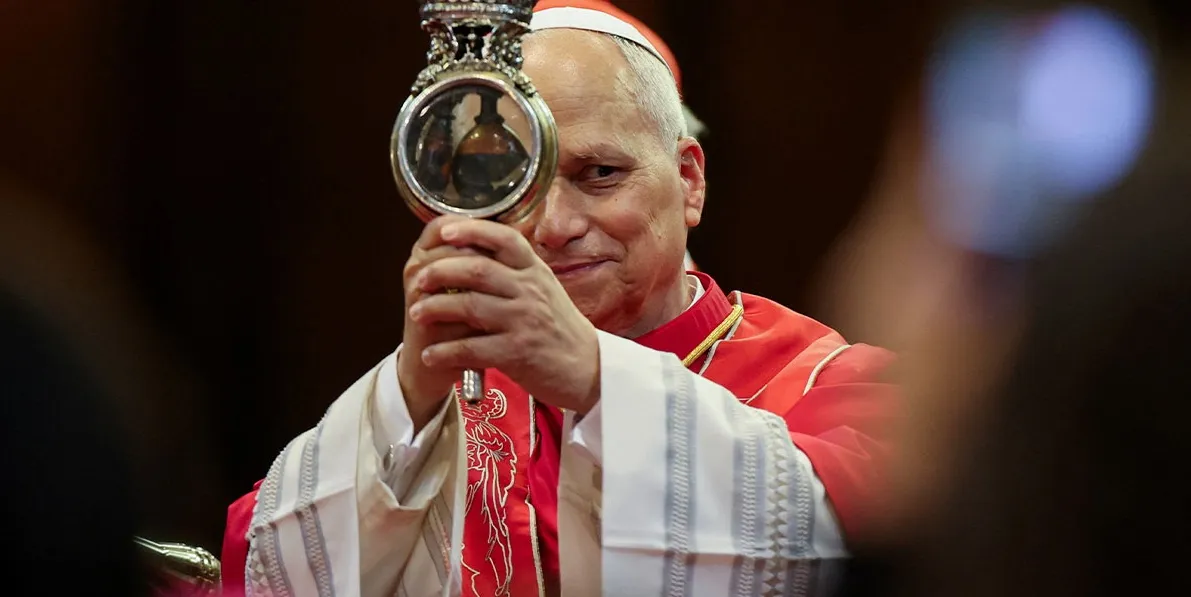
June 4, 2026
The Washington Stand
World News
Israel, Hezbollah, Pride Month, religious liberty, women's sports, and cultural identity continue dominating headlines across the United States and around the world. Through the analysis featured on Real Life Network and The Daniel Cohen Show, these stories are examined through a biblical worldview that seeks to understand not only what is happening, but why it matters. While these issues may appear unrelated at first glance, they reveal a common challenge facing both nations and individuals: the pressure to compromise truth for the sake of convenience, acceptance, or short-term peace.
Whether on the battlefield, in politics, or inside the church, the question remains the same. What happens when conviction gives way to compromise?
Israel's Security Cannot Depend on Empty Promises
Recent developments along Israel's northern border once again exposed the difficulty of making agreements with organizations that have repeatedly demonstrated hostility toward the Jewish state. Reports of ceasefire discussions involving Hezbollah and Lebanon were quickly overshadowed by renewed rocket and drone attacks into northern Israel.
For families living near the Lebanese border, these are not abstract geopolitical discussions. They are daily realities. Parents wake children in the middle of the night. Communities rush to bomb shelters. Soldiers continue serving in dangerous conditions while political leaders weigh competing pressures.
The challenge for Israel is unique.
Most nations can afford strategic mistakes. Israel often cannot.
The discussion surrounding negotiations with Iran raises similar concerns. For decades, Iranian leaders have used diplomacy, delay, and negotiations while continuing to support proxy groups throughout the region. The question is no longer whether Iran seeks regional influence. The question is whether Western leaders fully understand how long Iran is willing to wait to achieve its objectives.
Peace built on promises means little when one side continues preparing for conflict.
That reality explains why many Israelis remain skeptical whenever international pressure encourages concessions before long-term security concerns are addressed. History has taught painful lessons about trusting hostile actors who continue calling for Israel's destruction while negotiating publicly.
For more analysis of Israel, geopolitics, and current events through a biblical lens, viewers continue turning to Real Life Network and The Daniel Cohen Show.
When Institutions Stop Defending Truth
The pressure to compromise is not limited to foreign policy.
Across the Western world, institutions increasingly face demands to affirm ideas that directly conflict with biological reality, historic Christianity, and common sense. Pride Month once again highlighted these tensions as corporations, sports leagues, government officials, and even churches rushed to signal support for causes that many Christians believe contradict Scripture.
The issue is not whether churches should welcome people. They should. The gospel is for sinners. Churches should be filled with broken people seeking grace, forgiveness, healing, and transformation through Jesus Christ.
The problem emerges when welcoming people becomes indistinguishable from celebrating sin. A church exists to proclaim truth, not redefine it.
This concern became especially visible as some churches openly celebrated identities and lifestyles Scripture consistently identifies as sinful. In doing so, many critics argue these institutions have confused compassion with affirmation.
That distinction matters. A hospital welcomes sick people without celebrating disease. Likewise, churches should welcome everyone while remaining faithful to biblical truth.
The church serves people best when it refuses to compromise the truth that has the power to transform them.
This same tension extends beyond church walls. Professional sports leagues, entertainment companies, and major corporations increasingly adopt ideological positions that many Americans neither support nor recognize as representative of their values.
As cultural pressure grows, conviction becomes increasingly costly. That reality should not surprise believers. Scripture repeatedly warns that standing for truth often requires courage.
Fairness, Identity, and the Future of Cultural Leadership
Questions surrounding truth and reality have become especially visible in women's athletics.
The recent California state track championship reignited national debate after a biological male competing in the girls' division won multiple state titles. For many observers, the controversy was not complicated. It was a matter of fairness.
Young women trained, sacrificed, and competed only to find themselves competing against someone with significant biological advantages.
The response from state officials only intensified frustration. Rather than addressing the underlying issue, officials attempted to soften criticism through symbolic accommodations and shared podiums.
Yet symbols cannot resolve reality. Athletes understand competition. Parents understand competition. Most Americans understand competition. When fairness disappears, trust eventually follows.
A culture that refuses to acknowledge reality eventually loses the ability to pursue justice.
The broader challenge extends beyond sports. Questions surrounding identity, truth, biology, family, and morality increasingly shape political campaigns, educational institutions, and public life.
That is why states like Indiana and Tennessee have recently emphasized the importance of the nuclear family. These efforts reflect a growing recognition that healthy families remain foundational to healthy societies.
The cultural conversation is ultimately not about slogans or political branding. It is about whether truth remains objective or becomes subject to social pressure. The answer to that question will shape far more than public policy. It will shape the future.
The Hope of the Gospel
Political leaders will disappoint. Institutions will fail. Cultural movements will rise and fall.
Yet the deepest need of humanity remains unchanged.
Scripture teaches that all people have sinned and stand in need of reconciliation with God. No political movement, social cause, or cultural trend can solve that problem. That is why Jesus Christ came into the world. He lived the perfect life sinners could never live, died on the cross for sinners, and rose again from the grave.
Through repentance and faith in Christ, forgiveness, reconciliation, and eternal life are available to all who believe.
That hope remains greater than any headline.
For more biblically grounded reporting and analysis, visit Real Life Network and watch The Daniel Cohen Show.
Related Articles
25 min
Israel, Pride Month, and the Cost of Compromising Truth
.webp)
June 3, 2026
Daniel Cohen
Entertainment & Lifestyle
Three years ago, Real Life Network launched with a simple but important mission: to share biblical truth without compromise and help believers fast-forward their faith. What began as a vision for a trusted Christian streaming service has grown into a platform reaching viewers across the United States and around the world with Christ-centered content, biblical teaching, and faith-based programming.
Since its launch, Real Life Network has become a destination for believers seeking biblical truth in a culture often dominated by confusion and competing worldviews. Through Christian TV shows, sermons, documentaries, Bible studies, cultural commentary, and family-friendly programming, the network has remained committed to helping viewers engage the world through the lens of Scripture.
Over the past three years, God has used Real Life Network to expand its reach and impact in remarkable ways. Viewers have connected with trusted voices, compelling stories, and programs designed to strengthen faith and encourage spiritual growth. Whether through daily biblical teaching, Christian news analysis, or original programming, the mission has remained the same: proclaim the truth of God's Word and point people to Jesus Christ.
As many viewers search for reliable Christian media and uncensored news coverage rooted in a biblical worldview, Real Life Network has continued to provide content that addresses today's most important cultural, political, and spiritual issues without compromising biblical convictions. In an age of information overload, the network seeks to equip believers with wisdom, discernment, and confidence in God's truth.
This milestone is also an opportunity to celebrate God's faithfulness. Every viewer, supporter, ministry partner, and contributor has played a role in helping Real Life Network expand its influence and reach new audiences. Together, a growing community has helped make biblical content accessible to families, churches, and individuals seeking encouragement, truth, and hope.
As Real Life Network looks ahead, the mission continues. There are more people to reach, more stories to tell, and more opportunities to bring a biblical worldview into a culture searching for answers. The need for trusted Christian streaming services, biblical teaching, Christian TV shows, and faith-based media remains as important as ever.
The past three years have been a testimony to God's provision and faithfulness. The vision for the future remains clear: continue sharing truth, strengthening believers, delivering biblically grounded content, and pointing people to the hope found in Jesus Christ through Real Life Network.
Related Articles
- How Do Christian Streaming Platforms Reach Younger Generations? by Real Life Network
- How Does Streaming Faith-Based Content Strengthen My Faith by Real Life Network
- Best Faith-Based Documentaries to Watch for Free by Real Life Network
25 min
Celebrating Three Years of Real Life Network
June 3, 2026
Real Life Network
Entertainment & Lifestyle
Live streaming has become a major feature of modern media. From concerts and sporting events to interviews and breaking news, mainstream platforms have shown how powerful real-time viewing can be. That naturally leads many viewers to ask: Do Christian streaming platforms offer live events as well?
The answer is yes—though the purpose and approach often look different. Christian streaming platforms increasingly provide live access to sermons, conferences, special events, and timely discussions, giving believers opportunities to engage in real time rather than only on demand.
How Live Events Fit into Christian Streaming
Live events have long been part of church life. Worship services, evangelistic outreaches, conferences, and special gatherings have always carried a sense of immediacy and shared experience. Streaming technology simply extends that experience beyond physical walls.
Christian streaming platforms use live events to:
- Broadcast sermons and worship services
- Stream conferences and special teaching events
- Share timely conversations around cultural or global issues
- Connect viewers across locations at the same moment
While mainstream platforms often emphasize entertainment, Christian platforms focus on participation, learning, and spiritual encouragement.
What Kinds of Live Events Are Typically Offered
Christian streaming platforms tend to prioritize events that serve the Church and individual believers rather than one-time spectacles. These often include live broadcasts of:
- Weekend worship services
- Special sermon series launches
- Bible conferences and prophecy events
- Youth gatherings and leadership summits
- Live interviews or panel discussions
Some events are scheduled far in advance, while others respond to current events and pastoral needs. In both cases, the goal is to provide timely, relevant teaching rooted in Scripture.
How Live Christian Events Compare to Mainstream Streaming
The experience of watching a live event on a Christian platform is similar in function but different in focus. Like mainstream services, Christian platforms offer real-time access, interactive elements, and multi-device viewing. However, the emphasis is not on ratings or spectacle. Instead, live Christian streaming prioritizes:
- Biblical teaching over entertainment value
- Shared spiritual focus rather than viral moments
- Community engagement rather than passive viewing
- Encouragement and clarity rather than reaction
Many viewers find that this slower, more thoughtful approach helps them engage more deeply.
Why Live Events Matter for Faith
There is something uniquely impactful about knowing others are watching and learning at the same time. Live events help foster a sense of connection, even across distance.
For believers who:
- Cannot attend church in person
- Live far from strong teaching churches
- Want to participate in conferences they could never travel to
- Are seeking timely guidance during uncertain moments
Live streaming becomes a meaningful bridge rather than a replacement.
How Real Life Network Uses Live Events
Real Life Network regularly streams live events, sermons, and special programming to make biblical teaching accessible beyond physical locations. These live broadcasts often include:
- Church services
- Teaching events
- Conferences and special series
- Timely conversations addressing cultural or global developments
After the live broadcast ends, many of these events remain available on demand, allowing viewers to revisit teaching or catch up later. This combination of live access and ongoing availability gives viewers flexibility without losing the immediacy of the moment.
Live Events and the Church Connection
Christian streaming platforms are careful to emphasize that live-streamed events are not meant to replace involvement in a local church. Instead, they serve as an extension of teaching and encouragement.
Many churches use live streaming to:
- Reach homebound members
- Stay connected during travel or illness
- Share special events with a broader audience
- Invite people to explore faith in a lower-pressure setting
When paired with local fellowship and accountability, live streaming becomes a helpful support rather than a substitute.
Technology Has Lowered Barriers
One reason live Christian events are becoming more common is simple accessibility. Improvements in streaming technology mean that high-quality live broadcasts are now possible without massive production budgets. This has allowed:
- Smaller churches to reach wider audiences
- Conferences to stream globally
- Teaching to cross borders and time zones
Christian streaming platforms help centralize these efforts, making live events easier to find and watch.
What Viewers Should Expect Going Forward
As viewing habits continue to evolve, live Christian streaming is likely to grow—not by copying mainstream entertainment models, but by meeting spiritual needs more effectively. Viewers can expect:
- More live teaching opportunities
- Greater access to conferences and events
- Increased flexibility across devices
- A blend of live and on-demand content
This hybrid model reflects how people already engage with media today.
Christian streaming platforms do offer live events—and those events play an important role in teaching, encouragement, and connection. While the focus differs from mainstream platforms, the impact can be just as meaningful.
For believers seeking timely biblical teaching and shared spiritual experiences, live Christian streaming offers a valuable and growing resource.
Explore live and on-demand faith-based events anytime on Real Life Network.
Related Articles
- How Do Christian Streaming Platforms Reach Younger Generations? by Real Life Network
- How Does Streaming Faith-Based Content Strengthen My Faith by Real Life Network
- Best Faith-Based Documentaries to Watch for Free by Real Life Network
25 min
Do Christian Streaming Platforms Offer Live Events Like Mainstream Platforms?
June 2, 2026
Real Life Network
Entertainment & Lifestyle
Every generation faces cultural questions that test what it believes. Today’s conversations around identity, truth, justice, and morality are often complex, emotional, and fast-moving. For many believers, this raises an important question: How do Christian streaming platforms address tough cultural issues in a way that stays rooted in Scripture?
Faith-based platforms are not designed to ignore difficult topics. Instead, they aim to engage them carefully, anchoring conversations in biblical truth while encouraging wisdom, discernment, and clarity.
Starting With Scripture, Not Culture
One of the clearest differences in how Christian platforms approach cultural issues is where they begin. Rather than starting with trends, headlines, or popular opinion, they start with Scripture.
This foundation shapes the entire conversation. Instead of asking, “What does culture say about this?” the focus becomes, “What does God’s Word say?”
That shift matters. It keeps discussions grounded in something unchanging, even when the surrounding culture is constantly shifting.
Addressing Issues Without Avoiding Them
Avoiding difficult topics may feel easier, but it rarely helps believers grow. Christian streaming platforms increasingly recognize that people—especially younger audiences—are already encountering challenging ideas elsewhere.
Rather than staying silent, faith-based content often addresses topics such as:
- Identity and purpose
- Truth and morality
- Relationships and family
- Suffering and justice
- Cultural pressure and personal conviction
The goal is not to overwhelm or provoke, but to provide clarity where confusion often exists.
Focusing on Principles Rather Than Reactions
Cultural conversations can change quickly. What is debated today may look different tomorrow. That’s why Christian platforms tend to focus on biblical principles rather than reacting to every new development.
This approach emphasizes:
- Truth over trends
- Wisdom over immediacy
- Understanding over argument
- Long-term faithfulness over short-term reactions
By focusing on principles, viewers are better equipped to navigate future challenges—not just current ones.
Encouraging Discernment, Not Just Agreement
Another important aspect of biblical engagement is teaching discernment. Christian platforms are not simply aiming for viewers to agree with a position—they aim to help viewers think clearly.
This often includes:
- Explaining why certain beliefs align with Scripture
- Walking through difficult questions step by step
- Acknowledging complexity where it exists
- Encouraging personal study and reflection
Programs such as Bridge Bible Talk, Cure America with Star Parker, and teaching-based content like A Daily Walk often model this kind of thoughtful engagement, showing how to approach real issues without losing biblical grounding.
Maintaining a Tone of Clarity and Grace
One of the challenges in addressing cultural issues is tone. Conversations can quickly become harsh, reactive, or divisive. Christian streaming platforms typically aim for a different tone—one that reflects both truth and grace. This means:
- Speaking clearly without being combative
- Addressing issues directly without unnecessary harshness
- Recognizing the dignity of people, even in disagreement
- Keeping the focus on Christ rather than conflict
This tone helps viewers engage difficult topics without becoming discouraged or defensive.
Providing Context Through Teaching and Story
Not all learning happens through direct teaching. Many platforms also use stories, testimonies, and documentaries to explore cultural issues in a more personal and relatable way. These formats allow viewers to:
- See how faith is lived out in real situations
- Understand the human side of complex issues
- Reflect on how biblical truth applies in everyday life
This combination of teaching and storytelling helps move conversations from abstract ideas to practical understanding.
Supporting Conversations at Home and in Church
One of the most valuable roles Christian streaming platforms play is helping start conversations. Tough cultural issues are rarely resolved in a single viewing; they require discussion, reflection, and guidance.
Families and churches often use this content to:
- Introduce important topics in a structured way
- Create space for questions and dialogue
- Reinforce biblical teaching already being shared
- Encourage thoughtful, ongoing engagement
When used this way, streaming becomes a tool for discipleship rather than just information.
How Real Life Network Approaches Cultural Issues
Real Life Network offers a range of content that addresses cultural topics through a biblical lens while maintaining a steady, thoughtful tone. By combining teaching, discussion-based programming, and real-world insight, RLN helps viewers engage complex issues without losing sight of Scripture.
The platform’s focus is not on reacting to culture, but on equipping believers to understand it—and respond in a way that reflects truth, wisdom, and faith.
Cultural challenges are not new, but the pace and visibility of today’s issues make them feel more immediate than ever. Christian streaming platforms provide a way to engage these topics thoughtfully, with Scripture as the foundation and Christ as the focus.
Rather than avoiding difficult conversations, they offer a path forward—one rooted in truth, guided by wisdom, and shaped by grace.
Explore biblically grounded teaching and cultural insight anytime on Real Life Network.
Related Articles
- How Do Christian Streaming Platforms Reach Younger Generations? by Real Life Network
- How Does Streaming Faith-Based Content Strengthen My Faith by Real Life Network
- Best Faith-Based Documentaries to Watch for Free by Real Life Network
25 min
How Do Christian Platforms Address Tough Cultural Issues Biblically

May 31, 2026
Real Life Network
Business & Finance
America does not just have an economic crisis. We have a leadership crisis, a truth crisis, and in many ways, a spiritual crisis. Too many universities have abandoned biblical principles, embraced ideological agendas, and left students burdened with debt while stripping away faith, purpose, and common sense.
That is why my wife, Marnie Freeman, and I were so encouraged during our recent conversation with Claire Foster from Regent University. At a time when many institutions are losing their footing, Regent is doing the opposite, training students to become bold Christian leaders grounded in biblical truth, economic understanding, and servant leadership.
Watch this full episode on Pirate Money Radio, streaming now on the Real Life Network.
Why Christian Education Matters More Than Ever
One of the greatest blessings Marnie and I experienced as parents was watching our children graduate college while keeping both their faith and their values intact. That is becoming increasingly rare in America today.
Too many parents sacrifice financially to send their children to universities that openly undermine biblical truth and traditional values. Some schools that once began with Christian foundations, institutions like Harvard University and Yale University, have drifted so far from their origins that they now often work against the very principles they were founded to uphold.
Regent University was founded in 1977 by Pat Robertson with a very different mission: combining rigorous academics with unwavering biblical truth. According to Dr. Foster, the university’s vision is to develop Christian leaders who can influence every sphere of society — government, business, law, media, education, and beyond. That mission matters now more than ever.
Regent University Is Growing While Other Schools Decline
One of the most remarkable things about Regent is that it is thriving while many universities across America are struggling. Dr. Foster shared that Regent was recently ranked the number one Christian college in America and the number two military-friendly school in the nation. The university has doubled its student body during a period when many colleges are shrinking.
Why? Because families are searching for something deeper than credentials. They want truth, purpose, excellence, and leadership grounded in biblical values.
Regent’s emphasis on excellence, innovation, and integrity stood out immediately when Marnie and I visited the campus in Virginia Beach. The atmosphere felt different. Students were engaged, joyful, intelligent, and deeply rooted in faith.
The campus itself is beautiful, but what impressed us most was the spiritual foundation underneath it all. During chapel services, classroom discussions, and conversations with faculty, it became clear that Regent is intentionally discipling students — not simply preparing them for careers, but preparing them for life.
Watch this full episode on Pirate Money Radio, streaming now on the Real Life Network.
Why Biblical Principles Apply to Economics and Government
At Pirate Money Radio, we often say that God’s principles apply to every area of life, including money, economics, and government. Regent understands that reality.
During our conversation, Dr. Foster spoke about the importance of training leaders who understand biblical stewardship, honest weights and measures, and economic freedom. Those concepts are not separate from faith — they are deeply connected to it.
The Bible speaks extensively about debt, stewardship, honesty, generosity, and justice. Proverbs teaches wisdom about managing resources. Scripture warns about dishonest scales and reckless borrowing. These principles matter because economies rise or fall based on truth.
That is why I was especially encouraged to see Regent expanding its focus on economic education through the Robertson School of Government under the leadership of Michele Bachmann.
Too often, schools of government teach political power without teaching economic truth. Students graduate understanding bureaucracy but not liberty. They learn theories disconnected from biblical wisdom and real-world consequences. That must change.
The Economic War Room at Regent University
One of the greatest honors of my life recently came when Regent University awarded me an honorary Doctor of Science degree during a special ceremony attended by leaders including Ben Carson and Michele Bachmann.
But even more meaningful was Regent’s announcement that it is launching a dedicated Economic War Room within the Robertson School of Government. The purpose of this initiative is to train future leaders who understand economic sovereignty, monetary policy, freedom, and biblical principles. Students will learn how economics impacts liberty, national security, and the future of civilization itself.
This is critically important because economics is often the hidden battlefield behind nearly every major political conflict. Nations are enslaved by debt. Families are crushed by inflation. Governments manipulate currencies and expand control through monetary systems. Yet very few universities teach students how these systems truly work from a biblical worldview.
That is exactly what Regent intends to do.
As Dr. Foster explained, the goal is not simply to preserve ideas from the past. It is to equip the next generation of Christian leaders to defend freedom and apply biblical truth in the real world.
Watch this full episode on Pirate Money Radio, streaming now on the Real Life Network.
America Needs a Great Awakening Again
During the conversation, I shared the story of Benjamin Franklin and the transformation that occurred during America’s founding era. Franklin originally believed human wisdom alone could build a successful society. But after hearing the preaching of George Whitefield during the Great Awakening, Franklin began recognizing the necessity of God’s guidance in government and public life.
That spiritual awakening shaped America’s founding principles in profound ways. Today, America desperately needs another awakening, not merely political reform, but moral and spiritual renewal grounded in biblical truth.
That is why institutions like Regent matter so much. They are preparing students not simply to succeed financially, but to become principled leaders who can strengthen families, communities, churches, businesses, and government.
The Next Generation Gives Me Hope
One of the most encouraging parts of our conversation was hearing Dr. Foster describe what she sees in today’s students.
Despite being raised in a digital culture filled with confusion and distraction, many young people are hungry for truth, meaning, and authenticity. They are searching for something deeper than social media, political activism, or empty ideology. At Regent, students are encountering biblical truth in a way that is transforming their lives.
That gives me hope. America’s future will not be restored through politics alone. It will be restored by raising up men and women who understand God’s truth, apply biblical wisdom, and courageously lead in every sphere of society. That is exactly what Regent University is doing.
Stream Pirate Money Radio on the Real Life Network.
Related Articles
- Biblical Worldview vs Modern Marxism by Kevin Freeman
- A Christian Understanding of Economics by Kevin Freeman
- Biblical Money vs. Modern Currency: What the Bible Really Says by Kevin Freeman
25 min
Equipping GenZ with Excellence

May 30, 2026
Kevin Freeman
World News
Only days after U.S. President Donald Trump left a Beijing summit with CCP Chairman Xi Jinping, where religious freedom and jailed religious leaders were discussed, authorities in eastern China demolished a prominent church, razing the building with large excavators last week. Yazhong Church (also referred to as Yayang Church), an unregistered Protestant church in Wenzhou, Zhejiang Province — a region known as “China’s Jerusalem” — has been under siege since late last year.
On December 14 and 15, local authorities arrested 103 church members in a pre-dawn raid and took control of the church building, as confirmed last week in new reporting by Le Monde. That same week, at a public event, an unidentified government official announced: “We will see this campaign through to the end.”
Five months later, on Sunday, May 17, heavy construction vehicles passed through tightly controlled security checkpoints set up by authorities, according to multiple sources confirmed by ChinaAid News. On May 18, crews began to demolish the multi-level structure from the top down. By 11 a.m. Beijing Time on Tuesday, May 19, the beautiful and ornate sanctuary had been reduced to rubble.
Concurrently with the demolition, authorities arrested four additional church members, one identified as You Ci’en, according to local sources, cited anonymously to protect their safety. They join 18 other members of Yazhong Church previously jailed by the Chinese Communist Party (CCP) authorities.
The families of all detained individuals reportedly received official warnings instructing them to remain silent, sources familiar with the situation stated to ChinaAid News. Authorities reportedly imposed strict information controls ahead of the demolition, measures that sources said appeared intended to limit public scrutiny.
Multiple confidential sources said the area surrounding the church had been placed under lockdown in recent weeks, while checkpoints and guard posts were established roughly one kilometer from the site to prevent unauthorized access. The church cross was also covered with black cloth prior to the demolition.
Wenzhou has been called “China’s Jerusalem” due to its large Christian population. The destruction of Yazhong Church escalates a broader suppression campaign in Taishun County, documented over months by ChinaAid News.
The campaign has included continuous surveillance, stringent information controls, and the closure of businesses linked to alleged church members.
“My brothers and sisters in the faith have stood strong for so long,” said Bob Fu, president of Texas-based nonprofit group ChinaAid and a senior fellow at Family Research Council. “More so than the loss of a church building, I lament how the CCP has cracked down on this area known for its faithful Christians and oppressed them more and more day by day.”
He added, “These recent actions show that the persecution of Christians by Chinese authorities has intensified, becoming more institutionalized and targeted.”
Church Resisted Order to Display Chinese flag
The conflict originated from the church’s resistance to what congregants perceived as increasingly aggressive methods of religious repression imposed by local Chinese Communist Party authorities.
Yazhong Church is affiliated with the “Local Church” movement (also known as the “Assembly” movement), a faith tradition that traces its origins to the early 21st-century Chinese preacher Watchman Nee and shares historical roots with the British Closed Brethren movement.
Due to its location in the remote mountainous region of southern Zhejiang, the church has maintained the independent traditions characteristic of Wenzhou’s local churches and has historically kept a distance from local government authorities.
According to congregants, tensions escalated significantly during the previous summer. The immediate catalyst was a government directive requiring the Chinese national flag to be displayed inside the sanctuary and a flagpole erected on church grounds, which believers regarded as an infringement on the sanctity of their faith.
Subsequently, in June 2025, government personnel entered the church property by force, demolished part of the outer wall, and installed the flagpole, prompting collective protests and sparking a standoff between the church and the authorities.
Analysts who closely monitor religious freedom in China note that Wenzhou has been among the most aggressive regions in implementing religious policies over the past decade. Only churches affiliated with the state-controlled Three-Self Patriotic Movement are officially sanctioned.
“Any Christian church unwilling to submit to state power — even this one, without any political involvement — the Chinese Communist Party feels it has to silence and even destroy,” said Fu.
Pre-Christmas ‘Inspection’ Led to Mass Church Detentions
Chinese authorities planned the operation against Yazhong Church several months in advance, as previously reported by ChinaAid News.
On December 14 and 15, 2025, Zhejiang authorities deployed large numbers of special police and riot-control officers to Yayang Town, conducting coordinated “inspection operations” at 12 local church gathering sites.
During the operation targeting Yazhong Church, more than 100 believers were dispersed and temporarily detained.
As the government’s campaign intensified, the scope of detentions broadened. To date, 22 believers, including church leaders Lin Enzhao and Lin Enci, have been subjected to long-term criminal detention, according to multiple sources.
Authorities charged them with the ambiguous offense of “picking quarrels and provoking trouble,” a broad public-order offense frequently used against activists and religious groups.
However, sources note that four church members were recently released on bail pending trial.
Last week, French media outlet Le Monde continued its reporting on believers in Yayang last week with a video detailing new developments following an extensive January investigation.
‘Our Prayers Are Not Reduced to Rubble’
Despite ongoing international scrutiny, local authorities’ demolition of Yazhong Church reflects continuing tensions between Beijing and independent Christian communities across China. Observers have compared the incident to the 2014 demolition of Sanjiang Church in Wenzhou, which drew international attention. In this recent case, sources said authorities imposed a near-total ‘information vacuum’ before demolition crews arrived.
Law enforcement personnel at the scene reportedly imposed strict monitoring of electronic devices. Individuals attempting to take photographs or record video with mobile phones were immediately intercepted, expelled, or detained, sources tell ChinaAid News.
Human rights advocacy groups state that the authorities’ severe restrictions on online discussion and information dissemination highlight the sensitivity of such actions.
One analyst, granted anonymity for his safety, asked: “If the demolition was entirely lawful and proper, why would authorities go to such extraordinary lengths to impose a total information blackout?”
As of publication, neither the Wenzhou municipal government nor the Taishun County Public Security Bureau had issued a statement.
Sources indicated that local police continue to conduct sporadic arrests and interrogations targeting believers involved in the incident or those attempting to speak publicly about it.
“Our sources confirm that this beautiful and sacred place of worship has been destroyed — but our prayers are not reduced to rubble,” insisted Fu. “May this loss wake up the global church to what’s happening in China, a great conflict between faithful believers and state power.
This article was originally written by Goa Zhensai and published on The Washington Stand. For more content like this, visit Real Life Network.
25 min
Prominent Church in East China Demolished amid Escalating Crackdown
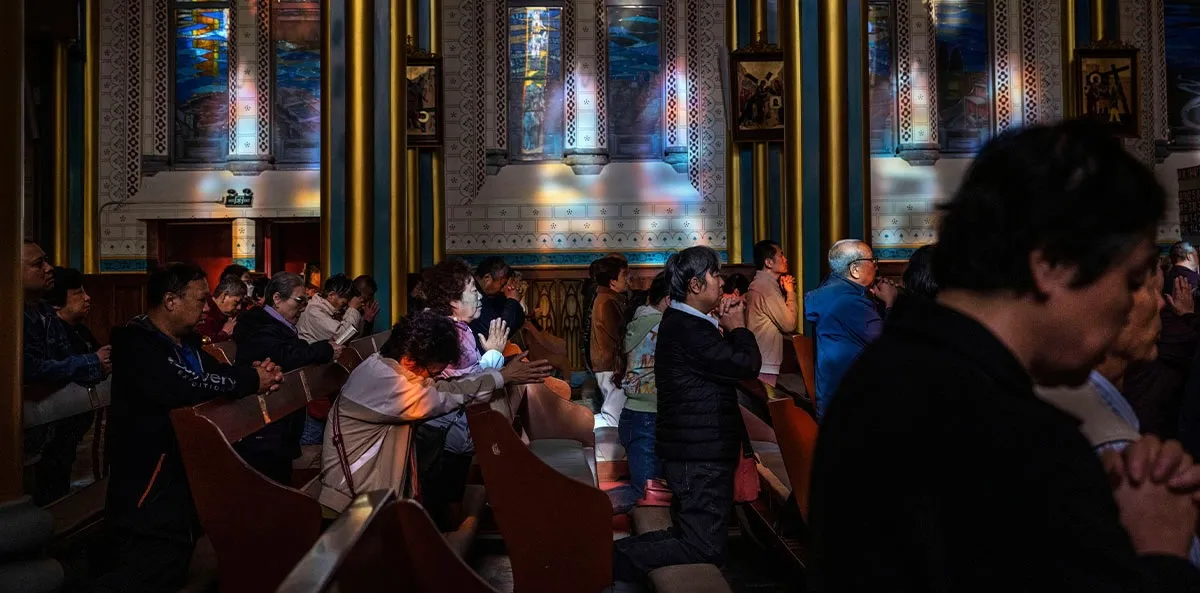
May 25, 2026
The Washington Stand
World News
In today’s online news, politics, and Christian streaming environment, the battles over election integrity, anti-Semitism, radical Islam, media manipulation, and the future of Western civilization are intensifying at an extraordinary pace. On Real Life Network and through The Daniel Cohen Show, viewers are engaging with analysis that cuts through political branding and legacy media narratives to examine what is actually happening beneath the surface. From Republican voters removing establishment politicians like Bill Cassidy to rising unrest in London, from anti-Semitic intimidation in New York City to Hamas propaganda campaigns shaping Western media coverage, these stories are not disconnected. They reveal a deeper struggle over truth, national identity, and the survival of the values that built the West.
The divide is no longer hidden.
It is unfolding in public for the entire world to see.
Election Integrity, Republican Revolt, and the End of the Rhino Era
The latest Republican primaries revealed something many establishment figures still refuse to acknowledge. Conservative voters are increasingly unwilling to tolerate politicians they believe abandoned the movement that elected them in the first place.
Louisiana Senator Bill Cassidy’s collapse in the Republican primary became one of the clearest examples yet. After voting with Democrats during President Trump’s second impeachment, Cassidy attempted to defend his decision as accountability and principle. Republican voters saw it differently.
They saw betrayal.
The result was historic. Cassidy not only lost support. He failed to even make the runoff election in his own state.
When political leaders repeatedly ignore the priorities of their own voters, those voters eventually remove them from power.
At the same time, Kentucky Congressman Thomas Massie now faces growing political backlash as conservatives accuse him of repeatedly obstructing key Republican priorities involving taxes, border security, Israel, and election integrity.
The frustration is broader than any single politician.
Many conservative voters increasingly believe portions of the Republican establishment have become more interested in media approval and institutional acceptance than actually advancing conservative policy goals. That frustration explains the growing support for legislation like the Save America Act, which would require proof of citizenship in federal elections.
For many voters, the issue is not controversial.
It is common sense.
The same frustration also explains why outsider voices and alternative media platforms continue gaining influence while trust in legacy institutions keeps collapsing.
For more biblically grounded reporting on politics, Israel, and culture, continue watching on Real Life Network and The Daniel Cohen Show.
Radical Islam, Anti-Semitism, and the Warnings Coming from Europe
At the same time, events unfolding in New York City and across the United Kingdom are raising major concerns about anti-Semitism, radical Islam, and the long-term consequences of failed immigration and assimilation policies.
One particularly disturbing example involved groups of Muslim men gathering directly outside an all-girls Jewish school in New York City during Friday prayers. The issue was not prayer itself. The issue was location and intent.
Why there?
Why directly outside a Jewish girls’ school?
For many Jewish families, the message felt unmistakable.
A society that refuses to confront intimidation eventually empowers the people carrying it out.
Meanwhile, similar tensions are rapidly escalating in London and other major European cities. Massive demonstrations across the UK protesting immigration policies, Islamist influence, and rising crime reflected a growing belief among ordinary citizens that political leaders no longer represent their interests.
These were not fringe activists.
They were working families, longtime residents, and ordinary citizens saying they no longer recognize their own country.
That concern intensified further as Islamist counter-protesters openly declared, “These streets are ours,” during demonstrations in London. Critics argue statements like that reveal a deeper ideological conflict unfolding across portions of Europe.
At the same time, British authorities continue aggressively policing speech involving Christianity, nationalism, and criticism of Islam while appearing far less aggressive toward radical Islamist activism itself.
That double standard has become impossible for many citizens to ignore.
Stay connected to biblically grounded analysis through Real Life Network and The Daniel Cohen Show.
Gaza Propaganda, Media Manipulation, and the Fight Over Truth
Beyond political unrest, the information war surrounding Israel and Gaza continues reshaping public perception across the West. Viral images, emotionally charged videos, and carefully crafted narratives now dominate social media platforms at extraordinary speed.
But increasingly, many of those images are being exposed as manipulated or staged.
One widely circulated photograph portraying a starving Palestinian child standing amid destruction was later revealed to involve carefully staged production techniques, including smoke effects, wind machines, and orchestrated camera positioning.
The image spread globally before questions were ever asked.
In the modern information war, emotional imagery often spreads faster than verified truth.
This pattern extends far beyond a single photograph.
Repeated examples of staged videos, recycled footage, choreographed hospital scenes, and manipulated casualty narratives have fueled growing skepticism toward media coverage surrounding Gaza. Critics argue many major outlets continue repeating Hamas-provided information with minimal scrutiny while applying intense skepticism toward Israel.
At the same time, Hamas continues openly indoctrinating children, rebuilding military infrastructure, and refusing meaningful demilitarization. Video footage showing children carrying rifles alongside terrorists only reinforced Israeli concerns that the conflict is far from over.
For Israel, this is not theoretical.
It is existential.
Meanwhile, the Justice Department’s decision to pursue the death penalty against Elias Rodriguez, the man accused of murdering Israeli embassy staffers Yaron Lischinsky and Sarah Milgrim in Washington, D.C., underscored the deadly consequences of radicalized anti-Semitism spreading across portions of the West.
Political violence fueled by ideological hatred is no longer happening only overseas.
It is happening here.
In a time when election integrity, anti-Semitism, media propaganda, and national identity are all colliding simultaneously, discernment matters more than ever. These debates are not isolated headlines. They reflect a broader struggle over truth, leadership, and the future direction of Western civilization.
Understanding that struggle requires more than outrage or political branding.
It requires wisdom grounded in truth.
For more biblically grounded reporting connecting current events to a biblical worldview, visit Real Life Network and watch The Daniel Cohen Show.
Related Articles
25 min
Election Integrity, Radical Islam, and the Growing Revolt Against the Political Establishment
%20Medium.avif)
May 20, 2026
Daniel Cohen
World News
In today’s online news, Christian streaming, and political media environment, the battle over truth, Israel, anti-Semitism, and cultural identity is intensifying across the United States and the Middle East. On Real Life Network and through The Daniel Cohen Show, viewers are confronting stories the legacy media increasingly avoids. From the newly released October 7 atrocity report and rising anti-Semitic unrest in New York City to debates over election integrity, media bias, and cultural decline in California, these headlines reveal a broader struggle over truth, morality, and the future direction of the West.
The deeper issue is no longer simply political.
It is spiritual, cultural, and civilizational.
October 7, Hamas Atrocities, and the Media’s Silence
The release of the most comprehensive report yet detailing Hamas atrocities on October 7 exposed horrifying acts of brutality committed against Israeli civilians. The report included survivor testimonies, forensic evidence, photographs, video documentation, and firsthand accounts from emergency responders.
The details are difficult to process.
Yet many major media organizations largely ignored the findings altogether.
That silence has become part of the story itself.
When evil becomes politically inconvenient, many institutions would rather suppress the truth than confront it honestly.
For many Israelis, October 7 was not merely a terrorist attack. It was a national trauma that fundamentally reshaped how the country views security, survival, and the surrounding region.
The atrocities committed that day shattered any illusion that Hamas represents a conventional political movement. The attack targeted civilians, families, children, Holocaust survivors, and entire communities with extraordinary cruelty.
At the same time, anti-Israel activism across universities and social media continues framing Israel as the aggressor while minimizing or excusing the violence carried out by Hamas.
That contradiction has become increasingly difficult to ignore.
The same activists who often speak passionately about human rights, women’s rights, and justice have remained largely silent regarding documented atrocities committed against Israeli civilians.
For more biblically grounded reporting on Israel, culture, and current events, continue watching on Real Life Network and The Daniel Cohen Show.
Media Narratives, Anti-Semitism, and America’s Cultural Divide
At the same time, growing anti-Semitic demonstrations across American cities are revealing deeper cultural fractures within the United States. Violent clashes surrounding pro-Hamas demonstrations in New York City, including unrest near Orthodox Jewish neighborhoods, highlighted how rapidly tensions are escalating.
For many Jewish Americans, the fear feels increasingly personal.
A society that excuses hatred against Jews eventually normalizes hatred against everyone else who stands for biblical truth.
That concern extends beyond isolated protests.
The broader issue involves how media narratives shape public perception. Critics increasingly argue that major outlets selectively amplify stories that damage Israel while minimizing evidence that challenges anti-Israel activism.
The controversy surrounding major outlets publishing questionable claims against Israel while overlooking extensive evidence of Hamas brutality only intensified those concerns.
At the same time, social media platforms remain central battlegrounds in the fight over information, propaganda, and censorship. Elon Musk’s comments regarding online censorship and the ideological influence shaping major technology platforms reflect growing public distrust toward legacy media institutions.
Many Americans increasingly feel they are not simply receiving news coverage.
They are receiving narrative management.
That distrust continues fueling the rise of alternative media, independent journalism, and platforms willing to challenge institutional narratives surrounding Israel, faith, politics, and culture.
Stay connected to biblically grounded analysis through Real Life Network and The Daniel Cohen Show.
Political Accountability, Cultural Decline, and the Future of the West
Beyond the Middle East conflict, broader concerns surrounding political accountability, urban decline, and election integrity continue shaping American politics. Cities like Los Angeles, New York, and San Francisco increasingly symbolize larger debates surrounding crime, homelessness, government spending, and cultural priorities.
The contrast between red and blue states continues widening.
Major corporations like Goldman Sachs shifting major operations away from New York reflect growing concerns surrounding taxation, public safety, governance, and long-term economic stability.
At the same time, debates surrounding voter ID laws and election integrity remain deeply polarizing. Many Americans view requiring proof of citizenship to vote as common sense, while critics frame those efforts as restrictive or discriminatory.
The broader frustration centers on accountability.
Citizens lose confidence in institutions when leaders appear unwilling to defend borders, enforce laws, or apply standards consistently.
That same frustration also explains the growing appeal of outsider political figures and alternative media voices willing to confront issues many voters believe establishment leaders ignore.
Meanwhile, California continues serving as a warning sign for many conservatives concerned about unchecked progressive governance. Rising homelessness, drug addiction, infrastructure failures, and controversial spending priorities continue fueling dissatisfaction among residents and businesses alike.
The political divide is no longer theoretical.
It is increasingly visible in everyday life.
In a time when truth itself is constantly contested, discernment matters more than ever. The battles surrounding Israel, anti-Semitism, censorship, election integrity, and cultural identity are not disconnected headlines. They reflect a broader struggle over morality, leadership, and the future direction of Western civilization.
Understanding that struggle requires more than political loyalty or outrage.
It requires wisdom grounded in truth.
For more biblically grounded reporting connecting current events to a biblical worldview, visit Real Life Network and watch The Daniel Cohen Show.
Related Articles
25 min
October 7, Media Silence, and the Rising Tide of Anti-Semitism in America
.webp)
May 15, 2026
Daniel Cohen
Faith & Culture
Fifty-four-year-old former Nebraska senator, husband, and father of three, Ben Sasse, was tragically diagnosed only six months ago with stage 4 pancreatic cancer and told he had three to four months to live. While the clinical trial that his doctors put him on has given him more time on earth than doctors predicted, the cancer has sadly continued to spread to his liver, lymph nodes, lung, and vascular system.
Each day that he lives is a miracle. Knowing this has caused Sasse to focus on what is truly important, and he has graciously shared his wisdom in several interviews recently. The following are five insights that we would all be wise to listen to and reflect upon.
1. Spend More Time with Family, Including Extended Family
In a recent extended interview on “60 Minutes,” Scott Pelley asked Sasse, “If you had another 30 years, what would your priority be?”
Sasse reflected, “I wish we’d had more babies. We have three great kids. I wish we had four or five. If I had 30 years left from now, I’d be working hard to take my zealous achiever daughters and try to figure out how you build something that’s a little bit like a family compound. How do you build something where you can have different generations come and go from it and have a thickness and a support system? How could you spend more time around your cousins or build the opportunity for your kids and your grandkids to spend more time around their cousins?”
He went on to share his regret of having a period where he spent too much time working and not enough time with his family: “I would travel a little bit less for work. … I spent way too many nights in hotel rooms. And I don’t know if my family even knows this, but I never really threw away any of my hotel keys. I’d come back from every trip, and I threw them in a box in a closet in my office, and there are thousands and thousands of hotel room keys, and sometimes I just look at it and feel a heaviness of regret. I would make better decisions about that.”
Later in the interview, Sasse expressed how tragic it is that people around the world have stopped having babies. He explained, “Having a baby is a bet on the future. And almost everywhere in the world — and the world is richer and richer and richer statistically than it’s ever been — people have decided, ‘Ah, actually babies are kind of an inconvenience.’ Babies have always been an inconvenience and the most glorious thing you can do to enrich your family and to make a bet on the future. … We’ve stopped making babies. We’ve decided that being distracted by a dopamine hit around a Candy Crush might be a good way to spend your time. Not if you’re fully human.”
2. Observe the Sabbath: Instead of Trying to Be Self-Sufficient, Rest in Almighty God
Similar to fellow Christian Charlie Kirk, Sasse sees the importance of following God’s Fourth Commandment to remember the Sabbath day and keep it holy. In an interview with Focus on the Family President Jim Daly, he shared:
“I have repented to my family. It started before this diagnosis, but we’ve talked about it a lot more intentionally since then. I have repented to my family about not having been a good leader about the Lord’s day. We never missed Sunday morning worship, but often by [2:00 or 3:00] in the afternoon, our hearts and affections and attentions were getting on to all the achievements we had to do, starting Monday morning and all the work we needed to do. And a lot of that work is important and meaningful, but man, the feast day of the soul is more important than I gave it attention to. And I now want my kids to view the glory of not needing to strive from Saturday night to Sunday night as an unbelievable blessing that we get to rest.
“Martin Luther’s great ‘A Mighty Fortress’ is based on Psalm 46, and if you read Psalm 46, there’s pretty obviously three movements. There’s you don’t have to fear anything. You’re going to be fine. God’s got this. And then this command: ‘Be still.’ It means stop trying to be self-sufficient. You get to be a child of the eternal king. And every Sunday, we can live that. I didn’t do that enough.”
Similarly, when Daly asked Sasse what advice he would give dads, he reiterated the importance of family worship time on the Sabbath:
“Let’s be humble with our kids and say … it’s glorious to get to reflect on the things of the Lord. What can we read together as a family this Sunday? How can we lock up our phones? How can we set aside time on the Lord’s Day to just linger and reflect back on the sermon, not have to get out of church the second it’s over, but go find the folks who are in need there or the visitors there. But I’d say two of the most practical operationalizable ones for us: we lock up our phones most of Sunday and we read aloud together a lot.”
3. Help Government Restrain Evil and Protect Freedoms
During CBS News’s “Things That Matter” townhall, a member of the audience asked Sasse how a Christian’s faith should impact his politics. He responded by emphasizing that Christians should seek to maintain order through government, not try to force religion on citizens. He explained:
“The secular sphere is still God’s space and God’s sphere, but it’s a question of whether or not explicit revealed theology is guiding our government. And I think that the purposes of government are to maintain order. It’s not to be theologically precise or accurate about what anybody should believe. The First Amendment is the most glorious inheritance anybody’s ever gotten in the history of government. Government is not the most important thing in the world, but it is glorious that our First Amendment has freedom of religion, speech, press, assembly, protest or redress of grievances. But that means that what I want government to do is create a space that is free from violence.
“So people can worship as they see fit, whether I agree with them or disagree with them. As a neighbor, I might want to wrestle with theology with somebody, but I don’t want to use the state to accomplish theological ends. I want to maintain order for a secular sphere that is free from violence.
“So I don’t subscribe to views of geopolitics as God is accomplishing a precise thing in those places. I think our servant leaders are responsible for using their time in office to try to minimize violence, maximize order [and] human liberty. In my view, the future of geopolitics 10 or 40 years from now is going to be more U.S.-led or more Chinese Communist Party-led, and I would rather have open navigation of the seaways, freedom of religion, human rights, commerce, trade, transparent contracts. And so, I would rather have there be more U.S.-led freedoms for the world — but not because the U.S. is an eternal entity. The U.S. is just the best experiment in government we’ve ever known. But governments are going to pass away ultimately. At the end of days, when we all wrestle through and with the questions around our own mortality, there will be no more tears, there will be no more cancer, there will also be no more government. Government is a tool. It’s a really important tool, but it’s a time-limited tool.”
In his interview with Daly, he explained, “Government is about restraining evil. It’s not about the glory of what happens at worship. It’s not about the warmth around your dinner table where you’re telling your kids how much you love them and asking them about their day. Government is just about a framework for ordered liberty. And so our passions [have to] hold moderately to certain institutions like government because they’re important, but they’re passing away.”
4. Community Is Essential: Escape Social Media Echo Chambers and Learn from Others
Sasse believes that how society handles the current communication revolution (especially social media and AI) is crucial, telling Daly, “I think a hundred years from now, if the Lord hasn’t returned yet, when we look back on this moment, we’re not going to talk very much about public policy. We’re going to talk about the fact that social media created a completely different kind of information ecosystem. And there [are] these grand temptations to steal our attention all the time. We know that only about 12% of Americans will read a book this year.”
Sasse told Pelley, “We’re living through a technological revolution which is creating an economic revolution. Let’s be clear, we’re the rich middle-class median. Americans are the richest people any time and place in all of human history. And yet, the economic revolutions that we’re living through are unsettling culture and place,” he pointed out. “And so people are incredibly rich at a material level statistically. And yet we’re pretty impoverished spiritually and communally in that we don’t have fit community. We don’t know our cousins. We don’t know the people who live two doors away from us. And we don’t feel like we’re in a common cause with people right now. And politics wants to trivialize that by screaming there’s some bad political actor somewhere. And if only that person were ripped out of the public square, politicians could fix all this. No, neighbors are going to have to fix this.”
He went on to say, “I do think social media is one of the fundamental problems that we’re dealing with right now. Right now, almost all politicians’ impulses and incentives … is to go narrow but deep and to do a lot of fan service. It doesn’t encourage a lot of self-scrutiny. It doesn’t encourage a lot of humility. It doesn’t encourage someone saying, ‘You know what, I used to believe this, but I listened to somebody else, and I realized I was wrong, and I’ve learned this new thing. There’s no audience for that. You want to just say more of, ‘We’re definitely right, and they’re definitely wrong.’ And that tribalism makes us pretty stupid.”
He continued, “One of the glorious things about the American experiment is believing in souls that can do deferred gratification. We can do deliberation that says, ‘Maybe I don’t have all the answers right now at my fingertips, and maybe the glories of a big and diverse creation is I can learn a lot from my neighbors.’”
5. Put Your Trust in Sovereign God, the Source of Peace
In the “60 Minutes” interview, Pelley observed, “You are completely devoted to your faith: what’s known as Reformed Christianity or Calvinism. And one of the tenets of that faith is that God ordains everything. And I wonder why you think God has put you to this test?”
Sasse answered, “Death is wicked. Death is evil. Death is not how it’s supposed to be. And me getting a cancer diagnosis again is pretty small on the grand scheme of things, but it’s a touch of grace because it forces me to tell the truth. And the lie I want to tell myself is that I’m the center of everything, and I’m going to be around forever, and I can work harder and store up enough that I can atone for my own brokenness. I can’t. And so, I hate cancer, but I’m also grateful for it. I tell a lot more truth to myself than I used to … when I thought I was super omnipotent and interesting.”
The most emotional and inspirational part of these interviews came at the end of this conversation. Everyone should listen and learn from this man of deep Christian faith.
Pelley, on the verge of tears, managed to say, “I make no comparison to what you’re going through, but there was a moment on 9/11 at the World Trade Center that I knew I was dead. And in that lightning flash of an instant, the only thing that crossed my mind was leaving my family behind. And I wonder how you reconcile that.”
Sasse responded, “Yeah … I’m incredibly blessed. My wife Melissa … we’ve been married 31 years. …We’re going to be apart for a time. But she’s tough and gritty and theologically rooted, and she’s going to be fine. My daughters are 24 and 22, and they’re extraordinary. I want to walk them down the aisle when they get married,” he paused, getting emotional. “That’s not likely to be. That’s not the math of my timecard. My son, we have a providential surprise. He’s a decade younger than big sisters. He’s … going to be fine, and he’ll have other wise men and women to put a hand on his shoulder. But I’m super bummed to not be there at 16 and 18 and 20 years old in his life. I want to give him more advice than he wants, and I want to put my arm on his shoulder, and I want his shoulders to get taller. But it’s not a surprise to God.”
Pelley noted, “And God, you believe, has a plan.”
Sasse, without hesitation, answered, “Absolutely. There are no maverick molecules in the universe.”
This article was written by Kathy Athearn and originally published at The Washington Stand. For more content like this, visit Real Life Network.
25 min
5 Insights from Ben Sasse as He Faces His Last Days on Earth
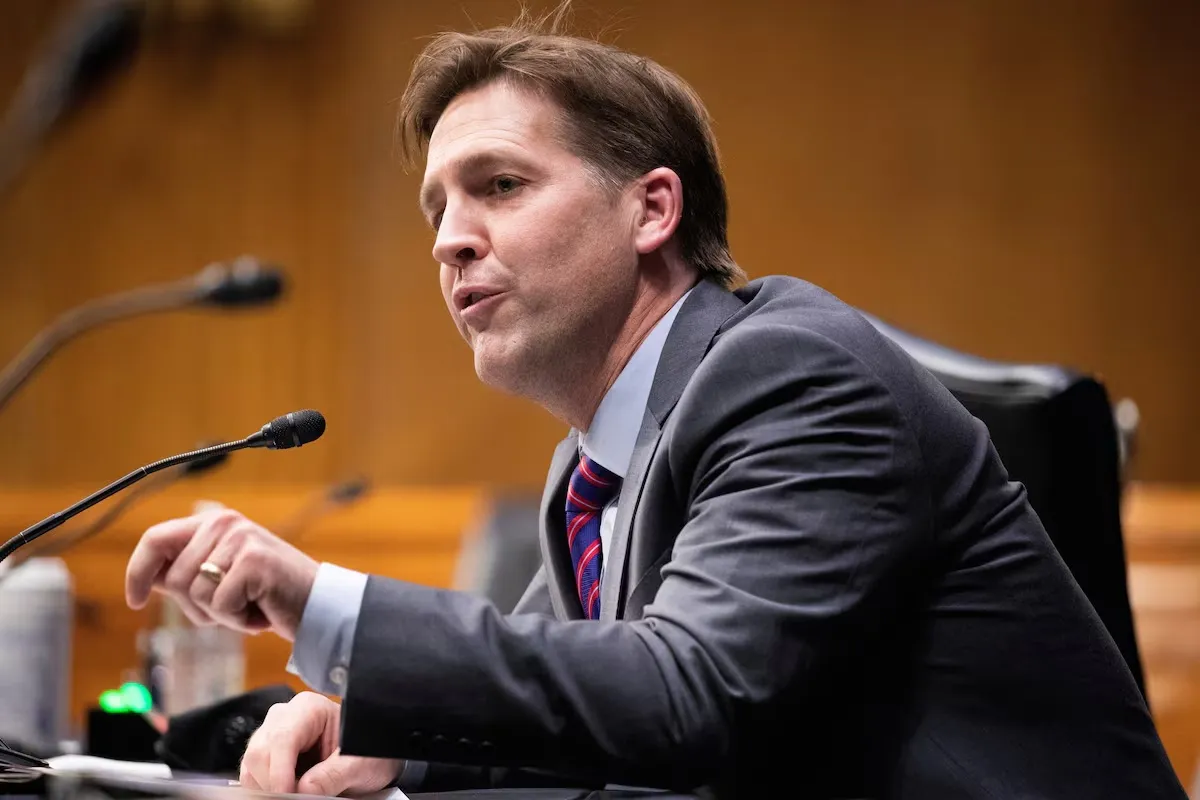
May 8, 2026
The Washington Stand
World News
In today’s online news, politics, and Christian streaming landscape, the connection between anti-Christian bias, political violence, Israel, and cultural truth is becoming increasingly clear. On Real Life Network and through The Daniel Cohen Show, viewers are engaging with reporting that cuts through media narratives to examine the deeper issues shaping America and the Middle East. From the Biden administration’s documented treatment of Christians to escalating political violence, from biblical ignorance surrounding Israel to the growing conflict with Iran, these stories are not isolated. They reveal a deeper spiritual and cultural battle that requires discernment grounded in a biblical worldview.
This is not simply about politics. It is about truth, power, and the direction of a civilization.
When Government Power Turns Against Faith
The recently released report from the Task Force to Eradicate Anti-Christian Bias paints a troubling picture. According to the findings, federal agencies across the Biden administration engaged in a pattern of hostility toward Christians and traditional religious beliefs. The report includes more than 1,000 footnotes, hundreds of pages of exhibits, and reviews spanning multiple federal agencies.
The allegations are serious.
Investigations into traditional Catholics, leaked communications from federal prosecutors mocking religious believers, and legal pressure placed on Christian institutions all point to something broader than isolated misconduct. They suggest a culture within parts of government that viewed biblical conviction not merely as disagreement, but as a threat.
When government power is used to punish conviction rather than protect liberty, the issue becomes far bigger than politics.
This concern becomes even more significant when combined with broader cultural messaging. The same political and entertainment figures who lecture Americans about morality and tolerance often openly ridicule biblical Christianity while promoting ideologies directly opposed to it.
That contrast matters.
A civilization that loses respect for faith does not become neutral. It increasingly becomes hostile toward those who continue to hold biblical convictions.
For more biblically grounded analysis of culture, politics, and Israel, continue watching on Real Life Network and The Daniel Cohen Show.
Israel, Biblical Truth, and the Rise of Confusion
At the same time, confusion surrounding Israel and the Bible continues to grow. Influencers and commentators with large audiences increasingly promote narratives that distort both history and Scripture.
One of the clearest examples is the repeated claim that “the Jews killed Jesus,” a statement that ignores the plain teaching of Scripture itself. Jesus said in John 10:18, “No one takes my life from me, but I lay it down of myself.” The crucifixion was not an accident of history. It was the fulfillment of God’s redemptive plan.
Biblical ignorance becomes dangerous when it is presented confidently to millions of people searching for truth.
This is why discernment matters.
There is also growing misinformation surrounding Israel itself. Claims that Israel is an apartheid state or that Jewish history in the land is fabricated collapse under both historical and archaeological scrutiny. Projects like the Temple Mount Sifting Project continue uncovering artifacts connected directly to ancient Judea and the biblical record.
The evidence is literally in the ground.
For believers, this matters because the Bible is not mythology detached from history. It is rooted in real places, real people, and real events. Archaeology consistently reinforces what Scripture has already declared.
Stay grounded in biblical truth and cultural clarity through Real Life Network and The Daniel Cohen Show.
Violence, Iran, and the Moral Clarity the Moment Requires
While cultural confusion deepens, political violence and global instability continue escalating. The attempted assassination plots against President Trump, the shootings involving Secret Service agents near the White House, and increasingly hostile rhetoric all point to a dangerous political climate.
The issue is not merely disagreement.
When public figures and media institutions repeatedly frame opponents as existential threats, the atmosphere changes. The line between rhetoric and justification begins to erode.
A culture that normalizes hatred should not be surprised when violence follows.
At the same time, the global stage remains volatile. Iran’s attacks in the Strait of Hormuz and the broader conflict involving Israel reveal the stakes of weakness versus strength in the Middle East. The region operates according to realities that many in the West fail to understand.
Power matters.
That is why efforts to contain Iran’s military capabilities and regional influence are viewed by many in Israel as essential to long-term peace and stability. The possibility of broader normalization between Saudi Arabia and Israel depends largely on neutralizing the destabilizing influence of the Iranian regime.
There is also a deeper moral battle taking place domestically, particularly surrounding abortion. Congressman Brandon Gill’s questioning of abortion advocates exposed the language war that has shaped public understanding for decades. Euphemisms obscure reality. Clinical truth exposes it.
A baby is not a slogan. A child in the womb is a human life made in the image of God.
In moments like these, moral clarity becomes essential.
In a time when faith is increasingly targeted, truth is distorted, and violence is escalating both politically and globally, discernment is no longer optional. These issues are connected by a deeper spiritual struggle over truth, morality, and authority.
Understanding that struggle requires more than headlines.
It requires a biblical worldview.
For more biblically grounded content that connects the news to the good news, visit Real Life Network and watch The Daniel Cohen Show.
Truth, Discernment, and the Direction of Culture
The deeper issue connecting these stories is not simply politics or media narratives. It is the growing battle over truth and moral clarity.
When governments target religious conviction, when violence becomes normalized, and when biblical truth is treated as outdated, the cultural foundation begins to shift. These moments are not isolated. They reflect a broader struggle over who shapes values, identity, and direction.
This is why discernment matters.
Christians are called to evaluate events through Scripture rather than through outrage, fear, or political tribalism. In a culture increasingly driven by confusion and reaction, remaining grounded in truth becomes essential.
Clarity matters. And truth does not change.
Related Articles
25 min
Anti-Christian Bias, Israel, and the Escalation of Political Violence in America
.webp)
May 6, 2026
Daniel Cohen
World News
In today’s online news, politics, and Christian streaming landscape, the battle for truth is not just happening in Washington. It is unfolding in culture, media, education, and even within the home. On Real Life Network and through The Daniel Cohen Show, viewers are engaging with content that connects biblical truth to the headlines shaping America and Israel. From proposals to allow non-citizens to vote in local elections to cultural messaging that is reshaping identity, morality, and purpose, these developments are not isolated. They reflect a deeper shift that requires discernment grounded in a biblical worldview.
This is not simply about politics. It is about truth and direction.
Power, Policy, and the Changing Rules
One of the clearest signals of this shift is the growing push to redefine who participates in the democratic process. A proposal from a Los Angeles city councilman seeks to explore allowing non-citizens to vote in local elections. The justification centers on residency, longevity, and participation in the community.
At first glance, that argument may sound reasonable.
However, it raises a fundamental question about the nature of citizenship itself. Voting is not simply about presence. It is about legal identity, responsibility, and the structure of governance. When that boundary begins to shift, the implications extend far beyond a single city.
When the definition of participation changes, the structure of representation changes with it.
This is not an isolated proposal. It reflects a broader strategy that intersects with census data, redistricting, and long-term political influence. When populations that are not eligible to vote are still counted for representation, the balance of power is affected.
This is not about theory. It is about math.
At the same time, legislative efforts like the Save America Act, which would require proof of citizenship for federal elections, remain stalled. The contrast between expanding access in one direction and reinforcing safeguards in another highlights the tension in how the system is being shaped.
For deeper, biblically grounded analysis of these developments, continue watching on Real Life Network and The Daniel Cohen Show.
Leadership, Consequences, and Real-World Impact
While policy debates continue, their consequences are being felt in real time. In Los Angeles, the devastating fires in the Palisades exposed not only the force of nature, but the impact of leadership decisions.
Thousands of homes were lost. Families were displaced. Communities were changed.
In the aftermath, questions have emerged about preparedness, resource management, and accountability. Basic infrastructure, such as water availability in hydrants and reservoirs, became a central issue.
When leadership fails to prepare for predictable challenges, the consequences are carried by the people.
The response from leadership has also drawn scrutiny. Statements that appear dismissive or disconnected from the lived experience of those affected only deepen frustration. At the same time, individuals directly impacted by the disaster are stepping forward, raising questions, and seeking accountability.
This dynamic reflects a broader pattern.
When institutions fail to meet expectations, trust begins to erode. That erosion is not limited to one event. It compounds over time, influencing how people view leadership more broadly.
Stay grounded in clear, biblically rooted analysis through Real Life Network and The Daniel Cohen Show.
Culture, Formation, and the Battle for the Next Generation
Beyond policy and leadership, the most significant battle may be taking place in culture itself. The messages shaping identity, relationships, and purpose are being delivered through some of the most influential platforms in the world.
Advice that prioritizes immediate gratification over long-term commitment is becoming normalized. Content that redefines morality and minimizes consequences is widely consumed.
These messages are not neutral.
What shapes the mind ultimately shapes the direction of a life.
At the same time, data continues to point to a different outcome for those raised in homes centered on faith. Studies show that teenagers in households focused on God are more likely to succeed academically, demonstrate emotional stability, and report a stronger sense of purpose.
This is not accidental.
It reflects the consistency of truth over time.
Parents, mentors, and church leaders play a critical role in this process. Streaming platforms, podcasts, and media can support that effort, but they cannot replace it. Formation happens through relationships, through intentional teaching, and through consistent exposure to truth.
This is why discernment matters.
It is not just about what is happening in the world. It is about what is shaping the next generation.
In a moment where political strategy, leadership decisions, and cultural influence are all intersecting, the need for clarity is more urgent than ever. These issues are connected by a deeper question about truth and responsibility.
Understanding that connection requires more than information.
It requires discernment.
For more biblically grounded content that helps you navigate today’s most pressing issues, visit Real Life Network and watch The Daniel Cohen Show.
The Hope of the Gospel
Amid political tension, cultural confusion, and competing narratives, Scripture directs us to a deeper truth. The greatest need is not policy reform or cultural correction. It is reconciliation with God.
The Bible teaches that all people have sinned and are separated from Him. This is a universal condition that no system or institution can fix. Left to ourselves, there is no path back.
But God has provided a way.
Jesus Christ lived a perfect life, died on the cross for sin, and rose again. Through Him, forgiveness is offered to all who repent and believe. This is not something earned. It is a gift of grace.
This truth changes everything.
A renewed heart leads to a renewed life. A restored relationship with God brings clarity, purpose, and hope. The transformation that society seeks begins at the individual level through Christ.
In a world searching for direction, the gospel provides what nothing else can. Truth that does not change and hope that endures.
Related Articles
25 min
Non-Citizen Voting, California Policy Failures, and Cultural Influence: What’s Shaping America Right Now
%20(1)%20Medium.webp)
May 4, 2026
Daniel Cohen
Entertainment & Lifestyle
Reaching younger generations has become one of the most important conversations within churches and ministries today. Teens and young adults are growing up in a digital-first world, where content is fast, accessible, and constantly competing for attention.
That reality raises an important question: How do Christian streaming platforms reach younger generations in a meaningful way?
The answer isn’t simply by adding more content. It’s by understanding how younger audiences engage, what they value, and how faith can be communicated clearly in the environments where they already spend time.
Meeting Younger Viewers Where They Already Are
Younger generations don’t typically wait for scheduled programming. They are used to accessing content on demand through phones, tablets, and streaming devices. Christian platforms have adapted by making content:
- Available anytime, not tied to a schedule
- Accessible across multiple devices
- Easy to navigate and discover
- Designed for shorter attention spans as well as deeper learning
By aligning with how younger viewers already consume media, faith-based platforms remove barriers that once made engagement more difficult.
Offering Content That Speaks to Real Questions
Younger audiences are asking thoughtful and often challenging questions about identity, purpose, truth, and faith. They are not looking for surface-level answers; they want clarity and honesty. Christian streaming platforms are increasingly providing content that addresses:
- Doubt and skepticism
- Cultural pressures and identity
- Science and faith
- Purpose and calling
- Real-life struggles and decisions
Programs like I Don’t Have Enough Faith to Be an Atheist, The Creation Today Show, and discussion-based formats such as Bridge Bible Talk help younger viewers explore these topics in a way that feels relevant and grounded.
Using Storytelling That Connects Emotionally
Story remains one of the most effective ways to reach younger generations. Documentaries, testimonies, and narrative-driven content allow viewers to see how faith plays out in real life. Faith-based platforms use storytelling to:
- Show how others navigate challenges
- Illustrate biblical truths through lived experience
- Create emotional connection alongside intellectual understanding
This kind of content helps younger viewers move from abstract ideas to personal engagement.
Creating a Safe and Consistent Environment
One of the biggest challenges for younger viewers is navigating a media environment filled with mixed messages. Many platforms present conflicting ideas about truth, identity, and purpose.
Christian streaming platforms offer a more consistent alternative. Instead of constantly filtering content, younger viewers can engage in an environment that:
- Reinforces biblical values
- Encourages thoughtful reflection
- Avoids unnecessary confusion or contradiction
- Supports spiritual growth over time
For parents, this consistency is especially important when guiding teens and children.
Balancing Depth and Accessibility
Younger generations are capable of engaging deeply when content is presented clearly and accessibly. Christian platforms are learning to balance:
- Short-form content that fits busy schedules
- Longer teaching for deeper study
- Conversational formats that feel approachable
- Structured series that build understanding over time
This flexibility allows viewers to engage at their own pace while still growing in their understanding of faith.
Encouraging Participation, Not Just Viewing
One key shift in reaching younger audiences is moving from passive viewing to active engagement.
Faith-based streaming content often becomes a starting point for:
- Conversations with parents or mentors
- Small group discussions
- Personal reflection and journaling
- Questions that lead to deeper study
Platforms like Real Life Network support this by offering a variety of content types—teaching, podcasts, documentaries, and discussion-based programs—that naturally lead into engagement rather than ending with the video itself.
The Role of Parents and Church Leaders
While platforms play a role, they are not the primary influence. Younger generations are most impacted by relationships—parents, pastors, and mentors who guide them. Christian streaming works best when it is:
- Introduced intentionally
- Watched together when possible
- Discussed afterward
- Connected back to Scripture
When adults use these tools wisely, they become part of a broader discipleship strategy rather than a replacement for it.
How Real Life Network Fits In
Real Life Network brings together a range of content that helps engage younger audiences without compromising biblical truth. From apologetics and cultural discussions to teaching and storytelling, RLN provides a platform where younger viewers can explore faith in a way that is both accessible and grounded.
By offering content across different formats and topics, RLN helps bridge the gap between traditional teaching and modern media habits.
Reaching younger generations requires understanding of how they think, what they value, and how they engage. Christian streaming platforms are rising to that challenge by meeting viewers where they are, addressing real questions, and providing content that encourages both understanding and growth.
When paired with strong relationships and intentional discipleship, these platforms can play a meaningful role in helping younger generations develop a steady, thoughtful faith.
Explore content designed to engage and encourage the next generation anytime on Real Life Network.
Related Articles
- How Does Streaming Faith-Based Content Strengthen My Faith by Real Life Network
- Best Faith-Based Documentaries to Watch for Free by Real Life Network
- Where Can I Find Clean Cartoons for My Kids? by Real Life Network
25 min
How Do Christian Streaming Platforms Reach Younger Generations?

May 4, 2026
Real Life Network
Faith & Culture
The new report released this week by the Department of Justice’s Task Force to Eradicate Anti-Christian Bias is a wake-up call.
The task force, led by Acting Attorney General Todd Blanche, has produced one of the most, if not the most, substantive works of this administration. The report, entitled “Eradicating Anti-Christian Bias within the Federal Government,” lays bare what is at the heart of the Left’s disdain for religious freedom: it is a clash of “worldviews” over abortion, gender ideology, and sexual orientation.
Before detailing abuses across the federal government, the 550+ page report lays the foundation for why the anti-Christian bias, pervasive in the Biden administration, is a threat to our nation.
Beginning with an extensive quote from the farewell address of America’s first president, George Washington, the report provides the historical context for why vibrant Christian faith should be embraced, not suppressed.
“Of all the dispositions and habits which lead to political prosperity, religion and morality are indispensable supports. In vain would that man claim the tribute of patriotism who should labor to subvert these great pillars of human happiness, these firmest props of the duties of men and citizens.” Washington went on to write, “let us with caution indulge the supposition that morality can be maintained without religion.”
If morality rests on transcendent truth, then to suppress the Christian faith, as the Biden administration did, is to weaken the moral foundation that sustains our political freedoms.
The report goes on to acknowledge that “The Nation’s origin and system of government bear the imprint of a Christian worldview and ethic, even as its laws strive to protect religious pluralism.”
Following the Left’s truncated view of religious freedom, the report highlights how the Biden administration “tolerated religious beliefs that were privately held but zealously pursued actions to limit Christians’ ability to live out their faith.” This is the essence of religious freedom: not merely belief, but the freedom to act on those biblical beliefs and convictions.
The report provides insight into how the Biden administration used government power against those who opposed its agenda — pressuring, penalizing, and, in some cases, prosecuting individuals unwilling to abandon their convictions, including the use of the Freedom of Access to Clinic Entrances Act, or the FACE Act, against pro-life advocates.
Aligned with organizations like the Southern Poverty Law Center and Planned Parenthood, this whole-of-government approach marginalized dissent and created a chilling effect for Christians in the public square.
What many suspected is now documented: an intentional effort to extend hostility toward Bible-believing Christians beyond the federal government by pressuring states and the private sector.
States were pressed into denying or revoking licenses for Christian foster care families and agencies. Educational institutions were forced into compliance with the administration’s view of human sexuality. At the same time, efforts targeted certain forms of Christian counseling, limiting the ability to help those struggling with gender dysphoria.
So what must be done with this report? The federal government is already using it to identify policies that must change. But the stakes are higher than policy alone.
Now is the time to establish safeguards at the federal, state, and local levels to prevent future administrations from hollowing out the First Amendment, and to preserve the truth that sustains both our freedom and our future. And it is also a time for boldness, boldness in proclaiming the gospel that transforms hearts and minds. Because that transformation does not remain private; it shapes how we live, how we act… and yes, how we vote.
This article was originally published on The Washington Stand. For more content like this, visit Real Life Network.
25 min
New Report Thaws the Chill of Bias against Christians

May 2, 2026
Tony Perkins
World News
In today’s online news, politics, and Christian streaming environment, questions of authority, accountability, and truth are converging in ways that are becoming harder to ignore. On Real Life Network and through The Daniel Cohen Show, viewers are engaging with analysis that connects biblical truth to the most pressing headlines. From the indictment of former FBI Director James Comey to broader questions about justice, leadership, and global instability, these stories are not isolated. They reveal a deeper pattern about how power is exercised and how truth is handled in the modern age.
This is not simply about one individual. It is about a system.
Accountability and the Question of Power
For years, Americans have heard a consistent message. No one is above the law. That principle is foundational to the nation’s identity. It reflects the belief that justice should be applied equally, regardless of position or influence.
Now, that principle is being tested.
The indictment of former FBI Director James Comey represents a moment that goes beyond legal proceedings. It raises a larger question about whether accountability applies equally at every level of leadership. The charges stem from actions that are now being examined through the lens of federal law, with potential consequences that are significant.
At the same time, it is important to recognize the distinction between an indictment and a conviction. The legal process is designed to evaluate evidence and determine truth through due process.
Accountability is not declared in headlines. It is established through truth tested over time.
This moment reflects more than a legal case. It reflects a shift in how authority is being viewed. When institutions that once operated with little scrutiny begin to face examination, it signals a change in public expectation.
That expectation is rooted in fairness.
For deeper analysis grounded in truth and a biblical worldview, continue watching on Real Life Network and The Daniel Cohen Show.
Trust, Media, and the Shaping of Perception
Beyond the legal case, there is a broader issue that continues to surface. Trust in media and institutions has been declining for years. That decline is not based on a single event. It is the result of repeated moments where perception and reality appear misaligned.
When narratives are presented in ways that omit key details or emphasize selective information, the result is confusion. Over time, that confusion leads to skepticism.
When people begin to question whether they are being told the full truth, trust does not fade slowly. It breaks.
This breakdown in trust creates a fragmented information environment. Individuals turn to sources that reinforce their existing beliefs, rather than challenge them with balanced perspectives.
The consequences are significant.
A society without a shared understanding of truth struggles to engage in meaningful dialogue. Differences become amplified. Common ground becomes harder to find.
This is why clarity is essential.
It is not enough to simply consume information. It must be evaluated carefully, consistently, and through a framework that prioritizes truth over narrative.
Stay grounded in clear, biblically rooted analysis through Real Life Network and The Daniel Cohen Show.
Global Signals and Cultural Direction
While domestic issues dominate headlines, global developments continue to send important signals about the direction of the world. Decisions made on the international stage often reflect deeper priorities and values.
Recent developments involving global institutions and leadership choices highlight a growing tension between stated goals and actual outcomes. When organizations tasked with maintaining stability make decisions that appear contradictory, it raises questions about consistency and credibility.
When leadership decisions contradict stated values, confidence in those institutions begins to erode.
At the same time, economic pressures and policy decisions are affecting everyday life. Rising costs, shifting energy strategies, and regulatory environments are shaping how people live and work.
These realities are not disconnected.
They are part of a larger pattern that reflects how leadership choices impact both national and global outcomes. Understanding that pattern requires more than observation. It requires discernment.
A biblical worldview provides that discernment.
It emphasizes truth, accountability, and stewardship. These principles offer a consistent lens through which to evaluate both cultural and geopolitical developments.
In a moment where legal accountability, media trust, and global instability are intersecting, the need for clarity has never been greater. The stories shaping the world are complex, but the principles needed to understand them remain constant.
Truth matters.
And the ability to recognize it is essential.
For more biblically grounded content that helps you navigate today’s most important issues, visit Real Life Network and watch The Daniel Cohen Show.
The Hope of the Gospel
Amid shifting institutions, cultural uncertainty, and questions of justice, Scripture directs attention to a deeper truth. The greatest need is not simply better systems or more effective leadership. It is reconciliation with God.
The Bible teaches that all people have sinned and are separated from Him. This separation cannot be resolved through human effort or any institution. No system can restore what has been broken.
But God has provided a way.
Jesus Christ lived a perfect life, died on the cross for sin, and rose again. Through Him, forgiveness is offered to all who repent and believe. This is not earned. It is given by grace.
This truth transforms everything.
A changed heart leads to changed action. A renewed mind leads to a renewed perspective. The clarity that society seeks begins with truth found in Christ.
In a world searching for answers, the gospel provides what nothing else can. Truth that remains and hope that endures.
Related Articles
- Rhetoric, Responsibility, and the Cost of What Is Said by Daniel Cohen
- A Nation Under Strain: Violence, Rhetoric, and the Search for Clarity by Daniel Cohen
- Power, Policy, and the Direction of the Moment by Daniel Cohen
25 min
Comey Indictment and the Crisis of Trust in Media, Government, and Global Leadership

April 30, 2026
Daniel Cohen
Business & Finance
The world can change faster than most people realize. History proves it. In 1977, Iran was considered a stable ally of the United States. Less than two years later, the Islamic Revolution transformed the nation into one of America’s most persistent adversaries. What was once an “island of stability” became a focal point of global conflict.
Today, the headlines suggest we may once again be standing at a pivotal moment, not just geopolitically, but economically. Because what’s happening overseas doesn’t stay overseas. It affects your wallet, your savings, and your financial future.
Watch this full episode on Pirate Money Radio, streaming now on the Real Life Network.
How Iran Reshaped the Global Economic Landscape
The Iranian Revolution didn’t just alter political alliances, it reshaped global markets. When the Ayatollah seized power, Iran transitioned from a pro-Western economic partner to a destabilizing force in the Middle East. The consequences have played out over decades, influencing energy markets, military conflicts, and international trade.
Today, Iran remains deeply connected to global economic tensions. Its actions in critical regions like the Strait of Hormuz continue to threaten oil supply chains, creating ripple effects that impact fuel prices and inflation worldwide. This is not abstract policy. It is a direct factor in what Americans pay at the pump and the grocery store.
Oil Prices, Inflation, and Economic Pressure
Whenever instability rises in the Middle East, oil markets react quickly. Even the threat of disruption can drive prices upward. Short-term spikes in oil prices often translate into broader inflationary pressure. Transportation costs increase. Manufacturing expenses rise. Consumers ultimately bear the burden.
Inflation, in many ways, acts like a hidden tax. It erodes purchasing power and places the greatest strain on working families trying to make ends meet. Yet history also shows that markets adjust. Supply chains adapt. Strategic reserves are deployed. While volatility creates short-term challenges, it can also lead to long-term corrections.
Understanding that balance is essential for wise financial decision-making.
What appears chaotic on the surface often has deeper strategic implications. Major geopolitical moves rarely exist in isolation. Actions involving Iran, energy markets, and global trade frequently intersect with broader economic competition, particularly involving nations like China and Russia.
From an economic standpoint, these dynamics influence currency strength, trade flows, and investment patterns. For example, shifts in oil availability can reshape global alliances and force major economies to adjust their strategies. This is where economic policy and national security converge. Decisions made on the world stage carry real consequences for everyday people, underscoring the importance of wisdom and long-term thinking.
Stream Pirate Money Radio on the Real Life Network.
Why Financial Stability Requires More Than Policy
While governments play a role in stabilizing markets, lasting financial security cannot depend solely on policy decisions. Economic systems are inherently vulnerable to disruption—whether through conflict, debt, or mismanagement. That reality highlights the need for individuals to take responsibility for their own financial future.
Preparation, discipline, and careful planning become essential in times like these. One of the most important lessons from economic volatility is the importance of sound money. Over time, the U.S. dollar has lost significant purchasing power. While it remains the world’s dominant currency, it is not immune to inflation or policy-driven devaluation.
That reality has led to renewed interest in alternatives such as gold and silver. In recent years, several states have taken steps to recognize precious metals as legal tender, opening the door for what is often called transactional gold. This allows individuals not only to hold gold, but to use it as a functional form of money.
It is not about abandoning the dollar. It is about creating stability and flexibility in an uncertain world.
The Future: Risk and Opportunity
Financial uncertainty often leads to reactive decisions. But reaction is not a strategy.
Periods of volatility call for a steady, disciplined approach to managing money. That includes thoughtful decisions about saving, spending, and investing, even when conditions feel unpredictable. It also means keeping a long-term perspective—recognizing that short-term disruptions are part of broader economic cycles.
Despite the challenges, there is reason for cautious optimism. Global markets are resilient. Innovation continues to drive productivity. And even in times of conflict, opportunities emerge for those who are prepared.
Energy markets may stabilize. Supply chains may improve. New technologies may reshape economic growth in ways we are only beginning to understand. At the same time, risks remain. Debt levels, geopolitical tensions, and currency volatility all require careful attention. Navigating this environment requires both awareness and action.
The situation in Iran is more than a geopolitical story. It is part of a larger narrative about how global events shape economic realities. For individuals and families, the takeaway is clear: financial stewardship matters more than ever.
In a world where markets can shift overnight, building a strong financial foundation, grounded in discipline, preparation, and wise decision-making, is essential for long-term stability.
Stream Pirate Money Radio on the Real Life Network.
Related Articles
- Protests, Power, and the Long March Through Institutions by Kevin Freeman
- Homeschooling for Liberty and Future-Proof Education by Kevin Freeman
- Economic Justice, Real Money, and America’s Future by Kevin Freeman
25 min
Iran’s Turn, and America’s Economic Strategy

April 28, 2026
Kevin Freeman
World News
In today’s online news, politics, and Christian streaming landscape, the connection between rhetoric, political violence, and cultural division is becoming impossible to ignore. On Real Life Network and through The Daniel Cohen Show, viewers are engaging with analysis that moves beyond headlines to examine truth, media influence, Israel, and the direction of the United States. From the attempted assassination at the White House Correspondents' Dinner to the broader pattern of language used by political leaders, media figures, and cultural influencers, these moments are not isolated. They reveal a deeper issue that demands discernment through a biblical worldview.
This is not simply about one incident. It is about the environment that surrounds it.
When Words Move Beyond Debate
The attempted assassination involving Cole Allen is not just a story about one individual. It is a moment that forces a larger question. How does language shape action?
Allen’s manifesto was not chaotic or incoherent. It was structured, deliberate, and clear in its intent. He used language that has been repeated across media platforms, political speeches, and public commentary for years. Terms such as criminal, traitor, and other accusations have become normalized in public discourse.
That normalization matters.
When language consistently frames a person as irredeemably dangerous, it can shape how others justify action.
This is not an argument about disagreement. Disagreement is part of a functioning society. The issue arises when disagreement turns into dehumanization. When opposition is no longer seen as wrong, but as evil beyond correction.
History shows where that path can lead.
At the same time, there has been a reluctance in some circles to acknowledge the connection between rhetoric and outcome. Even when a manifesto is made public and motives are stated clearly, the conversation often shifts away from accountability and toward deflection.
That disconnect only adds to the problem.
For more analysis grounded in truth and a biblical worldview, continue watching on Real Life Network and The Daniel Cohen Show.
Media Influence and the Question of Trust
The role of media in shaping public perception cannot be overstated. Trust is the foundation of any news organization. When that trust erodes, the consequences extend far beyond ratings or reputation.
Over time, many Americans have grown skeptical of legacy media. Statements that contradict observable facts, selective reporting, and visible bias have contributed to that decline in trust.
This is not a new concern.
Even within the industry, there have been acknowledgments that public confidence has diminished. When journalists themselves admit that trust has been lost, it confirms what many viewers already believe.
When truth becomes secondary to narrative, trust does not just weaken. It collapses.
This erosion of trust creates a vacuum. In that vacuum, people search for sources that align with their perspective, rather than sources that challenge them with truth.
The result is fragmentation.
Instead of a shared understanding of reality, there are competing versions of it. Each reinforced by the sources people choose to trust.
This is why clarity matters. Not just in what is reported, but in how it is reported.
Stay anchored in clear, biblically grounded analysis through Real Life Network and The Daniel Cohen Show.
Global Conflict and Cultural Confusion
While domestic tensions continue to rise, global events add another layer of urgency. The ongoing conflict involving Israel, Hamas, and Iran is not separate from the cultural moment in the United States. It reflects similar challenges related to truth, narrative, and moral clarity.
Israel continues to face real and immediate threats. Terror groups operate with stated intentions, and the consequences of those actions are felt by civilians on a daily basis.
At the same time, cultural responses to these events often reveal a lack of understanding. Protests, activism, and public statements frequently simplify complex realities or ignore key facts altogether.
When truth is ignored, even well-intentioned movements can end up supporting what they do not fully understand.
This is where discernment becomes essential.
A biblical worldview provides a framework for evaluating both domestic and global events. It emphasizes truth, accountability, and the value of human life. These principles do not change based on political alignment or cultural pressure.
They remain constant.
In a moment where confusion is widespread, that consistency is critical.
In a time when rhetoric is escalating, trust is declining, and global conflict is intensifying, the need for clarity has never been greater. These issues are not isolated. They are connected by a deeper question about truth and responsibility.
Understanding that connection requires more than information.
It requires discernment.
For more biblically grounded content that helps you navigate today’s most pressing issues, visit Real Life Network and watch The Daniel Cohen Show.
The Hope of the Gospel
Amid political division, cultural tension, and global uncertainty, Scripture directs attention to a deeper reality. The greatest problem humanity faces is not political disagreement or media bias. It is sin.
The Bible teaches that all people have sinned and are separated from God. This separation cannot be resolved through human effort or any system. No institution, leader, or ideology can restore what has been broken.
But God has provided a way.
Jesus Christ lived a perfect life, died on the cross for sin, and rose again. Through Him, forgiveness is offered to all who repent and believe. This is not earned. It is received by grace.
This is the foundation for true transformation.
Changed hearts lead to changed lives. Renewed minds lead to renewed direction. The clarity that society seeks begins with truth found in Christ.
In a world searching for answers, the gospel provides what nothing else can. Truth that does not change and hope that endures.
Related Articles
- A Nation Under Strain: Violence, Rhetoric, and the Search for Clarity by Daniel Cohen
- Power, Policy, and the Direction of the Moment by Daniel Cohen
- Israel’s Remembrance, New Alliances, and the Question of Moral Clarity by Daniel Cohen
25 min
Rhetoric, Responsibility, and the Cost of What Is Said

April 28, 2026
Daniel Cohen