Pornography use remains widespread in America, including among practicing Christians. As states pursue age verification laws, questions remain about what can effectively protect children and reduce pornography’s harmful effects.
The relentless hold that online pornography has on American society is continuing unabated, with limited public effort to contain or reduce it. Surveys show that porn use is almost as widespread among practicing Christians as it is in the general public. Even as age verification laws have spread throughout the country, a lingering question remains: could an internet service provider (ISP) filtration model implemented in the U.K. help lower porn consumption in the U.S.?
With the universal adoption of internet-enabled phones has come the reality that smut is now consumed as easily and privately as viewing a text. AddictionHelp.com estimates that an astounding 95% of porn traffic is viewed on phones, with just 5% of traffic viewed on desktops. This may help explain why porn use is so rampant among younger generations of adults aged 18-35 in America, with a stunning 87% of men and 28% of women viewing it at least weekly. Porn is so omnipresent that the vast majority (70%) of males under 18 have viewed porn, along with 40% of minor females. Fully half of teens under 15 have also viewed online obscenity.
Perhaps most distressing for the church is that even the majority of practicing Christians are consuming porn. According to a 2024 report from Barna and Pure Desire, 54% of those who say “faith is important to them and have attended church in the last month” sometimes view porn, compared to 61% of all U.S. adults.
All of this consumption is taking place on human beings who are being sexually abused and coerced into being filmed. One study found that all porn subjects were coerced to participate in being filmed in some way, with 96% of them being victims of sexual abuse as children.
The effects of porn use on consumers are also contributing to a spiraling mental health crisis in the U.S. Research shows that habitual consumption causes increased anxiety and depression, emotional numbness and relationship strain, impaired focus and productivity, and increased isolation and loneliness, not to mention increased sexual dysfunction.
The immense damage that porn has inflicted on public health has led to a large swath of U.S. states enacting laws that require porn sites to verify the age of potential users before allowing them website access. Since 2023, 25 states have passed such laws. While human rights advocates have rightly celebrated these efforts at reducing minors’ consumption of porn, subsequent studies have found that the laws have done little to mitigate overall porn use. One study found that the laws’ effect induced a 10% reduction in time spent on porn sites, but “Many users appear to have circumvented restrictions with VPNs [virtual private networks] or shifted to noncompliant sites that did not verify age.”
Another way that countries like the U.K. are attempting to tackle the smut problem is by requiring ISPs to offer internet services that filter out porn sites. In 2011, the U.K. government announced an agreement with the country’s four largest ISPs in which their default internet service would be free of porn sites, requiring subscribers to “opt in” to an unfiltered service if they wanted access to smut. ISPs began implementing the policy in 2013. But subsequent reports revealed that the vast majority of British users opted out of the service, showing that the model has likely had a negligible effect on lessening porn consumption in the country.
Still, the model remains untried in the U.S., where many parents would likely choose to curtail porn at its source instead of having to navigate third-party filters to protect their children. However, experts like Benjamin Bull, who serves as general counsel for the National Center on Sexual Exploitation, say that the ISP filtration model may not stand up to legal scrutiny if it were enacted in the U.S.
“While we admire the U.K. model for blocking pornography unless users opt out, I fear the First Amendment to the United States Constitution would likely make such a law in this country be held unconstitutional,” he told The Washington Stand. “Although pornography found by a court to be legally ‘obscene’ has no constitutional protection, there is a presumption of constitutional protection until such a ruling occurs. Our Supreme Court would likely strike down the U.K. model as a ‘prior restraint’ on presumptively protected expression and therefore a violation of the First Amendment.”
Bull continued, “However, in the most recent term of our Supreme Court, the court upheld a Texas law that prohibits dissemination of pornography to minors unless the online platform first obtains confirmation that the recipient is 18 years of age or older. In other words, age verification is now a requirement for online dissemination of pornography in Texas and several other states that have adopted this law. The reason is that while pornography is presumptively protected for adults, it has little, if any, protection for minors. Because of a ‘compelling’ governmental interest in protecting children, the Supreme Court held that the burden of determining that the recipient is an adult prior to dissemination passes constitutional muster.”
“This is much weaker than the U.K. model, and our Supreme Court may not have reached this decision had the U.K. not been a leader in curtailing unlimited access to pornography, which social scientists have concluded has a corrosive and negative effect on society in so many ways,” he added.
This article was written by Dan Hart and originally published on The Washington Stand. For more content like this, visit Real Life Network.

From Dolly Parton’s unexpected Jewish connection to Sharia law, foreign influence, and election integrity, Daniel Cohen examines the stories behind the headlines through a biblical worldview.
The biggest stories in the news often have another layer beneath the headlines. Political movements reveal the ideas shaping the country. Foreign relationships raise questions about influence and consistency. Cultural icons leave legacies that extend far beyond their fame.
On Real Life Network, The Daniel Cohen Show looks at those connections through a biblical worldview, bringing together the news, Israel, and Scripture. This week, those stories stretch from a growing debate over Sharia law and antisemitism to election integrity, foreign influence, and a remarkable connection between Dolly Parton and Jewish families around the world.
President Donald Trump recently told Glenn Beck that he would prohibit Sharia law in the United States. The statement raises a larger question Americans need to consider: Can a religious legal system operate alongside the protections and principles of the United States Constitution?
Sharia and the American constitutional system contain fundamental differences regarding the relationship between religion and government, individual rights, and the source of law. Whatever policies ultimately emerge, America cannot maintain competing legal systems when their requirements conflict with constitutional protections.
The issue becomes even more important when considering the political movements gaining influence across the country.
In Michigan, Democratic Senate candidate Abdul El-Sayed’s association with political commentator Hasan Piker has generated controversy. Piker has faced criticism for past comments about America, Israel, Hamas, and American Jews. Michigan Attorney General Dana Nessel, who is Jewish, has also publicly expressed concerns about the political environment within her own party. She has made clear that her Jewish identity comes before her political affiliation.
That is a principle worth remembering far beyond Michigan.
When allegiance to a political movement requires overlooking hatred, threats, or extremism, truth must take priority over party loyalty.
For Christians, antisemitism also carries biblical significance. Zechariah 2:8 describes Israel as the “apple of His eye,” pointing to God’s covenant relationship with the Jewish people. Christians should therefore be among the first to reject hatred directed toward Jews, regardless of whether it comes from the political left or right.
The same discernment is necessary when evaluating claims surrounding Israel and Gaza. Questions about UNRWA personnel, Hamas, humanitarian aid, and conditions inside Gaza demonstrate why accusations should be examined carefully rather than simply repeated. Facts matter. Context matters. And when accusations against Israel spread around the world, getting those facts right matters even more.
Consistency becomes much harder when scrutiny turns toward our own political side.
President Trump’s opposition to Sharia law deserves to be weighed alongside his administration’s relationships in the Muslim world, including Qatar and Turkey. The prospect of a Boeing 747 provided by Qatar, in particular, raises legitimate questions about appearances and foreign influence.
Qatar has maintained a complicated role in Middle Eastern affairs, including relationships with Hamas, while also serving as a major American security partner. Turkey presents its own challenges under President Recep Tayyip Erdoğan, whose relationship with Israel has become increasingly hostile.
Foreign policy inevitably requires dealing with governments that do not share American values. But Americans should still expect consistency from their leaders.
If foreign influence deserves scrutiny when it reaches the political left, it does not suddenly become harmless when it reaches the political right.
The same principle should apply to conservative media. Holding Democrats accountable while ignoring destructive rhetoric or questionable influences among conservatives does not demonstrate principle. It demonstrates partisanship.
Christians especially cannot allow political affiliation to determine when truth matters.
Election integrity provides another example. A recent Supreme Court decision allowed portions of Trump’s executive order concerning elections to move forward after determining that states challenging the order had sued prematurely. The dispute involves measures including ballot tracking and the creation of citizenship data that could be shared with states.
The Court did not settle every underlying legal question, meaning the dispute is far from finished. But the larger principle should not be controversial: eligible Americans should be able to vote, legitimate votes should be counted, and election systems should have safeguards capable of earning public confidence.
Against those contentious political stories stands a very different kind of American story.
Dolly Parton’s legacy is usually told through the obvious accomplishments: more than 100 million records sold, iconic songs, movies, awards, Dollywood, and a career spanning generations.
But there is another part of that legacy.
In the 1970s, a Jewish man from Brooklyn named Sandy Gallin became Parton’s manager. Gallin helped guide her crossover from country music into mainstream entertainment, including encouraging her to record “Here You Come Again.” Their professional relationship eventually developed into a partnership lasting roughly 25 years.
Then came another connection.
Parton launched the Imagination Library in 1995 with a simple mission: put books into the hands of children. Jewish philanthropist Harold Grinspoon saw what Parton had created and was inspired to develop a similar program for Jewish families.
That idea became PJ Library, which today distributes books about Jewish life and tradition to families around the world.
A Christian woman from Tennessee wanted children to read. A Jewish philanthropist saw what she was doing and carried that idea into Jewish homes across the globe.
Genesis 12:3 records God’s promise to Abraham: “I will bless those who bless you.”
Parton possessed the fame and business success to build an enormous personal fortune. Yet some of the most meaningful parts of her legacy are not about what she accumulated. They are about what she gave away.
A meaningful legacy is measured less by what we accumulate than by what we give, whom we bless, and what remains after we are gone.
That lesson reaches beyond Dolly Parton.
Politics will change. Elections will come and go. Today’s most influential personalities will eventually disappear from the headlines. But character, courage, generosity, and faithfulness leave a different kind of legacy.
Christians should be willing to confront antisemitism wherever it appears, examine political leaders consistently, demand truth from the institutions around them, and refuse to let partisan loyalty replace biblical conviction.
And when God gives someone influence, resources, or opportunity, the question is not merely how much can be gained from it.
The better question is what can be given through it.
Watch The Daniel Cohen Show on Real Life Network for more news and commentary connecting the headlines to the good news through a biblical worldview.

Speaking at Ukraine’s National Prayer Breakfast, Tony Perkins calls for more than political freedom, urging Ukraine to embrace spiritual renewal, remember its Christian heritage, and ground its future in dependence upon God.
On Sunday, August 23, Family Research Council President Tony Perkins delivered remarks at the Ukraine National Prayer Breakfast in Kyiv, with Ukrainian President Volodymyr Zelensky, members of the Ukrainian Parliament, and other dignitaries in attendance.
Mr. President, distinguished members of the Ukrainian government and Parliament, leaders of the church, honored guests, ladies and gentlemen:
It is a profound honor to be with you here in Kyiv at this consequential moment in the life of your nation. Thank you for the privilege of joining you for the Ukraine National Prayer Breakfast.
I come as a friend of Ukraine, grateful for the opportunity to stand with you in prayer, but most importantly to share with you from the word of God.
Alexander Solzhenitsyn wrote in “The Gulag Archipelago”:
“The line separating good and evil passes not through states, nor between classes, nor between political parties either — but right through every human heart.”
The Apostle Paul describes the deeper conflict this way in his letter to the Ephesians:
“For we do not wrestle against flesh and blood, but against principalities, against powers, against the rulers of the darkness of this age, against spiritual hosts of wickedness in the heavenly places.” (Ephesians 6:12)
There is a war for Ukraine’s territory, but the battlefield we see reflects a greater battle being waged in the heavenlies — a battle for the soul of Ukraine and the hearts of its people.
In the late 1980s and early 1990s, I worked with the U.S. Department of State managing one of its Anti-Terrorism Assistance Program sites. Shortly after the fall of the Berlin Wall in 1989, we began training police officers and other security officials in the United States from former Eastern Bloc countries.
I would personally acquire Bibles and place them in their dorm rooms before their arrival.
With one Polish class, the demand for Bibles was so great at the time that I was unable to get the Bibles before the officers arrived. They finally came in the night before the class was scheduled to leave.
My office was on the ground floor of the dormitory, so I sent word to their interpreter and escort that I had Bibles in Polish in my office if they would like one.
Within 10 minutes, the entire class was crowded into my office — some in their underwear, having jumped out of bed.
With tears in their eyes, some told me they had never owned a Bible. One asked for another for his elderly mother. One asked me to sign his Bible.
I told him, “I didn’t write it, so I better not sign it.”
I have never witnessed such a genuine hunger for the word of God.
Thirty-five years ago, Ukraine declared its independence, which was overwhelmingly affirmed by the Ukrainian people in December of that year.
That historic political awakening was preceded three years earlier by a remarkable spiritual opening as Christians marked the 1,000th anniversary of the Christianization of Kyivan Rus under Volodymyr the Great in 988.
While there were certainly political advantages for him to embrace Christianity, the ancient chronicles present a striking before-and-after portrait of Volodymyr. The ruler once associated with pagan worship, violence, and numerous wives and concubines became a ruler who destroyed idols, built churches, promoted Christian instruction, cared for the poor, and sought to govern according to his newfound Christian faith.
According to the earliest Christian accounts, the Christianization of Volodymyr changed the Grand Prince personally, and it changed the policies and direction of his realm.
A spiritually renewed heart lays the foundation for a reformation of our ways.
Genuine spiritual renewal should produce reform.
But reform apart from spiritual renewal cannot be sustained.
Jesus illustrated this principle with a sobering warning in Matthew 12:
“When an unclean spirit goes out of a man, he goes through dry places, seeking rest, and finds none. Then he says, ‘I will return to my house from which I came.’ And when he comes, he finds [it] empty, swept, and put in order. Then he goes and takes with him seven other spirits more wicked than himself, and they enter and dwell there; and the last [state] of that man is worse than the first. So shall it also be with this wicked generation.”
The warning? Jesus was speaking to those of His day who had experienced a measure of reform through John the Baptist’s ministry yet rejected the One to whom John pointed, Christ Himself. The warning, which extends beyond that generation, is that freedom from the bondage of evil cannot be sustained by merely removing what is evil; the life that has been emptied must come under the transforming rule and presence of God.
Thirty-five years ago, Ukraine swept away atheistic communism, but what has taken its place?
Could the battle for Ukraine’s territory also be part of a larger spiritual battle, an effort to return this nation to the bondage from which it was delivered?
In the 1950s, as America moved deeper into the Cold War with the Soviet Union, the Rev. George M. Docherty, pastor of the New York Avenue Presbyterian Church in Washington, D.C., delivered a sermon on February 7, 1954, on the American Pledge of Allegiance and what it did not include. With President Dwight Eisenhower sitting on the front pew, the reverend declared, “Apart from the mention of the little phrase ‘the United States of America,’ it could be the pledge of any republic. I could hear little Muscovites repeat a similar pledge to their hammer-and-sickle-flag in Moscow. Russia is also a republic that claims to have overthrown the tyranny of kingship. Russia also claims to be indivisible.”
Three days later, a bill was introduced in Congress to add the words “under God” to our pledge of Allegiance.
And on Flag Day, June 14, 1954, Eisenhower signed the bill into law, saying, “From this day forward, millions of school children will daily proclaim the dedication of our nation and our people to the Almighty.”
Two years later, Congress made “In God We Trust” our national motto.
America’s leaders at that moment understood that the contrast with atheistic communism could not merely be political. Enduring freedom required a transcendent foundation, a recognition that the nation and its liberties ultimately stood under the authority of God.
Notice that Jesus begins by describing a man, a man delivered from the oppression of evil, but He ends by applying the warning to an entire generation: “So shall it also be with this wicked generation.” A generation that rejects the truth.
The warning is clear: it is not enough to drive evil out. The house cannot remain empty.
Ukraine has a remarkable Christian heritage. The flame of faith was kept burning through decades of persecution by courageous Christian men and women.
Here in Kyiv, one family embodied that courage.
Pastor Petro Vins was repeatedly arrested for preaching the gospel under Stalin. His family was told that he died in a labor camp. Decades later, they learned that he had actually been executed by the Soviet state.
His son, Georgi Veens, became a Baptist pastor here in Kyiv. When Soviet authorities sought to control the church, Georgi refused to surrender its spiritual independence.
Georgi was arrested and sent to Soviet labor camps — not once, but twice — for his religious activities. While imprisoned, Soviet authorities even refused to allow him to possess a Bible.
Think about that. A government so afraid of this Book that it would not allow a prisoner to possess one.
Years later, I watched men emerging from behind the Iron Curtain run from their beds for the opportunity to own one of these life-changing books.
And then there was Georgi’s mother, Lydia. She organized and led other relatives of imprisoned Christians, documenting the persecution and getting their stories beyond the Iron Curtain. She too was imprisoned for her faithfulness.
One family. Three lives. The same choice: Christ over communism.
And they were not alone. There were hundreds more who chose Christ and the way of the cross and courage over communism and compromise.
But now it is this generation’s turn.
Having said no to communism — will you say yes to Christ?
Now is the moment for Ukraine to fan that flame of faith in Jesus Christ — not just with political reforms, but with spiritual renewal and a declaration of dependence upon Almighty God.
Will the independence declared 35 years ago be sustained by a spiritually renewed nation that declares its dependence upon God?
Not merely in words, but, as with Grand Prince Volodymyr in 988, in deeds.
Not in proclamation alone, but in practice.
Solzhenitsyn was right: the line between good and evil runs through every human heart. And ultimately, that is where the battle for the soul of Ukraine will be decided — one heart at a time, as men and women surrender their lives to Jesus Christ.
What does it mean to surrender your life to Jesus Christ?
“But what does it say? ‘The word is near you, in your mouth and in your heart’ (that is, the word of faith which we preach): that if you confess with your mouth the Lord Jesus and believe in your heart that God has raised Him from the dead, you will be saved. For with the heart one believes unto righteousness, and with the mouth confession is made unto salvation. For the Scripture says, ‘Whoever believes on Him will not be put to shame.’” (Romans 10:8-11)
Believe in your heart and confess with your mouth.
This article was originally published on The Washington Stand.

From political extremism and cultural confusion to the responsibility of parents, this article examines what happens when biblical truth is removed from the center of society and something else fills the void.
America’s political and cultural divisions are increasingly about more than elections or disagreements over public policy. From the growth of democratic socialism and the normalization of political contempt to debates over children, religious influence, and the future of the Republican Party, the deeper conflict concerns the values that will shape the country. The latest stories examined on Real Life Network reveal a common thread: when biblical truth is removed from the center of a culture, something else inevitably takes its place.
That replacement does not necessarily happen overnight. It happens gradually as ideas once considered extreme become acceptable, institutions abandon their founding principles, and basic moral convictions become increasingly difficult to defend in public.
A culture that removes God does not remain morally neutral. Something will always fill the void.
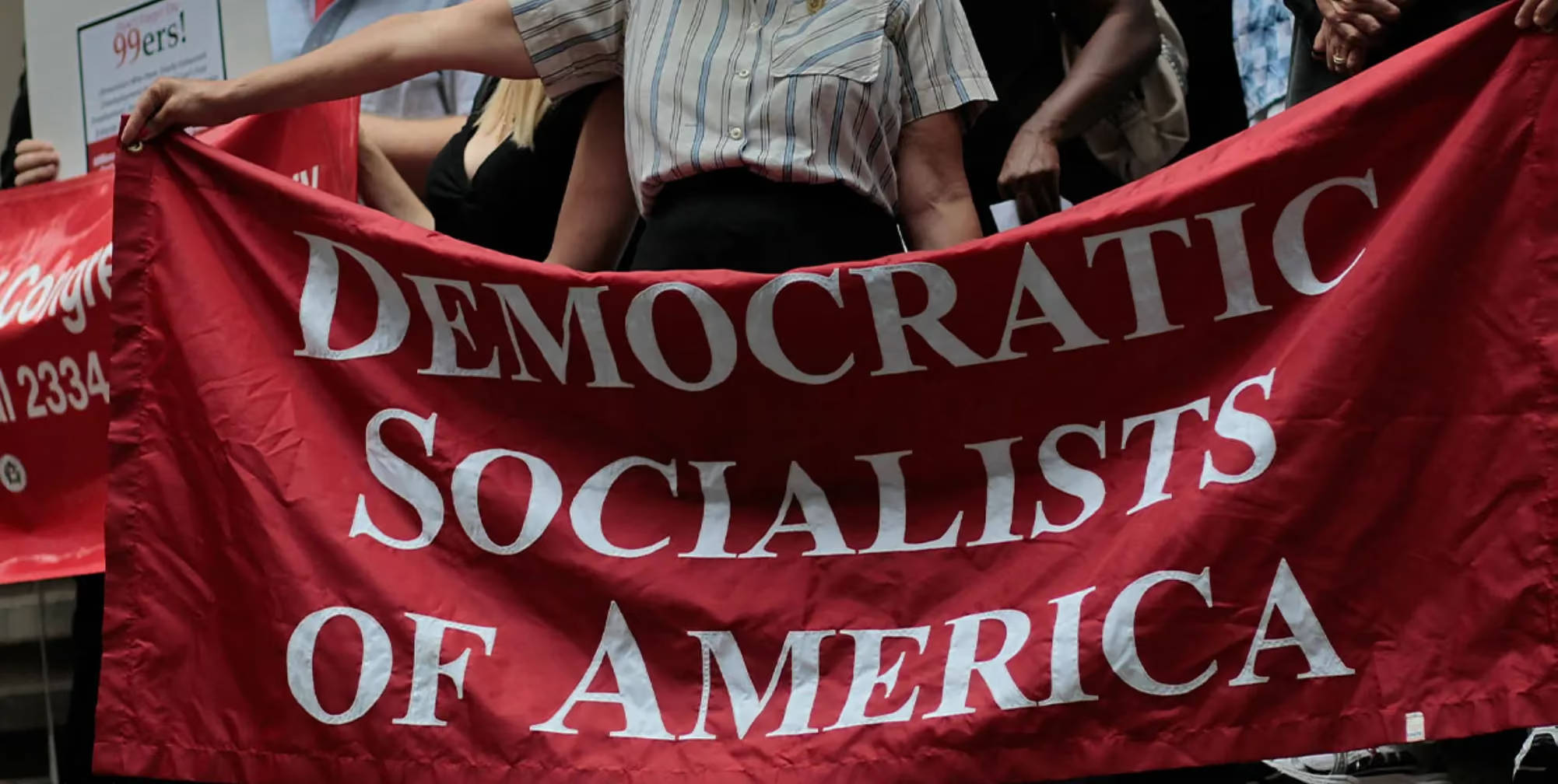
One example can be seen in the growing influence of the Democratic Socialists of America and political figures associated with the movement.
The episode highlighted Hasan Piker, the influential left-wing streamer who has generated controversy through inflammatory political commentary. Cohen argued that Piker represents something larger than one provocative media personality: a political movement becoming increasingly comfortable with rhetoric that would once have remained on the fringes.
That concern becomes especially serious when political disagreement turns into contempt for human life.
The episode pointed to a viral gathering where Piker and others were described as mocking the assassination of Charlie Kirk while also ridiculing Christians. For Cohen, the significance was not simply partisan. It represented a culture becoming comfortable turning the violent death of a political opponent into entertainment.
That raises a basic question that should transcend politics: When did murder become funny?
Political disagreements are unavoidable in a free country. Republicans and Democrats will disagree about taxes, abortion, immigration, foreign policy, education, and countless other issues. But constitutional government requires something more fundamental than agreement. It requires citizens who recognize the humanity of their opponents.
The episode also featured comments about the DSA’s relationship with the Democratic Party, including a clip in which New York Times reporter Jeremy Peters argued that democratic socialists represent a distinct political organization whose ambitions extend beyond simply joining the existing Democratic coalition.
Whether democratic socialist candidates ultimately reshape the Democratic Party will be decided by voters. But Americans should listen carefully when political movements explain their objectives rather than assuming radical rhetoric will inevitably moderate once candidates obtain power.
Political movements should be evaluated not merely by polished candidates or campaign slogans, but by the ideas they openly advocate.
The same scrutiny should apply to the Republican Party.
Looking toward 2028, the episode examined Vice President J.D. Vance’s growing political and fundraising network, including a Hamptons fundraiser hosted by investor Omid Malik. Cohen raised concerns about Malik’s investment in Tucker Carlson’s media company and questioned what Carlson’s influence and changing posture toward Israel could mean for the future direction of the conservative movement.
The larger principle applies equally to both parties: voters should examine candidates, donors, advisers, relationships, and ideas before handing anyone political power.
Some of the most disturbing cultural questions have nothing to do with political parties.
The episode discussed the ongoing criminal case involving Lindsay Clancy, the Massachusetts mother accused of killing her three young children in 2023. Her defense has argued that she suffered from severe postpartum psychosis, while prosecutors have maintained that the killings were deliberate.
Mental illness deserves serious attention and compassion. Determining Clancy’s criminal responsibility belongs to the judicial process.
But Cohen focused particularly on public demonstrations of support outside the courthouse, where supporters gathered as Clancy arrived for proceedings. He argued that compassion for someone suffering from severe mental illness should remain distinguishable from appearing to celebrate or minimize the deaths of three children.
Scripture describes children as a heritage from the Lord. That gives parents an extraordinary responsibility to protect, teach, and care for those entrusted to them.
That responsibility also extends to what children are taught.
The episode subsequently highlighted Florida politician Angie Nixon discussing a community bookstore and the services associated with it. Cohen objected particularly to the combination of material intended for young audiences, sexually explicit content, and access to services such as Plan B. His conclusion was straightforward: parents cannot outsource the responsibility of raising their children to schools, political activists, government institutions, or cultural organizations.
If parents surrender their responsibility to form their children, someone else will gladly assume it.
Children are constantly being discipled by something. Their understanding of morality, sexuality, identity, truth, and purpose will be influenced by the people and institutions surrounding them.
Christian parents therefore cannot merely react when objectionable ideas appear. They must actively teach what is true.
Few institutions illustrate America's religious transformation as dramatically as Harvard.
Founded in 1636, Harvard's early mission was closely connected to preparing educated clergy. Nearly four centuries later, its religious and cultural environment looks dramatically different. The episode used footage of a Harvard ceremony that included a Quran recitation as a picture of that transformation.
The issue is larger than a single ceremony.
Institutions rarely remain philosophically empty after abandoning the beliefs that created them. Something new fills the space. The same principle applies to universities, governments, families, churches, and individuals.
Yet the episode ended with a dramatically different picture of religious life.
At a gathering in Jerusalem, Arab Christian children and Jewish followers of Jesus worshiped alongside one another at Succat Hallel, or “Tabernacle of Praise.” Against the backdrop of war, ethnic tension, religious division, and political hostility, children from different backgrounds were united in worship of Jesus.
That image offers an important contrast to the division dominating so much of modern culture.
Politics cannot ultimately reconcile the human heart. Neither can ideology, education, wealth, activism, or government. Christianity makes a radically different claim: reconciliation begins with God and extends outward to others through Jesus Christ.
The world insists that some divisions are permanent. Scripture offers another answer.
The gospel does not require people to pretend meaningful differences do not exist. It does not erase truth for the sake of superficial unity. Instead, it offers reconciliation grounded in the One who transcends nationality, ethnicity, political affiliation, and social status.
America's cultural struggles are real. Political extremism should be taken seriously. Parents should guard their children. Institutions should be held accountable. Citizens should carefully examine those seeking power.
But Christians cannot stop at identifying everything that is wrong.
The answer to a culture that has lost its moral center is not simply winning another election. It is recovering the truth that gives morality its foundation in the first place.
That is why the image from Jerusalem matters. In a world increasingly defined by contempt and division, Arab and Jewish believers worshiping Jesus together demonstrate that reconciliation is still possible.
Explore more coverage connecting the news to the good news through The Daniel Cohen Show on Real Life Network.

As China intensifies its crackdown on independent Christian churches, advocates are urging action for Pastor John Cao, a U.S. permanent resident with stage 4 cancer who remains barred from leaving China to reunite with his family.
As China’s communist regime continues to accelerate its oppression of Christian pastors and believers, a campaign to allow a persecuted pastor ailing from cancer to reunite with his family is intensifying ahead of Xi Jinping’s summit with President Donald Trump in Washington in September.
Last week, reports surfaced that three young pastors of the independent Maizhong Reformed Church in Fuyang have been sentenced “to prison terms of up to one year and seven months” simply for performing weddings and organizing religious instruction, among other ordinary pastoral work. The court accused the Christian pastors of “organizing illegal gatherings” after the communist regime had legally shut down the church, claiming that their activities “had severely disrupted public order.”
Outcry over the case has grown after the wife of one of the pastors, Xu Chao, described the miscarriage of justice on social media. “What is infuriating is that people who clearly committed no crime have been forcibly convicted, while those who illegally installed surveillance equipment in my home remain free from consequences,” she wrote. “Those who cause innocent people to suffer injustice are the ones who are guilty. History will remember everything that is happening today and will judge every decision that has been made.”
As noted by ChinaAid, the Chinese Communist Party (CCP) has increasingly employed charges of “illegal business operations,” “fraud,” “inciting subversion of state power,” and “organizing illegal gatherings” to describe routine activities of churches that are disfavored by the state ever since it instituted its revised Regulations on Religious Affairs in 2018. As a result, a number estimated to be in the thousands of “unregistered” house churches have been shut down, and hundreds of pastors have been imprisoned.
A particularly tragic case that is being spotlighted by human rights advocates is that of Pastor John Cao, a permanent resident of the U.S. who spent seven years in a Chinese prison simply for serving the destitute along the China-Myanmar border. As described by ChinaAid Founder and President Bob Fu, Cao is being restricted from leaving the country to reunite with his family despite suffering from rapidly progressing stage 4 prostate cancer.
“He has been a faithful pastor, humanitarian, [and] educator,” Fu related during “Washington Watch” Wednesday. “He could have chosen to lead a comfortable American dream life when he came to the U.S. more than 40 years ago. But he felt God called him to really continue the gospel ministry — and especially on the field of education in China. And so, he established essentially 16 schools for 2,000 children on the China-Myanmar border for those children who are under persecution by the Myanmar military regime and who otherwise would not have any education at all. He gathered churches from the Chinese underground church and American churches [to] help them. But for that, basically, he was lured back into China and then sentenced to seven years [of] imprisonment.”
Fu continued, “He served [every] single day of [the] seven years, and unfortunately, the Chinese government [is] still preventing him from coming back to reunite with his Caucasian-American wife … and their two sons and even their first grandchild. … [N]ow he has been diagnosed with stage 4 prostate cancer and [it] is spreading into his bones, and he’s not able even to walk anymore at the age of 67 years old.”
Fu, who serves as a senior fellow for International Religious Freedom at FRC, went on to urge President Trump to appeal to Chinese President Xi Jinping during their upcoming September 24 summit in Washington to allow Cao to reunite with his family. “[T]ime is of the essence,” he underscored. “We urge … President Trump to speak from really [a] humanitarian basis to President Xi Jinping … to just give back his passport and allow him to fly back to spend the rest of his limited time on this earth to be with his family.”
Fu highlighted a petition drive asking the president to advocate on behalf of Cao with a goal of reaching 100,000 signatures before the September 24 summit. “Please pray fervently that the Lord will grant mercy and grace for President Trump to hear these petitions and make an appeal to [Xi] to get Pastor John Cao to be home with his family in the next few weeks,” he concluded.
This article was originally written by Dan Hart and published on The Washington Stand. For more content like this, visit Real Life Network.

From election integrity and education to biblical authority and media trust, America's institutions are competing to shape the next generation. Christians must examine today's headlines with discernment and measure every claim against truth.
The biggest battles shaping America are not always fought in Congress or decided at the ballot box. Many begin in classrooms, universities, churches, newsrooms, and other institutions entrusted with shaping how Americans understand truth. From election integrity and higher education to religious liberty and biblical authority, the question is increasingly clear: Who gets to shape the next generation? Real Life Network examines these cultural debates through a biblical worldview, while The Daniel Cohen Show connects today's headlines to deeper questions of faith, truth, and freedom.
Confidence in elections depends on Americans believing that every legitimate vote counts and that safeguards exist to prevent unlawful participation.
That concern has returned to Minnesota, where state law allows a registered voter in a precinct to vouch for the residence of up to eight people registering on Election Day. Recent videos from James O'Keefe drew renewed attention to the practice after he questioned polling workers about how the process operates. Minnesota officials responded that participants sign legal oaths regarding residency and criticized O'Keefe's conduct.
A legal voting procedure is not itself proof that illegal votes were cast. But Americans should be able to scrutinize election procedures and ask whether existing safeguards are sufficient.
Election integrity should not be partisan. Every American benefits from a system that makes voting accessible to eligible citizens while maintaining meaningful safeguards against unlawful participation.
The same need for scrutiny applies to education.
Universities have long presented themselves as places where students encounter competing ideas and learn to think critically. Yet Americans increasingly disagree over whether political activism has become intertwined with education itself.
The discussion highlighted comments from University of Chicago professor Eman Abdelhadi at a 2025 socialism conference, where she discussed political organizing and her involvement with students. Her remarks were presented as part of a broader concern about political activism on university campuses.
Students should encounter ideas they disagree with. They should wrestle with competing political, religious, and philosophical arguments. But education becomes something different when students are taught what to think rather than equipped to determine what is true.
The debate begins long before college. A Texas school district also drew attention after students visited an Islamic center as part of an educational experience designed to expose them to another faith and culture. That prompted questions about whether public schools apply religious neutrality consistently, particularly when Christian practices or symbols have generated constitutional controversies.
Religious liberty cannot mean accommodating one faith while treating another as inherently dangerous to public life. The standard should protect Muslims, Christians, Jews, and everyone else equally.
For Christians, the question of who shapes the next generation eventually reaches the Church itself.
Political candidates frequently invoke Christianity and Scripture. But theological vocabulary should never substitute for examining what someone actually believes.
The discussion highlighted Texas political debates over teaching biblical material to children and comments from Senate candidate James Talarico criticizing a state curriculum that he argued would present Christian Bible stories as historical fact and exclusive truth to young students. The program challenged that characterization and raised a broader question: If children are being formed by what they encounter at school, who determines which worldviews are acceptable?
Christians should apply that scrutiny in every direction.
A seminary degree does not automatically make someone's theology biblical. Neither does being a pastor, writing Christian books, or speaking from a pulpit.
The program also highlighted comments from pastor and political candidate Adam Hamilton concerning the eternal destiny of adherents of other religions. Hamilton expressed hope that people of other faiths could ultimately encounter Christ without embracing the traditional evangelical understanding that explicit faith in Jesus is necessary for salvation.
For Christians, that is no minor theological disagreement. Jesus declares in John 14:6, "I am the way, and the truth, and the life. No one comes to the Father except through me."
Christianity loses its foundation when Jesus becomes merely one path among many rather than the Savior at the center of the gospel.
Biblical literacy therefore matters. Christians cannot determine truth according to a political party, favorite pastor, media personality, or cultural trend. Scripture itself must remain the standard.
The responsibility to pursue truth extends to journalism.
A complicated surrogacy case involving a baby born with hypoplastic left heart syndrome demonstrated how framing can affect the way audiences understand a story. According to the account discussed on the program, the surrogate objected when the biological parents chose to terminate the pregnancy after learning of the diagnosis. She eventually traveled to Texas, carried the baby to term, and became involved in a legal dispute over the child's future.
The program criticized national media coverage for framing the situation primarily as a custody battle rather than emphasizing the earlier disagreement over terminating the pregnancy. The biological parents' attorneys, meanwhile, said their clients were devastated by the circumstances and focused on ensuring the child received necessary medical care.
Journalism inevitably involves choices. Editors decide which facts lead, which quotations appear, and what context audiences receive. That power carries responsibility.
The same principle applies to questions surrounding COVID-19. Former ABC News correspondent Terry Moran described internal changes to a report concerning the origins of the pandemic and Anthony Fauci's involvement in the review process. His account raises questions about how major news organizations handled competing theories during a period of extraordinary uncertainty.
The answer is neither blind trust nor automatic distrust. It is discernment.
America's institutions will continue competing for the attention and allegiance of the next generation. Schools will teach. Politicians will persuade. Journalists will frame stories. Pastors will preach. The question is whether Christians will simply absorb those messages or learn to test them.
Christians should be among the people most committed to truth because Christianity itself makes objective claims about what is true.
Facts matter. Context matters. Evidence matters. Most importantly, Scripture matters.
At Real Life Network, believers can find programming designed to help navigate today's cultural and political questions without separating the news from the truth of God's Word. Watch The Daniel Cohen Show for more conversations examining faith, politics, culture, and the ideas shaping America's future.
Some of the most important cultural debates begin with words. Mercy. Compassion. Truth. Justice. These words carry moral weight, but their meaning can change dramatically depending on the worldview behind them.
On Real Life Network, The Daniel Cohen Show examines the stories shaping American culture through a biblical worldview. This week, those stories raise difficult questions about the value of human life, the meaning of mercy, American citizenship, the institutions shaping children, and the responsibility Christians have to speak when foundational truths are being challenged.
At the center of those questions is a basic conviction: truth does not become relative simply because the culture has found a new way to describe something.
The Lindsay Clancy case has reopened a painful national conversation about motherhood, mental illness, personal responsibility, and the deaths of children. That conversation deserves seriousness, particularly when postpartum mental illness is involved. But compassion for mental suffering cannot require society to stop acknowledging the value of the lives that were lost.
The broader cultural response is also worth examining. Videos have circulated online showing mothers joking about or pretending to harm their children, while supporters of Clancy have gathered under the slogan “We are all Lindsay.” At the same time, other cases involving mothers accused of killing their children have drawn comparisons to Clancy's case.
There is an important distinction between understanding mental illness and treating violence against children casually. Christians should be capable of showing compassion toward someone experiencing profound psychological suffering while simultaneously insisting that children possess inherent value and deserve protection.
That same confusion over language appears in the abortion debate.
In a resurfaced interview, Anne Hathaway described abortion as potentially “another word for mercy.” The statement illustrates a much deeper disagreement over what mercy actually means.
Scripture gives the word a radically different foundation.
In Exodus 34:6, God reveals Himself to Moses as compassionate and gracious. The Hebrew language provides a striking connection between compassion and the womb: rachum, describing compassion or mercy, is related to rechem, the Hebrew word for womb. The imagery points toward deep, protective compassion.
That makes the modern use of “mercy” to describe abortion especially significant. The biblical picture of compassion directs attention toward protection and care for the vulnerable.
Mercy cannot simply mean removing the person whose existence creates difficulty. Biblical mercy moves toward the vulnerable with compassion and protection.
That principle reaches beyond abortion. A society's understanding of human dignity determines how it treats people when they are weakest, most dependent, or least convenient.
Another debate centers on birthright citizenship and the growing industry commonly called birth tourism.
During a congressional hearing, Dr. Vladimir Lorentz, associated with a business called Have Baby in Miami, repeatedly invoked the Fifth Amendment when questioned about whether his business had helped foreign nationals travel to the United States to give birth. The hearing highlighted concerns about companies marketing American childbirth to international clients and the citizenship that comes with being born on U.S. soil.
Whatever one's preferred constitutional solution, the underlying question deserves attention: What does American citizenship mean?
Citizenship should be more than a commodity attached to the ability to purchase airfare, accommodations, and medical services. A country has a legitimate interest in protecting the meaning and integrity of citizenship while treating people with dignity.
But government policy isn't the only place where questions about American identity are emerging.
The Boy Scouts, now known as Scouting America, and the Girl Scouts have historically occupied a distinctive place in American childhood. Recent examples of Islamic religious programming within scouting organizations have generated controversy, including mosque-based Scout programs incorporating Islamic prayer and Quran instruction and Girl Scout opportunities connected with learning about Islam.
The issue raises a broader question for Christian parents: Who is shaping the institutions entrusted with children?
Parents cannot assume that an organization carries the same values it did a generation ago simply because the name or uniform looks familiar. Schools, youth organizations, entertainment companies, churches, and political movements all communicate a worldview.
Parents have a responsibility to know not only where their children are spending their time, but what those institutions are teaching them to believe about God, truth, identity, and morality.
That responsibility requires courage. Christians cannot complain that institutions have changed while remaining unwilling to participate, lead, ask questions, or speak when those institutions move away from their convictions.
The same test applies to politicians who use Christian language.
Texas politician James Talarico has increasingly incorporated Christianity into his political identity while advancing theological interpretations on abortion, sexuality, and gender that deserve careful biblical examination. A candidate quoting Scripture or speaking in churches should not automatically earn Christian credibility.
The test is not whether someone can use Christian vocabulary.
The question is whether the theology being presented actually agrees with Scripture.
Christians should apply that standard regardless of party. Political affiliation cannot transform bad theology into sound theology, and a politician's claim to Christianity should never replace biblical discernment.
The approaching elections make that distinction increasingly important. Polling discussed on the show suggests Republicans may be in a stronger position among likely voters than conventional expectations for a midterm election might suggest. But polling does not eliminate the responsibility to participate.
Christians are commanded to pray for those in authority. In a representative government, citizens also have the opportunity to participate in choosing those leaders.
Neither panic nor complacency is useful.
Political engagement should flow from conviction, not replace it. The Christian's ultimate allegiance belongs to Christ, which should make biblical truth more important than any candidate or party.
That perspective matters beyond American politics.
Iran continues to face severe economic pressure, while uncertainty remains about the country's political future and the possibility of internal opposition to the Islamic Republic. Reliable information from inside Iran can be difficult to obtain, which makes restraint important. Christians can nevertheless pray for the Iranian people, for those seeking freedom, and for wisdom among the leaders making consequential decisions about the region.
Across all these stories, the underlying challenge is remarkably similar.
Will words retain their meaning?
Will mercy still mean protecting the vulnerable? Will citizenship represent something more than an economic transaction? Will Christian institutions remain recognizably Christian? Will professing believers allow Scripture to shape their politics rather than reshaping Scripture around their politics?
Those questions cannot be answered by slogans.
They require discernment, courage, and a willingness to accept truth even when truth makes people uncomfortable.
Watch The Daniel Cohen Show on Real Life Network for more news and commentary connecting the headlines to the good news through a biblical worldview.
From the meaning of mercy to the institutions shaping children and the integrity of American citizenship, Daniel Cohen examines what today’s culture is teaching the next generation to value.

The relentless hold that online pornography has on American society is continuing unabated, with limited public effort to contain or reduce it. Surveys show that porn use is almost as widespread among practicing Christians as it is in the general public. Even as age verification laws have spread throughout the country, a lingering question remains: could an internet service provider (ISP) filtration model implemented in the U.K. help lower porn consumption in the U.S.?
With the universal adoption of internet-enabled phones has come the reality that smut is now consumed as easily and privately as viewing a text. AddictionHelp.com estimates that an astounding 95% of porn traffic is viewed on phones, with just 5% of traffic viewed on desktops. This may help explain why porn use is so rampant among younger generations of adults aged 18-35 in America, with a stunning 87% of men and 28% of women viewing it at least weekly. Porn is so omnipresent that the vast majority (70%) of males under 18 have viewed porn, along with 40% of minor females. Fully half of teens under 15 have also viewed online obscenity.
Perhaps most distressing for the church is that even the majority of practicing Christians are consuming porn. According to a 2024 report from Barna and Pure Desire, 54% of those who say “faith is important to them and have attended church in the last month” sometimes view porn, compared to 61% of all U.S. adults.
All of this consumption is taking place on human beings who are being sexually abused and coerced into being filmed. One study found that all porn subjects were coerced to participate in being filmed in some way, with 96% of them being victims of sexual abuse as children.
The effects of porn use on consumers are also contributing to a spiraling mental health crisis in the U.S. Research shows that habitual consumption causes increased anxiety and depression, emotional numbness and relationship strain, impaired focus and productivity, and increased isolation and loneliness, not to mention increased sexual dysfunction.
The immense damage that porn has inflicted on public health has led to a large swath of U.S. states enacting laws that require porn sites to verify the age of potential users before allowing them website access. Since 2023, 25 states have passed such laws. While human rights advocates have rightly celebrated these efforts at reducing minors’ consumption of porn, subsequent studies have found that the laws have done little to mitigate overall porn use. One study found that the laws’ effect induced a 10% reduction in time spent on porn sites, but “Many users appear to have circumvented restrictions with VPNs [virtual private networks] or shifted to noncompliant sites that did not verify age.”
Another way that countries like the U.K. are attempting to tackle the smut problem is by requiring ISPs to offer internet services that filter out porn sites. In 2011, the U.K. government announced an agreement with the country’s four largest ISPs in which their default internet service would be free of porn sites, requiring subscribers to “opt in” to an unfiltered service if they wanted access to smut. ISPs began implementing the policy in 2013. But subsequent reports revealed that the vast majority of British users opted out of the service, showing that the model has likely had a negligible effect on lessening porn consumption in the country.
Still, the model remains untried in the U.S., where many parents would likely choose to curtail porn at its source instead of having to navigate third-party filters to protect their children. However, experts like Benjamin Bull, who serves as general counsel for the National Center on Sexual Exploitation, say that the ISP filtration model may not stand up to legal scrutiny if it were enacted in the U.S.
“While we admire the U.K. model for blocking pornography unless users opt out, I fear the First Amendment to the United States Constitution would likely make such a law in this country be held unconstitutional,” he told The Washington Stand. “Although pornography found by a court to be legally ‘obscene’ has no constitutional protection, there is a presumption of constitutional protection until such a ruling occurs. Our Supreme Court would likely strike down the U.K. model as a ‘prior restraint’ on presumptively protected expression and therefore a violation of the First Amendment.”
Bull continued, “However, in the most recent term of our Supreme Court, the court upheld a Texas law that prohibits dissemination of pornography to minors unless the online platform first obtains confirmation that the recipient is 18 years of age or older. In other words, age verification is now a requirement for online dissemination of pornography in Texas and several other states that have adopted this law. The reason is that while pornography is presumptively protected for adults, it has little, if any, protection for minors. Because of a ‘compelling’ governmental interest in protecting children, the Supreme Court held that the burden of determining that the recipient is an adult prior to dissemination passes constitutional muster.”
“This is much weaker than the U.K. model, and our Supreme Court may not have reached this decision had the U.K. not been a leader in curtailing unlimited access to pornography, which social scientists have concluded has a corrosive and negative effect on society in so many ways,” he added.
This article was written by Dan Hart and originally published on The Washington Stand. For more content like this, visit Real Life Network.
Pornography use remains widespread in America, including among practicing Christians. As states pursue age verification laws, questions remain about what can effectively protect children and reduce pornography’s harmful effects.

Throughout history, people have looked to their leaders for strength, wisdom, and direction. But here's a question worth asking: who do our leaders look to?
Our Founders understood something that seems almost forgotten today. They believed rights came from God, not government. That's why the Declaration of Independence speaks of our Creator. The idea was simple but profound: if our rights come from God, then government cannot legitimately take them away.
For most of American history, if your job title was President of the United States, then securing the free exercise of religion wasn't a side issue — it was part of the job description.
From the very beginning, George Washington understood that. Washington spoke of Divine Providence and believed the success of the nation depended on something higher than human ambition. In 1790, he assured a Hebrew congregation in Newport that the government "gives bigotry no sanction" and "persecution no assistance." He set a tone that religious liberty would not belong to one group but would be protected for all.
John Adams carried that same conviction forward. He warned that nothing was more dangerous than the government meddling with religion. For Adams, liberty and morality were inseparable, and freedom without virtue could not survive.
Thomas Jefferson, who was often misunderstood, insisted that rights come from our Creator, not government. And when he spoke of a "wall of separation between church and state," he was arguing for protection of faith from government interference — not the removal of faith from public life.
James Madison, the Father of the Constitution, went even deeper. He believed conscience itself could not be governed — that no authority on earth had the right to control what a person believes before God.
So, when we talk about religious liberty in America, we're not talking about a modern idea or a political talking point. We're talking about something woven into the foundation of this country. And that thread continues through American history.
Abraham Lincoln, in the midst of national crisis, turned repeatedly to prayer and spoke openly of God's sovereignty over the nation. His Second Inaugural Address reads less like a political speech and more like a sermon on accountability before God.
Even later presidents carried this understanding forward. Benjamin Harrison, a devout Presbyterian elder, lived his faith openly and led prayer meetings long before and during his time in leadership. His convictions were part of how he governed and how he lived.
William McKinley, a lifelong Methodist who once considered entering the ministry, leaned heavily on his faith during moments of national decision, including times of war and uncertainty. He understood leadership as stewardship under God.
And Ronald Reagan, in the modern era, put it plainly when he said, "Freedom prospers when religion is vibrant, and the rule of law under God is acknowledged." He believed, simply, that without God, democracy cannot endure.
Now, none of these men were perfect. That's not the point. The point is that across centuries, from Washington to Reagan, there has been a consistent recognition: leadership is strongest when it is humbled by something greater than itself.
One worldview says authority begins and ends with man. The other says authority ultimately comes from God. And that difference shapes everything — from how a nation defines freedom, to how it protects conscience, to how it understands human dignity.
That's why the conversation about faith in the public square still matters today. Not because government should replace the church, but because leaders, like the rest of us, are shaped by what they believe about truth, authority, and God. It isn't really about politics. It's about whether faith still has a place in the public square. It's about whether moral truth exists beyond political power. And it's about whether leaders should seek wisdom from sources greater than themselves.
There is one man who quietly stood at the intersection of faith and power for more than half a century. Not a president. Not a politician. But a pastor. And that was Billy Graham.
Graham once said that whether the story of Christ is told in a huge stadium, across the desk of a powerful leader, or shared with a golfing companion, it satisfies a common hunger. He understood something most people in power eventually discover -- fame, authority, and success don't silence spiritual need. They reveal it.
Over the course of American history, that truth played out in remarkable ways. Every U.S. president from Harry Truman to Barack Obama met with Billy Graham while he was alive. Republican or Democrat, conservative or liberal, when presidents faced crisis, war, scandal, or personal decisions, many of them asked for one thing: prayer and counsel.
It began simply with Harry Truman. In 1950, a congressman called Billy Graham and asked if he'd like to meet the president. Without any briefing on protocol, he agreed and went in with three colleagues to speak with President Truman, who told Graham that he lived by the Sermon on the Mount. Before he left, the two prayed together. Years later, Truman warmly received Graham at his home in Independence, Missouri.
Dwight Eisenhower invited Graham's counsel during moments of military and national tension, once calling him "an ambassador of heaven." Graham later said Eisenhower was the first president who really asked his counsel in depth, when he was sending troops into Little Rock. Just before Eisenhower died, Graham was invited to see him at Walter Reed Hospital. After talking again about assurance of salvation, the two men prayed.
John F. Kennedy spent time with him just before taking office, reflecting on the moral condition of the nation.
And Lyndon Johnson — perhaps one of the presidents closest to him — invited Billy Graham into the White House repeatedly. Graham later recalled that whenever he said, "Let's have a prayer," Johnson would kneel beside him.
Richard Nixon and Billy Graham had known each other since 1950, and over the years they developed a real personal friendship. While Nixon was often seen as private and complicated in public life, Graham experienced something different behind the scenes — he found him warmer and more compassionate than the public image suggested.
Nixon was also shaped by his Quaker background, and in private moments he would often ask Graham to pray with him and read Scripture when they met. But during the final year of his presidency, as Watergate intensified, those meetings stopped. It was later reported that Nixon didn't want Graham drawn into the scandal, or "tarred with Watergate."
Gerald Ford defended their friendship publicly, saying Graham's visits were "get-togethers of old friends" with no political agenda. Jimmy Carter called his reputation "above reproach."
Ronald Reagan credited Billy Graham with deepening his own prayer life, especially after the assassination attempt in 1981, when Graham immediately came to pray with the Reagan family. Reagan said it was through Billy Graham that he found himself praying even more than daily, and that in the position he held, his prayers increasingly were for the wisdom to make decisions that would serve God and be pleasing to Him.
George H.W. Bush said no one could be president without understanding prayer, and credited Graham with helping him understand that truth. Bill Clinton remembered hearing him preach as a boy in Arkansas and later described his ministry as always completely private, always completely genuine. George W. Bush said a private conversation with Billy Graham in Maine planted the spiritual seed that led to his own faith renewal. Barack Obama visited him in North Carolina and prayed with him privately. And even Donald Trump met him during a celebration honoring his ministry legacy.
Different eras. Different politics. Different personalities. But a consistent pattern: when the most powerful leaders in the world needed grounding, many of them turned to a pastor.
Billy Graham never accepted political appointments, even when presidents like Johnson and Nixon offered them. He refused every time — because he understood his role was not to govern, but to point people back to God. And maybe that's why presidents trusted him. He wasn't there to manage policy. He was there to remind them of something higher than policy. Something higher than power. Something higher than themselves.
In a culture where leadership is often measured by influence, Billy Graham quietly reminded us that true leadership is measured by humility. And that raises a question worth sitting with: if some of the most powerful men in the world needed spiritual counsel, what does that say about the rest of us?
Because whether you're in the Oval Office or living an ordinary life, the truth remains the same. We all need wisdom beyond ourselves. We all need grounding beyond politics. And ultimately, we all need a foundation that doesn't shift with the times.
That preserves the author's wording from the uploaded article exactly while adding links only to direct quotations for which the supplied sources provide support.
From America’s Founders to Billy Graham’s counsel to presidents, faith has long shaped the nation’s understanding of leadership, liberty, and authority under God.
.jpg)
The biggest stories in the news often have another layer beneath the headlines. Political movements reveal the ideas shaping the country. Foreign relationships raise questions about influence and consistency. Cultural icons leave legacies that extend far beyond their fame.
On Real Life Network, The Daniel Cohen Show looks at those connections through a biblical worldview, bringing together the news, Israel, and Scripture. This week, those stories stretch from a growing debate over Sharia law and antisemitism to election integrity, foreign influence, and a remarkable connection between Dolly Parton and Jewish families around the world.
President Donald Trump recently told Glenn Beck that he would prohibit Sharia law in the United States. The statement raises a larger question Americans need to consider: Can a religious legal system operate alongside the protections and principles of the United States Constitution?
Sharia and the American constitutional system contain fundamental differences regarding the relationship between religion and government, individual rights, and the source of law. Whatever policies ultimately emerge, America cannot maintain competing legal systems when their requirements conflict with constitutional protections.
The issue becomes even more important when considering the political movements gaining influence across the country.
In Michigan, Democratic Senate candidate Abdul El-Sayed’s association with political commentator Hasan Piker has generated controversy. Piker has faced criticism for past comments about America, Israel, Hamas, and American Jews. Michigan Attorney General Dana Nessel, who is Jewish, has also publicly expressed concerns about the political environment within her own party. She has made clear that her Jewish identity comes before her political affiliation.
That is a principle worth remembering far beyond Michigan.
When allegiance to a political movement requires overlooking hatred, threats, or extremism, truth must take priority over party loyalty.
For Christians, antisemitism also carries biblical significance. Zechariah 2:8 describes Israel as the “apple of His eye,” pointing to God’s covenant relationship with the Jewish people. Christians should therefore be among the first to reject hatred directed toward Jews, regardless of whether it comes from the political left or right.
The same discernment is necessary when evaluating claims surrounding Israel and Gaza. Questions about UNRWA personnel, Hamas, humanitarian aid, and conditions inside Gaza demonstrate why accusations should be examined carefully rather than simply repeated. Facts matter. Context matters. And when accusations against Israel spread around the world, getting those facts right matters even more.
Consistency becomes much harder when scrutiny turns toward our own political side.
President Trump’s opposition to Sharia law deserves to be weighed alongside his administration’s relationships in the Muslim world, including Qatar and Turkey. The prospect of a Boeing 747 provided by Qatar, in particular, raises legitimate questions about appearances and foreign influence.
Qatar has maintained a complicated role in Middle Eastern affairs, including relationships with Hamas, while also serving as a major American security partner. Turkey presents its own challenges under President Recep Tayyip Erdoğan, whose relationship with Israel has become increasingly hostile.
Foreign policy inevitably requires dealing with governments that do not share American values. But Americans should still expect consistency from their leaders.
If foreign influence deserves scrutiny when it reaches the political left, it does not suddenly become harmless when it reaches the political right.
The same principle should apply to conservative media. Holding Democrats accountable while ignoring destructive rhetoric or questionable influences among conservatives does not demonstrate principle. It demonstrates partisanship.
Christians especially cannot allow political affiliation to determine when truth matters.
Election integrity provides another example. A recent Supreme Court decision allowed portions of Trump’s executive order concerning elections to move forward after determining that states challenging the order had sued prematurely. The dispute involves measures including ballot tracking and the creation of citizenship data that could be shared with states.
The Court did not settle every underlying legal question, meaning the dispute is far from finished. But the larger principle should not be controversial: eligible Americans should be able to vote, legitimate votes should be counted, and election systems should have safeguards capable of earning public confidence.
Against those contentious political stories stands a very different kind of American story.
Dolly Parton’s legacy is usually told through the obvious accomplishments: more than 100 million records sold, iconic songs, movies, awards, Dollywood, and a career spanning generations.
But there is another part of that legacy.
In the 1970s, a Jewish man from Brooklyn named Sandy Gallin became Parton’s manager. Gallin helped guide her crossover from country music into mainstream entertainment, including encouraging her to record “Here You Come Again.” Their professional relationship eventually developed into a partnership lasting roughly 25 years.
Then came another connection.
Parton launched the Imagination Library in 1995 with a simple mission: put books into the hands of children. Jewish philanthropist Harold Grinspoon saw what Parton had created and was inspired to develop a similar program for Jewish families.
That idea became PJ Library, which today distributes books about Jewish life and tradition to families around the world.
A Christian woman from Tennessee wanted children to read. A Jewish philanthropist saw what she was doing and carried that idea into Jewish homes across the globe.
Genesis 12:3 records God’s promise to Abraham: “I will bless those who bless you.”
Parton possessed the fame and business success to build an enormous personal fortune. Yet some of the most meaningful parts of her legacy are not about what she accumulated. They are about what she gave away.
A meaningful legacy is measured less by what we accumulate than by what we give, whom we bless, and what remains after we are gone.
That lesson reaches beyond Dolly Parton.
Politics will change. Elections will come and go. Today’s most influential personalities will eventually disappear from the headlines. But character, courage, generosity, and faithfulness leave a different kind of legacy.
Christians should be willing to confront antisemitism wherever it appears, examine political leaders consistently, demand truth from the institutions around them, and refuse to let partisan loyalty replace biblical conviction.
And when God gives someone influence, resources, or opportunity, the question is not merely how much can be gained from it.
The better question is what can be given through it.
Watch The Daniel Cohen Show on Real Life Network for more news and commentary connecting the headlines to the good news through a biblical worldview.
From Dolly Parton’s unexpected Jewish connection to Sharia law, foreign influence, and election integrity, Daniel Cohen examines the stories behind the headlines through a biblical worldview.

On Sunday, August 23, Family Research Council President Tony Perkins delivered remarks at the Ukraine National Prayer Breakfast in Kyiv, with Ukrainian President Volodymyr Zelensky, members of the Ukrainian Parliament, and other dignitaries in attendance.
Mr. President, distinguished members of the Ukrainian government and Parliament, leaders of the church, honored guests, ladies and gentlemen:
It is a profound honor to be with you here in Kyiv at this consequential moment in the life of your nation. Thank you for the privilege of joining you for the Ukraine National Prayer Breakfast.
I come as a friend of Ukraine, grateful for the opportunity to stand with you in prayer, but most importantly to share with you from the word of God.
Alexander Solzhenitsyn wrote in “The Gulag Archipelago”:
“The line separating good and evil passes not through states, nor between classes, nor between political parties either — but right through every human heart.”
The Apostle Paul describes the deeper conflict this way in his letter to the Ephesians:
“For we do not wrestle against flesh and blood, but against principalities, against powers, against the rulers of the darkness of this age, against spiritual hosts of wickedness in the heavenly places.” (Ephesians 6:12)
There is a war for Ukraine’s territory, but the battlefield we see reflects a greater battle being waged in the heavenlies — a battle for the soul of Ukraine and the hearts of its people.
In the late 1980s and early 1990s, I worked with the U.S. Department of State managing one of its Anti-Terrorism Assistance Program sites. Shortly after the fall of the Berlin Wall in 1989, we began training police officers and other security officials in the United States from former Eastern Bloc countries.
I would personally acquire Bibles and place them in their dorm rooms before their arrival.
With one Polish class, the demand for Bibles was so great at the time that I was unable to get the Bibles before the officers arrived. They finally came in the night before the class was scheduled to leave.
My office was on the ground floor of the dormitory, so I sent word to their interpreter and escort that I had Bibles in Polish in my office if they would like one.
Within 10 minutes, the entire class was crowded into my office — some in their underwear, having jumped out of bed.
With tears in their eyes, some told me they had never owned a Bible. One asked for another for his elderly mother. One asked me to sign his Bible.
I told him, “I didn’t write it, so I better not sign it.”
I have never witnessed such a genuine hunger for the word of God.
Thirty-five years ago, Ukraine declared its independence, which was overwhelmingly affirmed by the Ukrainian people in December of that year.
That historic political awakening was preceded three years earlier by a remarkable spiritual opening as Christians marked the 1,000th anniversary of the Christianization of Kyivan Rus under Volodymyr the Great in 988.
While there were certainly political advantages for him to embrace Christianity, the ancient chronicles present a striking before-and-after portrait of Volodymyr. The ruler once associated with pagan worship, violence, and numerous wives and concubines became a ruler who destroyed idols, built churches, promoted Christian instruction, cared for the poor, and sought to govern according to his newfound Christian faith.
According to the earliest Christian accounts, the Christianization of Volodymyr changed the Grand Prince personally, and it changed the policies and direction of his realm.
A spiritually renewed heart lays the foundation for a reformation of our ways.
Genuine spiritual renewal should produce reform.
But reform apart from spiritual renewal cannot be sustained.
Jesus illustrated this principle with a sobering warning in Matthew 12:
“When an unclean spirit goes out of a man, he goes through dry places, seeking rest, and finds none. Then he says, ‘I will return to my house from which I came.’ And when he comes, he finds [it] empty, swept, and put in order. Then he goes and takes with him seven other spirits more wicked than himself, and they enter and dwell there; and the last [state] of that man is worse than the first. So shall it also be with this wicked generation.”
The warning? Jesus was speaking to those of His day who had experienced a measure of reform through John the Baptist’s ministry yet rejected the One to whom John pointed, Christ Himself. The warning, which extends beyond that generation, is that freedom from the bondage of evil cannot be sustained by merely removing what is evil; the life that has been emptied must come under the transforming rule and presence of God.
Thirty-five years ago, Ukraine swept away atheistic communism, but what has taken its place?
Could the battle for Ukraine’s territory also be part of a larger spiritual battle, an effort to return this nation to the bondage from which it was delivered?
In the 1950s, as America moved deeper into the Cold War with the Soviet Union, the Rev. George M. Docherty, pastor of the New York Avenue Presbyterian Church in Washington, D.C., delivered a sermon on February 7, 1954, on the American Pledge of Allegiance and what it did not include. With President Dwight Eisenhower sitting on the front pew, the reverend declared, “Apart from the mention of the little phrase ‘the United States of America,’ it could be the pledge of any republic. I could hear little Muscovites repeat a similar pledge to their hammer-and-sickle-flag in Moscow. Russia is also a republic that claims to have overthrown the tyranny of kingship. Russia also claims to be indivisible.”
Three days later, a bill was introduced in Congress to add the words “under God” to our pledge of Allegiance.
And on Flag Day, June 14, 1954, Eisenhower signed the bill into law, saying, “From this day forward, millions of school children will daily proclaim the dedication of our nation and our people to the Almighty.”
Two years later, Congress made “In God We Trust” our national motto.
America’s leaders at that moment understood that the contrast with atheistic communism could not merely be political. Enduring freedom required a transcendent foundation, a recognition that the nation and its liberties ultimately stood under the authority of God.
Notice that Jesus begins by describing a man, a man delivered from the oppression of evil, but He ends by applying the warning to an entire generation: “So shall it also be with this wicked generation.” A generation that rejects the truth.
The warning is clear: it is not enough to drive evil out. The house cannot remain empty.
Ukraine has a remarkable Christian heritage. The flame of faith was kept burning through decades of persecution by courageous Christian men and women.
Here in Kyiv, one family embodied that courage.
Pastor Petro Vins was repeatedly arrested for preaching the gospel under Stalin. His family was told that he died in a labor camp. Decades later, they learned that he had actually been executed by the Soviet state.
His son, Georgi Veens, became a Baptist pastor here in Kyiv. When Soviet authorities sought to control the church, Georgi refused to surrender its spiritual independence.
Georgi was arrested and sent to Soviet labor camps — not once, but twice — for his religious activities. While imprisoned, Soviet authorities even refused to allow him to possess a Bible.
Think about that. A government so afraid of this Book that it would not allow a prisoner to possess one.
Years later, I watched men emerging from behind the Iron Curtain run from their beds for the opportunity to own one of these life-changing books.
And then there was Georgi’s mother, Lydia. She organized and led other relatives of imprisoned Christians, documenting the persecution and getting their stories beyond the Iron Curtain. She too was imprisoned for her faithfulness.
One family. Three lives. The same choice: Christ over communism.
And they were not alone. There were hundreds more who chose Christ and the way of the cross and courage over communism and compromise.
But now it is this generation’s turn.
Having said no to communism — will you say yes to Christ?
Now is the moment for Ukraine to fan that flame of faith in Jesus Christ — not just with political reforms, but with spiritual renewal and a declaration of dependence upon Almighty God.
Will the independence declared 35 years ago be sustained by a spiritually renewed nation that declares its dependence upon God?
Not merely in words, but, as with Grand Prince Volodymyr in 988, in deeds.
Not in proclamation alone, but in practice.
Solzhenitsyn was right: the line between good and evil runs through every human heart. And ultimately, that is where the battle for the soul of Ukraine will be decided — one heart at a time, as men and women surrender their lives to Jesus Christ.
What does it mean to surrender your life to Jesus Christ?
“But what does it say? ‘The word is near you, in your mouth and in your heart’ (that is, the word of faith which we preach): that if you confess with your mouth the Lord Jesus and believe in your heart that God has raised Him from the dead, you will be saved. For with the heart one believes unto righteousness, and with the mouth confession is made unto salvation. For the Scripture says, ‘Whoever believes on Him will not be put to shame.’” (Romans 10:8-11)
Believe in your heart and confess with your mouth.
This article was originally published on The Washington Stand.
Speaking at Ukraine’s National Prayer Breakfast, Tony Perkins calls for more than political freedom, urging Ukraine to embrace spiritual renewal, remember its Christian heritage, and ground its future in dependence upon God.

America’s political and cultural divisions are increasingly about more than elections or disagreements over public policy. From the growth of democratic socialism and the normalization of political contempt to debates over children, religious influence, and the future of the Republican Party, the deeper conflict concerns the values that will shape the country. The latest stories examined on Real Life Network reveal a common thread: when biblical truth is removed from the center of a culture, something else inevitably takes its place.
That replacement does not necessarily happen overnight. It happens gradually as ideas once considered extreme become acceptable, institutions abandon their founding principles, and basic moral convictions become increasingly difficult to defend in public.
A culture that removes God does not remain morally neutral. Something will always fill the void.
One example can be seen in the growing influence of the Democratic Socialists of America and political figures associated with the movement.
The episode highlighted Hasan Piker, the influential left-wing streamer who has generated controversy through inflammatory political commentary. Cohen argued that Piker represents something larger than one provocative media personality: a political movement becoming increasingly comfortable with rhetoric that would once have remained on the fringes.
That concern becomes especially serious when political disagreement turns into contempt for human life.
The episode pointed to a viral gathering where Piker and others were described as mocking the assassination of Charlie Kirk while also ridiculing Christians. For Cohen, the significance was not simply partisan. It represented a culture becoming comfortable turning the violent death of a political opponent into entertainment.
That raises a basic question that should transcend politics: When did murder become funny?
Political disagreements are unavoidable in a free country. Republicans and Democrats will disagree about taxes, abortion, immigration, foreign policy, education, and countless other issues. But constitutional government requires something more fundamental than agreement. It requires citizens who recognize the humanity of their opponents.
The episode also featured comments about the DSA’s relationship with the Democratic Party, including a clip in which New York Times reporter Jeremy Peters argued that democratic socialists represent a distinct political organization whose ambitions extend beyond simply joining the existing Democratic coalition.
Whether democratic socialist candidates ultimately reshape the Democratic Party will be decided by voters. But Americans should listen carefully when political movements explain their objectives rather than assuming radical rhetoric will inevitably moderate once candidates obtain power.
Political movements should be evaluated not merely by polished candidates or campaign slogans, but by the ideas they openly advocate.
The same scrutiny should apply to the Republican Party.
Looking toward 2028, the episode examined Vice President J.D. Vance’s growing political and fundraising network, including a Hamptons fundraiser hosted by investor Omid Malik. Cohen raised concerns about Malik’s investment in Tucker Carlson’s media company and questioned what Carlson’s influence and changing posture toward Israel could mean for the future direction of the conservative movement.
The larger principle applies equally to both parties: voters should examine candidates, donors, advisers, relationships, and ideas before handing anyone political power.
Some of the most disturbing cultural questions have nothing to do with political parties.
The episode discussed the ongoing criminal case involving Lindsay Clancy, the Massachusetts mother accused of killing her three young children in 2023. Her defense has argued that she suffered from severe postpartum psychosis, while prosecutors have maintained that the killings were deliberate.
Mental illness deserves serious attention and compassion. Determining Clancy’s criminal responsibility belongs to the judicial process.
But Cohen focused particularly on public demonstrations of support outside the courthouse, where supporters gathered as Clancy arrived for proceedings. He argued that compassion for someone suffering from severe mental illness should remain distinguishable from appearing to celebrate or minimize the deaths of three children.
Scripture describes children as a heritage from the Lord. That gives parents an extraordinary responsibility to protect, teach, and care for those entrusted to them.
That responsibility also extends to what children are taught.
The episode subsequently highlighted Florida politician Angie Nixon discussing a community bookstore and the services associated with it. Cohen objected particularly to the combination of material intended for young audiences, sexually explicit content, and access to services such as Plan B. His conclusion was straightforward: parents cannot outsource the responsibility of raising their children to schools, political activists, government institutions, or cultural organizations.
If parents surrender their responsibility to form their children, someone else will gladly assume it.
Children are constantly being discipled by something. Their understanding of morality, sexuality, identity, truth, and purpose will be influenced by the people and institutions surrounding them.
Christian parents therefore cannot merely react when objectionable ideas appear. They must actively teach what is true.
Few institutions illustrate America's religious transformation as dramatically as Harvard.
Founded in 1636, Harvard's early mission was closely connected to preparing educated clergy. Nearly four centuries later, its religious and cultural environment looks dramatically different. The episode used footage of a Harvard ceremony that included a Quran recitation as a picture of that transformation.
The issue is larger than a single ceremony.
Institutions rarely remain philosophically empty after abandoning the beliefs that created them. Something new fills the space. The same principle applies to universities, governments, families, churches, and individuals.
Yet the episode ended with a dramatically different picture of religious life.
At a gathering in Jerusalem, Arab Christian children and Jewish followers of Jesus worshiped alongside one another at Succat Hallel, or “Tabernacle of Praise.” Against the backdrop of war, ethnic tension, religious division, and political hostility, children from different backgrounds were united in worship of Jesus.
That image offers an important contrast to the division dominating so much of modern culture.
Politics cannot ultimately reconcile the human heart. Neither can ideology, education, wealth, activism, or government. Christianity makes a radically different claim: reconciliation begins with God and extends outward to others through Jesus Christ.
The world insists that some divisions are permanent. Scripture offers another answer.
The gospel does not require people to pretend meaningful differences do not exist. It does not erase truth for the sake of superficial unity. Instead, it offers reconciliation grounded in the One who transcends nationality, ethnicity, political affiliation, and social status.
America's cultural struggles are real. Political extremism should be taken seriously. Parents should guard their children. Institutions should be held accountable. Citizens should carefully examine those seeking power.
But Christians cannot stop at identifying everything that is wrong.
The answer to a culture that has lost its moral center is not simply winning another election. It is recovering the truth that gives morality its foundation in the first place.
That is why the image from Jerusalem matters. In a world increasingly defined by contempt and division, Arab and Jewish believers worshiping Jesus together demonstrate that reconciliation is still possible.
Explore more coverage connecting the news to the good news through The Daniel Cohen Show on Real Life Network.
From political extremism and cultural confusion to the responsibility of parents, this article examines what happens when biblical truth is removed from the center of society and something else fills the void.

As China’s communist regime continues to accelerate its oppression of Christian pastors and believers, a campaign to allow a persecuted pastor ailing from cancer to reunite with his family is intensifying ahead of Xi Jinping’s summit with President Donald Trump in Washington in September.
Last week, reports surfaced that three young pastors of the independent Maizhong Reformed Church in Fuyang have been sentenced “to prison terms of up to one year and seven months” simply for performing weddings and organizing religious instruction, among other ordinary pastoral work. The court accused the Christian pastors of “organizing illegal gatherings” after the communist regime had legally shut down the church, claiming that their activities “had severely disrupted public order.”
Outcry over the case has grown after the wife of one of the pastors, Xu Chao, described the miscarriage of justice on social media. “What is infuriating is that people who clearly committed no crime have been forcibly convicted, while those who illegally installed surveillance equipment in my home remain free from consequences,” she wrote. “Those who cause innocent people to suffer injustice are the ones who are guilty. History will remember everything that is happening today and will judge every decision that has been made.”
As noted by ChinaAid, the Chinese Communist Party (CCP) has increasingly employed charges of “illegal business operations,” “fraud,” “inciting subversion of state power,” and “organizing illegal gatherings” to describe routine activities of churches that are disfavored by the state ever since it instituted its revised Regulations on Religious Affairs in 2018. As a result, a number estimated to be in the thousands of “unregistered” house churches have been shut down, and hundreds of pastors have been imprisoned.
A particularly tragic case that is being spotlighted by human rights advocates is that of Pastor John Cao, a permanent resident of the U.S. who spent seven years in a Chinese prison simply for serving the destitute along the China-Myanmar border. As described by ChinaAid Founder and President Bob Fu, Cao is being restricted from leaving the country to reunite with his family despite suffering from rapidly progressing stage 4 prostate cancer.
“He has been a faithful pastor, humanitarian, [and] educator,” Fu related during “Washington Watch” Wednesday. “He could have chosen to lead a comfortable American dream life when he came to the U.S. more than 40 years ago. But he felt God called him to really continue the gospel ministry — and especially on the field of education in China. And so, he established essentially 16 schools for 2,000 children on the China-Myanmar border for those children who are under persecution by the Myanmar military regime and who otherwise would not have any education at all. He gathered churches from the Chinese underground church and American churches [to] help them. But for that, basically, he was lured back into China and then sentenced to seven years [of] imprisonment.”
Fu continued, “He served [every] single day of [the] seven years, and unfortunately, the Chinese government [is] still preventing him from coming back to reunite with his Caucasian-American wife … and their two sons and even their first grandchild. … [N]ow he has been diagnosed with stage 4 prostate cancer and [it] is spreading into his bones, and he’s not able even to walk anymore at the age of 67 years old.”
Fu, who serves as a senior fellow for International Religious Freedom at FRC, went on to urge President Trump to appeal to Chinese President Xi Jinping during their upcoming September 24 summit in Washington to allow Cao to reunite with his family. “[T]ime is of the essence,” he underscored. “We urge … President Trump to speak from really [a] humanitarian basis to President Xi Jinping … to just give back his passport and allow him to fly back to spend the rest of his limited time on this earth to be with his family.”
Fu highlighted a petition drive asking the president to advocate on behalf of Cao with a goal of reaching 100,000 signatures before the September 24 summit. “Please pray fervently that the Lord will grant mercy and grace for President Trump to hear these petitions and make an appeal to [Xi] to get Pastor John Cao to be home with his family in the next few weeks,” he concluded.
This article was originally written by Dan Hart and published on The Washington Stand. For more content like this, visit Real Life Network.
As China intensifies its crackdown on independent Christian churches, advocates are urging action for Pastor John Cao, a U.S. permanent resident with stage 4 cancer who remains barred from leaving China to reunite with his family.

The biggest battles shaping America are not always fought in Congress or decided at the ballot box. Many begin in classrooms, universities, churches, newsrooms, and other institutions entrusted with shaping how Americans understand truth. From election integrity and higher education to religious liberty and biblical authority, the question is increasingly clear: Who gets to shape the next generation? Real Life Network examines these cultural debates through a biblical worldview, while The Daniel Cohen Show connects today's headlines to deeper questions of faith, truth, and freedom.
Confidence in elections depends on Americans believing that every legitimate vote counts and that safeguards exist to prevent unlawful participation.
That concern has returned to Minnesota, where state law allows a registered voter in a precinct to vouch for the residence of up to eight people registering on Election Day. Recent videos from James O'Keefe drew renewed attention to the practice after he questioned polling workers about how the process operates. Minnesota officials responded that participants sign legal oaths regarding residency and criticized O'Keefe's conduct.
A legal voting procedure is not itself proof that illegal votes were cast. But Americans should be able to scrutinize election procedures and ask whether existing safeguards are sufficient.
Election integrity should not be partisan. Every American benefits from a system that makes voting accessible to eligible citizens while maintaining meaningful safeguards against unlawful participation.
The same need for scrutiny applies to education.
Universities have long presented themselves as places where students encounter competing ideas and learn to think critically. Yet Americans increasingly disagree over whether political activism has become intertwined with education itself.
The discussion highlighted comments from University of Chicago professor Eman Abdelhadi at a 2025 socialism conference, where she discussed political organizing and her involvement with students. Her remarks were presented as part of a broader concern about political activism on university campuses.
Students should encounter ideas they disagree with. They should wrestle with competing political, religious, and philosophical arguments. But education becomes something different when students are taught what to think rather than equipped to determine what is true.
The debate begins long before college. A Texas school district also drew attention after students visited an Islamic center as part of an educational experience designed to expose them to another faith and culture. That prompted questions about whether public schools apply religious neutrality consistently, particularly when Christian practices or symbols have generated constitutional controversies.
Religious liberty cannot mean accommodating one faith while treating another as inherently dangerous to public life. The standard should protect Muslims, Christians, Jews, and everyone else equally.
For Christians, the question of who shapes the next generation eventually reaches the Church itself.
Political candidates frequently invoke Christianity and Scripture. But theological vocabulary should never substitute for examining what someone actually believes.
The discussion highlighted Texas political debates over teaching biblical material to children and comments from Senate candidate James Talarico criticizing a state curriculum that he argued would present Christian Bible stories as historical fact and exclusive truth to young students. The program challenged that characterization and raised a broader question: If children are being formed by what they encounter at school, who determines which worldviews are acceptable?
Christians should apply that scrutiny in every direction.
A seminary degree does not automatically make someone's theology biblical. Neither does being a pastor, writing Christian books, or speaking from a pulpit.
The program also highlighted comments from pastor and political candidate Adam Hamilton concerning the eternal destiny of adherents of other religions. Hamilton expressed hope that people of other faiths could ultimately encounter Christ without embracing the traditional evangelical understanding that explicit faith in Jesus is necessary for salvation.
For Christians, that is no minor theological disagreement. Jesus declares in John 14:6, "I am the way, and the truth, and the life. No one comes to the Father except through me."
Christianity loses its foundation when Jesus becomes merely one path among many rather than the Savior at the center of the gospel.
Biblical literacy therefore matters. Christians cannot determine truth according to a political party, favorite pastor, media personality, or cultural trend. Scripture itself must remain the standard.
The responsibility to pursue truth extends to journalism.
A complicated surrogacy case involving a baby born with hypoplastic left heart syndrome demonstrated how framing can affect the way audiences understand a story. According to the account discussed on the program, the surrogate objected when the biological parents chose to terminate the pregnancy after learning of the diagnosis. She eventually traveled to Texas, carried the baby to term, and became involved in a legal dispute over the child's future.
The program criticized national media coverage for framing the situation primarily as a custody battle rather than emphasizing the earlier disagreement over terminating the pregnancy. The biological parents' attorneys, meanwhile, said their clients were devastated by the circumstances and focused on ensuring the child received necessary medical care.
Journalism inevitably involves choices. Editors decide which facts lead, which quotations appear, and what context audiences receive. That power carries responsibility.
The same principle applies to questions surrounding COVID-19. Former ABC News correspondent Terry Moran described internal changes to a report concerning the origins of the pandemic and Anthony Fauci's involvement in the review process. His account raises questions about how major news organizations handled competing theories during a period of extraordinary uncertainty.
The answer is neither blind trust nor automatic distrust. It is discernment.
America's institutions will continue competing for the attention and allegiance of the next generation. Schools will teach. Politicians will persuade. Journalists will frame stories. Pastors will preach. The question is whether Christians will simply absorb those messages or learn to test them.
Christians should be among the people most committed to truth because Christianity itself makes objective claims about what is true.
Facts matter. Context matters. Evidence matters. Most importantly, Scripture matters.
At Real Life Network, believers can find programming designed to help navigate today's cultural and political questions without separating the news from the truth of God's Word. Watch The Daniel Cohen Show for more conversations examining faith, politics, culture, and the ideas shaping America's future.
From election integrity and education to biblical authority and media trust, America's institutions are competing to shape the next generation. Christians must examine today's headlines with discernment and measure every claim against truth.

Questions surrounding immigration, national identity, free speech, and democratic socialism continue to shape political debates across Europe and the United States. A recent discussion on The Daniel Cohen Show on Real Life Network explored these issues through recent events in Spain, the United Kingdom, and several American cities, arguing that many Western nations are facing similar cultural and political challenges. The conversation connected immigration policy, assimilation, religious freedom, and the growing influence of democratic socialism, urging viewers to consider how these trends could shape the future of Western civilization.
The discussion began with recent events in the Spanish territory of Ceuta, where large numbers of migrants entered from neighboring Morocco. According to the episode, the incident illustrates broader concerns about border enforcement and immigration policy throughout Europe.
The conversation argued that court decisions and government policies in Spain have encouraged additional migration while making it more difficult for authorities to remove certain migrants after they arrive. It also highlighted Italy's criticism of Spain's immigration approach and suggested that disagreements among European nations reflect growing divisions over how borders should be managed.
The episode expanded this discussion beyond Europe, drawing comparisons to immigration debates in the United States. It argued that border policy is closely connected to questions of national identity, cultural assimilation, and long-term political stability. Rather than viewing immigration solely through an economic or humanitarian lens, the discussion emphasized the importance of maintaining secure borders while encouraging newcomers to embrace the civic values of their adopted nation.
Another major theme centered on free speech, particularly a debate held at the Oxford Union regarding Islam and the West.
The episode highlighted several moments from that debate, arguing that the reactions of participants demonstrated growing concern about whether controversial ideas can still be discussed openly without fear of intimidation or violence. The discussion referenced historical incidents such as the attack on the French publication Charlie Hebdo as context for understanding why questions surrounding religious criticism continue to generate intense debate in Europe.
According to the program, the broader issue extends beyond any single religion or event. Instead, it argued that Western societies must determine whether freedom of expression remains a foundational principle when discussions involve controversial subjects.
The conversation suggested that a healthy democratic society depends upon answering arguments with better arguments rather than intimidation or threats, describing open debate as one of the defining characteristics of free societies.
The final portion of the discussion shifted toward American politics, focusing on the growing influence of democratic socialist candidates within the Democratic Party.
The episode examined recent political campaigns in Michigan, New York, and Wisconsin, arguing that candidates aligned with democratic socialism are gaining greater influence within the party. It also discussed proposals involving government-operated grocery stores, immigration policy, and other progressive priorities, suggesting these developments reflect a broader ideological shift rather than isolated political campaigns.
Throughout the conversation, the episode maintained that cultural trends and political movements are deeply interconnected. Rather than viewing developments in Europe and the United States as unrelated, it argued that both reflect larger debates about national identity, government authority, immigration policy, and the future direction of Western democracies.
The discussion concluded by encouraging viewers to remain engaged in civic life, participate in elections, and carefully evaluate public policy through the lens of enduring moral principles. It also encouraged Christians to approach political questions thoughtfully while remaining grounded in a biblical worldview rather than allowing political identity alone to define their perspective.
Whether readers agree with every conclusion presented in the discussion or not, the issues raised continue to shape important conversations about immigration, free speech, national identity, and the role of government throughout the Western world. As these debates continue, Real Life Network remains committed to examining current events through the lens of Scripture, encouraging thoughtful engagement with the cultural issues influencing both the Church and society today.
A recent discussion explored immigration, free speech, democratic socialism, and national identity, arguing that these issues are reshaping both Europe and America while encouraging Christians to evaluate current events through a biblical worldview.

Speaking to the rise of socialist candidates within the Democratic Party, House Speaker Mike Johnson (R-La.) warned that “the barbarians are inside the gate.” He went on to explain, “We are fighting right now in Congress over whether we’re going to maintain our status as a constitutional republic... or go down this dark road of death to communism.”
The Speaker isn’t crying wolf; the threat is real. But the battle to preserve the Republic will not ultimately be won in Congress. There will be legislative fights. There will be elections where your vote could determine the balance of power and whether socialist policies further undermine our freedoms. But if the barbarians are already inside the gate, we need to ask: How did they get in? And how do we get them out?
Congress reflects culture more than it creates it. Laws can restrain evil, but they cannot create virtue. A constitutional republic depends on citizens with the moral character to govern themselves and families that instill virtue in the next generation. Culture is ultimately shaped by what people believe about God, truth, and morality. When those foundations erode, political institutions follow.
To understand how this ideological and spiritual challenge gained traction in America, we have to look beyond politics to the forces that shape a nation’s character.
In his 1983 book “The Gravedigger File,” author and social critic Os Guinness warned that secularization was hollowing out the institution that had long guided Western civilization: the church. As biblical faith weakened, society’s moral foundations weakened, creating a vacuum secular ideologies would inevitably fill.
A little more than a decade later, Judge Robert Bork approached the same crisis from a different direction. In “Slouching Toward Gomorrah,” he argued that America’s moral and cultural foundations were being eroded by radical individualism and radical egalitarianism, weakening the institutions upon which constitutional government depends. Nominated to the Supreme Court by Ronald Reagan in 1987, Bork was rejected because of his originalist view of the Constitution. Though writing as a constitutional scholar rather than a theologian, he arrived at a remarkably similar conclusion.
After coming to Washington, I hoped to meet Robert Bork. I invited him to lunch, and he graciously accepted. During our conversation, I asked for his prognosis of America’s future.
He replied, “The culture is too far gone for the country to turn around.”
For a moment, I thought there was no hope.
Then he added, “There is one thing that could save the country, a genuine renewal of religion in America. But unfortunately, the church has been, and continues to be, in decline.”
So how did the barbarians get inside the gate? Through the church’s loss of its preserving influence as the salt of the earth. And how do we secure the gate once again?
Jesus said, “You are the salt of the earth.” Salt preserves what would otherwise decay. History has confirmed what Christ taught. The decisive battle for America’s future will not ultimately be won in Congress, but in the church as it once again shapes the nation’s moral character. Change the nation’s character, and its politics will follow.
“In God We Trust” cannot remain merely a motto etched in stone. It must once again become the conviction written upon our hearts and reflected in how we live.
This article was originally published on The Washington Stand. For more content like this, visit Real Life Network.
House Speaker Mike Johnson warns that socialism is gaining ground in America, but the deeper battle is not political. Discover why the church, not Congress, holds the key to restoring the nation's moral foundation and preserving the constitutional republic.

House Republicans are advocating for protecting children from being exposed to transgender content in TV shows.
On July 13, 47 House members wrote a letter to the Federal Communications Commission (FCC) imploring a “review of the TV Parental Guidelines to ensure that children are not being indoctrinated with radical gender ideology behind their parents’ backs.” Some of the GOP members who signed on included Andy Ogles (Tenn.), Lauren Boebert (Colo.), and Randy Fine (Fla.).
“American children and families are under attack. Parents deserve full transparency from television and streaming services regarding unwanted sexual content in programming rated for children, and it is our intention to provide them with the tools and information they need to make informed choices for their families,” stated the letter. “Unfortunately for America’s children, Democrats disagree.”
This comes after a Public Notice issued by the FCC in April stated that “parents have raised concerns that controversial gender identity issues are being included or promoted in children’s programs without providing any disclosure or transparency to parents,” specifically referring to shows with transgender and “non-binary” programming.
“We believe that families should not be blindsided by ideological content hidden inside entertainment marketed to minors,” the House members penned in their letter.
An analysis by Concerned Women for America found that “Netflix programming rated appropriate for children revealed that 41% of G-rated series and 41% of TV-Y7-rated series contain LGBTQ+ content.”
“Parents are highly concerned about content indoctrinating their children, and our recent polling shows a majority of parents say it is crucial for TV programs to disclose sensitive themes in children’s TV programming. We are grateful to those 47 House Republican members who have stood up for children and families,” said Penny Nance, CEO and president of Concerned Women for America.
CWA discovered in a poll that 87% of Americans think it is “very important or somewhat important” that children’s content includes labels indicating themes such as gender and sexual orientation.
“We believe the FCC needs to ensure that the TV content ratings system is transparent and accurate so parents can make informed viewing decisions for their children. Right now, the TV ratings system does not alert parents to LGBTQ+ themes in their children’s TV shows. Parents should have that information, and it’s time to give them that choice,” Nance said.
The April FCC note added that per the Telecommunications Act of 1996, “parents should be provided with timely information about the nature of upcoming video programming and have the ability to block violent, sexual, or other programming that parents believe is harmful to their children. Congress specifically excluded ratings based on political or religious content.”
In recent years, progressive and “woke” themes have become increasingly ever-present in TV shows made for children.
One such show, “The Owl House,” is a cartoon that aired from 2020-2023 on the Disney Channel. The media recommendations site Screenwise described the show as “...(suitable for ages 7+), following a teen girl who stumbles into a magical world full of witches, demons, and surprisingly deep feelings. It features LGBTQ+ representation, moderate fantasy violence, and some genuinely intense/scary moments…”.
According to a press release, CWA filed a comment with the FCC “about why TV programs should alert parents to LGBTQ+ and other sensitive content in shows, especially those targeted to children.”
This article was originally written by Quinn Delamater and published on The Washington Stand. For more content like this, visit Real Life Network.

A group of House Republicans is urging the FCC to strengthen TV parental guidelines by requiring greater transparency about gender identity and LGBTQ+ themes in children's programming, arguing that parents deserve clear information before choosing content for their families.

Optimism is insufficient to hold you up against the harsh reality of telling your daughters you won’t be alive long enough to walk them down the aisle or letting your parents know they’ll have to bury their son, Ben Sasse shared in The Wall Street Journal late last year.
Sasse is a 44-year-old former senator from Nebraska who was diagnosed with metastasized, stage 4 pancreatic cancer in December 2025 and given mere months to live. He is also a husband and father of three children.
“I already had a death sentence before last week too — we all do,” Sasse said. “As a Christian, the weeks running up to Christmas are a time to orient our hearts toward the hope of what’s to come,” he continued. “Death and dying aren’t the same — the process of dying is still something to be lived.”
Sasse’s response to his diagnosis created shockwaves. While optimism is insufficient for Sasse, there’s one thing that isn’t: the hope, security, and comfort found in Jesus Christ.
“We [Christians] hope in a real Deliverer — a rescuing God, born at a real time, in a real place,” he wrote.
For the believer, Sasse’s response is not confusing — it makes sense. A Christian’s inheritance is the perfect peace of Christ.
“Peace I leave with you; my peace I give to you. Not as the world gives do I give to you. Let not your hearts be troubled, neither let them be afraid,” Jesus reassures us in John 14:27.
“The way in which the former senator and his family are clinging to Christ in the midst of profound suffering is a vivid reminder for so many of us that a Christian’s hope is not rooted ultimately in favorable circumstances, but really in the character of God and the resurrection of Jesus Christ,” David Closson, the director of the Center for Biblical Worldview at Family Research Council, told The Washington Stand.
In a recent survey, the American Bible Society asked respondents if they turn to the Bible when they encounter difficulties in life or if they blame God for their troubles and reject any religious expression.
The organization found an increase in Bible reading, which directly results in an increase in hope for those who have put their trust in the Lord.
“From a biblical perspective, this makes sense. Scripture never promises that Christians will be spared suffering. In John 16:33 Jesus tells his followers that in this world you will have tribulation,” Closson said. “But Scripture consistently teaches that suffering has a way of stripping away false securities, and reminding us of our dependence on God, and then we could also say trials often expose the inadequacy of the other things we are tempted to trust in, such as our health, careers, finances, relationships, or sense of control.”
The report shows that those who experience difficult life circumstances and trauma are even more likely to read the Bible and rely on their faith for peace and healing than those who haven’t dealt with hardships.
Steadfast faith does not deny the reality of pain, Closson said. “It rather demonstrates that suffering does not have the final word.”
Bible reading was recorded to be 48% for those who faced a life-threatening illness or injury, like Sasse, compared to 37% for those who have not.
The report also found that 38% of those dealing with a life-threatening illness or injury said that their faith was “a great source of comfort to them” as they navigated “life issues,” compared to 31% of those not experiencing a tragedy.
“The mind regulates more effectively when attention is gently anchored to something safe, meaningful and true,” Joanna Hargreaves, a Christian psychotherapist, posted. “Regular Biblical Meditation soothes your amygdala. The amygdala is your brain’s alarm system triggering fear, stress, and anger.”
It is the natural tendency of the heart of the believer to turn to God in the midst of trials and tribulations. It is a mark of spiritual health to lean on the promises of eternity found in God’s word rather than looking to the world for comfort during times of impossible pain.
Closson also observed that unique opportunities for gospel ministry are presented when people are confronted with their own mortality. “As believers, we should be prepared to meet those moments with compassion and care and share the hope that’s ultimately found in the gospel,” he argued. “This report confirms something that Christians have believed for centuries, which is that while God does not waste suffering, he often does use it to draw people closer to himself.”
Because of sin, we live in a world where dads lose their lives to cancer too early, where divorce is common, and confusion about gender and sexuality runs rampant.
But God.
“The testimony of many believers is the suffering that has become the very context in which the promises of God become most precious. Bible passages that maybe seemed abstract in times of ease suddenly become more personal when read from a hospital room or while caring for a sick loved one,” Closson mused.
Take heart, for I have overcome the world, Jesus tells his followers. He calls us not to be discouraged. Sasse is a living example of what it means to embrace this. Amid the trial, he understands what we could all benefit from as a reminder: though we live in a fleeting world, there is an unfailing hope.
This article was originally written by Quinn Delamater and published on The Washington Stand. For more content like this, visit Real Life Network.
Former Senator Ben Sasse's response to a terminal cancer diagnosis points to a hope that transcends circumstances. His story reminds believers that true peace is found not in optimism, but in the unchanging promises of Jesus Christ.
.webp)
In a setback for religious freedom, the U.S. Court of Appeals for the First Circuit ruled last Thursday that Christian schools in Maine must comply with pro-LGBT regulations that conflict with their religious beliefs, if they want to participate in a public tuition assistance program. “Essentially what the court has said is that you can believe what you want to believe, you can talk about what you believe, but once you exercise what you believe, that’s conduct that the state of Maine can regulate,” said Jeremy Dys, senior counsel for First Liberty Institute, which brought the lawsuit.
In Crosspoint Church v. Makin, a two-judge panel (one judge died before the opinion was issued) partially upheld a lower court order denying a preliminary injunction against Maine’s pro-LGBT regulations. Crosspoint Church runs Bangor Christian School (BCS). The court decided a second lawsuit featuring a Catholic school (St. Dominic Academy v. Makin) on the same day, on almost identical grounds.
BCS holds employees and students to basic biblical standards for gender and sexuality, and requires teachers to ascribe to a statement of faith. But those standards run afoul of provisions in the Maine Human Rights Act (MHRA), which Maine now applies to schools seeking to participate in its tuition assistance program. “A private school that participates in the tuition-assistance program and then violates the MHRA exposes itself to civil suits from both the Maine Human Rights Commission (MHRC) and private alleged victims, with remedies including injunctive relief and monetary damages,” the court described.
Specifically, the MHRA “‘Religious Nondiscrimination Rule’ bars covered schools from discriminating in admissions, financial aid, academics, and the like on the basis of religion,” as the court described, and its “‘Sexual Orientation and Gender Identity Nondiscrimination Rule’ bars discrimination in all the same activities on the basis of sexual orientation or gender identity but exempts religious schools that do not receive public funding.”
In practice, this rule would have the effect of preventing BCS’s attempts to enforce its biblical norms of sexuality and gender, Dys told The Washington Stand. For instance, if a male student identified as transgender and wished to use the female restrooms and locker rooms, BCS could not enforce its policies against him without violating the Sexual Orientation and Gender Identity Nondiscrimination Rule. “When the state of Maine presents this sort of regulation on conduct, it creates a real problem,” he said.
Yet the court concluded the Sexual Orientation and Gender Identity Nondiscrimination Rule “works no constitutional violation.” It also held that “certain of BCS’s policies” violated the Religious Nondiscrimination Rule, including “church member discounts” and “consideration of ‘prospective students’ spiritual fit.’”
Besides these rules, the MHRA also establishes an “Employment Rule” that “bars employment discrimination based on ‘race or color, sex, sexual orientation or gender identity, physical or mental disability, religion, age, ancestry, national origin or familial status,’” as the court described. With regard to this rule, the court partially reversed the district court, finding that Crosspoint Church fell into a carveout in the rule, thereby eliminating the “case or controversy.”
Finally, the MHRA’s “Religious Expression Rule” stipulates that, “to the extent that an educational institution permits religious expression, it cannot discriminate between religions in so doing.” The court rightly held that “the Religious Expression Rule unconstitutionally violates Crosspoint’s free-exercise rights” and remanded it to the district court for an injunction.
In the lawsuit, Crosspoint argued that “a set of recent amendments to the MHRA specifically targets BCS, in violation of the Free Exercise Clause,” as the court characterized it, based on a years-long history of litigation.
Maine has offered state tuition assistance to enable parents to send their children to the school of their choice since 1980. However, the program excluded Christian schools until 2022, when a 6-3 U.S. Supreme Court found the policy unconstitutional in Carson v. Makin. Parents at BCS were at the center of that case.
Based on its recent decisions in Trinity Lutheran (2016) and Espinoza v. Montana (2019), where government entities tried to block Christian schools from generally available public benefits, the Supreme Court in Carson held that “Maine’s ‘nonsectarian’ requirement for its otherwise generally available tuition assistance payments violates the Free Exercise Clause of the First Amendment. Regardless of how the benefit and restriction are described, the program operates to identify and exclude otherwise eligible schools on the basis of their religious exercise.”
In anticipation of a defeat in front of the Supreme Court, the Maine legislature amended the law in 2021, allowing Christian schools to receive state tuition assistance, but only if they complied with the state’s rules for nondiscrimination towards sexual orientation and gender identity.
In 2023, Maine Attorney General Aaron Frey (D) professed to be scandalized at the very nature of a Christian school. “The education provided by the schools at issue here is inimical to a public education,” he complained. “They promote a single religion to the exclusion of all others, refuse to admit gay and transgender children, and openly discriminate in hiring teachers and staff.”
Frey’s comments came in response to another federal lawsuit filed by Crosspoint Church, alleging that attaching general state funding to LGBT strings amounted to a “poison pill” for accepting the money. “Putting Plaintiff to the choice of participating in a generally available benefit program or surrendering its constitutionally protected religious exercise penalizes its religious exercise and constitutes a substantial burden,” the lawsuit argued.
However, the district court refused to view the circumstances in that light, or to apply the recent string of Supreme Court precedents. Instead, U.S. District Judge John Woodcock, a George W. Bush appointee, ruled in February 2024 that “the educational antidiscrimination provisions do not violate the Free Exercise Clause because they are neutral, generally applicable, and rationally related to a legitimate government interest.”
This language reached further back to the “neutrality” test established in the Supreme Court’s 1990 ruling in Employment Division v. Smith, the controversial decision that prompted a furious Congress to overwhelmingly pass the Religious Freedom Restoration Act of 1991.
Dys contended that both the district court and the appellate court were wrong to rely on the neutrality test in this context, “because you can’t simply exclude religious exercise because it’s religious,” he told TWS. “You have to give full faith and credit to that part of the Constitution,” referring to the Free Exercise Clause of the First Amendment.
“I suspect there’s going to be further action on this case,” he concluded. First Liberty is still reviewing whether to appeal the case to the full First Circuit or directly to the Supreme Court. In either case, Dys said, “We’re going to seek further review.”
“We are disappointed that though the First Circuit acknowledges that religious institutions can teach what they believe, it would then refuse to allow conduct consistent with those beliefs,” Dys declared. “Religious education plays a critical role in our diverse society, but Maine’s leadership will not tolerate conduct consistent with those religious beliefs. As the U.S. Supreme Court has repeatedly said, punishing religious institutions for being religious is odious to our Constitution.”
This article was originally written by Joshua Arnold and published on The Washington Stand. For more content like this, visit Real Life Network.
A federal appeals court ruled that Christian schools in Maine must comply with state LGBT policies to participate in a public tuition program, raising new questions about whether religious freedom protects both belief and biblical practice.

A billionaire promoting socialism sounds like a contradiction. Yet that contradiction reveals one of the most effective political strategies of our time. Modern socialism rarely arrives wearing the labels of Marxism or communism. Instead, it presents itself through words almost everyone supports: compassion, affordability, fairness, and justice. As discussed on The Daniel Cohen Show, the real danger isn't that people suddenly embrace government control overnight. It's that one seemingly reasonable idea at a time can gradually reshape an entire worldview. Watch more biblical news and cultural analysis anytime on Real Life Network.
Very few people wake up one morning hoping to exchange freedom for government control. History shows that isn't how socialism spreads.
It begins with a promise. Affordable housing. Lower healthcare costs. Free college. Rent control.
Each proposal sounds compassionate on its own. After all, who doesn't want families to afford a home or seniors to receive quality medical care?
The problem isn't that people care about those issues. The problem is believing every problem requires another government solution.
Scott Wiener's confrontation with progressive activists illustrated this principle in a different context. Even one of California's most progressive lawmakers discovered that agreeing with a movement on ninety percent of its agenda is no longer enough. Once ideological movements redefine compassion as complete agreement, yesterday's allies become today's opponents.
Socialism doesn't ask people to embrace every radical idea at once. It persuades them to accept one more government solution until the entire worldview has changed.
That pattern is becoming increasingly visible across American politics.
A newly elected democratic socialist in Colorado didn't campaign on abolishing capitalism overnight. The campaign focused on affordability and economic fairness. Yet beneath those promises sits a much broader political vision, one that continues expanding long after voters cast their ballots.
History demonstrates that ideas rarely remain isolated. They grow, evolve, and eventually influence every other area of public life.
Compassion is one of Christianity's highest virtues.
Jesus consistently demonstrated compassion toward the poor, the sick, and the marginalized. Scripture repeatedly commands believers to care for widows, orphans, and those in need. That makes compassion incredibly powerful politically.
If compassion can be redefined as support for bigger government, then disagreement no longer becomes a policy debate. It becomes a moral failure. Questions are replaced with accusations.
Disagreement becomes evidence of intolerance. Nuance disappears. That transformation explains why so many political conversations today generate more heat than light.
The issue is no longer simply whether a proposal works. The issue becomes whether opposing it proves someone lacks compassion altogether.
A society that equates compassion with government power eventually loses the ability to distinguish genuine charity from political coercion.
The contradiction becomes especially striking when some of socialism's loudest advocates are themselves among society's wealthiest individuals.
When billionaires encourage everyone else to embrace socialism while continuing to enjoy extraordinary personal wealth, the message deserves closer examination. If these ideas truly represent the best path forward, why are those promoting them rarely eager to live by the same economic principles themselves?
Ideas should always be tested not only by their promises but also by their results.
Readers looking for more biblical commentary on today's cultural and political issues can explore additional episodes on Real Life Network.
Perhaps the strongest argument against socialism isn't theoretical. It's historical.
Throughout the twentieth century, nations embraced socialism believing they were creating greater equality and prosperity. Instead, many experienced economic collapse, political oppression, food shortages, and the loss of individual freedom.
Those lessons should not be ignored simply because the language has changed.
Today's conversations may emphasize affordability rather than revolution, but the underlying assumption remains remarkably similar: that government can ultimately solve humanity's deepest problems.
Scripture offers a different perspective.
The Bible recognizes that injustice exists because people are fallen, not because governments are too small. Good laws matter, but they cannot transform the human heart. No political system, whether socialist, capitalist, or otherwise, can accomplish what only God can do.
That reality doesn't eliminate the responsibility to pursue justice or care for those in need. It simply reminds us that lasting hope cannot rest in political promises.
The most dangerous ideas are often introduced through the language of compassion before revealing the cost they ultimately demand.
Christians should never lose their compassion. They should also never surrender their discernment.
History teaches that freedom is far easier to lose than to recover. Every generation must carefully examine the ideas shaping its culture, asking not only whether they sound compassionate today, but where they ultimately lead tomorrow.
Compassion and truth were never meant to compete. They belong together. When separated, both eventually suffer.
To watch the full discussion behind these ideas and explore more biblical news analysis, visit The Daniel Cohen Show on Real Life Network, where new episodes are available to stream for free.
Socialism rarely gains support by promoting government control outright. Instead, it begins with promises of compassion, affordability, and fairness. This article explores why those ideas deserve careful examination and how they can reshape an entire political movement.
.webp)
Three years ago, Real Life Network launched with a simple but important mission: to share biblical truth without compromise and help believers fast-forward their faith. What began as a vision for a trusted Christian streaming service has grown into a platform reaching viewers across the United States and around the world with Christ-centered content, biblical teaching, and faith-based programming.
Since its launch, Real Life Network has become a destination for believers seeking biblical truth in a culture often dominated by confusion and competing worldviews. Through Christian TV shows, sermons, documentaries, Bible studies, cultural commentary, and family-friendly programming, the network has remained committed to helping viewers engage the world through the lens of Scripture.
Over the past three years, God has used Real Life Network to expand its reach and impact in remarkable ways. Viewers have connected with trusted voices, compelling stories, and programs designed to strengthen faith and encourage spiritual growth. Whether through daily biblical teaching, Christian news analysis, or original programming, the mission has remained the same: proclaim the truth of God's Word and point people to Jesus Christ.
As many viewers search for reliable Christian media and uncensored news coverage rooted in a biblical worldview, Real Life Network has continued to provide content that addresses today's most important cultural, political, and spiritual issues without compromising biblical convictions. In an age of information overload, the network seeks to equip believers with wisdom, discernment, and confidence in God's truth.
This milestone is also an opportunity to celebrate God's faithfulness. Every viewer, supporter, ministry partner, and contributor has played a role in helping Real Life Network expand its influence and reach new audiences. Together, a growing community has helped make biblical content accessible to families, churches, and individuals seeking encouragement, truth, and hope.
As Real Life Network looks ahead, the mission continues. There are more people to reach, more stories to tell, and more opportunities to bring a biblical worldview into a culture searching for answers. The need for trusted Christian streaming services, biblical teaching, Christian TV shows, and faith-based media remains as important as ever.
The past three years have been a testimony to God's provision and faithfulness. The vision for the future remains clear: continue sharing truth, strengthening believers, delivering biblically grounded content, and pointing people to the hope found in Jesus Christ through Real Life Network.
Related Articles
Real Life Network celebrates three years of sharing biblical truth through Christian TV shows, faith-based programming, uncensored news analysis, and a trusted Christian streaming service reaching viewers around the world.

In today’s online news, politics, and Christian streaming environment, debates surrounding socialism, border security, government power, Israel, and the future direction of America are becoming impossible to ignore. On Real Life Network and through The Daniel Cohen Show, viewers are engaging with analysis that cuts through political branding and media narratives to examine what competing visions for America would actually look like in practice. From Gavin Newsom’s California record to Alexandria Ocasio-Cortez’s growing influence inside the Democrat Party, from Kamala Harris’s role in the border crisis to concerns over socialism and American decline, these conversations are revealing a larger struggle over leadership, truth, and national identity.
The stakes are no longer theoretical.
The direction of the next decade is already being debated in real time.
The latest polling surrounding the Democrat presidential field for 2028 revealed a dramatic shift inside the party. Alexandria Ocasio-Cortez surged into first place among potential candidates, ahead of Pete Buttigieg, Gavin Newsom, and Kamala Harris.
That polling matters because it reflects where energy inside the Democrat Party is moving.
AOC represents a movement built around expansive government power, aggressive climate mandates, identity politics, open border policies, and socialist-style economic restructuring. At the same time, Gavin Newsom continues positioning himself as the polished face of progressive governance despite California’s mounting problems involving homelessness, crime, taxation, illegal immigration, and population loss.
The contrast between rhetoric and reality has become increasingly difficult to ignore.
Political branding can shape perception for a season, but reality eventually exposes whether policies are actually working.
California remains central to that debate.
Despite billions spent on homelessness initiatives, the crisis continues growing. Businesses and families continue leaving the state. Infrastructure failures, rising living costs, and public safety concerns continue fueling frustration among ordinary residents.
At the same time, Newsom’s critics increasingly point to what they describe as a pattern of symbolic politics replacing practical governance. Whether discussing lockdown hypocrisy during COVID, taxpayer-funded programs for prison inmates, or escalating state spending with little measurable improvement, opponents argue California reflects a model of governance many Americans do not want exported nationally.
For more biblically grounded reporting on politics, culture, and current events, continue watching on Real Life Network and The Daniel Cohen Show.
Beyond personalities, the larger ideological battle inside the Democrat Party revolves around the role of government itself. Figures like AOC continue promoting Medicare for All, the Green New Deal, expanded welfare systems, student debt forgiveness, and sweeping economic redistribution policies.
The messaging is emotionally effective.
Promises of free healthcare, free education, free childcare, and government-provided security resonate strongly with younger voters struggling financially in an uncertain economy.
But critics argue those promises ignore economic reality.
The promise of socialism often sounds compassionate until someone asks who ultimately pays the cost.
This debate is not merely theoretical. Around the world, examples of socialist governance have repeatedly produced economic collapse, shortages, inflation, and growing government dependency. Venezuela remains one of the clearest modern examples.
At the same time, polling data showing rising support for democratic socialism among younger Americans has intensified concern among conservatives who believe many young voters are increasingly disconnected from the historical consequences of centralized government power.
The issue also intersects with broader cultural messaging.
Many progressive leaders increasingly frame success itself with suspicion, arguing wealth creation is inherently exploitative. Critics counter that entrepreneurship, innovation, and private industry are precisely what historically fueled American prosperity.
That contrast became especially visible in debates surrounding Elon Musk, Jeff Bezos, and private sector innovation versus government inefficiency. While companies like Tesla built massive global charging networks through private investment, federal programs backed by billions in taxpayer funding struggled to produce measurable results.
Stay connected to biblically grounded cultural analysis through Real Life Network and The Daniel Cohen Show.
At the same time, concerns surrounding border security and foreign policy continue shaping the broader political conversation. Kamala Harris’s role overseeing border policy during the Biden administration remains a central point of criticism among conservatives who point to millions of illegal crossings occurring during her tenure.
For many Americans, the issue extends beyond immigration itself.
It involves questions of sovereignty, law enforcement, economic pressure, and national identity.
When a nation loses control of its borders, it eventually struggles to maintain confidence in every other institution tied to national stability.
Those same concerns now intersect with growing anxiety surrounding America’s role on the world stage.
Daniel Cohen’s perspective from Israel adds another dimension to the discussion. Living in Israel during October 7 and the ongoing regional conflict with Iran, he repeatedly emphasized the importance of strong American leadership and unwavering support for Israel’s security.
That concern becomes especially significant given rising anti-Israel sentiment among portions of the progressive left. AOC and other Democrat Socialists of America members have openly pushed to reduce or eliminate support for Israel, including opposition to defensive systems like Iron Dome.
For Israelis living under constant missile threats, these are not abstract political debates.
They are life-and-death realities.
At the same time, broader geopolitical instability following the Afghanistan withdrawal, escalating Iranian aggression, and rising tensions involving China and Russia continue fueling concerns about American weakness abroad.
The question voters increasingly face is not simply which policies sound appealing.
It is which leadership vision appears capable of maintaining stability in an increasingly unstable world.
In a moment where socialism, border security, government power, and foreign policy are all converging in the national conversation, discernment matters more than ever. These debates are not isolated headlines. They reflect competing visions for America’s future and fundamentally different understandings of freedom, leadership, and responsibility.
Understanding those differences requires more than political slogans or emotional appeals.
It requires wisdom grounded in truth.
For more biblically grounded reporting connecting current events to a biblical worldview, visit Real Life Network and watch The Daniel Cohen Show.
Related Articles
From AOC and Gavin Newsom to socialism, border security, and Israel, the 2028 Democrat field is shaping a larger debate over America’s future, leadership, and national identity.

In today’s online news, politics, and Christian streaming landscape, the battle over immigration, political power, media narratives, and cultural identity is intensifying across America. On Real Life Network and through The Daniel Cohen Show, viewers are engaging with conversations that challenge mainstream narratives surrounding California politics, Islamism, election strategy, and the growing divide between red and blue states. From Tom Steyer’s rise in California politics to Ron DeSantis taking direct aim at groups linked to Islamist activism, these stories are exposing larger questions about leadership, national identity, and the direction of the country.
At the same time, voters are increasingly frustrated with policies that appear disconnected from everyday reality.
That frustration is reshaping politics in real time.
California has long served as a testing ground for progressive politics, but recent developments reveal how dramatically the political landscape continues shifting. Billionaire activist Tom Steyer is once again emerging as a major Democrat figure, now backed by organizations like the Council on American Islamic Relations, better known as CAIR.
That endorsement matters.
CAIR has become one of the most influential Islamist lobbying organizations in the country, and its political partnerships increasingly intersect with progressive Democrat movements. The alliance reflects a broader political strategy that unites activists around shared opposition to conservative values, even when their underlying worldviews fundamentally conflict.
The contradictions are obvious.
Modern progressive movements often promote causes that directly conflict with traditional Islamic beliefs, yet political convenience has created a coalition that continues expanding in influence across major cities and universities.
Political alliances built on shared opposition rather than shared values eventually expose deeper contradictions beneath the surface.
At the same time, California’s leadership continues facing criticism over homelessness, crime, illegal immigration, taxation, and infrastructure failures. Many residents increasingly feel disconnected from political elites who appear insulated from the consequences of the policies they support.
This frustration explains why outsider candidates and independent media voices are gaining traction.
Voters are searching for authenticity and accountability in a political system that often feels manufactured and disconnected from reality.
For more biblically grounded analysis of politics, culture, and media narratives, continue watching on Real Life Network and The Daniel Cohen Show.
While California continues moving further left, Florida Governor Ron DeSantis is taking a dramatically different approach. Recent legislation signed in Florida targets organizations connected to foreign extremist influence and expands the state’s authority to restrict terror-linked activity.
The legislation directly addresses concerns many conservatives believe national leaders have ignored for years.
DeSantis argues the issue is not simply immigration policy. It is about protecting the cultural and constitutional foundations of the country from ideological movements openly hostile to Western values.
That debate is becoming increasingly central in American politics.
When ideological movements openly declare their long-term goals, ignoring those statements does not make the threat disappear.
Critics accuse conservatives of fearmongering. Supporters argue they are responding to clear public statements and growing political influence networks operating across universities, nonprofits, and activist organizations.
The broader concern centers on assimilation versus transformation.
Historically, immigration into the United States operated within a framework where newcomers assimilated into American civic values. Today, many conservatives argue some activist movements are instead seeking to fundamentally reshape those values altogether.
This debate extends beyond Florida.
It now influences elections, education, immigration policy, and the broader cultural conversation surrounding identity and national cohesion.
Stay grounded in biblical truth and cultural clarity through Real Life Network and The Daniel Cohen Show.
At the same time, the growing popularity of democratic socialism continues reshaping political conversations, especially in places like New York and California. Politicians such as Alexandria Ocasio-Cortez and Zoran Mamdani increasingly frame wealth creation itself as morally suspect while promoting larger government systems and expanded state control.
Critics argue those ideas consistently collapse under economic reality.
Examples from New York City, California, and even socialist governments abroad continue fueling concerns about rising taxes, shrinking tax bases, growing deficits, and worsening public services.
The contrast is becoming difficult to ignore.
The promise of socialism often sounds compassionate in theory, but economic reality eventually exposes whether the system can actually sustain itself.
This political contrast also explains why states like Florida, Tennessee, and Texas continue gaining population while states like California and New York lose residents. Families and businesses increasingly vote with their feet.
The same contrast appears in cultural issues as well.
Debates surrounding gender ideology, biological reality, women’s sports, and family structure continue dividing the country. Conservative-led states are increasingly emphasizing the nuclear family, parental rights, and biological distinctions, while progressive governments continue expanding identity-based bureaucracies and social policies.
For many Americans, the issue is no longer abstract.
It is personal.
Parents, schools, sports competitions, churches, and local communities are all directly affected by the cultural direction these policies create.
In a political environment increasingly shaped by ideological extremes, media narratives, and cultural confusion, discernment matters more than ever. These debates are not isolated headlines. They reflect a deeper struggle over identity, truth, and the future direction of American society.
Understanding that struggle requires more than outrage or political tribalism.
It requires wisdom grounded in truth.
For more biblically grounded reporting connecting today’s headlines to a biblical worldview, visit Real Life Network and watch The Daniel Cohen Show.
Related Articles
From California politics and immigration debates to socialism, Islamism, and cultural conflict, today’s headlines reveal a growing divide over America’s identity, values, and future direction.
.webp)
Fifty-four-year-old former Nebraska senator, husband, and father of three, Ben Sasse, was tragically diagnosed only six months ago with stage 4 pancreatic cancer and told he had three to four months to live. While the clinical trial that his doctors put him on has given him more time on earth than doctors predicted, the cancer has sadly continued to spread to his liver, lymph nodes, lung, and vascular system.
Each day that he lives is a miracle. Knowing this has caused Sasse to focus on what is truly important, and he has graciously shared his wisdom in several interviews recently. The following are five insights that we would all be wise to listen to and reflect upon.
In a recent extended interview on “60 Minutes,” Scott Pelley asked Sasse, “If you had another 30 years, what would your priority be?”
Sasse reflected, “I wish we’d had more babies. We have three great kids. I wish we had four or five. If I had 30 years left from now, I’d be working hard to take my zealous achiever daughters and try to figure out how you build something that’s a little bit like a family compound. How do you build something where you can have different generations come and go from it and have a thickness and a support system? How could you spend more time around your cousins or build the opportunity for your kids and your grandkids to spend more time around their cousins?”
He went on to share his regret of having a period where he spent too much time working and not enough time with his family: “I would travel a little bit less for work. … I spent way too many nights in hotel rooms. And I don’t know if my family even knows this, but I never really threw away any of my hotel keys. I’d come back from every trip, and I threw them in a box in a closet in my office, and there are thousands and thousands of hotel room keys, and sometimes I just look at it and feel a heaviness of regret. I would make better decisions about that.”
Later in the interview, Sasse expressed how tragic it is that people around the world have stopped having babies. He explained, “Having a baby is a bet on the future. And almost everywhere in the world — and the world is richer and richer and richer statistically than it’s ever been — people have decided, ‘Ah, actually babies are kind of an inconvenience.’ Babies have always been an inconvenience and the most glorious thing you can do to enrich your family and to make a bet on the future. … We’ve stopped making babies. We’ve decided that being distracted by a dopamine hit around a Candy Crush might be a good way to spend your time. Not if you’re fully human.”
Similar to fellow Christian Charlie Kirk, Sasse sees the importance of following God’s Fourth Commandment to remember the Sabbath day and keep it holy. In an interview with Focus on the Family President Jim Daly, he shared:
“I have repented to my family. It started before this diagnosis, but we’ve talked about it a lot more intentionally since then. I have repented to my family about not having been a good leader about the Lord’s day. We never missed Sunday morning worship, but often by [2:00 or 3:00] in the afternoon, our hearts and affections and attentions were getting on to all the achievements we had to do, starting Monday morning and all the work we needed to do. And a lot of that work is important and meaningful, but man, the feast day of the soul is more important than I gave it attention to. And I now want my kids to view the glory of not needing to strive from Saturday night to Sunday night as an unbelievable blessing that we get to rest.
“Martin Luther’s great ‘A Mighty Fortress’ is based on Psalm 46, and if you read Psalm 46, there’s pretty obviously three movements. There’s you don’t have to fear anything. You’re going to be fine. God’s got this. And then this command: ‘Be still.’ It means stop trying to be self-sufficient. You get to be a child of the eternal king. And every Sunday, we can live that. I didn’t do that enough.”
Similarly, when Daly asked Sasse what advice he would give dads, he reiterated the importance of family worship time on the Sabbath:
“Let’s be humble with our kids and say … it’s glorious to get to reflect on the things of the Lord. What can we read together as a family this Sunday? How can we lock up our phones? How can we set aside time on the Lord’s Day to just linger and reflect back on the sermon, not have to get out of church the second it’s over, but go find the folks who are in need there or the visitors there. But I’d say two of the most practical operationalizable ones for us: we lock up our phones most of Sunday and we read aloud together a lot.”
During CBS News’s “Things That Matter” townhall, a member of the audience asked Sasse how a Christian’s faith should impact his politics. He responded by emphasizing that Christians should seek to maintain order through government, not try to force religion on citizens. He explained:
“The secular sphere is still God’s space and God’s sphere, but it’s a question of whether or not explicit revealed theology is guiding our government. And I think that the purposes of government are to maintain order. It’s not to be theologically precise or accurate about what anybody should believe. The First Amendment is the most glorious inheritance anybody’s ever gotten in the history of government. Government is not the most important thing in the world, but it is glorious that our First Amendment has freedom of religion, speech, press, assembly, protest or redress of grievances. But that means that what I want government to do is create a space that is free from violence.
“So people can worship as they see fit, whether I agree with them or disagree with them. As a neighbor, I might want to wrestle with theology with somebody, but I don’t want to use the state to accomplish theological ends. I want to maintain order for a secular sphere that is free from violence.
“So I don’t subscribe to views of geopolitics as God is accomplishing a precise thing in those places. I think our servant leaders are responsible for using their time in office to try to minimize violence, maximize order [and] human liberty. In my view, the future of geopolitics 10 or 40 years from now is going to be more U.S.-led or more Chinese Communist Party-led, and I would rather have open navigation of the seaways, freedom of religion, human rights, commerce, trade, transparent contracts. And so, I would rather have there be more U.S.-led freedoms for the world — but not because the U.S. is an eternal entity. The U.S. is just the best experiment in government we’ve ever known. But governments are going to pass away ultimately. At the end of days, when we all wrestle through and with the questions around our own mortality, there will be no more tears, there will be no more cancer, there will also be no more government. Government is a tool. It’s a really important tool, but it’s a time-limited tool.”
In his interview with Daly, he explained, “Government is about restraining evil. It’s not about the glory of what happens at worship. It’s not about the warmth around your dinner table where you’re telling your kids how much you love them and asking them about their day. Government is just about a framework for ordered liberty. And so our passions [have to] hold moderately to certain institutions like government because they’re important, but they’re passing away.”
Sasse believes that how society handles the current communication revolution (especially social media and AI) is crucial, telling Daly, “I think a hundred years from now, if the Lord hasn’t returned yet, when we look back on this moment, we’re not going to talk very much about public policy. We’re going to talk about the fact that social media created a completely different kind of information ecosystem. And there [are] these grand temptations to steal our attention all the time. We know that only about 12% of Americans will read a book this year.”
Sasse told Pelley, “We’re living through a technological revolution which is creating an economic revolution. Let’s be clear, we’re the rich middle-class median. Americans are the richest people any time and place in all of human history. And yet, the economic revolutions that we’re living through are unsettling culture and place,” he pointed out. “And so people are incredibly rich at a material level statistically. And yet we’re pretty impoverished spiritually and communally in that we don’t have fit community. We don’t know our cousins. We don’t know the people who live two doors away from us. And we don’t feel like we’re in a common cause with people right now. And politics wants to trivialize that by screaming there’s some bad political actor somewhere. And if only that person were ripped out of the public square, politicians could fix all this. No, neighbors are going to have to fix this.”
He went on to say, “I do think social media is one of the fundamental problems that we’re dealing with right now. Right now, almost all politicians’ impulses and incentives … is to go narrow but deep and to do a lot of fan service. It doesn’t encourage a lot of self-scrutiny. It doesn’t encourage a lot of humility. It doesn’t encourage someone saying, ‘You know what, I used to believe this, but I listened to somebody else, and I realized I was wrong, and I’ve learned this new thing. There’s no audience for that. You want to just say more of, ‘We’re definitely right, and they’re definitely wrong.’ And that tribalism makes us pretty stupid.”
He continued, “One of the glorious things about the American experiment is believing in souls that can do deferred gratification. We can do deliberation that says, ‘Maybe I don’t have all the answers right now at my fingertips, and maybe the glories of a big and diverse creation is I can learn a lot from my neighbors.’”
In the “60 Minutes” interview, Pelley observed, “You are completely devoted to your faith: what’s known as Reformed Christianity or Calvinism. And one of the tenets of that faith is that God ordains everything. And I wonder why you think God has put you to this test?”
Sasse answered, “Death is wicked. Death is evil. Death is not how it’s supposed to be. And me getting a cancer diagnosis again is pretty small on the grand scheme of things, but it’s a touch of grace because it forces me to tell the truth. And the lie I want to tell myself is that I’m the center of everything, and I’m going to be around forever, and I can work harder and store up enough that I can atone for my own brokenness. I can’t. And so, I hate cancer, but I’m also grateful for it. I tell a lot more truth to myself than I used to … when I thought I was super omnipotent and interesting.”
The most emotional and inspirational part of these interviews came at the end of this conversation. Everyone should listen and learn from this man of deep Christian faith.
Pelley, on the verge of tears, managed to say, “I make no comparison to what you’re going through, but there was a moment on 9/11 at the World Trade Center that I knew I was dead. And in that lightning flash of an instant, the only thing that crossed my mind was leaving my family behind. And I wonder how you reconcile that.”
Sasse responded, “Yeah … I’m incredibly blessed. My wife Melissa … we’ve been married 31 years. …We’re going to be apart for a time. But she’s tough and gritty and theologically rooted, and she’s going to be fine. My daughters are 24 and 22, and they’re extraordinary. I want to walk them down the aisle when they get married,” he paused, getting emotional. “That’s not likely to be. That’s not the math of my timecard. My son, we have a providential surprise. He’s a decade younger than big sisters. He’s … going to be fine, and he’ll have other wise men and women to put a hand on his shoulder. But I’m super bummed to not be there at 16 and 18 and 20 years old in his life. I want to give him more advice than he wants, and I want to put my arm on his shoulder, and I want his shoulders to get taller. But it’s not a surprise to God.”
Pelley noted, “And God, you believe, has a plan.”
Sasse, without hesitation, answered, “Absolutely. There are no maverick molecules in the universe.”
This article was written by Kathy Athearn and originally published at The Washington Stand. For more content like this, visit Real Life Network.
As former Senator Ben Sasse faces terminal cancer, his reflections on family, faith, work, technology, and the future offer a sobering perspective on what truly matters in life.

In today’s online news, politics, and Christian streaming landscape, the connection between anti-Christian bias, political violence, Israel, and cultural truth is becoming increasingly clear. On Real Life Network and through The Daniel Cohen Show, viewers are engaging with reporting that cuts through media narratives to examine the deeper issues shaping America and the Middle East. From the Biden administration’s documented treatment of Christians to escalating political violence, from biblical ignorance surrounding Israel to the growing conflict with Iran, these stories are not isolated. They reveal a deeper spiritual and cultural battle that requires discernment grounded in a biblical worldview.
This is not simply about politics. It is about truth, power, and the direction of a civilization.
The recently released report from the Task Force to Eradicate Anti-Christian Bias paints a troubling picture. According to the findings, federal agencies across the Biden administration engaged in a pattern of hostility toward Christians and traditional religious beliefs. The report includes more than 1,000 footnotes, hundreds of pages of exhibits, and reviews spanning multiple federal agencies.
The allegations are serious.
Investigations into traditional Catholics, leaked communications from federal prosecutors mocking religious believers, and legal pressure placed on Christian institutions all point to something broader than isolated misconduct. They suggest a culture within parts of government that viewed biblical conviction not merely as disagreement, but as a threat.
When government power is used to punish conviction rather than protect liberty, the issue becomes far bigger than politics.
This concern becomes even more significant when combined with broader cultural messaging. The same political and entertainment figures who lecture Americans about morality and tolerance often openly ridicule biblical Christianity while promoting ideologies directly opposed to it.
That contrast matters.
A civilization that loses respect for faith does not become neutral. It increasingly becomes hostile toward those who continue to hold biblical convictions.
For more biblically grounded analysis of culture, politics, and Israel, continue watching on Real Life Network and The Daniel Cohen Show.
At the same time, confusion surrounding Israel and the Bible continues to grow. Influencers and commentators with large audiences increasingly promote narratives that distort both history and Scripture.
One of the clearest examples is the repeated claim that “the Jews killed Jesus,” a statement that ignores the plain teaching of Scripture itself. Jesus said in John 10:18, “No one takes my life from me, but I lay it down of myself.” The crucifixion was not an accident of history. It was the fulfillment of God’s redemptive plan.
Biblical ignorance becomes dangerous when it is presented confidently to millions of people searching for truth.
This is why discernment matters.
There is also growing misinformation surrounding Israel itself. Claims that Israel is an apartheid state or that Jewish history in the land is fabricated collapse under both historical and archaeological scrutiny. Projects like the Temple Mount Sifting Project continue uncovering artifacts connected directly to ancient Judea and the biblical record.
The evidence is literally in the ground.
For believers, this matters because the Bible is not mythology detached from history. It is rooted in real places, real people, and real events. Archaeology consistently reinforces what Scripture has already declared.
Stay grounded in biblical truth and cultural clarity through Real Life Network and The Daniel Cohen Show.
While cultural confusion deepens, political violence and global instability continue escalating. The attempted assassination plots against President Trump, the shootings involving Secret Service agents near the White House, and increasingly hostile rhetoric all point to a dangerous political climate.
The issue is not merely disagreement.
When public figures and media institutions repeatedly frame opponents as existential threats, the atmosphere changes. The line between rhetoric and justification begins to erode.
A culture that normalizes hatred should not be surprised when violence follows.
At the same time, the global stage remains volatile. Iran’s attacks in the Strait of Hormuz and the broader conflict involving Israel reveal the stakes of weakness versus strength in the Middle East. The region operates according to realities that many in the West fail to understand.
Power matters.
That is why efforts to contain Iran’s military capabilities and regional influence are viewed by many in Israel as essential to long-term peace and stability. The possibility of broader normalization between Saudi Arabia and Israel depends largely on neutralizing the destabilizing influence of the Iranian regime.
There is also a deeper moral battle taking place domestically, particularly surrounding abortion. Congressman Brandon Gill’s questioning of abortion advocates exposed the language war that has shaped public understanding for decades. Euphemisms obscure reality. Clinical truth exposes it.
A baby is not a slogan. A child in the womb is a human life made in the image of God.
In moments like these, moral clarity becomes essential.
In a time when faith is increasingly targeted, truth is distorted, and violence is escalating both politically and globally, discernment is no longer optional. These issues are connected by a deeper spiritual struggle over truth, morality, and authority.
Understanding that struggle requires more than headlines.
It requires a biblical worldview.
For more biblically grounded content that connects the news to the good news, visit Real Life Network and watch The Daniel Cohen Show.
The deeper issue connecting these stories is not simply politics or media narratives. It is the growing battle over truth and moral clarity.
When governments target religious conviction, when violence becomes normalized, and when biblical truth is treated as outdated, the cultural foundation begins to shift. These moments are not isolated. They reflect a broader struggle over who shapes values, identity, and direction.
This is why discernment matters.
Christians are called to evaluate events through Scripture rather than through outrage, fear, or political tribalism. In a culture increasingly driven by confusion and reaction, remaining grounded in truth becomes essential.
Clarity matters. And truth does not change.
Related Articles
From anti-Christian bias and political violence to Israel, Iran, and abortion, today’s headlines reveal a deeper battle over truth and morality. This article examines these issues through a biblical worldview.
.webp)
The new report released this week by the Department of Justice’s Task Force to Eradicate Anti-Christian Bias is a wake-up call.
The task force, led by Acting Attorney General Todd Blanche, has produced one of the most, if not the most, substantive works of this administration. The report, entitled “Eradicating Anti-Christian Bias within the Federal Government,” lays bare what is at the heart of the Left’s disdain for religious freedom: it is a clash of “worldviews” over abortion, gender ideology, and sexual orientation.
Before detailing abuses across the federal government, the 550+ page report lays the foundation for why the anti-Christian bias, pervasive in the Biden administration, is a threat to our nation.
Beginning with an extensive quote from the farewell address of America’s first president, George Washington, the report provides the historical context for why vibrant Christian faith should be embraced, not suppressed.
“Of all the dispositions and habits which lead to political prosperity, religion and morality are indispensable supports. In vain would that man claim the tribute of patriotism who should labor to subvert these great pillars of human happiness, these firmest props of the duties of men and citizens.” Washington went on to write, “let us with caution indulge the supposition that morality can be maintained without religion.”
If morality rests on transcendent truth, then to suppress the Christian faith, as the Biden administration did, is to weaken the moral foundation that sustains our political freedoms.
The report goes on to acknowledge that “The Nation’s origin and system of government bear the imprint of a Christian worldview and ethic, even as its laws strive to protect religious pluralism.”
Following the Left’s truncated view of religious freedom, the report highlights how the Biden administration “tolerated religious beliefs that were privately held but zealously pursued actions to limit Christians’ ability to live out their faith.” This is the essence of religious freedom: not merely belief, but the freedom to act on those biblical beliefs and convictions.
The report provides insight into how the Biden administration used government power against those who opposed its agenda — pressuring, penalizing, and, in some cases, prosecuting individuals unwilling to abandon their convictions, including the use of the Freedom of Access to Clinic Entrances Act, or the FACE Act, against pro-life advocates.
Aligned with organizations like the Southern Poverty Law Center and Planned Parenthood, this whole-of-government approach marginalized dissent and created a chilling effect for Christians in the public square.
What many suspected is now documented: an intentional effort to extend hostility toward Bible-believing Christians beyond the federal government by pressuring states and the private sector.
States were pressed into denying or revoking licenses for Christian foster care families and agencies. Educational institutions were forced into compliance with the administration’s view of human sexuality. At the same time, efforts targeted certain forms of Christian counseling, limiting the ability to help those struggling with gender dysphoria.
So what must be done with this report? The federal government is already using it to identify policies that must change. But the stakes are higher than policy alone.
Now is the time to establish safeguards at the federal, state, and local levels to prevent future administrations from hollowing out the First Amendment, and to preserve the truth that sustains both our freedom and our future. And it is also a time for boldness, boldness in proclaiming the gospel that transforms hearts and minds. Because that transformation does not remain private; it shapes how we live, how we act… and yes, how we vote.
This article was originally published on The Washington Stand. For more content like this, visit Real Life Network.
A new report highlights claims of anti-Christian bias in federal policy, raising questions about religious liberty, government overreach, and whether faith is being pushed out of public life in the United States.

For years, one organization has quietly shaped how Americans are told to think about extremism.
The Southern Poverty Law Center has not just observed the national conversation. It has influenced it. Its reports are cited by the media, relied upon by institutions, and used to define who is considered dangerous, who is considered legitimate, and who is pushed outside the boundaries of acceptable public discourse.
That level of influence carries consequences.
It also raises a fundamental question. Who is holding the gatekeeper accountable?
Because the story surrounding the SPLC is no longer just about the groups it labels. It is about the credibility of the institution doing the labeling.
Over the years, concerns have steadily grown. Critics have pointed to the organization’s “hate map,” arguing that it does more than identify threats. It collapses categories, placing mainstream Christian and conservative organizations alongside violent extremists. That kind of classification is not neutral. It shapes perception. It influences behavior. And in some cases, it has contributed to real-world danger.
One of the clearest examples came in 2012, when a gunman targeted the Family Research Council after using the SPLC’s map to identify his target. He later admitted his intent was mass violence. The attack was stopped, but the implications were unmistakable. When an organization labels broadly, the consequences do not remain theoretical.
At the same time, the SPLC has faced its own internal crises. Leadership shakeups, allegations of misconduct, and the firing of founder Morris Dees exposed cracks in the image of moral authority the organization had carefully built. When an institution presents itself as a watchdog, its own conduct becomes part of the story.
I have personally examined this pattern before. In my book, Living Fearless in Christ, I documented how even federal agencies have, at times, leaned on SPLC reporting to inform investigations, including inquiries into so-called “radical” Catholics. That should concern every American. When one private organization’s classifications begin influencing government action, the stakes move from cultural to constitutional.
For more biblically grounded content that helps you navigate today’s headlines with clarity, visit Real Life Network and watch Living Fearless.
Now, that story has taken a far more serious turn.
According to a federal indictment posted by the Department of Justice, the SPLC is accused of engaging in deceptive financial practices and misrepresenting how donor funds were used. The indictment alleges that money raised under the premise of combating extremism was, in part, directed toward individuals connected to extremist groups themselves.
Even more striking are the claims regarding embedded “field sources.” The indictment alleges that individuals operating within extremist networks were actively participating in those environments while under SPLC supervision. In some cases, those same individuals were allegedly contributing to the very activity the organization publicly condemned.
The document goes further, stating that one such source was present in online leadership discussions tied to the planning of the 2017 Unite the Right rally in Charlottesville, even assisting with coordination efforts for attendees .
If these allegations are accurate, the implications are profound.
Because Charlottesville was not just another event. It became a defining moment in modern American political life. The violence and the tragic loss of life rightly drew condemnation. No moral society excuses that. No Christian justifies hatred.
But what followed was something broader. Charlottesville became a symbol. It was used to define entire movements, to blur distinctions, and to cast suspicion far beyond those directly responsible. Millions of Americans found themselves associated with something they had no part in.
That narrative shaped public opinion. It influenced institutions. It affected reputations.
And now, there are serious allegations suggesting that the forces behind that moment may not have been as straightforward as the public was led to believe.
If individuals connected to extremist groups were being engaged, influenced, or even indirectly supported in ways that were not disclosed, while their actions were used to construct a national narrative, then the issue is no longer just bias. It is whether perception itself was being shaped in ways the public did not understand.
That is a serious charge. And it demands serious scrutiny.
This does not excuse wrongdoing by those who committed acts of violence. Accountability remains where it belongs. But justice also demands that the full truth be known. It demands that narratives be accurate, not constructed. It demands that influence be transparent, not concealed.
Scripture speaks directly to this kind of moment. We are warned against false witness. We are warned against dishonest scales. We are warned that those who judge will themselves be judged by the same measure. These are not abstract ideals. They are standards.
The SPLC has built its influence by defining others. It has drawn lines, labeled groups, and shaped how Americans understand extremism. That authority carries weight. It carries consequences. And it carries responsibility.
If the allegations now before the public raise credible concerns about whether that responsibility has been upheld, they cannot be ignored.
Because this is not just about one organization.
It is about whether power can operate without scrutiny. It is about whether narratives can be shaped without accountability. It is about whether institutions that claim to stand for justice are willing to be measured by the same standard they impose on everyone else.
Truth is not a partisan tool. It is a standard. And a standard applied only to others is not justice. It is control.
The Southern Poverty Law Center has spent years defining who should be questioned.
Now it must answer a far more serious question.
What happens when the institution that judges everyone else is finally judged itself?
For more biblically grounded content that helps you navigate today’s headlines with clarity, visit Real Life Network and watch Living Fearless.
Related Articles
Questions surrounding the Southern Poverty Law Center are shifting from who it labels to how it operates. This article examines growing concerns about influence, accountability, and whether institutions are being held to the same standard they apply to others.

In today’s online news, politics, and Christian streaming landscape, the gap between political power and political action is becoming more visible. On Real Life Network and through The Daniel Cohen Show, viewers are engaging with content that connects biblical truth to the headlines shaping the United States and beyond. From election integrity debates to policy failures in California and the broader cultural moment, the stories dominating the news are not isolated. They point to deeper questions about leadership, truth, and responsibility that require discernment.
This is not simply about policy. It is about direction.
One of the most significant political stories right now is not about who holds power, but how that power is being used. The party that currently holds the House, the Senate, and the White House has the ability to act decisively, yet key legislation remains stalled.
The Save America Act is a clear example. The purpose of the bill is straightforward. It aims to ensure that only American citizens vote in federal elections by requiring proof of citizenship and identification. For most Americans, this is not controversial. Polling shows overwhelming support across political affiliations.
Yet the bill remains in limbo.
When a clear mandate is not acted upon, confidence in leadership begins to erode.
The explanation often comes down to procedure. Senate rules, vote thresholds, and the filibuster all play a role. These are real constraints, but they also raise a larger question. At what point does process become an excuse for inaction?
At the same time, opposition voices remain active and engaged. Even without formal power, they continue to shape the conversation and influence outcomes.
For deeper, biblically grounded analysis of leadership and cultural direction, continue watching on Real Life Network and The Daniel Cohen Show.
While legislative efforts stall, political strategy continues to move forward in other ways. Redistricting, messaging, and long term planning are shaping the future landscape of elections.
In states like Virginia, recent actions have significantly altered the balance of representation. These decisions are not temporary. They have lasting impact on how power is distributed and maintained.
Momentum is not built in a single moment. It is built through consistent, strategic action over time.
This is where urgency becomes critical. Political outcomes are not determined only on election day. They are shaped in the months and years leading up to it.
At the same time, public perception plays a key role. Voters are watching not just what leaders say, but what they do. When action does not match expectation, trust is affected.
The contrast between strategy and hesitation is becoming more apparent. Those who act with clarity and consistency often shape the outcome, even without holding formal authority.
Stay informed with clear, biblical analysis of political and cultural trends through Real Life Network and The Daniel Cohen Show.
Beyond Washington, policy decisions are producing visible consequences in states like California. What happens at the policy level does not stay theoretical. It impacts real people in real ways.
Recent reports of large scale fraud within healthcare systems illustrate this clearly. Instances of fake operations and misuse of funds highlight deeper issues of oversight and accountability.
When systems lack accountability, the consequences are both financial and moral.
At the same time, economic policies continue to shape everyday life. High taxes, rising costs, and regulatory challenges are influencing where people live, work, and invest. The effects are measurable and ongoing.
These outcomes raise important questions about leadership and responsibility. They also highlight the importance of evaluating policy not just by intention, but by result.
A biblical worldview provides a framework for that evaluation. It emphasizes truth, accountability, and stewardship. These principles are essential when considering how resources are managed and how decisions affect others.
In a moment where political power, strategic action, and policy outcomes are all intersecting, the need for clarity is clear. The issues shaping the nation are complex, but the principles needed to understand them are not.
Truth matters.
And the ability to recognize it is essential.
For more biblically grounded content that helps you navigate today’s headlines with clarity, visit Real Life Network and watch The Daniel Cohen Show.
Amid political debates and cultural shifts, Scripture points to a deeper and more lasting truth. The greatest need is not simply better leadership or improved policy. It is reconciliation with God.
The Bible teaches that all people have sinned and fall short of His standard. This separation cannot be resolved through human effort or systems. No law or institution can restore what has been broken.
But God has provided a way.
Jesus Christ lived a perfect life, died on the cross for sin, and rose again. Through Him, forgiveness is offered to all who repent and believe. This is not something that can be earned. It is a gift of grace.
This truth changes everything.
It provides not only clarity, but transformation. In a world searching for direction, the gospel offers what nothing else can. Unchanging truth and lasting hope.
Related Articles
Political power, stalled legislation, and real world policy outcomes are shaping more than headlines. This article examines how leadership, strategy, and accountability are influencing the direction of the country.

In today’s online news, politics, and Christian streaming environment, the conversation around Israel, Iran, and U.S. leadership is changing in ways that cannot be ignored. On Real Life Network, viewers are engaging with analysis that cuts through media narratives to examine what is actually happening. From Senate votes impacting Israel’s defensive systems to cultural and policy decisions shaping life in California and beyond, the headlines point to something deeper. A biblical worldview is essential to understand the direction of both global conflict and domestic policy.
This is not simply a political moment. It is a test of moral clarity.
For decades, support for Israel’s Iron Dome missile defense system was one of the few issues that crossed political lines. It was widely understood as a defensive necessity. Iron Dome exists for one purpose, to intercept rockets before they strike homes, schools, and hospitals.
That clarity is now being challenged.
Recent Senate votes attempted to block portions of funding tied to Israel’s defense capabilities. While those efforts ultimately failed, the number of lawmakers supporting the measure increased significantly. That shift matters.
A purely defensive system should not require political justification, yet that is exactly what is happening.
The arguments against funding are often framed in terms of budget priorities or broader critiques of military aid. On the surface, those arguments may appear reasonable. However, when examined closely, they fail to account for the reality on the ground.
Iron Dome does not escalate conflict. It does not target civilians. It exists to stop incoming threats. The moral distinction is clear.
At the same time, threats against Israel remain active. Hezbollah continues to operate along the northern border. Iran’s influence and missile capabilities continue to grow. The idea that Israel can simply absorb these threats without defensive support is not grounded in reality.
For deeper, biblically grounded insight into Israel and global conflict, continue watching on Real Life Network.
Understanding Israel’s position requires more than headlines. It requires seeing the reality firsthand.
On the northern border, underground tunnel systems built by Hezbollah reveal the scale and sophistication of the threat. These tunnels are not improvised structures. They are engineered pathways with electricity, ventilation, and communication systems, designed to move weapons and personnel into Israeli territory.
This is not theoretical. It is operational.
When threats are hidden beneath the surface, ignoring them does not remove the danger.
Israel’s response to these tunnels is straightforward. They are either destroyed or filled with cement to prevent use. These actions are defensive in nature, aimed at preventing infiltration and protecting civilians.
Yet even these measures are criticized by some policymakers.
This raises a serious question. What is the alternative?
Allowing these systems to remain intact would create ongoing risk. Neutralizing them is not escalation. It is prevention.
The broader context includes multiple groups that have openly declared their intent to attack Israel. These are not isolated actors. They are part of a coordinated network supported by larger regional powers.
Discernment requires acknowledging this reality rather than minimizing it.
Stay anchored in truth by engaging content that prioritizes clarity over narrative on Real Life Network.
While global conflict captures attention, domestic policy decisions carry their own consequences.
In states like California, economic and regulatory choices are reshaping industries and communities. Proposals such as significant minimum wage increases are presented as solutions to economic challenges. However, the practical impact often tells a different story.
Businesses operate on basic principles. They must remain sustainable. When costs rise beyond what a business can support, adjustments are made. In many cases, that means reducing staff or increasing automation.
Economic policy does not operate in theory. It produces measurable outcomes in people’s lives.
Examples of automation replacing entry level jobs are becoming more common. What were once opportunities for early work experience are increasingly replaced by machines. This is not driven by a lack of compassion. It is driven by economic necessity.
At the same time, concerns about fraud and accountability continue to surface. Reports of significant financial mismanagement raise questions about oversight and responsibility. When investigations are blocked or delayed, public trust erodes.
Leadership decisions matter.
They shape economic conditions, public safety, and long term stability. When those decisions are not grounded in reality, the consequences are felt broadly.
In a time when both global conflict and domestic policy are shifting rapidly, the need for discernment is clear. Support for Israel is no longer a settled issue. Economic policy is reshaping opportunity. Leadership decisions are influencing both.
Understanding these developments requires more than information.
It requires truth.
For more biblically grounded content that helps you see clearly in a complex and changing world, visit Real Life Network.
Amid political tension, global conflict, and cultural change, Scripture directs attention to a deeper reality. The greatest need is not political reform or international stability. It is reconciliation with God.
The Bible teaches that all people have sinned and stand separated from Him. This is a universal condition that no policy or system can resolve. Left to ourselves, there is no path back.
But God has provided one.
Jesus Christ, the Son of God, entered into history, lived a sinless life, and went to the cross to bear the penalty for sin. He died in the place of sinners and rose again, defeating death. Through Him, forgiveness is offered.
This is not earned. It is received.
Those who repent and place their faith in Christ are reconciled to God and given new life. This is the foundation of true hope, one that does not shift with circumstances or depend on human systems.
In a world searching for clarity, the gospel provides what nothing else can. Truth that is unchanging and hope that is lasting.
Related Articles
Support for Israel, rising global threats, and economic policy at home are shifting at the same time. This article connects the dots and explains why discernment and a biblical worldview are critical right now.

In today’s online news, politics, and Christian streaming landscape, the clash between biblical truth and cultural pressure is becoming impossible to ignore. On Real Life Network, conversations are exposing how institutions from sports leagues to global leaders are responding to faith, Israel, and morality. From the NBA controversy surrounding a player speaking biblical truth to Israel’s decisive action against terrorism, this moment reveals a deeper spiritual battle shaping our culture.
This is not just about sports or politics. This is about truth under pressure.
The NBA just sent a clear message.
A young player spoke openly about his faith, affirmed biblical truth, and called sin what it is. The result was immediate. He lost his position.
This was not about performance. This was not about basketball. This was about belief.
The league celebrates Pride Month openly. It promotes certain values without hesitation. But when a player expresses a biblical worldview, suddenly it becomes unacceptable.
The issue is not tolerance. The issue is which beliefs are allowed and which are punished.
There are players across the league who hold similar convictions privately. The difference is that most do not say it publicly. Speaking truth now comes with a cost.
Meanwhile, figures within the league who push political narratives face no consequences. The standard is not consistency. The standard is alignment.
This is where we are as a culture. If your message matches the prevailing narrative, you are amplified. If your message reflects Scripture, you are silenced.
For more bold conversations on faith, culture, and truth, watch on Real Life Network.
While cultural debates dominate headlines in the West, Israel is dealing with something far more serious.
Terrorism.
After decades of attacks targeting civilians, Israel has approved the death penalty for terrorists convicted of carrying out these acts. Predictably, critics immediately responded with accusations and outrage. But the reality is straightforward.
If someone commits acts of terror, there are consequences. This is not complicated. This is justice.
A nation defending its people is not oppression. It is responsibility.
For years, Israel has absorbed attacks on buses, in neighborhoods, and in public spaces. The decision to strengthen consequences is not driven by hatred. It is driven by survival.
At the same time, the response from the global media continues to distort reality. Terrorists are often portrayed as victims, while Israel is framed as the aggressor.
This reversal of truth is dangerous.
It blurs moral clarity and confuses those trying to understand what is actually happening. A biblical worldview recognizes the difference between justice and evil. It does not apologize for defending life.
Stay informed with biblically grounded analysis of Israel and global events on Real Life Network.
Beyond sports and geopolitics, there is a broader issue unfolding.
Truth is no longer neutral. It is being filtered, reshaped, and in many cases, suppressed.
When biblical truth is labeled harmful and cultural narratives are treated as unquestionable, society begins to lose its foundation.
This is not limited to one institution. It spans media, politics, entertainment, and education.
At the same time, harmful policies and decisions often go unchallenged if they align with the right narrative. Stories that do not fit that narrative are minimized or ignored altogether.
This selective attention shapes perception. And perception shapes reality.
When truth is silenced, confusion fills the void.
The challenge for believers is clear. Faith cannot remain private in a world that is increasingly hostile to it. Silence is not a neutral position. It is a surrender of influence.
Speaking truth requires courage. It always has. But it is also necessary.
In a world where biblical truth is being tested, the response matters. Whether it is a player standing firm in his faith, a nation defending its people, or individuals choosing to speak clearly in a confused culture, each moment reveals where we stand.
The battle is not just cultural. It is spiritual. And the question is not whether pressure will come. The question is how we will respond when it does.
For more truth-driven, biblically grounded content that cuts through media bias and cultural confusion, visit Real Life Network.
Related Articles
A bold look at the NBA controversy, Israel’s fight against terrorism, and the growing cultural pressure against biblical truth in today’s world.
.webp)
The Real Life Network is founded by Jack Hibbs, who also serves as the senior pastor of Calvary Chapel Chino Hills in Southern California and the voice of the Real Life television and radio broadcasts. Dedicated to proclaiming truth and standing boldly in opposition to false doctrines that distort the Word of God and the character of Christ, Jack’s voice challenges today’s generation to both understand and practice an authentic Christian worldview.