
Stream Real Life Network Now

WATCH NOW
Zohran Mamdani

World News
25 min
When Nothing Is Sacred, Everything Becomes Political
From the solemnity of September 11 to the use of Scripture in politics, America faces a deeper question about what it still considers sacred. Christians are called to respond with compassion, biblical discernment, and the courage to stand for truth.
There are moments that should transcend politics.
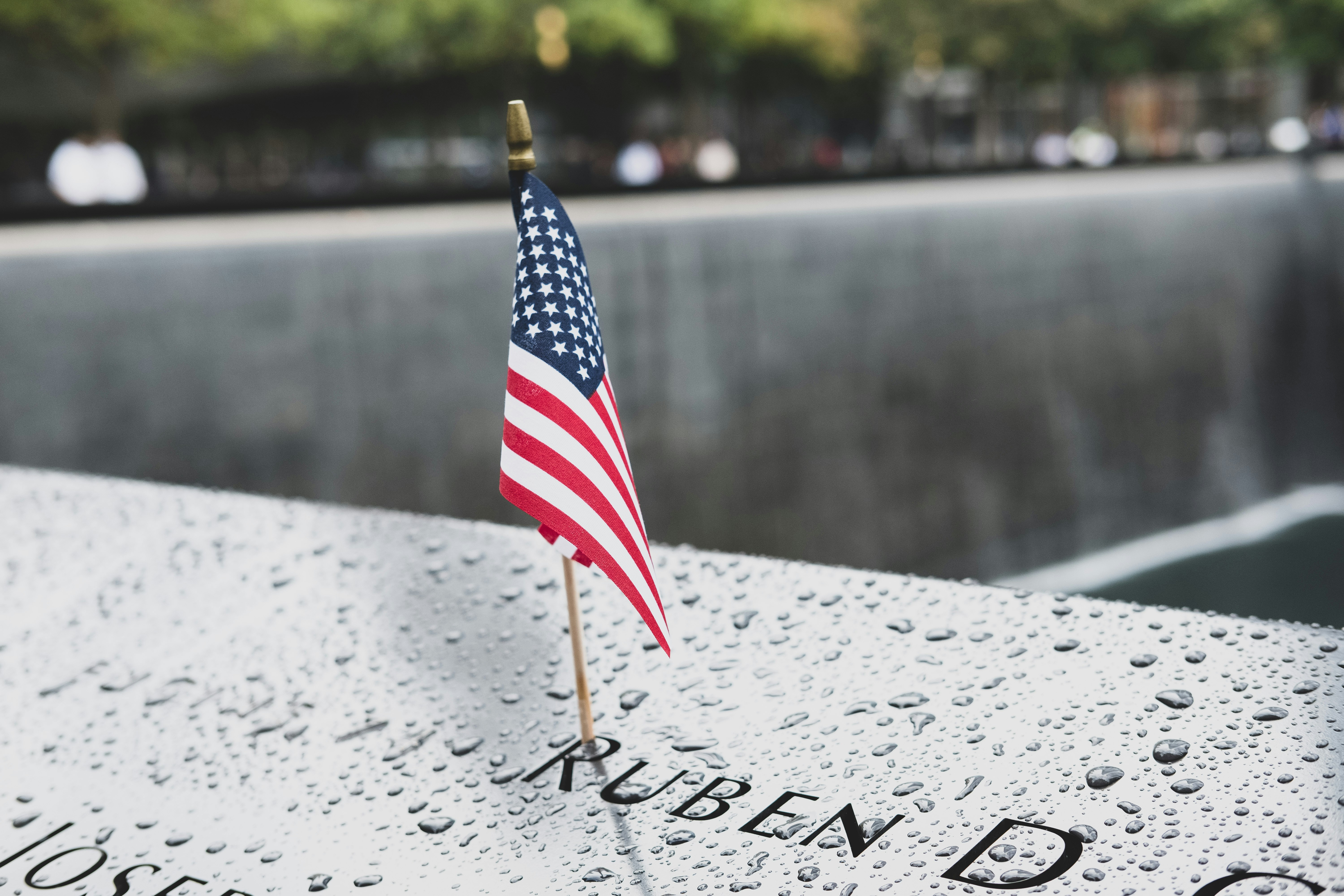
A memorial honoring nearly 3,000 Americans murdered on September 11 should be one of them. It should be a place for grief, remembrance, gratitude, and reverence. Families who have carried that loss for 25 years deserve something increasingly rare in American public life: a moment in which their pain is not reduced to another political opportunity.
That is why images of Alexandria Ocasio-Cortez and New York City Mayor Zohran Mamdani smiling and laughing together during the 25th anniversary commemoration drew criticism. A photograph cannot reveal the context of every conversation or establish what prompted a smile. But juxtaposed with grieving families at Ground Zero, the moment raised a larger question worth asking: Does American culture still recognize that some things should be treated as sacred?
These are exactly the kinds of cultural questions worth examining on Real Life Network and The Daniel Cohen Show, where the headlines are considered alongside the biblical truths that should shape how Christians understand them.
Leadership Requires More Than the Right Policies
Public leadership is not merely about legislation, budgets, speeches, or elections. Leadership also requires understanding the human consequences behind public events.
That principle extends far beyond a single 9/11 ceremony.
When thirteen American service members were killed during the 2021 withdrawal from Afghanistan, controversy followed images of President Joe Biden appearing to check his watch during the dignified transfer ceremony at Dover Air Force Base. Biden later disputed some characterizations of the moment, but Gold Star families publicly described feeling disrespected.
Politics can make people remarkably selective about empathy. When someone on the other side suffers, compassion becomes conditional. When an uncomfortable tragedy threatens a preferred narrative, attention shifts somewhere else.
Christians cannot adopt that standard.
Human dignity does not change according to political usefulness. A child killed in an act of violence matters. A soldier returned home in a flag-draped casket matters. A family still grieving someone murdered on September 11 matters. An immigrant victim matters. An American citizen victim matters. Political affiliation does not determine the value of a human life.
A healthy society should be capable of looking at suffering and seeing a human being before seeing a political opportunity.
Jesus warned that a time would come when “the love of many will grow cold” (Matthew 24:12). That description should make Christians examine more than the behavior of politicians. It should make believers examine their own hearts.
Have politics made compassion selective? Has outrage become entertainment? Have human tragedies become useful primarily when they help defeat the other side?
If so, something far more important than an election is being lost.
Biblical Language Cannot Become Political Branding
The same problem appears when Christianity itself becomes a political instrument.
Texas politician James Talarico has increasingly incorporated Christian language into his political message. In one recent appearance, he invoked Matthew 25 while arguing that Jesus would condemn senators over food assistance, Medicaid, and deportations.
Christians should welcome politicians talking seriously about Scripture. But biblical vocabulary does not automatically make an argument biblical.
Matthew 25 unquestionably demonstrates Christ's concern for the vulnerable. Christians should care about hungry people, strangers, the sick, prisoners, and those suffering around them. But translating those commands directly into support for a particular government program requires an additional political argument. Christians can share the same biblical concern while disagreeing about which policies best address it.
The same principle applies to immigration.
Scripture repeatedly commands God's people to care for foreigners and strangers. Scripture also recognizes nations, governing authorities, boundaries, and civil order. Romans 13 gives government genuine authority, while Acts 17:26 speaks of God determining nations and their dwelling places.
Neither side gets to erase the passages that complicate its politics.
Scripture should judge political convictions. Political convictions should never be allowed to rewrite Scripture.
That requires biblical literacy.
A politician who can quote a verse fluently may still misuse it. A conservative can misuse Scripture just as easily as a progressive. Christians who know only fragments of the Bible become vulnerable to anyone capable of wrapping a political agenda in Christian vocabulary.
Read the Word. Know the context. Test the argument.
Courage Means Refusing to Follow the Crowd
There is another quality disappearing from American life: the courage to stand alone.
The Lindsay Clancy case offers a difficult example. Clancy admitted killing her three young children but mounted an insanity defense. Her 2026 trial ended in a mistrial after eleven jurors favored acquittal and one juror held out.
According to another juror who later discussed the deliberations publicly, the lone holdout was a Black man.
Whatever conclusions people reach about the complicated legal questions surrounding mental illness and criminal responsibility, there is something worth recognizing in anyone willing to maintain a sincerely held conviction while an entire room pressures him to surrender it.
Standing with the crowd is easy. Standing alone costs something.
That lesson reaches far beyond a courtroom.
Christians will increasingly encounter moments when biblical convictions are unpopular, unfashionable, or professionally inconvenient. There will be pressure to remain silent because speaking could cost friendships, opportunities, influence, or reputation.
Conviction means deciding beforehand that truth matters more.
That does not grant permission to be reckless or cruel. Courage without humility quickly becomes arrogance. But humility without courage can become cowardice disguised as kindness.
Christian conviction requires both: the humility to recognize when we are wrong and the courage to stand when God's truth is clear.
America does not merely need better political messaging. It needs adults capable of recognizing sacred things, leaders who understand the human cost of their decisions, Christians who know Scripture well enough to recognize when it is being manipulated, and ordinary people willing to stand for truth when standing becomes uncomfortable.
Politics will continue changing. Candidates will come and go. Headlines that seem enormous today will eventually disappear.
The deeper question is what kind of people Americans are becoming in the process.
When nothing is sacred, everything becomes political. Christians should resist that transformation by recovering reverence, compassion, biblical discernment, and courage.
Continue examining the cultural and political stories shaping America through a biblical worldview on The Daniel Cohen Show, streaming free on Real Life Network.
World News
25 min
New Yorkers Gather over 100,000 Signatures to Exclude Mamdani from 9/11 Ceremony
As New York marks the 25th anniversary of September 11, families of 9/11 victims and other critics are calling for Mayor Zohran Mamdani to stay away from the memorial, arguing that the day should remain centered on those who were lost and the families who still carry that grief.
The mayor of New York City’s presence will not be welcomed by all at the metropolis’s upcoming 9/11 memorial service. “I am not asking politely, I am demanding” New York City Councilmember Vickie Paladino (R) asserted from the steps of New York City Hall on Tuesday, “that he not show his face on that sacred ground.” The councilwoman, along with many others in the Big Apple, has made one thing clear: they do not want the mayor to be present at the event on Friday.
The ceremony to be held is the official 25th anniversary 9/11 commemoration at the World Trade Center Memorial Plaza and is a private event for families who lost loved ones on that day. On Tuesday, Forbes reported that a change.org petition created by relatives of 9/11 victims has received over 100,000 signatures to exclude Mamdani from the event.
This resistance is largely the result of Mamdani’s affiliation with Ramzi Kassem, who Mamdani appointed as the city’s chief legal counsel. In the past, Kassem represented a convicted al-Qaeda member whose brother-in-law was one of the 9/11 plane hijackers. The mayor drew criticism last Friday when video circulated of Mamdani signaling for the symbolic pen he had just used to authorize an executive order regarding 9/11 at city hall to be given to Kassem.
“That was a message to each and every one of us,” Paladino said about the pen, and she stood in the sea of those gathered at the city hall. “Cryptic as it is, but read through the lines. What’s going on here at City Hall and what we got representing us at City Hall, they do not belong on sacred ground. I could go through a list of people that he associates himself with and continues to associate himself with. We, the people, do not care for Zohran Mamdani.”
Robert Maginnis, retired U.S. Army lieutenant colonel and senior fellow for National Security at Family Research Council, told The Washington Stand that the country can never lose sight of the effects of the tragedy that took place 25 years ago.
“What should not be lost in the political controversy is the extraordinary emotional significance of September 11. The memorial ceremony belongs first and foremost to the nearly 3,000 people who were murdered, the families who still live with that loss, the first responders and service members whose lives were changed by what followed, and a nation that promised never to forget. Anyone who participates in that ceremony should do so with humility and with an appreciation for just how deeply those memories still run.”
Charles Wolf, a man who lost his wife in the North Tower attack, also announced at city hall that he did not want Mamdani to attend: “We don’t want a mayor who only wants to be there for the publicity. This mayor is not serving us. He’s serving himself,” he shared.
“We are asking, respectfully, that he not show up even though there is going to be other politicians there. These are the politicians that helped us, pushed beneficial laws through, and literally held our hand during that time. Mayor Mamdani has not shown any of that. None of it. He just wants to be there because he wants to be there.”
Rudy Guiliani, the former mayor of New York City during the attack on the World Trade Center, also spoke against Mamdani’s planned attendance at the event. “Frankly, whatever he’d like to say, he doesn’t agree that Sept. 11 was an Islamic terrorist attack on the United States of America,” Giuliani told Newsmax in an interview on Sunday. “Having lost friends there, and being very close to many of the families, it offends me that he’s coming.”
Maginnis said that his experiences in the post-9/11 world, including working at the Pentagon in the Department of the Army, have shaped his perception of the tragedy. “Those experiences have given me an enduring appreciation for what September 11 means to the families of the victims, to those who served in the years that followed, and to millions of Americans who remember the fear, anger, and grief of that day.”
“That is the context in which I view the controversy surrounding Mayor Zohran Mamdani and his chief counsel, Ramzi Kassem,” he added. “Kassem’s prior representation of a terrorism defendant has become a particular point of contention for some 9/11 families. At the same time, representing a criminal defendant should not, by itself, be equated with sharing that defendant’s beliefs or actions.”
This article was originally written by Quinn Delamater and published on The Washington Stand. For more content like this, visit Real Life Network.
World News
25 min
What Happens When a Nation Forgets Its Enemies
As America celebrates 250 years of independence, a deeper question emerges: Can a nation remain free if it loses the ability to recognize its enemies? History shows that freedom depends not only on military strength but also on moral clarity and discernment.
America's 250th birthday should have been a celebration of freedom, sacrifice, and the enduring promise of the American experiment. Instead, it exposed a growing divide over what America is and whether it is even worth celebrating. As explored on The Daniel Cohen Show, that debate goes far beyond politics. It raises a far more important question: What happens when a nation loses the ability to recognize its enemies? History offers a sobering answer. Nations rarely lose their freedoms because they lack resources or military strength. They lose them when they lose the clarity to distinguish truth from deception, allies from adversaries, and liberty from tyranny. Watch more biblical news and cultural analysis anytime on Real Life Network.
Every Nation Needs the Wisdom to Recognize Its Enemies
The loudest voices are not always the wisest.
On America's 250th birthday, New York mayoral nominee Zohran Mamdani used one of the nation's most symbolic moments to focus almost exclusively on America's failures. Every nation has flaws. Honest people acknowledge that. Patriotism has never required pretending history is perfect. But gratitude and criticism are not mutually exclusive.
A mature patriot can recognize both the blessings of a nation and the mistakes it has made. The problem begins when criticism becomes the only story worth telling. That mindset slowly erodes the gratitude that has welcomed generations of immigrants seeking opportunity and freedom. Daniel's own family story illustrates the difference.
After surviving the horrors of World War II, his mother arrived in New York Harbor as a young Jewish immigrant. Like countless others before her, she watched the Statue of Liberty come into view and saw more than a monument. She saw hope.
That hope was not rooted in the belief that America was perfect. It was rooted in the knowledge that America offered something millions of people around the world desperately wanted: the opportunity to build a better future.
Gratitude for a nation's blessings does not require ignoring its failures, but forgetting its blessings guarantees those failures become the only story left to tell.
History repeatedly shows that civilizations decline long before they collapse. They first lose confidence in the very principles that made them flourish.
Confusing Friends and Enemies Comes at a Cost
Perhaps the greatest danger facing any nation is not military weakness but moral confusion.
The Cold War generation understood something that modern America increasingly seems to forget. Not every ideology deserves equal respect. Some ideas are fundamentally incompatible with freedom.
President Ronald Reagan understood that reality when he confronted Soviet communism with moral clarity rather than diplomatic ambiguity. His famous challenge to Mikhail Gorbachev to "tear down this wall" was more than memorable rhetoric. It reflected a willingness to identify an enemy without apology.
That same clarity appears increasingly absent today.
Iran openly funds terrorism, threatens Israel's destruction, and continues allowing chants of "Death to America" to echo through public demonstrations. Those are not misunderstandings. They are declarations.
Yet public debate increasingly treats those realities as negotiable.
Even cultural institutions have become hesitant to speak plainly about radical Islamic terrorism. That hesitation helps explain why a film like Citizen Vigilante has generated so much attention. Whether viewers ultimately praise or criticize the movie is almost secondary. Its popularity suggests many Americans are hungry for stories that acknowledge threats they believe have been ignored.
A nation that cannot clearly identify its enemies will eventually struggle to defend the freedoms those enemies seek to destroy.
Discernment has never been optional. It is essential for survival.
Readers interested in more biblical analysis of today's headlines can explore additional programming on Real Life Network.
Freedom Requires More Than Military Strength
America has overcome extraordinary challenges during the past 250 years. Civil war. Economic depression. World wars. Terrorism. Political upheaval.
The nation's endurance has never depended solely on military power or economic success. It has depended on a shared understanding that freedom is worth defending. That defense begins with truth.
It requires recognizing when destructive ideologies are repackaged under more appealing language. It requires understanding that propaganda often succeeds by making dangerous ideas sound compassionate. And it requires remembering that evil rarely announces itself honestly.
Scripture repeatedly calls believers to exercise discernment. Not fear. Not paranoia. Discernment. The ability to distinguish good from evil has always been one of God's expectations for His people. That principle applies as much to nations as it does to individuals.
America's greatest strength has never been that it avoided every mistake. Its strength has been the willingness to confront threats without losing confidence in the ideals that made the nation worth defending.
Freedom survives only when people possess the courage to recognize evil before it becomes impossible to ignore.
As America begins its next 250 years, that lesson may be more important than ever. Political parties will change. Leaders will come and go. International conflicts will rise and fall.
But the need for wisdom, gratitude, courage, and discernment will remain constant. The future of a free society depends not only on the enemies outside its borders but also on whether its citizens still possess the clarity to recognize them.
Watch the full discussion on The Daniel Cohen Show and explore more biblical news and cultural commentary anytime on Real Life Network.
World News
25 min
New York Politics, Anti-Israel Activism, and the Questions Many Leaders Avoid
From New York City politics and anti-Israel activism to major races in Texas and California, recent events reveal growing debates over leadership, identity, faith, and the future direction of American culture.
Politics, culture, Israel, religious liberty, and the future of Western values continue to dominate headlines across the United States. Through the reporting and analysis featured on Real Life Network and The Daniel Cohen Show, these stories are viewed through a biblical worldview that seeks to understand not only what is happening, but why it matters. Recent developments in New York, Texas, California, and beyond reveal growing debates about leadership, identity, anti-Semitism, and the direction of American culture.
While the stories may seem unrelated at first glance, a common thread runs through many of them. Increasingly, voters are questioning whether political leaders truly represent the values they claim to defend.
Political Branding Meets Public Scrutiny
Political campaigns are built on image. Candidates work tirelessly to present themselves as authentic, relatable, and trustworthy. Yet in an era where information moves instantly, public figures face unprecedented scrutiny.
The controversy surrounding Maine Senate candidate Graham Plattner illustrates that reality. Questions surrounding past behavior, judgment, and personal conduct have become central to public discussions about his candidacy. While voters ultimately decide whether such issues matter, campaigns increasingly discover that personal credibility often becomes inseparable from political messaging.
The same dynamic is unfolding in Texas.
James Tallarico has received significant attention from Democrats searching for a statewide candidate capable of appealing to younger voters and progressive activists. Yet questions surrounding his positions on gender, abortion, faith, and cultural issues continue generating debate among Texans who view those issues as central rather than secondary.
Voters are increasingly evaluating candidates through the lens of worldview rather than party affiliation alone.
This shift helps explain why campaigns increasingly focus on cultural issues. For many Americans, questions surrounding family, faith, education, biological reality, and religious liberty feel far more immediate than traditional partisan talking points.
The result is a political environment where authenticity matters more than carefully crafted messaging.
For more analysis of politics, culture, and current events through a biblical lens, viewers continue turning to Real Life Network and The Daniel Cohen Show for thoughtful reporting grounded in truth.
New York's Direction Raises Larger Questions
Nowhere are these cultural tensions more visible than New York City.
The decision by Mayor Zohran Mamdani not to participate in the city's Israel Day Parade generated significant controversy. For decades, New York's leaders have recognized the city's historic connection to its Jewish community, which remains the largest Jewish population outside of Israel.
That history makes symbolic decisions matter.
Supporters argue Mamdani is simply remaining consistent with his views on Israel. Critics argue the decision reflects a broader hostility toward the Jewish state and raises concerns about the future relationship between city leadership and New York's Jewish community.
The discussion extends beyond one parade.
Recent years have witnessed a dramatic increase in anti-Semitic incidents across North America and Europe. University campuses, public demonstrations, and social media platforms have become battlegrounds where debates about Israel often spill over into hostility toward Jewish people themselves.
A society cannot tolerate hostility toward one group without eventually weakening its commitment to human dignity for all groups.
The challenge is compounded by the rise of ideological coalitions that often appear united politically despite holding fundamentally different worldviews.
This reality became increasingly visible through public appearances involving progressive politicians and activist groups whose beliefs diverge sharply on issues such as women's rights, religious liberty, sexual ethics, and freedom of expression.
Yet political alliances continue forming because shared political objectives often outweigh philosophical differences.
That trend deserves careful examination.
California, Culture, and the Future of Civic Leadership
While New York grapples with questions surrounding identity and representation, California finds itself confronting a different set of challenges.
Crime, homelessness, affordability, public safety, and government accountability remain dominant concerns throughout the state. Those frustrations have created opportunities for outsider candidates willing to challenge entrenched political systems.
The rise of Spencer Pratt's mayoral campaign in Los Angeles reflects this dynamic. What began as an unconventional candidacy has gained traction by focusing attention on issues many residents experience every day.
The campaign's appeal is not primarily ideological.
It is practical.
Voters increasingly want solutions to visible problems rather than explanations for why those problems continue to exist.
The same reality shapes the California governor's race. As Democrats continue searching for their preferred candidate, Republicans face pressure to consolidate support behind a candidate capable of advancing to the general election.
Political success ultimately depends upon whether leaders address the realities citizens encounter in everyday life.
This broader dissatisfaction extends beyond California. Across the country, Americans continue expressing concern about inflation, public safety, education, border security, and trust in institutions.
Those concerns explain why political outsiders continue finding support despite lacking traditional political credentials.
Citizens are searching for leaders who acknowledge reality rather than redefine it.
The Hope Beyond Politics
Politics matters because ideas matter. Elections have consequences. Leadership matters.
But politics cannot solve humanity's deepest problem.
Scripture teaches that every person stands in need of reconciliation with God. No government, political movement, or cultural trend can repair what sin has broken. That is why Jesus Christ came into the world. He lived the perfect life sinners could never live, died on the cross for sinners, and rose again from the grave.
Through repentance and faith in Christ, forgiveness and eternal life are available to all who believe.
That hope remains greater than any election, political movement, or cultural controversy.
For more biblically grounded reporting and analysis, visit Real Life Network and watch The Daniel Cohen Show.
Related Articles
World News
25 min
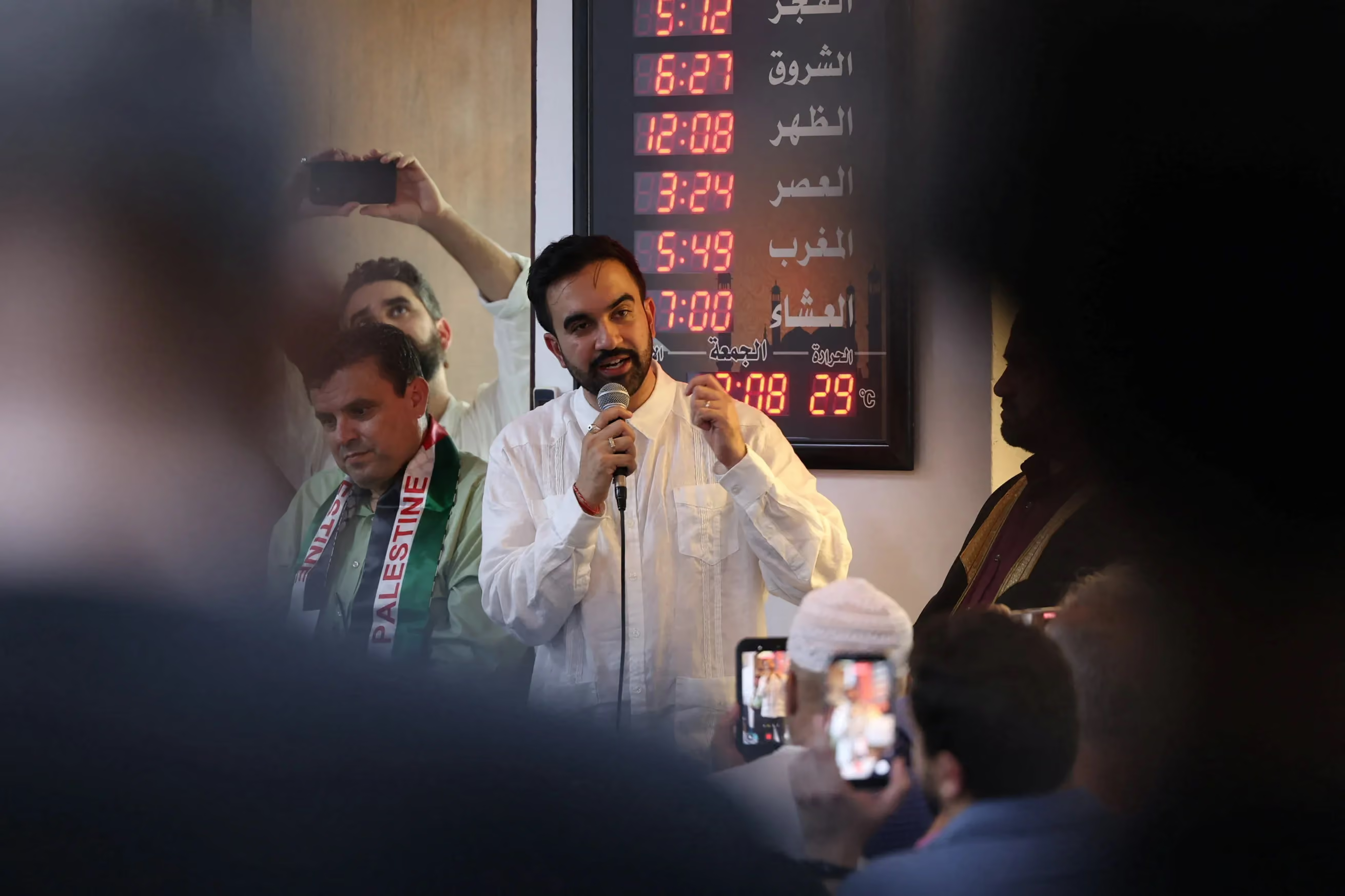
New York’s Fall: Zoran Mamdani, Cultural Chaos, and Biblical Discernment
Daniel Cohen exposes how radical politics, gender confusion, and rising antisemitism reveal a deeper spiritual battle. This episode calls believers to return to Scripture, think clearly, and stand firm in biblical truth amid cultural chaos.
Cultural Chaos from City Hall to the Locker Room
Mamdani never hid his agenda. He promised rent freezes, city-owned grocery stores, free health care for everyone, and the power for the city to seize private buildings from “bad landlords.” Daniel calls it what it is: Marxism—wrapped in compassion, funded by taxpayers far beyond New York.
At the same time, America is approving madness in its most vulnerable spaces. Cohen revisits the Gold’s Gym story of Tish Hyman, a black lesbian woman who was naked in the women’s locker room when a biological man walked in claiming to be a woman. When she objected, she was removed from the gym. He stayed.
The “most oppressed” in our culture are no longer the women who feel unsafe. They are the men who claim to be women and demand access to female spaces—even after a violent past. That is not compassion. It is confusion. Scripture says, “God is not a God of confusion but of peace” (1 Corinthians 14:33).
This same spirit of confusion shows up on the political right. Daniel confronts influential conservatives who platform open antisemites like Nick Fuentes without pushback. When Tucker Carlson gives a soft interview to a Holocaust denier and tells critics to “buzz off,” that is not courage—it is compromise.
The irony is painful. Some voices who claim to defend Christian values mock concern about real persecution. Ted Cruz highlights Christians slaughtered in Nigeria and Sudan, and Tucker calls it “weird.” Yet believers are being burned in churches, beheaded, and hunted for their faith. If we cannot call evil what it is, the problem is not our enemies—it’s our lack of discernment.
Money, Power, and the Battle for Our Hearts
The moral breakdown runs from City Hall to Capitol Hill. President Trump proposes sending Affordable Care Act subsidies directly to citizens instead of bloated insurance companies. Chuck Schumer would rather protect corporate profits than reopen government.
Then there is Nancy Pelosi. She entered Washington as a public servant and leaves with an estimated net worth in the hundreds of millions. Her stock portfolio beat top hedge funds and even Warren Buffett’s returns. When asked about insider trading, she dodged with nervous smiles.
Meanwhile, mainstream media runs tearful stories about people on government aid unable to afford eyebrow appointments. Daniel’s point is not cruelty—it is responsibility. Benefits meant to feed families were never designed to fund luxuries.
"For even when we were with you, we commanded you this: If anyone will not work, neither shall he eat." (2 Thessalonians 3:10)
Yet glimpses of sanity remain. Tennessee removed pride flags from public schools so classrooms can focus on education, not activism. Italy proposed banning face-covering Islamic garments in public, arguing that religious freedom should not create parallel societies. These are imperfect steps—but at least they recognize a truth: no nation survives when it refuses to say no to destructive ideologies.
A Biblical Response to a World on Fire
From Mamdani’s victory party to transgender men in women’s locker rooms to antisemitism and the persecution of Christians, Daniel Cohen returns to one truth: this is not political chaos—it is spiritual war.
The answer is not despair. It is not loyalty to pundits or politicians. The answer is returning to the Word of God. Genesis 1:27 tells us that God created humanity male and female. Romans 11 reminds us that God’s covenant with Israel stands. Ephesians 6 declares that our real enemies are not flesh and blood but spiritual powers of darkness.
So what should Christians do?
Wake up spiritually. Read Scripture so you can recognize lies from both left and right.
Refuse cowardice. When you see antisemitism or the abuse of the vulnerable, speak truth in love.
Live ready. Jesus is coming again—not to rule from New York or Brussels but from Jerusalem.
History is not falling apart. It is falling into place under His authority. Stay grounded in Scripture, stand with truth, and let your hope rest in Christ—not in the chaos of the world.
World News
25 min
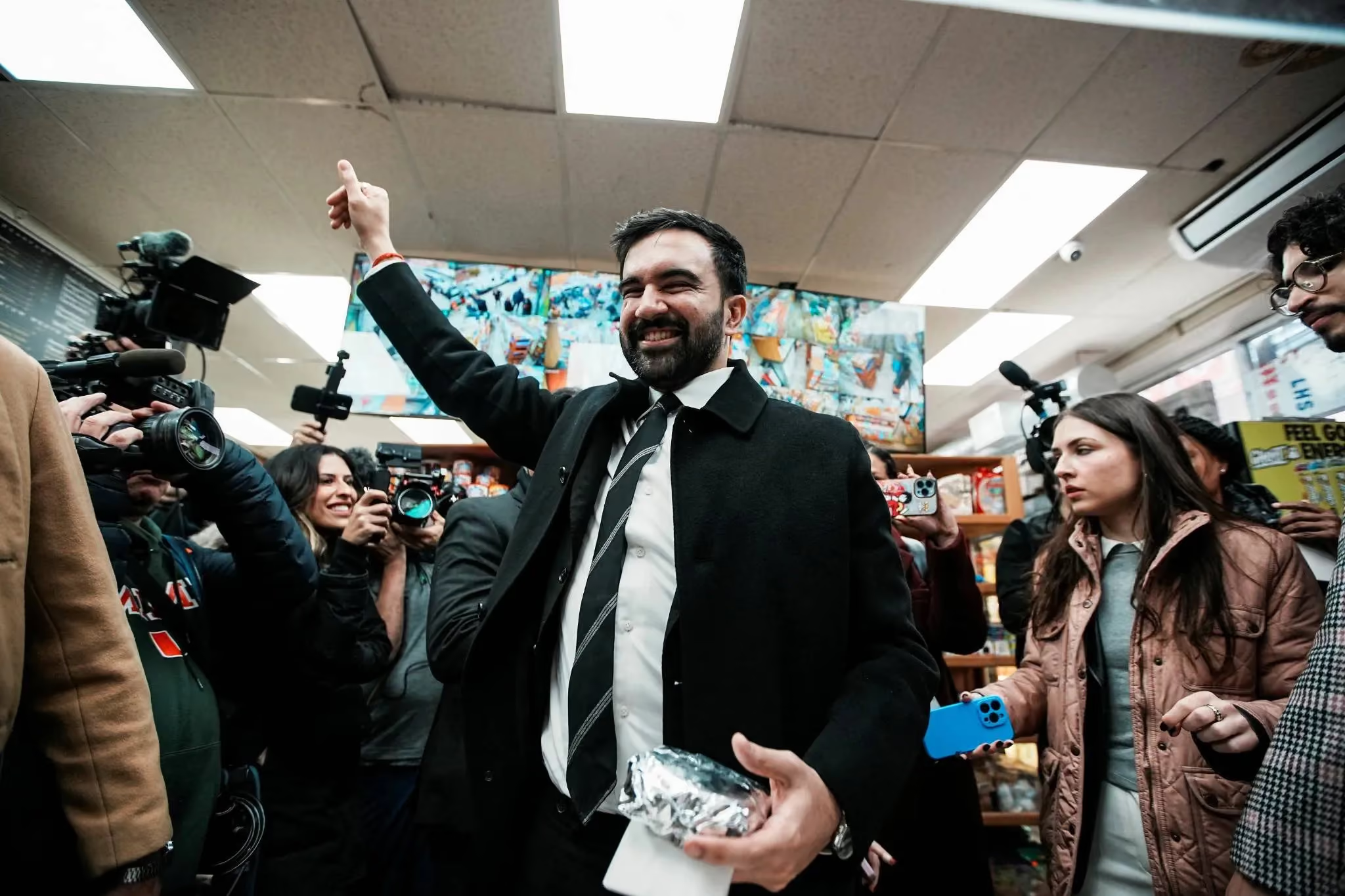
Zoran Mamdani and the Rise of Spiritual Deception
Zoran Mamdani has formed an alliance against truth. Daniel Cohen exposes how radical Islam, socialism, and deception are reshaping America and attacking Israel. This is not just politics. It is spiritual warfare.
The celebration in New York was not just political. It was spiritual. As progressive activists, socialist leaders, and Islamic radicals united behind Zoran Mamdani, the world saw an alliance that defies logic but fulfills prophecy. Islam is incompatible with the LGBTQ movement, yet both locked arms in a common cause. The contradiction reveals the deeper battle Daniel Cohen exposes on The Daniel Cohen Show on Real Life Network (RLN): the war is not merely political. It is about biblical truth, deception, and the erosion of America’s moral foundation.
A Dark Alliance: From Politics to Spiritual Warfare
Cohen describes Mamdani’s rise as more than a political victory. It is the merging of ideologies that stand against both Israel and the gospel. Islamists, socialists, and progressives are uniting under a banner of moral confusion. “This isn’t rebellion or empowerment,” Cohen says. “It’s deception.”
He recalls his mother’s journey from Haifa, Israel, to the United States, weeping at the sight of the Statue of Liberty. That moment symbolized hope, gratitude, and faith in God’s providence. That same statue, Cohen warns, now stands before a generation celebrating oppression in the name of freedom. “In their version,” he says, “Lady Liberty’s face would be covered, her freedom silenced.”
This strange alliance of Marxism and Islamism—a “Red-Green Alliance”—has become a spiritual warfare front line. From the streets of New York City to college campuses across America, the same deception spreads: anti-Israel propaganda, antisemitism, and hatred cloaked as justice.
Truth Under Attack: From New York to Israel
Cohen highlights what he calls “a coordinated movement against biblical worldview and Israel’s covenant promises.” Mamdani’s supporters include those who defend Hamas, deny Zionism, and excuse jihad under the banner of liberation. It is the same spirit that fuels unrest on college campuses and influences the progressive left, mainstream media, and even parts of the conservative movement.
He quotes Scripture, reminding viewers that “God is on the throne” and that “nothing happens outside of His purview.” The chaos in America’s streets, midterm elections, and social divisions mirror a deeper blindness, one that refuses to call evil what it is.
Cohen points to Pastor Jack Hibbs, founder of Real Life Network, and Pastor Tom Hughes, who stood at the Nova music festival memorial near Gaza. Their messages echo the biblical truth that God’s promises to Israel are irrevocable. Nations may rage, but His covenant stands.
The Great Deception and the Call to Discernment
While radicals chant for Sharia law and progressives cheer socialism, Cohen calls believers to recognize what is truly happening: a spiritual war disguised as politics. “When Marx meets Muhammad, freedom dies twice,” he warns. The problem is not only ideological but theological. Humanity keeps trying to build a utopia without God, and the result is always tyranny.
He also warns conservatives not to trade discernment for celebrity influence. Voices like Tucker Carlson and others in the GOP may speak truth at times but can also minimize real evil, like antisemitism or persecution of Christians in Africa and the Middle East. “We must stand for truth even when it costs something,” Cohen says.
He quotes 2 Chronicles 16:9: “The eyes of the Lord run to and fro throughout the earth, to show Himself strong on behalf of those whose heart is loyal to Him.” The real question is not who wins elections but who will stand for truth when compromise is easier.
The Hope of the Gospel
The world is spiraling in confusion because it has rejected the Creator. But there is hope, not in politics or protest, but in the cross of Jesus Christ. Humanity’s deepest problem is not cultural decay or global conflict. It is sin. And the only remedy is redemption.
Through His death and resurrection, Jesus Christ conquered sin, defeated death, and offers forgiveness to all who repent and believe. True freedom does not come from Trump, Biden, or any human government. It comes from the Savior who said, “If the Son sets you free, you will be free indeed.”
Daniel Cohen ends his broadcast the same way he lives: calling believers to stand with Israel, defend truth, love courageously, and live ready for Christ’s return.
Thank you! Your submission has been received!
Oops! Something went wrong while submitting the form.
World News
There are moments that should transcend politics.
A memorial honoring nearly 3,000 Americans murdered on September 11 should be one of them. It should be a place for grief, remembrance, gratitude, and reverence. Families who have carried that loss for 25 years deserve something increasingly rare in American public life: a moment in which their pain is not reduced to another political opportunity.
That is why images of Alexandria Ocasio-Cortez and New York City Mayor Zohran Mamdani smiling and laughing together during the 25th anniversary commemoration drew criticism. A photograph cannot reveal the context of every conversation or establish what prompted a smile. But juxtaposed with grieving families at Ground Zero, the moment raised a larger question worth asking: Does American culture still recognize that some things should be treated as sacred?
These are exactly the kinds of cultural questions worth examining on Real Life Network and The Daniel Cohen Show, where the headlines are considered alongside the biblical truths that should shape how Christians understand them.
Leadership Requires More Than the Right Policies
Public leadership is not merely about legislation, budgets, speeches, or elections. Leadership also requires understanding the human consequences behind public events.
That principle extends far beyond a single 9/11 ceremony.
When thirteen American service members were killed during the 2021 withdrawal from Afghanistan, controversy followed images of President Joe Biden appearing to check his watch during the dignified transfer ceremony at Dover Air Force Base. Biden later disputed some characterizations of the moment, but Gold Star families publicly described feeling disrespected.
Politics can make people remarkably selective about empathy. When someone on the other side suffers, compassion becomes conditional. When an uncomfortable tragedy threatens a preferred narrative, attention shifts somewhere else.
Christians cannot adopt that standard.
Human dignity does not change according to political usefulness. A child killed in an act of violence matters. A soldier returned home in a flag-draped casket matters. A family still grieving someone murdered on September 11 matters. An immigrant victim matters. An American citizen victim matters. Political affiliation does not determine the value of a human life.
A healthy society should be capable of looking at suffering and seeing a human being before seeing a political opportunity.
Jesus warned that a time would come when “the love of many will grow cold” (Matthew 24:12). That description should make Christians examine more than the behavior of politicians. It should make believers examine their own hearts.
Have politics made compassion selective? Has outrage become entertainment? Have human tragedies become useful primarily when they help defeat the other side?
If so, something far more important than an election is being lost.
Biblical Language Cannot Become Political Branding
The same problem appears when Christianity itself becomes a political instrument.
Texas politician James Talarico has increasingly incorporated Christian language into his political message. In one recent appearance, he invoked Matthew 25 while arguing that Jesus would condemn senators over food assistance, Medicaid, and deportations.
Christians should welcome politicians talking seriously about Scripture. But biblical vocabulary does not automatically make an argument biblical.
Matthew 25 unquestionably demonstrates Christ's concern for the vulnerable. Christians should care about hungry people, strangers, the sick, prisoners, and those suffering around them. But translating those commands directly into support for a particular government program requires an additional political argument. Christians can share the same biblical concern while disagreeing about which policies best address it.
The same principle applies to immigration.
Scripture repeatedly commands God's people to care for foreigners and strangers. Scripture also recognizes nations, governing authorities, boundaries, and civil order. Romans 13 gives government genuine authority, while Acts 17:26 speaks of God determining nations and their dwelling places.
Neither side gets to erase the passages that complicate its politics.
Scripture should judge political convictions. Political convictions should never be allowed to rewrite Scripture.
That requires biblical literacy.
A politician who can quote a verse fluently may still misuse it. A conservative can misuse Scripture just as easily as a progressive. Christians who know only fragments of the Bible become vulnerable to anyone capable of wrapping a political agenda in Christian vocabulary.
Read the Word. Know the context. Test the argument.
Courage Means Refusing to Follow the Crowd
There is another quality disappearing from American life: the courage to stand alone.
The Lindsay Clancy case offers a difficult example. Clancy admitted killing her three young children but mounted an insanity defense. Her 2026 trial ended in a mistrial after eleven jurors favored acquittal and one juror held out.
According to another juror who later discussed the deliberations publicly, the lone holdout was a Black man.
Whatever conclusions people reach about the complicated legal questions surrounding mental illness and criminal responsibility, there is something worth recognizing in anyone willing to maintain a sincerely held conviction while an entire room pressures him to surrender it.
Standing with the crowd is easy. Standing alone costs something.
That lesson reaches far beyond a courtroom.
Christians will increasingly encounter moments when biblical convictions are unpopular, unfashionable, or professionally inconvenient. There will be pressure to remain silent because speaking could cost friendships, opportunities, influence, or reputation.
Conviction means deciding beforehand that truth matters more.
That does not grant permission to be reckless or cruel. Courage without humility quickly becomes arrogance. But humility without courage can become cowardice disguised as kindness.
Christian conviction requires both: the humility to recognize when we are wrong and the courage to stand when God's truth is clear.
America does not merely need better political messaging. It needs adults capable of recognizing sacred things, leaders who understand the human cost of their decisions, Christians who know Scripture well enough to recognize when it is being manipulated, and ordinary people willing to stand for truth when standing becomes uncomfortable.
Politics will continue changing. Candidates will come and go. Headlines that seem enormous today will eventually disappear.
The deeper question is what kind of people Americans are becoming in the process.
When nothing is sacred, everything becomes political. Christians should resist that transformation by recovering reverence, compassion, biblical discernment, and courage.
Continue examining the cultural and political stories shaping America through a biblical worldview on The Daniel Cohen Show, streaming free on Real Life Network.
25 min
September 15, 2026
Daniel Cohen
World News
The mayor of New York City’s presence will not be welcomed by all at the metropolis’s upcoming 9/11 memorial service. “I am not asking politely, I am demanding” New York City Councilmember Vickie Paladino (R) asserted from the steps of New York City Hall on Tuesday, “that he not show his face on that sacred ground.” The councilwoman, along with many others in the Big Apple, has made one thing clear: they do not want the mayor to be present at the event on Friday.
The ceremony to be held is the official 25th anniversary 9/11 commemoration at the World Trade Center Memorial Plaza and is a private event for families who lost loved ones on that day. On Tuesday, Forbes reported that a change.org petition created by relatives of 9/11 victims has received over 100,000 signatures to exclude Mamdani from the event.
This resistance is largely the result of Mamdani’s affiliation with Ramzi Kassem, who Mamdani appointed as the city’s chief legal counsel. In the past, Kassem represented a convicted al-Qaeda member whose brother-in-law was one of the 9/11 plane hijackers. The mayor drew criticism last Friday when video circulated of Mamdani signaling for the symbolic pen he had just used to authorize an executive order regarding 9/11 at city hall to be given to Kassem.
“That was a message to each and every one of us,” Paladino said about the pen, and she stood in the sea of those gathered at the city hall. “Cryptic as it is, but read through the lines. What’s going on here at City Hall and what we got representing us at City Hall, they do not belong on sacred ground. I could go through a list of people that he associates himself with and continues to associate himself with. We, the people, do not care for Zohran Mamdani.”
Robert Maginnis, retired U.S. Army lieutenant colonel and senior fellow for National Security at Family Research Council, told The Washington Stand that the country can never lose sight of the effects of the tragedy that took place 25 years ago.
“What should not be lost in the political controversy is the extraordinary emotional significance of September 11. The memorial ceremony belongs first and foremost to the nearly 3,000 people who were murdered, the families who still live with that loss, the first responders and service members whose lives were changed by what followed, and a nation that promised never to forget. Anyone who participates in that ceremony should do so with humility and with an appreciation for just how deeply those memories still run.”
Charles Wolf, a man who lost his wife in the North Tower attack, also announced at city hall that he did not want Mamdani to attend: “We don’t want a mayor who only wants to be there for the publicity. This mayor is not serving us. He’s serving himself,” he shared.
“We are asking, respectfully, that he not show up even though there is going to be other politicians there. These are the politicians that helped us, pushed beneficial laws through, and literally held our hand during that time. Mayor Mamdani has not shown any of that. None of it. He just wants to be there because he wants to be there.”
Rudy Guiliani, the former mayor of New York City during the attack on the World Trade Center, also spoke against Mamdani’s planned attendance at the event. “Frankly, whatever he’d like to say, he doesn’t agree that Sept. 11 was an Islamic terrorist attack on the United States of America,” Giuliani told Newsmax in an interview on Sunday. “Having lost friends there, and being very close to many of the families, it offends me that he’s coming.”
Maginnis said that his experiences in the post-9/11 world, including working at the Pentagon in the Department of the Army, have shaped his perception of the tragedy. “Those experiences have given me an enduring appreciation for what September 11 means to the families of the victims, to those who served in the years that followed, and to millions of Americans who remember the fear, anger, and grief of that day.”
“That is the context in which I view the controversy surrounding Mayor Zohran Mamdani and his chief counsel, Ramzi Kassem,” he added. “Kassem’s prior representation of a terrorism defendant has become a particular point of contention for some 9/11 families. At the same time, representing a criminal defendant should not, by itself, be equated with sharing that defendant’s beliefs or actions.”
This article was originally written by Quinn Delamater and published on The Washington Stand. For more content like this, visit Real Life Network.
25 min
New Yorkers Gather over 100,000 Signatures to Exclude Mamdani from 9/11 Ceremony
September 9, 2026
The Washington Stand
World News
America's 250th birthday should have been a celebration of freedom, sacrifice, and the enduring promise of the American experiment. Instead, it exposed a growing divide over what America is and whether it is even worth celebrating. As explored on The Daniel Cohen Show, that debate goes far beyond politics. It raises a far more important question: What happens when a nation loses the ability to recognize its enemies? History offers a sobering answer. Nations rarely lose their freedoms because they lack resources or military strength. They lose them when they lose the clarity to distinguish truth from deception, allies from adversaries, and liberty from tyranny. Watch more biblical news and cultural analysis anytime on Real Life Network.
Every Nation Needs the Wisdom to Recognize Its Enemies
The loudest voices are not always the wisest.
On America's 250th birthday, New York mayoral nominee Zohran Mamdani used one of the nation's most symbolic moments to focus almost exclusively on America's failures. Every nation has flaws. Honest people acknowledge that. Patriotism has never required pretending history is perfect. But gratitude and criticism are not mutually exclusive.
A mature patriot can recognize both the blessings of a nation and the mistakes it has made. The problem begins when criticism becomes the only story worth telling. That mindset slowly erodes the gratitude that has welcomed generations of immigrants seeking opportunity and freedom. Daniel's own family story illustrates the difference.
After surviving the horrors of World War II, his mother arrived in New York Harbor as a young Jewish immigrant. Like countless others before her, she watched the Statue of Liberty come into view and saw more than a monument. She saw hope.
That hope was not rooted in the belief that America was perfect. It was rooted in the knowledge that America offered something millions of people around the world desperately wanted: the opportunity to build a better future.
Gratitude for a nation's blessings does not require ignoring its failures, but forgetting its blessings guarantees those failures become the only story left to tell.
History repeatedly shows that civilizations decline long before they collapse. They first lose confidence in the very principles that made them flourish.
Confusing Friends and Enemies Comes at a Cost
Perhaps the greatest danger facing any nation is not military weakness but moral confusion.
The Cold War generation understood something that modern America increasingly seems to forget. Not every ideology deserves equal respect. Some ideas are fundamentally incompatible with freedom.
President Ronald Reagan understood that reality when he confronted Soviet communism with moral clarity rather than diplomatic ambiguity. His famous challenge to Mikhail Gorbachev to "tear down this wall" was more than memorable rhetoric. It reflected a willingness to identify an enemy without apology.
That same clarity appears increasingly absent today.
Iran openly funds terrorism, threatens Israel's destruction, and continues allowing chants of "Death to America" to echo through public demonstrations. Those are not misunderstandings. They are declarations.
Yet public debate increasingly treats those realities as negotiable.
Even cultural institutions have become hesitant to speak plainly about radical Islamic terrorism. That hesitation helps explain why a film like Citizen Vigilante has generated so much attention. Whether viewers ultimately praise or criticize the movie is almost secondary. Its popularity suggests many Americans are hungry for stories that acknowledge threats they believe have been ignored.
A nation that cannot clearly identify its enemies will eventually struggle to defend the freedoms those enemies seek to destroy.
Discernment has never been optional. It is essential for survival.
Readers interested in more biblical analysis of today's headlines can explore additional programming on Real Life Network.
Freedom Requires More Than Military Strength
America has overcome extraordinary challenges during the past 250 years. Civil war. Economic depression. World wars. Terrorism. Political upheaval.
The nation's endurance has never depended solely on military power or economic success. It has depended on a shared understanding that freedom is worth defending. That defense begins with truth.
It requires recognizing when destructive ideologies are repackaged under more appealing language. It requires understanding that propaganda often succeeds by making dangerous ideas sound compassionate. And it requires remembering that evil rarely announces itself honestly.
Scripture repeatedly calls believers to exercise discernment. Not fear. Not paranoia. Discernment. The ability to distinguish good from evil has always been one of God's expectations for His people. That principle applies as much to nations as it does to individuals.
America's greatest strength has never been that it avoided every mistake. Its strength has been the willingness to confront threats without losing confidence in the ideals that made the nation worth defending.
Freedom survives only when people possess the courage to recognize evil before it becomes impossible to ignore.
As America begins its next 250 years, that lesson may be more important than ever. Political parties will change. Leaders will come and go. International conflicts will rise and fall.
But the need for wisdom, gratitude, courage, and discernment will remain constant. The future of a free society depends not only on the enemies outside its borders but also on whether its citizens still possess the clarity to recognize them.
Watch the full discussion on The Daniel Cohen Show and explore more biblical news and cultural commentary anytime on Real Life Network.
25 min
What Happens When a Nation Forgets Its Enemies
July 6, 2026
Daniel Cohen
World News
Politics, culture, Israel, religious liberty, and the future of Western values continue to dominate headlines across the United States. Through the reporting and analysis featured on Real Life Network and The Daniel Cohen Show, these stories are viewed through a biblical worldview that seeks to understand not only what is happening, but why it matters. Recent developments in New York, Texas, California, and beyond reveal growing debates about leadership, identity, anti-Semitism, and the direction of American culture.
While the stories may seem unrelated at first glance, a common thread runs through many of them. Increasingly, voters are questioning whether political leaders truly represent the values they claim to defend.
Political Branding Meets Public Scrutiny
Political campaigns are built on image. Candidates work tirelessly to present themselves as authentic, relatable, and trustworthy. Yet in an era where information moves instantly, public figures face unprecedented scrutiny.
The controversy surrounding Maine Senate candidate Graham Plattner illustrates that reality. Questions surrounding past behavior, judgment, and personal conduct have become central to public discussions about his candidacy. While voters ultimately decide whether such issues matter, campaigns increasingly discover that personal credibility often becomes inseparable from political messaging.
The same dynamic is unfolding in Texas.
James Tallarico has received significant attention from Democrats searching for a statewide candidate capable of appealing to younger voters and progressive activists. Yet questions surrounding his positions on gender, abortion, faith, and cultural issues continue generating debate among Texans who view those issues as central rather than secondary.
Voters are increasingly evaluating candidates through the lens of worldview rather than party affiliation alone.
This shift helps explain why campaigns increasingly focus on cultural issues. For many Americans, questions surrounding family, faith, education, biological reality, and religious liberty feel far more immediate than traditional partisan talking points.
The result is a political environment where authenticity matters more than carefully crafted messaging.
For more analysis of politics, culture, and current events through a biblical lens, viewers continue turning to Real Life Network and The Daniel Cohen Show for thoughtful reporting grounded in truth.
New York's Direction Raises Larger Questions
Nowhere are these cultural tensions more visible than New York City.
The decision by Mayor Zohran Mamdani not to participate in the city's Israel Day Parade generated significant controversy. For decades, New York's leaders have recognized the city's historic connection to its Jewish community, which remains the largest Jewish population outside of Israel.
That history makes symbolic decisions matter.
Supporters argue Mamdani is simply remaining consistent with his views on Israel. Critics argue the decision reflects a broader hostility toward the Jewish state and raises concerns about the future relationship between city leadership and New York's Jewish community.
The discussion extends beyond one parade.
Recent years have witnessed a dramatic increase in anti-Semitic incidents across North America and Europe. University campuses, public demonstrations, and social media platforms have become battlegrounds where debates about Israel often spill over into hostility toward Jewish people themselves.
A society cannot tolerate hostility toward one group without eventually weakening its commitment to human dignity for all groups.
The challenge is compounded by the rise of ideological coalitions that often appear united politically despite holding fundamentally different worldviews.
This reality became increasingly visible through public appearances involving progressive politicians and activist groups whose beliefs diverge sharply on issues such as women's rights, religious liberty, sexual ethics, and freedom of expression.
Yet political alliances continue forming because shared political objectives often outweigh philosophical differences.
That trend deserves careful examination.
California, Culture, and the Future of Civic Leadership
While New York grapples with questions surrounding identity and representation, California finds itself confronting a different set of challenges.
Crime, homelessness, affordability, public safety, and government accountability remain dominant concerns throughout the state. Those frustrations have created opportunities for outsider candidates willing to challenge entrenched political systems.
The rise of Spencer Pratt's mayoral campaign in Los Angeles reflects this dynamic. What began as an unconventional candidacy has gained traction by focusing attention on issues many residents experience every day.
The campaign's appeal is not primarily ideological.
It is practical.
Voters increasingly want solutions to visible problems rather than explanations for why those problems continue to exist.
The same reality shapes the California governor's race. As Democrats continue searching for their preferred candidate, Republicans face pressure to consolidate support behind a candidate capable of advancing to the general election.
Political success ultimately depends upon whether leaders address the realities citizens encounter in everyday life.
This broader dissatisfaction extends beyond California. Across the country, Americans continue expressing concern about inflation, public safety, education, border security, and trust in institutions.
Those concerns explain why political outsiders continue finding support despite lacking traditional political credentials.
Citizens are searching for leaders who acknowledge reality rather than redefine it.
The Hope Beyond Politics
Politics matters because ideas matter. Elections have consequences. Leadership matters.
But politics cannot solve humanity's deepest problem.
Scripture teaches that every person stands in need of reconciliation with God. No government, political movement, or cultural trend can repair what sin has broken. That is why Jesus Christ came into the world. He lived the perfect life sinners could never live, died on the cross for sinners, and rose again from the grave.
Through repentance and faith in Christ, forgiveness and eternal life are available to all who believe.
That hope remains greater than any election, political movement, or cultural controversy.
For more biblically grounded reporting and analysis, visit Real Life Network and watch The Daniel Cohen Show.
Related Articles
25 min
New York Politics, Anti-Israel Activism, and the Questions Many Leaders Avoid
June 1, 2026
Daniel Cohen
World News
Cultural Chaos from City Hall to the Locker Room
Mamdani never hid his agenda. He promised rent freezes, city-owned grocery stores, free health care for everyone, and the power for the city to seize private buildings from “bad landlords.” Daniel calls it what it is: Marxism—wrapped in compassion, funded by taxpayers far beyond New York.
At the same time, America is approving madness in its most vulnerable spaces. Cohen revisits the Gold’s Gym story of Tish Hyman, a black lesbian woman who was naked in the women’s locker room when a biological man walked in claiming to be a woman. When she objected, she was removed from the gym. He stayed.
The “most oppressed” in our culture are no longer the women who feel unsafe. They are the men who claim to be women and demand access to female spaces—even after a violent past. That is not compassion. It is confusion. Scripture says, “God is not a God of confusion but of peace” (1 Corinthians 14:33).
This same spirit of confusion shows up on the political right. Daniel confronts influential conservatives who platform open antisemites like Nick Fuentes without pushback. When Tucker Carlson gives a soft interview to a Holocaust denier and tells critics to “buzz off,” that is not courage—it is compromise.
The irony is painful. Some voices who claim to defend Christian values mock concern about real persecution. Ted Cruz highlights Christians slaughtered in Nigeria and Sudan, and Tucker calls it “weird.” Yet believers are being burned in churches, beheaded, and hunted for their faith. If we cannot call evil what it is, the problem is not our enemies—it’s our lack of discernment.
Money, Power, and the Battle for Our Hearts
The moral breakdown runs from City Hall to Capitol Hill. President Trump proposes sending Affordable Care Act subsidies directly to citizens instead of bloated insurance companies. Chuck Schumer would rather protect corporate profits than reopen government.
Then there is Nancy Pelosi. She entered Washington as a public servant and leaves with an estimated net worth in the hundreds of millions. Her stock portfolio beat top hedge funds and even Warren Buffett’s returns. When asked about insider trading, she dodged with nervous smiles.
Meanwhile, mainstream media runs tearful stories about people on government aid unable to afford eyebrow appointments. Daniel’s point is not cruelty—it is responsibility. Benefits meant to feed families were never designed to fund luxuries.
"For even when we were with you, we commanded you this: If anyone will not work, neither shall he eat." (2 Thessalonians 3:10)
Yet glimpses of sanity remain. Tennessee removed pride flags from public schools so classrooms can focus on education, not activism. Italy proposed banning face-covering Islamic garments in public, arguing that religious freedom should not create parallel societies. These are imperfect steps—but at least they recognize a truth: no nation survives when it refuses to say no to destructive ideologies.
A Biblical Response to a World on Fire
From Mamdani’s victory party to transgender men in women’s locker rooms to antisemitism and the persecution of Christians, Daniel Cohen returns to one truth: this is not political chaos—it is spiritual war.
The answer is not despair. It is not loyalty to pundits or politicians. The answer is returning to the Word of God. Genesis 1:27 tells us that God created humanity male and female. Romans 11 reminds us that God’s covenant with Israel stands. Ephesians 6 declares that our real enemies are not flesh and blood but spiritual powers of darkness.
So what should Christians do?
Wake up spiritually. Read Scripture so you can recognize lies from both left and right.
Refuse cowardice. When you see antisemitism or the abuse of the vulnerable, speak truth in love.
Live ready. Jesus is coming again—not to rule from New York or Brussels but from Jerusalem.
History is not falling apart. It is falling into place under His authority. Stay grounded in Scripture, stand with truth, and let your hope rest in Christ—not in the chaos of the world.
25 min
New York’s Fall: Zoran Mamdani, Cultural Chaos, and Biblical Discernment
November 11, 2025
Daniel Cohen
World News
The celebration in New York was not just political. It was spiritual. As progressive activists, socialist leaders, and Islamic radicals united behind Zoran Mamdani, the world saw an alliance that defies logic but fulfills prophecy. Islam is incompatible with the LGBTQ movement, yet both locked arms in a common cause. The contradiction reveals the deeper battle Daniel Cohen exposes on The Daniel Cohen Show on Real Life Network (RLN): the war is not merely political. It is about biblical truth, deception, and the erosion of America’s moral foundation.
A Dark Alliance: From Politics to Spiritual Warfare
Cohen describes Mamdani’s rise as more than a political victory. It is the merging of ideologies that stand against both Israel and the gospel. Islamists, socialists, and progressives are uniting under a banner of moral confusion. “This isn’t rebellion or empowerment,” Cohen says. “It’s deception.”
He recalls his mother’s journey from Haifa, Israel, to the United States, weeping at the sight of the Statue of Liberty. That moment symbolized hope, gratitude, and faith in God’s providence. That same statue, Cohen warns, now stands before a generation celebrating oppression in the name of freedom. “In their version,” he says, “Lady Liberty’s face would be covered, her freedom silenced.”
This strange alliance of Marxism and Islamism—a “Red-Green Alliance”—has become a spiritual warfare front line. From the streets of New York City to college campuses across America, the same deception spreads: anti-Israel propaganda, antisemitism, and hatred cloaked as justice.
Truth Under Attack: From New York to Israel
Cohen highlights what he calls “a coordinated movement against biblical worldview and Israel’s covenant promises.” Mamdani’s supporters include those who defend Hamas, deny Zionism, and excuse jihad under the banner of liberation. It is the same spirit that fuels unrest on college campuses and influences the progressive left, mainstream media, and even parts of the conservative movement.
He quotes Scripture, reminding viewers that “God is on the throne” and that “nothing happens outside of His purview.” The chaos in America’s streets, midterm elections, and social divisions mirror a deeper blindness, one that refuses to call evil what it is.
Cohen points to Pastor Jack Hibbs, founder of Real Life Network, and Pastor Tom Hughes, who stood at the Nova music festival memorial near Gaza. Their messages echo the biblical truth that God’s promises to Israel are irrevocable. Nations may rage, but His covenant stands.
The Great Deception and the Call to Discernment
While radicals chant for Sharia law and progressives cheer socialism, Cohen calls believers to recognize what is truly happening: a spiritual war disguised as politics. “When Marx meets Muhammad, freedom dies twice,” he warns. The problem is not only ideological but theological. Humanity keeps trying to build a utopia without God, and the result is always tyranny.
He also warns conservatives not to trade discernment for celebrity influence. Voices like Tucker Carlson and others in the GOP may speak truth at times but can also minimize real evil, like antisemitism or persecution of Christians in Africa and the Middle East. “We must stand for truth even when it costs something,” Cohen says.
He quotes 2 Chronicles 16:9: “The eyes of the Lord run to and fro throughout the earth, to show Himself strong on behalf of those whose heart is loyal to Him.” The real question is not who wins elections but who will stand for truth when compromise is easier.
The Hope of the Gospel
The world is spiraling in confusion because it has rejected the Creator. But there is hope, not in politics or protest, but in the cross of Jesus Christ. Humanity’s deepest problem is not cultural decay or global conflict. It is sin. And the only remedy is redemption.
Through His death and resurrection, Jesus Christ conquered sin, defeated death, and offers forgiveness to all who repent and believe. True freedom does not come from Trump, Biden, or any human government. It comes from the Savior who said, “If the Son sets you free, you will be free indeed.”
Daniel Cohen ends his broadcast the same way he lives: calling believers to stand with Israel, defend truth, love courageously, and live ready for Christ’s return.
25 min
Zoran Mamdani and the Rise of Spiritual Deception
November 10, 2025
Daniel Cohen