
Stream Real Life Network Now

WATCH NOW
Spiritual Growth


World News
25 min
Unhappiness and Isolation Are Rising among Young People, but Those Who Are Religious Are Thriving
As loneliness and unhappiness rise among young Americans, research links religious faith and marriage with greater happiness, stronger relationships, and better educational outcomes, while Christian leaders urge Gen Z to put biblical truth into practice.
Social science data continues to emerge showing that America’s young people are increasingly non-religious, isolated, and unhappy. But the data also shows that young people who are religious are thriving, with higher levels of happiness, more friends, are more likely to be married, and better educational outcomes than their non-religious peers.
Research released by the Institute for Family Studies (IFS) notes that since 2000, reports of unhappiness among young people aged 20 to 35 has more than doubled, surging from 11% to 23%. This has coincided with an era where young people are isolating at unprecedented levels as they immerse themselves in screens, pornography, social media, video games, and AI chatbots. “Socializing among young men and women is down more than 50%, from 12 hours to 5 hours per week,” IFS observes. Unsurprisingly, this has led to a precipitous decline in relationships and dating, with two thirds of young people not in serious relationships and teen dating down 50%.
As unhappiness and loneliness has risen among young people, so too has secularism. In March, Arizona Christian University’s Cultural Research Center reported that only 1% of Gen Z (ages 18 to 22) and 4% of adults in general has a biblical worldview (defined as “individuals whose beliefs and behaviors are consistently aligned with biblical principles”). The figure is down significantly since 1994, when 12% of adults reported a biblical worldview.
But married and religious young people seem to be largely escaping the unhappiness trap, with 50% saying they are “very happy” compared to just 16% of their secular, unmarried peers. As IFS points out, “faith and family remain two of the strongest bulwarks against loneliness and despair.”
For young men in particular, religion appears to be the hinge that catapults them into a future of contentment and success. Data shows that religious men are more likely to desire and attain marriage than those who are non-religious. They are also almost twice as likely to report feeling “very happy” and to say that life feels “purposeful/meaningful” than secular men. Religious men also report less mental health issues, anxiety, and depression. They also have bachelor’s degrees at far higher rates than non-religious men (46% vs. 16%) and report finishing trade school/apprenticeships at 29% (vs. 14% of secular men).
Where a happier minority of young people find meaning and purpose in religion, a far larger percentage appear to hold politics and government as their primary focal point, especially with the rising popularity of socialism.
“[M]y generation has grown up in a very hyper political age,” Counteract USA Founder and CEO Abigail DeJarnatt contended during “Washington Watch” Friday. “… [Many believe that] government can be the arbiter of morality. That’s what happens when Marxism infuses into our society. And that’s just what we’ve grown up with. So when you’re online and you’re on TikTok [watching] recipe videos, there’s also political ideologies that are being pushed on and talked about amongst Gen Z. So it’s not surprising at all that this is where we’re at, and I think we’ll just continue to see a lot more of it among young people.”
DeJarnatt further explained how her ministry is attempting to engage Gen Z with truth. “The primary thing that we’re focusing on with Gen Z Christians is teaching them a framework of biblical critical thinking,” she explained. “Because the reality is, a lot of Gen Z’s world is unfolding online. A lot of the conversations, online friendships, relationships. … What we’re trying to teach Gen Z to do is look at what they’re seeing online and ask, ‘Is it true? Is it not?’ … We’re trying to tell Gen Z [to] ask questions as fast as we’re scrolling online. Slow down. … And as Christians, we have to weigh that against the Bible itself.”
DeJarnatt went on to argue that a sense of self entitlement undergirded by Marxism has heavily influenced young people to abandon a solid biblical ethic. “[T]his Marxism that’s invaded our culture, just the hyper individualism in Gen Z,” she emphasized. “[Much of] Gen Z is [saying], ‘We aren’t happy with either political party.’ I think we have this idea that we can have it all. [It’s the] same framework of pick and choose our own ideology to the Bible. … [W]e think, ‘I like this, I don’t like this. I’m going to choose this. I’m not going to choose this.’”
DeJarnatt concluded by urging young believers to move beyond their comfort zones in order to spread the gospel to an isolated and unhappy wider culture.
“We see so many young Christians who are taught all these amazing things and their amazing churches that are Bible-based,” she noted. “They’re in Bible-based families that are going back to Scripture, but we need to teach Gen Z to take all the things that they know and actually apply them to the key conversations happening around us, having the conversations, just getting Gen Z to talk to each other … articulating those beliefs so that they actually become effective in wielding the sword of the spirit in the spiritual battle that’s raging all around us. They have the tools. They just need to know how to use them well.”
This article was written by Dan Hart and originally published on The Washington Stand. For more content like this, visit Real Life Network.

10 Best Christian Streaming Platforms in 2026
Christian streaming platforms now offer everything from Bible teaching and apologetics to movies, kids’ shows, and family entertainment. This guide compares streaming options to help families find the service that best fits their needs.
Christian families have more streaming choices than ever. Alongside mainstream services, a growing number of platforms now offer Christian movies, Bible teaching, children’s programming, documentaries, inspirational series, apologetics, and family-friendly entertainment.
But the best Christian streaming platforms serve very different purposes. Some are built around biblical teaching. Others focus on movies, children’s programming, Bible studies, or simply giving families cleaner entertainment options.
Here are 10 Christian and faith-oriented streaming platforms worth considering.
1. Real Life Network: Best for Christian Teaching and Faith-Based Programming
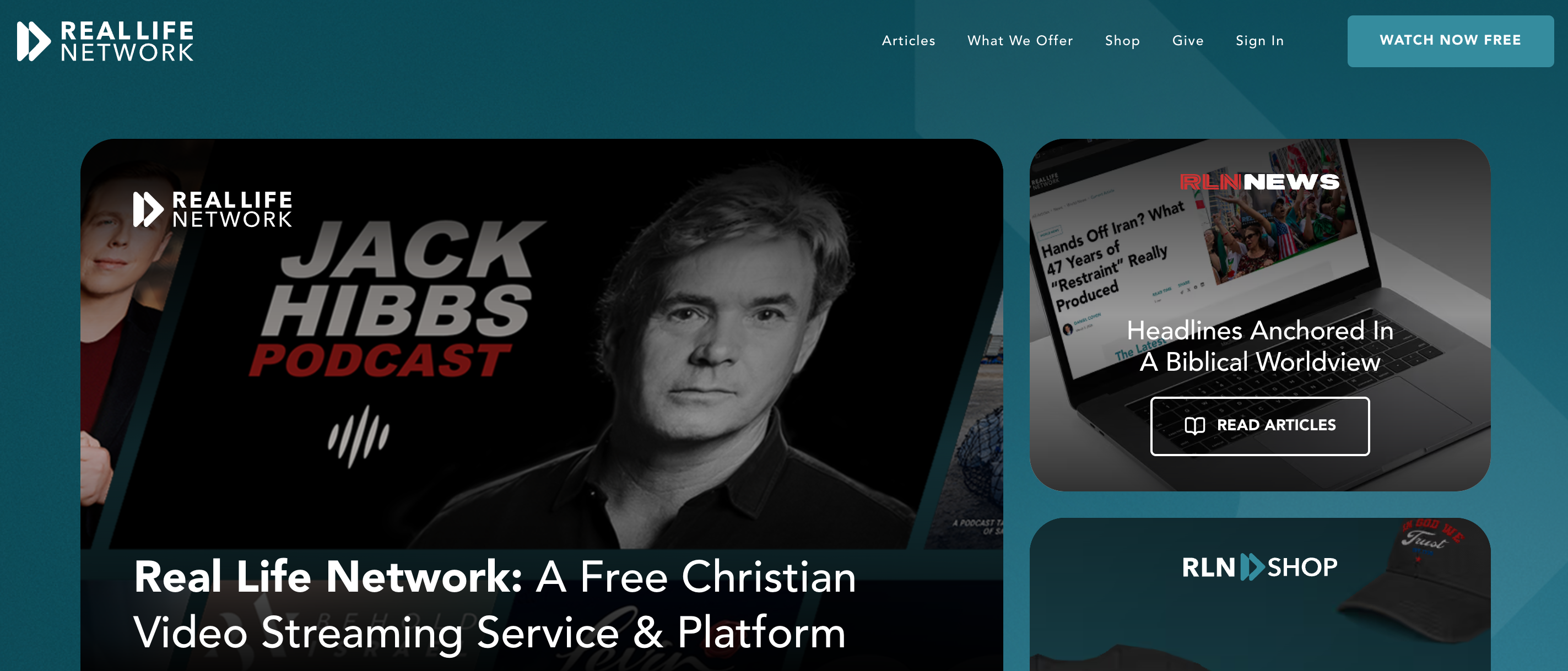
Cost: Free
Real Life Network offers one of the broadest combinations of biblical programming available without a subscription fee. The donor-supported platform includes Bible teaching, Christian news, apologetics, documentaries, podcasts, kids’ programs, movies, cultural commentary, and live events.
Viewers can find programs such Real Life with Jack Hibbs, RLN News, The Daniel Cohen Show, Cross Examined, The Creation Today Show, Superbook, and many other offerings within one biblically curated environment.
Unlike services centered primarily on movies, RLN is particularly strong for viewers who want entertainment combined with biblical teaching and programs addressing faith, culture, current events, and worldview.
Best for: Christians looking for a broad, free streaming platform built around biblical truth.
2. Pure Flix: Best for Christian Movies and Family Entertainment
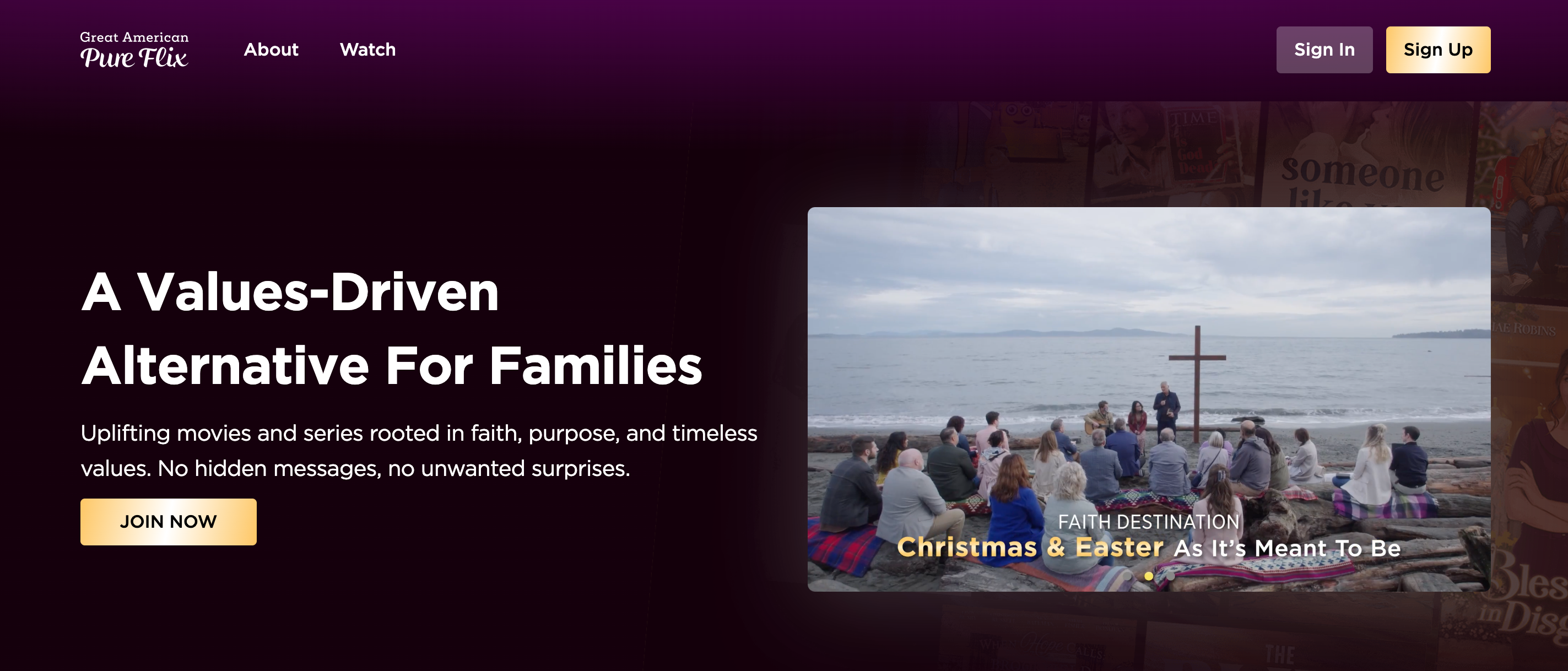
Cost: Paid subscription; plans begin at $9.99 per month
Great American Pure Flix is one of the best-known Christian streaming services for faith-forward movies and scripted entertainment.
Its catalog combines original series, Christian films, family dramas, Christmas programming, kids’ shows, and uplifting entertainment centered on faith, family, and traditional values. Multiple membership levels are available, with higher tiers adding features such as special screenings and early access.
For viewers who want a faith-oriented alternative to browsing mainstream movie libraries, Pure Flix remains one of the strongest options.
Best for: Christian movies, original series, family dramas, and faith-centered entertainment.
3. UP Faith & Family: Best for Wholesome Family Entertainment

Cost: $5.99 per month or $59.99 annually
UP Faith & Family offers thousands of hours of commercial-free family movies, dramas, series, and inspirational entertainment.
Its catalog is broader than explicitly Christian programming. Viewers will find faith-friendly movies alongside wholesome family dramas and popular series such as Heartland.
That distinction makes UP Faith & Family particularly useful for households looking for cleaner entertainment without requiring every program to function as Christian teaching.
Best for: Wholesome dramas, family movies, romantic stories, and uplifting entertainment.
4. Faith Channel: Best for Faith-Based Shows and Inspirational Content
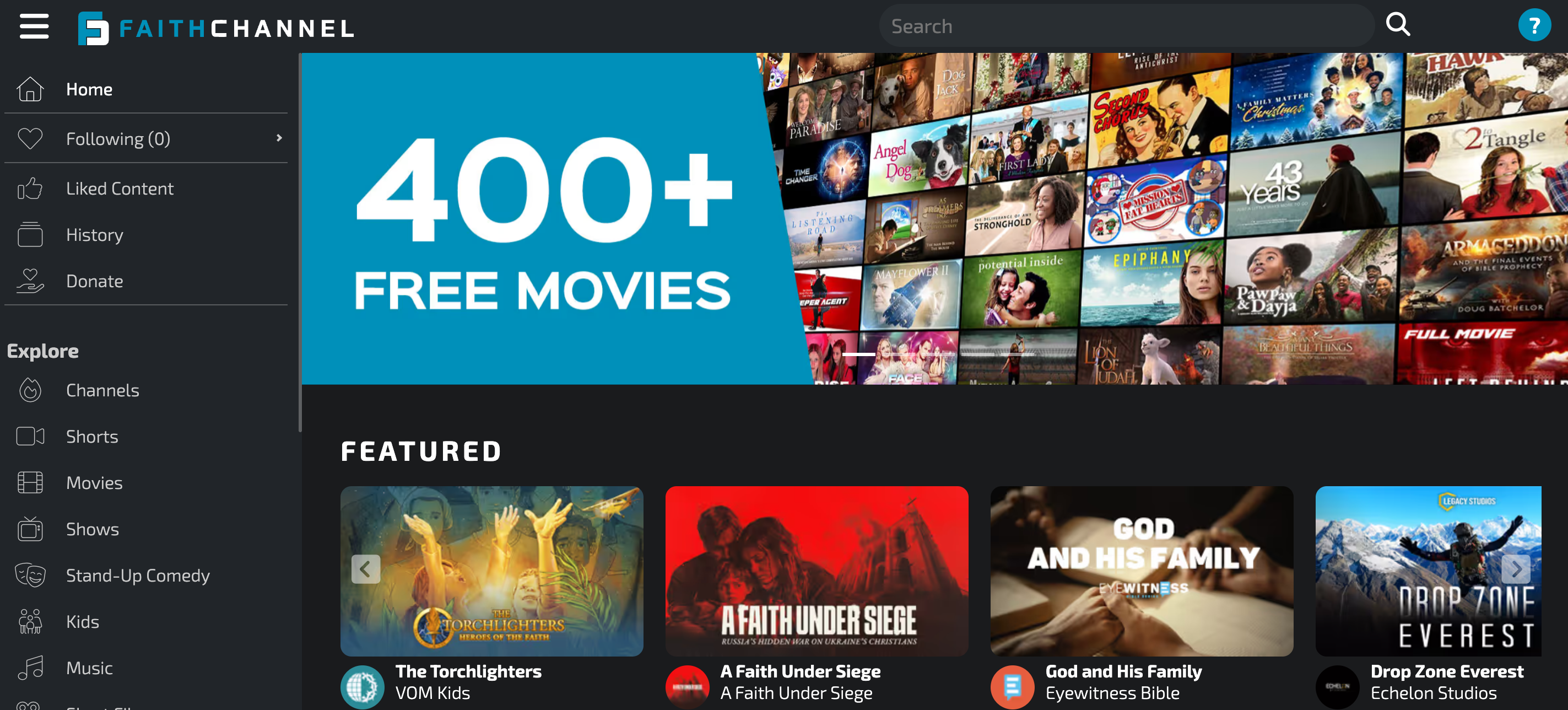
Cost: Free
FaithChannel is a free Christian streaming service offering movies, television shows, documentaries, preaching, teaching, music, podcasts, children’s programming, and other inspirational content.
Its growing library includes programming from a variety of independent Christian ministries and content producers. Titles range from Heroic Faith and The Torchlighters to apologetics, Bible prophecy, family films, podcasts, and children’s shows.
Because much of its catalog comes from different creators and ministries, viewers can encounter a particularly wide variety of formats and perspectives.
Best for: Exploring free Christian films, independent programs, teaching, podcasts, and inspirational content.
5. Go Minno: Best for Christian Kids’ Shows and Bible-Based Content

Cost: $10.99 per month or $69.99 annually after a free trial
Minno is designed specifically for Christian families with younger children.
Its library includes more than 175 shows, including the classic VeggieTales collection, Bible stories, music, educational programs, and Christian children’s entertainment. Families can stream across multiple devices and download programming for offline viewing.
Because the service is built specifically for children rather than including kids’ programming as one category within a larger library, it gives parents a focused alternative to mainstream children’s streaming.
Best for: Preschool and elementary-age children, Christian cartoons, Bible stories, and faith-based learning.
6. Yippee: Best for Safe, Faith-Focused Kids’ Entertainment

Cost: $7.99 per month or an annual subscription after a free trial
Yippee combines Christian children’s television with the energetic creator-driven format kids often encounter online.
Its library includes thousands of episodes from hundreds of series and movies, including Superbook, Christian programming, music, educational shows, and parent-approved creators. Yippee emphasizes that its environment contains no ads and no recommendation algorithms.
That makes it especially attractive to parents whose children enjoy online video but who want more control over what appears next.
Best for: Families seeking a Christian alternative to children’s YouTube viewing.
7. RightNow Media: Best for Bible Studies and Church Groups
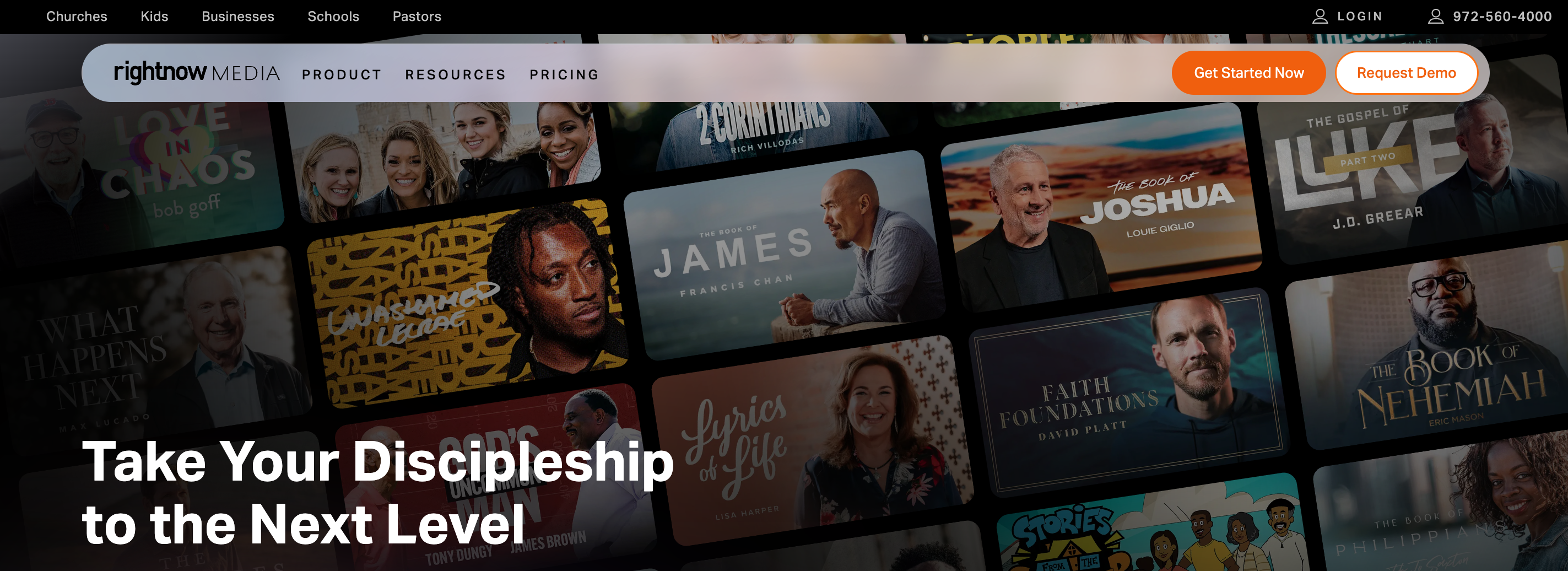
Cost: Access is generally provided through subscribing churches and Christian organizations
RightNow Media is less like Netflix and more like an enormous digital discipleship library.
It offers more than 25,000 video Bible studies covering Scripture, marriage, parenting, leadership, finances, recovery, Christian living, and other topics. The service also includes more than 2,000 children’s episodes and downloadable materials for many studies.
Rather than purchasing individual subscriptions, users generally receive access through a participating church, ministry, or organization.
Its combination of teaching videos and discussion materials makes RightNow Media particularly useful for small groups and church ministries.
Best for: Bible studies, small groups, church discipleship, leadership development, and Christian education.
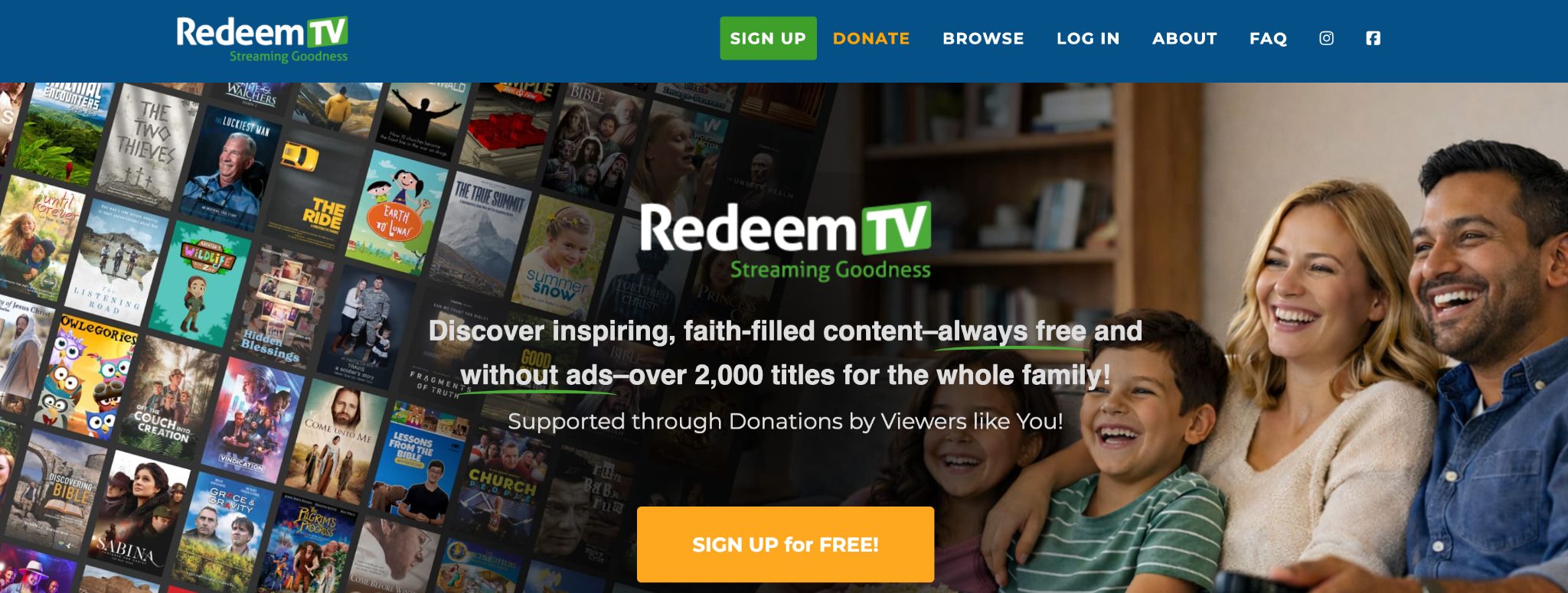
8. RedeemTV: Best Free Christian Film Streaming Platform
Cost: Free
RedeemTV offers more than 2,000 faith-filled titles without subscription fees or advertising.
Its donor-supported library includes Christian movies, documentaries, animated programs, television series, and family entertainment. Titles include The Pilgrim’s Progress, Vindication, Fragments of Truth, Ryan Defrates, and many others.
RedeemTV is especially strong for viewers whose primary interest is films and entertainment. Real Life Network offers a broader mix of teaching, news, cultural programming, and entertainment, while RedeemTV concentrates more heavily on movies and series.
Best for: Free Christian movies and shows without commercials.
9. VidAngel: Best for Filtering Movies and TV Shows

Cost: $9.99 per month when billed directly; supported streaming subscriptions may also be required
VidAngel takes a completely different approach to family entertainment.
Rather than providing only a traditional catalog of Christian programming, VidAngel lets viewers apply customizable filters to supported movies and shows from other streaming services. Families can choose categories of language, sexual content, violence, and other material they would prefer to mute or skip.
That means parents do not necessarily have to reject an entire movie because of a handful of objectionable scenes.
VidAngel requires users to have their own subscriptions to compatible streaming services for much of its filtered content.
Best for: Families who want more control over mainstream movies and television shows.
10. Christian Cinema: Best for Renting and Buying Christian Movies

Cost: Individual rentals and purchases; optional subscription plans are also available
Christian Cinema is useful for viewers who do not necessarily want another monthly streaming subscription.
Movies can be rented individually and streamed for a limited viewing period or purchased and stored in a digital library for on-demand viewing. The service specializes in Christian and faith-based films rather than trying to compete as a broad general-entertainment platform.
Christian Cinema also offers optional subscription plans for additional movies and television programming, but its rent-or-buy model remains a major distinction.
Best for: Viewers who want specific Christian movies without committing to another full streaming subscription.
What Should You Look for in a Christian Streaming Service?
The best platform depends on what you want from it.
Start by considering biblical alignment. A platform described as “family-friendly,” “inspirational,” or even “faith-based” is not necessarily the same as a service intentionally grounded in Scripture. Families should consider who selects the programming and what worldview shapes the library.
Next, consider the type of content your household actually watches. Parents with young children may get more value from Minno or Yippee, while a small-group leader may find RightNow Media far more useful. Movie lovers may prefer Pure Flix or RedeemTV, while viewers interested in Bible teaching, apologetics, news, and culture may find Real Life Network a better fit.
Finally, consider cost, commercials, device compatibility, offline viewing, parental controls, and whether a service requires other subscriptions to function.
Are There Any Free Christian Streaming Platforms?
Yes.
Real Life Network is completely free and donor-supported, offering Christian teaching, news, movies, kids’ programs, apologetics, podcasts, and more without a paid tier. RedeemTV is also donor-supported and offers more than 2,000 titles free without ads. FaithChannel provides free faith-and-family programming as well.
Angel has selected titles available without a Guild membership, although most of its full catalog now requires paid access.
For families trying to reduce monthly subscription costs, the amount of Christian programming available free is substantial.
Which Christian Streaming Platform Is Best for Families?
There is no single answer for every household. For families seeking a platform the whole household can use, Real Life Network has an advantage because its free library extends beyond children’s entertainment to Bible teaching, movies, documentaries, current events, apologetics, podcasts, and family programming.
Families primarily concerned with younger children may prefer Minno or Yippee. Those wanting a traditional movie-and-series experience may choose Pure Flix, UP Faith & Family, or RedeemTV.
The best choice is the one that not only avoids objectionable material but also supports the values parents are working to build at home.
Frequently Asked Questions About Christian Streaming Platforms
What Is the Best Christian Streaming Platform?
The best platform depends on your priorities. Real Life Network is a strong all-around choice for viewers seeking free biblical teaching, Christian news, apologetics, kids’ programming, movies, documentaries, and cultural content. Pure Flix is particularly strong for Christian movies and scripted entertainment, while Minno and Yippee specialize in children’s programming.
What Is the Best Free Christian Streaming Service?
Real Life Network and RedeemTV are two of the strongest completely free options. RLN provides a broad mix of programming, while RedeemTV has a particularly large free library of Christian films and series. FaithChannel is another free option worth exploring.
Is There a Christian Alternative to Netflix?
Several services can function as Christian or family-oriented alternatives to Netflix. Pure Flix most closely resembles a traditional subscription movie-and-series platform, while Real Life Network combines entertainment with teaching, news, apologetics, and family programming at no cost.
What Is the Best Christian Streaming Platform for Kids?
Minno and Yippee are specifically built around Christian children’s entertainment. Real Life Network also offers free children’s programming within a larger platform designed for the whole family.
Do I Need to Pay for Christian Streaming?
No. While many Christian streaming services charge monthly or annual subscription fees, Real Life Network, RedeemTV, and FaithChannel offer free options.
Finding the Best Christian Streaming Platform for Your Home
Christian streaming is no longer a single category. Families can now choose platforms specializing in movies, Bible studies, kids’ shows, documentaries, teaching, news, apologetics, and wholesome general entertainment.
The right choice depends on what you want entering your home and what role you want media to play in your family.
For viewers who want to begin with a service built around biblical truth without adding another monthly expense, Real Life Network provides free access to Christian teaching, news, family programming, movies, documentaries, podcasts, apologetics, kids’ shows, and more.
Explore free Christian streaming today on Real Life Network.

7 Family Media Questions Every Christian Parent Should Ask
What children watch can shape what they admire, accept as normal, and learn to value. These seven questions can help Christian parents evaluate entertainment thoughtfully and teach their children lifelong biblical discernment.
Choosing what your family watches used to be relatively simple. Today, children can encounter movies, shows, videos, games, social media, podcasts, and other digital content across multiple devices throughout the day.
That makes media decisions about more than whether a particular movie contains bad language or an inappropriate scene. Stories communicate ideas. Characters model attitudes. Entertainment can reinforce beliefs about relationships, identity, success, morality, authority, and what makes life meaningful.
Christian parents don’t need to approach every screen with suspicion. But thoughtful questions can help families move beyond simply asking, “Is this allowed?” toward developing genuine biblical discernment.
Here are seven questions worth asking.
1. What Is This Teaching My Child to Admire?
Every story has heroes. Sometimes they’re obvious. Other times the audience is simply encouraged to sympathize with certain characters, choices, or lifestyles.
Ask what qualities the program presents as admirable. Is courage celebrated? Loyalty? Honesty? Sacrifice? Compassion? Or does the story consistently reward selfishness, dishonesty, disrespect, cruelty, or behavior that conflicts with what your family is teaching?
This doesn’t mean every protagonist must behave perfectly. Some of the best stories involve flawed people learning from mistakes.
The more important question is whether the story ultimately recognizes the difference between wisdom and foolishness, good and evil, truth and deception.
2. What Does This Program Treat as Normal?
Media doesn’t always persuade through direct arguments. Often, it influences simply by repetition.
When children repeatedly see particular attitudes, relationships, behaviors, or beliefs presented as normal, those ideas can gradually begin to feel ordinary. That is why parents should pay attention not only to dramatic objectionable moments but also to the assumptions underneath a story.
What does the program communicate about marriage? Parents? Faith? Sexuality? Authority? Success? Human worth?
Children may not consciously identify those ideas, but that doesn’t mean they aren’t noticing them.
Parents can help by occasionally asking, “What do you think that show is saying about this?” That simple question teaches children to watch actively rather than absorb everything passively.
3. Is This Appropriate for My Particular Child?
An age rating can be helpful, but parents know their children better than a rating system does.
Two children of the same age may react very differently to the same movie. One might handle a tense historical story well, while another has nightmares after mild suspense. One teenager may be ready to engage thoughtfully with difficult cultural questions while another isn’t.
Christian parenting requires more than finding the boundary of what is technically permitted.
Romans 14:19 encourages believers to “pursue the things which make for peace and the things by which one may edify another.”
A useful question, then, is not only, Can my child watch this? but Will this be beneficial for my child right now?
4. How Does My Child Feel After Watching It?
Sometimes the effect of media becomes clearer after the screen turns off. Does a child seem encouraged, curious, imaginative, or eager to talk? Or irritable, anxious, fearful, disrespectful, restless, or obsessed with watching more?
One viewing won’t necessarily reveal a pattern. But repeated reactions can tell parents something important.
The same is true for adults. Some entertainment leaves viewers refreshed. Other content leaves them angry, agitated, discouraged, or mentally exhausted.
Philippians 4:8 directs believers toward what is true, noble, just, pure, lovely, commendable, virtuous, and praiseworthy. That provides a useful biblical framework for considering not just what enters the mind, but what it produces there.
5. Is Screen Time Crowding Out Something Better?
A perfectly acceptable program can still become a problem if it consumes too much time.
The issue may not be what a child is watching. It may be what he or she is no longer doing. Is screen time replacing sleep? Outdoor play? Reading? Family conversation? Church involvement? Homework? Prayer and Scripture? Time with friends?
Sometimes the wisest media decision is not finding a better show but leaving the television off.
Healthy media habits recognize entertainment as one part of life rather than the center of it.
6. Can This Become a Conversation Instead of Just Consumption?
Parents don’t have to eliminate every story containing an idea they disagree with. Sometimes those moments provide valuable opportunities to teach.
Watching together allows parents to ask questions.
- Why do you think that character made that choice?
- Was it wise?
- What consequences followed?
- What does the Bible teach about that issue?
- How would following Jesus change the way someone responds?
Those conversations help children build discernment that will eventually matter far more than parental controls.
Christian media can provide especially natural opportunities for these discussions. A program such as LifeWise Academy can lead into conversations about bringing biblical truth into everyday life. Genesis Science Minute can introduce questions about creation and science in just 60 seconds. The Pilgrim’s Progress can start conversations about temptation, perseverance, and following Christ.
The goal isn’t to interrogate children after every episode. It’s to make talking about ideas a normal part of family life.
7. Does Our Entertainment Support the Kind of Home We’re Trying to Build?
This may be the most important question of all.
Parents spend years teaching children what is true, who they are, what relationships should look like, why Scripture matters, and what it means to follow Christ.
It makes sense to ask whether the family’s entertainment choices generally support those priorities or continually work against them. That doesn’t require every show to be overtly Christian. But intentionally including faith-based programming can help create a healthier balance.
Younger children might enjoy biblical programming such as Superbook, iBible, or Learn, Grow and Go! Older children and teens can explore apologetics through In Depth Apologetics for Kids or creation-focused content. Families can also choose movies, documentaries, Bible teaching, and programs built around Christian service, history, and worldview.
Real Life Network provides these kinds of options in one biblically curated streaming environment, giving parents a place to begin without having to sort through an enormous mainstream catalog first.
Teach Discernment, Not Just Rules
Parents cannot screen every piece of media their children will encounter forever.
Eventually, children become teenagers. Teenagers become adults. They choose their own movies, follow their own accounts, download their own apps, and decide which voices deserve their attention.
That’s why the long-term goal is bigger than creating a list of approved and prohibited programs. It is helping children learn to ask good questions themselves.
- What is this teaching me?
- Does it agree with what I know to be true?
- How is it affecting my thoughts and attitudes?
- Is this worth my time?
- Would I make this same choice if Jesus were sitting beside me?
Those questions turn media discernment from a parental restriction into a lifelong Christian practice.
The goal isn’t a home without screens. It’s a home where screens know their place, parents remain engaged, and entertainment doesn’t get the final word on what children learn to value.
Explore free, biblically curated kids’ shows, family programs, movies, Bible teaching, and more on Real Life Network.
.jpg)
How Personal Interviews Can Strengthen Faith, Reveal Truth, and Shape a Biblical Worldview
Personal interviews bring biblical truth into real life through stories of faith, hardship, testimony, and conviction, helping Christians grow in discernment and understand how Scripture applies to a complicated world.
Some truths become easier to understand when you hear them through another person’s experience. A sermon may explain forgiveness, while an interview with someone who has forgiven an enemy can show what forgiveness looks like when it costs something. A Bible study may teach about trusting God through hardship, while a conversation with someone who has survived persecution, addiction, grief, or war can bring that truth into everyday life.
That is part of what makes personal interviews so valuable in Christian media. They allow viewers to hear ideas explored through stories, questions, experiences, and honest reflection. When those conversations are grounded in biblical truth, they can strengthen faith while also helping Christians think more carefully about the world around them.
1. Personal Stories Make Biblical Truth Concrete
Christians often know important biblical principles long before they understand how those principles play out in difficult circumstances. It is one thing to read that believers should trust God. It is another to hear someone explain how he or she continued trusting God after losing a career, facing persecution, walking through serious illness, or experiencing personal tragedy.
Programs such as The Resilient Show, hosted by Chad Robichaux, can open conversations about trauma, recovery, purpose, and resilience through the experiences of people who have endured significant challenges. Stories like these help viewers see that biblical faith is not reserved for ideal circumstances. It is meant to shape how believers live when life becomes difficult.
2. Interviews Allow Important Questions to Be Asked
Strong interviews do more than provide inspiring stories. They ask questions: Why did you believe that? What changed your mind? How did your faith affect your decision? What would you say to someone who disagrees?
Those questions create space for ideas to be examined rather than merely stated. This can be especially valuable when discussing theology, culture, politics, science, or apologetics because viewers get to hear not only a conclusion but also some of the reasoning behind it.
Programs such as Small Talk Big Issues bring together conversations with faith leaders, journalists, entrepreneurs, political figures, and other guests to explore significant issues from a Christian perspective. The interview format makes room for nuance that is often missing from headlines or short social-media clips.
3. Testimony Can Strengthen Faith
Personal testimony has always had an important place in Christianity. The New Testament repeatedly records people describing what Christ had done in their lives. The man healed by Jesus in John 9 offered one of the simplest examples: “One thing I know: that though I was blind, now I see” (John 9:25 NKJV).
A testimony does not replace Scripture, but it can illustrate Scripture. Hearing how someone came to faith, overcame fear, remained faithful under pressure, or experienced God’s provision can encourage believers facing their own struggles.
Living Fearless with Hedieh, for example, draws in part from Hedieh Mirahmadi’s experience of leaving Islam and becoming a follower of Christ. Conversations shaped by experiences like hers can introduce viewers to questions involving religious belief, freedom, culture, fear, and the work of the Gospel.
4. Conversations Help Christians Understand Different Perspectives
It is easy to form opinions about people we have never heard speak for themselves. Interviews slow that process down by allowing viewers to hear how another person understands an issue, why someone holds a particular belief, or how circumstances shaped his or her perspective.
That does not require Christians to agree with everything a guest says. In fact, disagreement can be useful when viewers are learning to compare ideas with Scripture. A strong biblical worldview is developed as believers learn to identify assumptions, examine arguments, recognize truth, and test what they hear against God’s Word.
That kind of discernment is especially important in a culture where complicated issues are often reduced to slogans.
5. Interviews Can Connect Faith with Current Events
Christians do not live their faith in isolation from the world. Questions about government, education, technology, religious freedom, economics, international conflict, family, and culture all affect daily life.
Interview-based programs can help connect those developments with biblical principles. The Daniel Cohen Show, Rose Unplugged, Cure America, and The City of God each use conversations and interviews to engage cultural or public issues from faith-informed perspectives.
Rather than treating Christianity as something confined to church services, these discussions encourage viewers to consider how biblical truth relates to public life.
6. Real People Can Challenge Easy Assumptions
Some of the most valuable interviews are uncomfortable. A person who has experienced persecution may challenge a casual approach to religious freedom. A missionary may challenge assumptions about evangelism. A veteran may speak differently about courage or sacrifice than someone who has never faced danger. A Christian serving the poor may cause viewers to reconsider how they think about generosity.
Programs connected with ministries such as Samaritan’s Purse, Fred Jordan Missions TV, and Evangelism Explosion International can introduce viewers to Christians putting faith into action through service, outreach, disaster response, and evangelism. Those stories can move the question from “What do Christians believe?” to “What should Christians do because they believe it?”
7. Interviews Can Support Apologetics Without Becoming a Debate
Not every interview is an apologetics program, but interviews can still help Christians understand why they believe what they believe. A scientist can discuss evidence for creation. A former skeptic can explain objections that once kept him from Christianity. A historian can discuss the reliability of biblical accounts. A pastor or theologian can respond to difficult questions about suffering, morality, or the resurrection.
Programs such as Cross Examined and The Creation Today Show give viewers opportunities to hear Christian truth claims examined through questions and conversation. Sometimes a thoughtful interview can accomplish something a formal debate cannot because it lets viewers follow the reasoning at a more natural pace.
Hearing Truth Through Someone Else’s Story
Christian faith ultimately rests on the truth of God’s Word, not the personality or experiences of an interview guest. But personal conversations can help illuminate those truths in memorable and practical ways.
A good interview lets viewers encounter people they might never meet, hear perspectives they might never otherwise consider, and see biblical principles applied to real circumstances. It can encourage faith, expose assumptions, deepen understanding, and prompt better questions.
That is why interviews occupy an important place in Christian media. They remind us that faith is not merely a collection of ideas. It is lived out by real people facing real choices in a complicated world.
Explore personal interviews, Christian conversations, cultural discussions, testimonies, and more for free on Real Life Network.

World News
25 min
Remembering Charlie Kirk: A Life of Faith, Family, and Courage
One year after Charlie Kirk’s death, his commitment to Christ, family, courage, and America offers a lasting challenge to live faithfully, strengthen our homes, invest in the next generation, and stand courageously for our convictions.
One year after the death of Charlie Kirk, there is much worth remembering about a life that ended far too soon. He was known across the country as a conservative activist, speaker, and founder of Turning Point USA. But the convictions that increasingly defined his public life went deeper than politics. Kirk spoke openly about his faith in Jesus Christ, his love for his wife and children, and his belief that strong families were essential to the future of America.
When asked how he wanted to be remembered, Kirk pointed to courage and his Christian faith. Those who worked closely with him likewise described his relationship with Christ as the most important part of his life. He used an enormous platform not simply to discuss elections and public policy, but to encourage people to follow Jesus and take their faith seriously.
That priority deserves to be remembered.
Kirk also understood something increasingly countercultural: the future of a nation is inseparable from the health of its families.
He married Erika in 2021, and they had two children. Fatherhood became an important part of the message he shared with young Americans. He encouraged young adults to pursue marriage, welcome children, leave behind empty pursuits, and build something that could endure beyond themselves. His wife later recalled that marriage and family were among the greatest joys of his life.
That message mattered because Kirk spent much of his career speaking directly to young people. He founded Turning Point USA at only 18 and built an organization centered on engaging the next generation in the future of the country.
Yet preserving America was about more than winning elections. A country ultimately depends upon the character of its people, the strength of its homes, and the convictions parents pass to their children.
If we want to honor Kirk's life, admiration is not enough. We should imitate what was worthy of imitation.
Go to Real Life Network to watch great moments from the life of Charlie Kirk.
That means having the courage to profess Christ when doing so carries a cost. It means building strong marriages and treating parenthood as a calling rather than an inconvenience. It means investing in young people instead of surrendering the next generation to whatever ideas happen to dominate the culture. And it means being willing to enter conversations with people who disagree rather than retreating from difficult questions.
Kirk became famous in part because he was willing to walk onto college campuses, take questions, defend his convictions, and invite disagreement. His example should encourage Christians to develop convictions strong enough to withstand opposition without becoming afraid of the people on the other side.
Most importantly, his legacy should point beyond politics.
Political victories pass. Organizations change. Elections are won and lost. But faithfulness to Christ, love within the home, children raised with conviction, and lives invested in others carry significance far beyond an election cycle.
Charlie Kirk cared deeply about America's future. His life offered a reminder that the work of building that future begins with faithfulness to God, courage in the public square, and commitment to the family at home.
Go to Real Life Network to watch great moments from the life of Charlie Kirk.

Devotional
25 min
Created to Work, but Working under the Curse
Work is one of God’s good gifts, yet the Fall has made it difficult, frustrating, and fleeting. Scripture explains both our desire to find meaning in work and our longing for the lasting rest found in Christ.
One morning, I was riding my bicycle along Washington, D.C.’s Anacostia River when an egret glided over the trail. The pure-white wading birds have always fascinated me with their elegant stillness and regal grace. They look even more impressive on the rare occasions when they spread their wings and take flight, making them look even larger. Yet this impromptu bird-watching experience came to an abrupt and discordant end. The moment before the egret swooped into the brush and out of sight, he made like a bomber and dropped a load of ordnance worthy of an animal twice his size.
A graceful bird, caught in its least graceful position.
The minor incident nearly passed out of my mind until I realized that this un-constipated egret provided an apt example for man’s complex condition. From beginning to end, mankind’s creation is the gift of God. We are created in God’s image and likeness, given dominion over every living thing, and blessed with the good command to fill the earth with God’s image-bearers through procreation (Genesis 1:26-28). Yet our first parents squandered these divine blessings through disobedience and rebellion, for which they were cast out of God’s presence (Genesis 3:22-23) and condemned to die (Genesis 2:17).
Man is a graceful bird, caught in his least graceful position.
Christianity’s nuanced view of human nature becomes incomprehensible without the first three chapters of Genesis. This is why so many human philosophies veer into error on either one side or the other. Most human philosophies boil down to the opinion that man is basically good, or that he is basically bad. Only the Bible (and those influenced by the Bible) can explain how man is created good, but corrupted.
Mankind’s complex condition affects every aspect of our lives, even the way we work. Before anything had tarnished God’s “very good” creation (Genesis 1:31), we read that “The Lord God took the man and put him in the garden of Eden to work it and keep it” (Genesis 2:15). Work is not a consequence of the fall, but a basic function of man, which God created for good. Adam’s task was merely to imitate God’s own example in creative effort (Genesis 2:9), and it carries religious undertones, as the same verbs are used to describe service at the tabernacle in Numbers 3.
However, mankind’s work did not escape the Fall unscathed. Not only was Adam cast out of the lush garden into uncultivated land, but God also declared, “cursed is the ground because of you; in pain you shall eat of it all the days of your life; thorns and thistles it shall bring forth for you; and you shall eat the plants of the field. By the sweat of your face you shall eat bread, till you return to the ground, for out of it you were taken; for you are dust, and to dust you shall return” (Genesis 3:17-19).
The ground was Adam’s domain of work. By extension, this curse extends to all arenas of work. All work is toilsome, demanding, and sometimes fleeting, as the whole creation is “subjected to futility” (Romans 8:20).
Man is a graceful bird, caught in his least graceful position.
Again, the Bible’s complex theology of work has better power to explain the different attitudes people have towards their work than the fractured, individualistic worldviews dominant in America today. Some people love their jobs, while some people hate them. Why? Can individualism or critical theory offer a satisfying answer to this question? (Critical theory would blame group oppression, but that is not satisfying.)
The Bible has an answer. Some people love their jobs because work is a gift from God — a good gift that God created as part of his blessing on mankind. Even in a fallen world, the wise preacher concludes, “There is nothing better for a person than that he should eat and drink and find enjoyment in his toil. This also, I saw, is from the hand of God” (Ecclesiastes 2:24, see also Ecclesiastes 5:18-19 and 9:9). Yet some people also hate their jobs because work is cursed after the Fall.
Man is a graceful bird, but he is still caught in his least graceful position.
The very unseemliness of the aforementioned egret’s evacuation is what makes it an appropriate metaphor for fallen man under sin. “We have all become like one who is unclean,” Isaiah confesses, “and all our righteous deeds are like a polluted garment” (Isaiah 64:6). We need one who can wash our filth away, to achieve for us what we could never achieve by our own works.
Even though work is good, it is not ultimate. The Lord God engaged in his creative work for six days, “and he rested on the seventh day from all his work that he had done” (Genesis 2:2). Just as man was made to imitate God’s work, so man was also supposed to imitate God’s rest (Exodus 20:8-11). But, under the curse of sin, that rest became fleeting and far off.
From the earliest generations, Adam’s descendants sought one who would restore them to God’s rest. Thus, Noah’s father Lamech said in hope, “Out of the ground that the Lord has cursed, this one shall bring us relief from our work and from the painful toil of our hands” (Genesis 5:29). Yet Noah did not bring an end to toil, hard labor, or the futility of human industry. Nor did Moses, Joshua, David, or any human leader called by God throughout history. All were sinners, after all.
Yet painful toil under the curse is not man’s final condition, for “there remains a Sabbath rest for the people of God” (Hebrews 4:9). Those who are forgiven of their sins by the blood of Christ receive true grace. They are not only restored to right fellowship with God, but they also receive eternal life and enter into God’s rest.
For now, we recognize that all honest work is good. “In all toil there is profit, but mere talk tends only to poverty” (Proverbs 14:23). “Let the thief no longer steal, but rather let him labor, doing honest work with his own hands, so that he may have something to share with anyone in need” (Ephesians 4:28). “It is the hard-working farmer who ought to have the first share of the crops” (2 Timothy 2:6). But work is not ultimate, and one day our painful toil will come to an end.
Man is a graceful bird, and one day his graceless condition will be remedied in full. One day, those who are in Christ will enter into the glory and rest of their Redeemer.
This article was originally written by Joshua Arnold and published on The Washington Stand. For more content like this, visit Real Life Network.
Thank you! Your submission has been received!
Oops! Something went wrong while submitting the form.
Entertainment & Lifestyle
For many people, YouTube has become the default place to watch videos online. Sermons, podcasts, music, documentaries, and short clips are all just a search away. That convenience has led many believers to ask an important question: How does Christian streaming compare to YouTube content?
Both offer access to faith-based material, but the experience is very different. Christian streaming platforms are designed around a specific mission and environment, while YouTube functions as a massive open platform built for every type of content imaginable.
Understanding the difference can help viewers and families decide which environment best supports their goals, values, and spiritual growth.
YouTube Offers Variety. Christian Streaming Offers Focus.
One of YouTube’s greatest strengths is its enormous variety. Almost anyone can upload content, which means viewers can find sermons, worship music, apologetics, podcasts, and Bible studies from thousands of creators.
But that openness also creates challenges. On YouTube:
- Content quality varies widely
- Recommendations can shift quickly away from faith-based material
- Ads and autoplay often interrupt viewing
- The surrounding environment may include content that conflicts with biblical values
Christian streaming platforms take a different approach. Instead of trying to offer everything to everyone, they curate content around a clear biblical foundation. That focus creates a more consistent viewing experience.
A More Curated Environment for Families
One of the biggest differences between YouTube and Christian streaming platforms is the environment surrounding the content itself. Parents using YouTube often find themselves monitoring:
- Suggested videos
- Advertisements
- Comment sections
- Autoplay recommendations
- Unrelated or inappropriate thumbnails
Even when watching a helpful sermon or kids’ video, the next recommendation may lead somewhere entirely different.
Christian streaming platforms are built differently. Their libraries are intentionally curated, which helps reduce the constant need for filtering and supervision.
For families, this creates a safer and more predictable environment.
Christian Streaming Prioritizes Discipleship
YouTube is designed primarily for engagement and watch time. Its algorithms are built to keep viewers clicking and consuming more content.
Christian streaming platforms are generally designed with a different goal: discipleship. That means the emphasis is often on:
- Biblical teaching
- Spiritual growth
- Encouragement and wisdom
- Family discipleship
- Meaningful conversations rather than endless scrolling
Platforms like Real Life Network bring together sermons, documentaries, apologetics programs, podcasts, and family-friendly content in one place, creating an experience centered on faith rather than algorithms.
Less Noise, More Intentionality
One challenge many viewers experience on YouTube is distraction. A person may begin watching a sermon and quickly end up pulled into unrelated content, debates, entertainment clips, or trending topics.
Christian streaming platforms reduce that noise by keeping the focus narrow and intentional. Instead of endless content loops, viewers are more likely to encounter:
- Related biblical teaching
- Faith-based documentaries
- Worship content
- Christian worldview discussions
- Family-safe programming
This consistency helps viewers stay focused on why they came in the first place.
Quality and Production Continue to Improve
There was a time when many people assumed Christian streaming content would feel lower-budget or outdated compared to mainstream platforms or top YouTube creators. That gap has narrowed significantly. Today, Christian streaming platforms often feature:
- Professionally produced documentaries
- High-quality teaching series
- Studio-level interviews and podcasts
- Well-produced family programming
On RLN, viewers can explore content ranging from films like Before the Wrath and C.S. Lewis: The Most Reluctant Convert to discussion-driven programs such as Bridge Bible Talk and teaching from ministries like A Daily Walk.
The result is a viewing experience that feels polished while still remaining grounded in biblical purpose.
YouTube Still Has Value
This doesn’t mean YouTube is inherently negative. Many ministries use YouTube effectively to share sermons, clips, and outreach content with wide audiences. For people exploring faith, YouTube can even become a first point of contact.
But there is a difference between using YouTube occasionally and building a long-term media environment around it. Christian streaming platforms provide a more stable and intentional space for ongoing spiritual growth.
Choosing the Right Tool for the Right Purpose
For many believers, the choice isn’t necessarily either-or. Some use YouTube for quick clips or live events while relying on Christian streaming platforms for more consistent teaching and family viewing.
The key question is: What kind of environment do you want shaping your attention most consistently?
That question matters because media habits influence thought patterns, conversations, and spiritual focus over time.
How Real Life Network Fits into the Picture
Real Life Network was created to provide a focused, biblically grounded alternative to the constant noise of mainstream digital media. Rather than competing for attention through trends or controversy, RLN prioritizes content that strengthens faith and encourages discernment.
By bringing together teaching, apologetics, documentaries, podcasts, and family programming in one curated environment, RLN helps viewers engage Christian content without navigating the distractions commonly associated with open platforms.
YouTube offers convenience and variety, but Christian streaming platforms offer something different: consistency, focus, and intentionality.
For individuals and families looking to build healthier media habits and stay grounded in biblical truth, faith-based streaming provides a more curated and discipleship-oriented experience.
Explore focused, faith-based streaming anytime on Real Life Network.
Related Articles
- Do Christian Streaming Platforms Offer Ad-Free Viewing? by Real Life Network
- How Do Christian Streaming Platforms Reach Younger Generations? by Real Life Network
- How Does Streaming Faith-Based Content Strengthen My Faith by Real Life Network
25 min
.webp)
June 8, 2026
Real Life Network
Entertainment & Lifestyle
Spiritual growth often happens in small, consistent moments rather than dramatic experiences. A few minutes in God’s Word before work, a devotional during a lunch break, or a short teaching before bed can shape an entire day.
That’s why more people are asking: Can I find devotional content on streaming platforms?
The answer is yes. Christian streaming platforms increasingly offer devotional-style programming designed to encourage viewers throughout the week—not just during church services. These programs combine Scripture, practical insight, and real-life application in formats that fit naturally into everyday routines.
What Counts as Devotional Content?
Devotional content is typically shorter, more personal, and more focused on everyday spiritual encouragement than a traditional sermon or Bible study. These programs often include:
- Scripture-centered reflections
- Practical encouragement for daily life
- Conversations about faith and growth
- Short-form teaching that fits busy schedules
- Devotions designed for regular viewing habits
Some devotionals are only a few minutes long, while others take a more conversational or teaching-oriented approach.
Why Streaming Works So Well for Devotionals
Streaming platforms are especially effective for devotional content because they make encouragement available anytime and anywhere. Instead of waiting for scheduled broadcasts, viewers can:
- Watch a devotional in the morning
- Listen during a commute
- Stream encouragement during a break
- Revisit episodes throughout the week
This accessibility helps believers stay connected to biblical truth consistently, even during busy seasons.
Devotional Programs Available on Real Life Network
Real Life Network offers several devotional and encouragement-focused programs that help viewers stay grounded in Scripture throughout the week.
So True with Philip De Courcy
Hosted by Pastor Philip De Courcy, So True delivers biblical teaching with clarity, warmth, and practical application. The program focuses on helping believers understand Scripture and apply truth faithfully in everyday life.
Its approachable style makes it especially helpful for viewers looking for steady, Scripture-centered encouragement without unnecessary complexity.
Groundworks with Steve Wiggins
Groundworks with Pastor Steve Wiggins takes a devotional approach centered on daily engagement with God’s Word. Episodes are concise but rich with biblical insight, making them ideal for viewers who want meaningful encouragement in a shorter format.
Steve Wiggins brings an energetic yet thoughtful teaching style that emphasizes knowing Scripture, obeying it, and living it out practically.
Living Fearless with Andy and Hedieh
Hosted by Andy and Hedieh Falco, Living Fearless focuses on encouragement, resilience, and faith-filled living in difficult circumstances. Through personal stories, biblical truth, and practical wisdom, the program helps viewers navigate fear, uncertainty, and everyday challenges with confidence rooted in Christ.
Its conversational tone makes it especially relatable for viewers walking through stressful or uncertain seasons.
How Devotional Streaming Differs from Sermons
While sermons and long-form teaching remain important, devotional content serves a different purpose. Devotionals are often:
- Shorter and easier to fit into daily life
- More conversational and reflective
- Focused on encouragement and application
- Designed for consistent engagement over time
For many people, devotionals become part of a daily rhythm rather than a once-a-week experience.
Helping Families Build Spiritual Habits
Streaming devotionals can also support spiritual growth within families. Parents may:
- Watch a short devotional before school or dinner
- Share encouraging episodes with teens
- Use devotional content as a conversation starter
- Reinforce biblical habits throughout the week
Because these programs are accessible on phones, tablets, and televisions, they fit naturally into modern routines.
Encouragement During Difficult Seasons
One reason devotional content matters so much is because life is not always predictable. During seasons of stress, grief, uncertainty, or spiritual dryness, shorter encouragement-focused programs can help believers stay connected to truth without feeling overwhelmed.
Streaming platforms make that encouragement available immediately—whether someone needs hope, wisdom, or simply a reminder of God’s faithfulness.
A More Intentional Media Habit
Many people already spend part of their day listening to podcasts, scrolling videos, or consuming media. Devotional streaming offers an opportunity to redirect some of that attention toward content that strengthens faith rather than draining it.
Even a few minutes of biblical encouragement each day can help shift perspective over time.
Christian streaming platforms are no longer limited to sermons and movies. Today, they offer devotional content designed to encourage believers consistently throughout the week.
Programs like So True, Groundworks, and Living Fearless help viewers stay rooted in Scripture, encouraged in everyday life, and connected to biblical truth in practical ways.
For anyone looking to build healthier spiritual habits, devotional streaming can be a meaningful place to start.
Explore devotional and encouragement-focused content anytime on Real Life Network.
Related Articles
- How Do Christian Streaming Platforms Reach Younger Generations? by Real Life Network
- How Does Streaming Faith-Based Content Strengthen My Faith by Real Life Network
- Best Faith-Based Documentaries to Watch for Free by Real Life Network
25 min
Can I Find Devotional Content on Streaming Platforms?
.webp)
June 6, 2026
Real Life Network
Entertainment & Lifestyle
Every generation faces cultural questions that test what it believes. Today’s conversations around identity, truth, justice, and morality are often complex, emotional, and fast-moving. For many believers, this raises an important question: How do Christian streaming platforms address tough cultural issues in a way that stays rooted in Scripture?
Faith-based platforms are not designed to ignore difficult topics. Instead, they aim to engage them carefully, anchoring conversations in biblical truth while encouraging wisdom, discernment, and clarity.
Starting With Scripture, Not Culture
One of the clearest differences in how Christian platforms approach cultural issues is where they begin. Rather than starting with trends, headlines, or popular opinion, they start with Scripture.
This foundation shapes the entire conversation. Instead of asking, “What does culture say about this?” the focus becomes, “What does God’s Word say?”
That shift matters. It keeps discussions grounded in something unchanging, even when the surrounding culture is constantly shifting.
Addressing Issues Without Avoiding Them
Avoiding difficult topics may feel easier, but it rarely helps believers grow. Christian streaming platforms increasingly recognize that people—especially younger audiences—are already encountering challenging ideas elsewhere.
Rather than staying silent, faith-based content often addresses topics such as:
- Identity and purpose
- Truth and morality
- Relationships and family
- Suffering and justice
- Cultural pressure and personal conviction
The goal is not to overwhelm or provoke, but to provide clarity where confusion often exists.
Focusing on Principles Rather Than Reactions
Cultural conversations can change quickly. What is debated today may look different tomorrow. That’s why Christian platforms tend to focus on biblical principles rather than reacting to every new development.
This approach emphasizes:
- Truth over trends
- Wisdom over immediacy
- Understanding over argument
- Long-term faithfulness over short-term reactions
By focusing on principles, viewers are better equipped to navigate future challenges—not just current ones.
Encouraging Discernment, Not Just Agreement
Another important aspect of biblical engagement is teaching discernment. Christian platforms are not simply aiming for viewers to agree with a position—they aim to help viewers think clearly.
This often includes:
- Explaining why certain beliefs align with Scripture
- Walking through difficult questions step by step
- Acknowledging complexity where it exists
- Encouraging personal study and reflection
Programs such as Bridge Bible Talk, Cure America with Star Parker, and teaching-based content like A Daily Walk often model this kind of thoughtful engagement, showing how to approach real issues without losing biblical grounding.
Maintaining a Tone of Clarity and Grace
One of the challenges in addressing cultural issues is tone. Conversations can quickly become harsh, reactive, or divisive. Christian streaming platforms typically aim for a different tone—one that reflects both truth and grace. This means:
- Speaking clearly without being combative
- Addressing issues directly without unnecessary harshness
- Recognizing the dignity of people, even in disagreement
- Keeping the focus on Christ rather than conflict
This tone helps viewers engage difficult topics without becoming discouraged or defensive.
Providing Context Through Teaching and Story
Not all learning happens through direct teaching. Many platforms also use stories, testimonies, and documentaries to explore cultural issues in a more personal and relatable way. These formats allow viewers to:
- See how faith is lived out in real situations
- Understand the human side of complex issues
- Reflect on how biblical truth applies in everyday life
This combination of teaching and storytelling helps move conversations from abstract ideas to practical understanding.
Supporting Conversations at Home and in Church
One of the most valuable roles Christian streaming platforms play is helping start conversations. Tough cultural issues are rarely resolved in a single viewing; they require discussion, reflection, and guidance.
Families and churches often use this content to:
- Introduce important topics in a structured way
- Create space for questions and dialogue
- Reinforce biblical teaching already being shared
- Encourage thoughtful, ongoing engagement
When used this way, streaming becomes a tool for discipleship rather than just information.
How Real Life Network Approaches Cultural Issues
Real Life Network offers a range of content that addresses cultural topics through a biblical lens while maintaining a steady, thoughtful tone. By combining teaching, discussion-based programming, and real-world insight, RLN helps viewers engage complex issues without losing sight of Scripture.
The platform’s focus is not on reacting to culture, but on equipping believers to understand it—and respond in a way that reflects truth, wisdom, and faith.
Cultural challenges are not new, but the pace and visibility of today’s issues make them feel more immediate than ever. Christian streaming platforms provide a way to engage these topics thoughtfully, with Scripture as the foundation and Christ as the focus.
Rather than avoiding difficult conversations, they offer a path forward—one rooted in truth, guided by wisdom, and shaped by grace.
Explore biblically grounded teaching and cultural insight anytime on Real Life Network.
Related Articles
- How Do Christian Streaming Platforms Reach Younger Generations? by Real Life Network
- How Does Streaming Faith-Based Content Strengthen My Faith by Real Life Network
- Best Faith-Based Documentaries to Watch for Free by Real Life Network
25 min
How Do Christian Platforms Address Tough Cultural Issues Biblically

May 31, 2026
Real Life Network
Business & Finance
America is standing at a crossroads. More politicians, influencers, and media voices are openly promoting socialism while attacking free markets, private property, and individual ownership. Some even attempt to wrap these ideas in Christian language. That should concern every believer and every American who values liberty.
On a recent episode of Pirate Money Radio, I sat down with my good friend and co-host Mike Carter to unpack the growing push toward socialism in America and explain why free markets are not only more effective economically, they are far more consistent with biblical principles.
The truth is simple: free markets create opportunity, preserve liberty, and encourage stewardship. Socialism concentrates power, destroys ownership, and eventually leads to control over every aspect of life.
Watch this full episode on Pirate Money Radio, streaming now on the Real Life Network.
Socialism Always Comes Down to Ownership
Most people misunderstand the debate between socialism and free markets. The issue is not whether societies use money, buildings, land, or resources. Every economic system uses capital. Even Karl Marx understood that.
The real question is this: Who owns it?
Under free markets, individuals can own property, businesses, savings, and the product of their labor. Under socialism and communism, ownership increasingly shifts toward the collective or the state. That sounds compassionate in theory, but history shows where it leads. When government controls property, government eventually controls people.
My friend Allen West once described socialism as “economic slavery,” and he was exactly right. If you no longer control the fruits of your labor, then your labor belongs to someone else. That is not freedom.
We have seen this story play out repeatedly throughout history. Venezuela was once one of the wealthiest nations in the world. Then socialism took over under Hugo Chávez and later Nicolás Maduro. Today the nation is economically devastated while political elites continue living comfortably.
Meanwhile, Poland embraced free-market reforms after escaping Soviet communism and experienced remarkable economic growth and stability. Free markets consistently create prosperity. Socialism consistently creates dependency and centralized power.
Watch this full episode on Pirate Money Radio, streaming now on the Real Life Network.
The Bible Supports Stewardship and Private Property
Some pastors and political activists now claim socialism is more biblical than free markets. That argument completely falls apart under Scripture. The Bible clearly affirms private property and stewardship responsibilities. The Ten Commandments include “Thou shalt not steal” and “Thou shalt not covet.” Those commands only make sense if people are allowed to own property in the first place.
Psalm 24 reminds us that God ultimately owns everything, but He entrusts stewardship responsibilities to individuals and families. That distinction matters. The Bible encourages generosity, compassion, and caring for the poor — but it consistently presents giving as voluntary, not coerced. Scripture says God loves a cheerful giver, not a forced one.
There is a massive difference between biblical generosity and government redistribution.
Even the Pilgrims learned this lesson the hard way. Early settlers attempted communal ownership systems after arriving in America, and the results were disastrous. Starvation, laziness, and economic collapse followed. Only after private property rights were established did the colony begin to prosper, eventually leading to the first Thanksgiving.
Human beings are designed to steward, build, create, and provide. Free markets allow people to do exactly that.
Watch this full episode on Pirate Money Radio, streaming now on the Real Life Network.
The Real Solution to the Wealth Gap
Now let me be clear: the wealth gap in America is real. Families are struggling with inflation, housing costs, and declining purchasing power. But socialism will not solve those problems. It will make them worse. The biblical answer starts with stewardship and personal generosity. Christians should absolutely care for the poor, help those in need, and build systems that create opportunity.
But the answer is not handing more power to government bureaucracies. The second solution is expanding economic freedom. Excessive regulations drive up the cost of housing, energy, food, and transportation. Free markets increase opportunity and reduce barriers for working families.
We are already seeing this happen in Argentina under Javier Milei, where free-market reforms are reversing years of economic decline and reducing poverty.
The third solution is honest money.Inflation quietly transfers wealth from working families to financial and political elites. That is why we continue advocating for “Pirate Money” solutions built around gold and silver-backed systems that preserve purchasing power over time.
When governments endlessly print money, ordinary people pay the price through rising costs and declining savings. Honest weights and measures matter because economic freedom depends on stable money.
Watch this full episode on Pirate Money Radio, streaming now on the Real Life Network.
America Must Choose Freedom Over Control
At the end of the day, this debate is bigger than economics. It is about freedom, stewardship, and the future of America itself.
Free markets are not perfect because people are imperfect. But free markets create choices, innovation, ownership, and opportunity. They allow families to build wealth, support ministries, help others, and pursue their God-given calling.
Socialism does the opposite. It centralizes authority, weakens personal responsibility, and ultimately replaces freedom with dependence. America now faces a decision between those two visions.
I believe the biblical path is clear.
Stream Pirate Money Radio on the Real Life Network.
Related Articles
- Biblical Worldview vs Modern Marxism by Kevin Freeman
- Homeschooling for Liberty and Future-Proof Education by Kevin Freeman
- Biblical Money vs. Modern Currency: What the Bible Really Says by Kevin Freeman
25 min
A Christian Understanding of Economics

May 27, 2026
Kevin Freeman
Faith & Culture
If the internet can be trusted, we spend one third of our life at the office.
That’s a lot of time.
Work is all around us. It’s unavoidable. For most people, work involves hanging out with coworkers, stressing over projects, and joining the rest of the commuters on the highway heading home. Jobs can feel mundane, boring, routine, unspiritual. But that couldn’t be farther from the truth. Your job is your ministry, whether it’s considered “spiritual” or not.
Every occupation has a chance to be more than clocking in and out every day. All good work, ecclesiastical or otherwise, is a launchpad for kingdom work. The danger happens when we believe “secular” work is less meaningful than “sacred” work (occupations deemed “religious,” such as biblical counselors, church leaders, ministry partners).
Just as it takes a calling to be a pastor or spiritual leader, it also takes a calling to be a technician or a car salesman or a high school teacher or a stay-at-home mom. Each person is equipped with unique talents to serve the body of Christ and minister to the world. To paraphrase the Apostle Paul, we can’t all be eyes or ears. Someone’s gotta be the toes. And the beauty is that we can only step forward when everyone is working at the thing they are best at. Just as it would be wrong to force an eye to carry the weight of the body, so it is also wrong to force toes to use glasses.
English writer Dorothy Sayers provocatively puts it this way: “Let the Church remember this: that every maker and worker is called to serve God in his profession or trade — not outside it. The Apostles complained rightly when they said it was not meet they should leave the word of God and serve tables; their vocation was to preach the word. But the person whose vocation it is to prepare the meals beautifully might with equal justice protest: It is not meet for us to leave the service of our tables to preach the word.”
The mistake of categorizing work into sacred and secular is that we steal dominion from God. In essence, we’re saying “religious” work glorifies the Lord more than “non-religious” jobs do not. But this isn’t the case. As Abraham Kuyper famously said, “There is not a square inch in the whole domain of our human existence over which Christ, who is Sovereign over all, does not cry, Mine!” God seeks glory from the most mundane of tasks: eating and drinking (1 Cor 10:31). The God who blesses the farmer (2 Cor 9:10), cares for the field laborer (Ruth 2:19), and provides for tentmakers (Acts 18:3) is intensely interested in all good occupations. God demands more than just religious jobs; to him, all worthy jobs belong to the realm of sacred.
At the end of the day, it’s not what the job is (assuming it’s a non-sinful occupation), but rather how the job’s done. In Jesus’s parable of the Talents, it wasn’t ultimately about the sum of money the three servants received. The point was how they did — or didn’t — steward that money in the ruler’s absence. Jesus delights in faithfulness to small things. Erik Cooper, who (among many roles) serves as an executive leader for a nonprofit real estate company, comments, “There was never intended to be a sacred-secular divide. Whether we’re putting our hands to closing loans, making films, or accounting, it all matters to God. It is all part of his forming, filling, and subduing. It can all be redeemed by the finished work of Jesus because it was always intended to be part of God’s work in the world.”
As stewards in God’s kingdom, our calling is to labor well. God’s dominion extends far beyond the walls of church buildings. He cares about how you cultivate that one-third of your life. No task is too small or insignificant to go unnoticed by the King. Jon Bloom, co-founder of Desiring God, sums it up nicely, “According to 1 Corinthians 7:17-24, your job (assuming it’s not inherently unethical or immoral) is a ministry assignment from God. It may not be your career assignment, but it’s today’s assignment. And God wants you to carry out that assignment with dependent faith, diligence, and excellence.”
This article was orginally written by Hannah Tu and published on The Washington Stand. For more content like this, visit Real Life Network.
25 min
The Ministry of Your ‘Secular’ Job

May 21, 2026
The Washington Stand
Faith & Culture
Humans are lonelier than ever before. Even before the pandemic, almost five out of 10 U.S. adults reported experiences of loneliness. For young adults aged 15-24, time spent in-person with friends has fallen almost 70% from 2003 to 2020, from about two and half hours down to 40 minutes per day. The lack of meaningful interaction comes with a cost. Research finds that a lack of social connections can be as dangerous to our health as smoking 15 cigarettes a day. Humans were designed for community, not for isolation. But the solution is always trickier than it first appears.
In a culture that values independence and autonomy, making time for community seems tangential or even burdensome. For some, the mere thought of a social event depletes their personal energy battery. In a fallen world, relationships are complicated. People can be our best friends, and cruelest enemies. We get burned, withdraw, and then experience loneliness while making little effort to socialize.
Our society subtly reinforces the concept that reality is something to flee or escape; a bad dream to smother underneath a barrage of entertainment, information, or other forms of distraction. With the proliferation of smartphones, unplugging from the current situation and escaping into the digital sphere has never been so easy or so tempting. Additionally, many in-person connection points have now moved to screens. Online college options, virtual training, and remote jobs are increasingly prevalent. That’s not to say that online spaces are somehow bad or should be avoided; rather, with every advantage (think flexibility, cost, and time-savings), there is always a disadvantage (a sense of association without the anchor of relationships).
The issue is that we don’t reinvest the time and resources gained by the virtual world back into in-person relationships and interactions. The data provides the proof. In 2018, Pew Research Center found, “A majority of Americans (59%) say they feel some attachment to their local community, but only 16% say they feel very attached; 41% say they are not too or not at all attached to the community where they live. Adults in urban, suburban and rural areas report nearly identical levels of attachment to their local community.”
Our immediate community often lacks the tailoring, diversity, and ability to fast-forward that the digitalscape so frequently offers. Marketers call this phenomenon fragmentation: the splintering of groups defined by distinct preferences or requirements. When we get used to such customization to our preferences, we naturally grow more isolated from one another as we become increasingly defined by what sets us apart.
But there’s no easy fix. After all, relationships are the result of time, energy, effort, and being authentic about ourselves and with others (not to mention the emotional stakes that come with the drama and messiness of other sinners). But that’s the interesting thing. Redemptive history starts with two people in a garden and reaches its climax as a cultivated city: a sanctified arena when God’s creation and a multitude of people coexist in community. Human flourishing happens in fellowship, not in isolation. And more than ever, Christians need to lead by example.
Brian Brown understands this tension well. He’s the founder and executive director of The Anselm Society, a Colorado-based organization dedicated to a renaissance of the Christian imagination and recapturing the sense of shared community among kingdom-minded creatives. “We live in a culture that has made escapism into a virtue. We’re encouraged by a million cues to be anywhere but here, anyone but who God made us to be,” he remarked to The Washington Stand. “In the face of that, the person who chooses to show up has tremendous power — to see and be seen, to invite others in, to treat the local church and the dinner table as essentials rather than extras. But to do that, we have to dare to see ourselves as God sees us: as beloved bearers of His image.”
As images of God, we reflect him best in our collectiveness and diversity. It’s when the body of Christ comes together in fellowship that we get a more accurate glimpse at the vastness and depth of divine character (Ephesians 4:11-13; 15-16). Through the Messiah’s redemptive work, Christians have the opportunity, indeed the calling, to work towards restoration of the vision.
Despite the digital advances in communication and connection points, people are lonelier than ever before. It’s easy to run with the culture, burying ourselves in the endless mountain of “extra things,” perhaps even attempting to fill our own ache for meaningful connection. There is both pain and reward in pulling our heads out of the mountain and “showing up” in acts of simple relationship-building. “Showing up” doesn’t need to be elaborate, but it needs to be essential and intentional if we are serious about changing the tide of isolation.
In a hurting world, the simple act of being there for someone matters. If Christians are to be known by our love for one another (John 13:35; 2 Corinthians 13:11), we must be willing to demonstrate it.
This was orginally written by Hannah Tu and published on The Washington Stand. For more content like this, visit Real Life Network.
25 min
The Wilderness of Social Isolation and the Christian Calling to Community

May 18, 2026
The Washington Stand
Entertainment & Lifestyle
Reaching younger generations has become one of the most important conversations within churches and ministries today. Teens and young adults are growing up in a digital-first world, where content is fast, accessible, and constantly competing for attention.
That reality raises an important question: How do Christian streaming platforms reach younger generations in a meaningful way?
The answer isn’t simply by adding more content. It’s by understanding how younger audiences engage, what they value, and how faith can be communicated clearly in the environments where they already spend time.
Meeting Younger Viewers Where They Already Are
Younger generations don’t typically wait for scheduled programming. They are used to accessing content on demand through phones, tablets, and streaming devices. Christian platforms have adapted by making content:
- Available anytime, not tied to a schedule
- Accessible across multiple devices
- Easy to navigate and discover
- Designed for shorter attention spans as well as deeper learning
By aligning with how younger viewers already consume media, faith-based platforms remove barriers that once made engagement more difficult.
Offering Content That Speaks to Real Questions
Younger audiences are asking thoughtful and often challenging questions about identity, purpose, truth, and faith. They are not looking for surface-level answers; they want clarity and honesty. Christian streaming platforms are increasingly providing content that addresses:
- Doubt and skepticism
- Cultural pressures and identity
- Science and faith
- Purpose and calling
- Real-life struggles and decisions
Programs like I Don’t Have Enough Faith to Be an Atheist, The Creation Today Show, and discussion-based formats such as Bridge Bible Talk help younger viewers explore these topics in a way that feels relevant and grounded.
Using Storytelling That Connects Emotionally
Story remains one of the most effective ways to reach younger generations. Documentaries, testimonies, and narrative-driven content allow viewers to see how faith plays out in real life. Faith-based platforms use storytelling to:
- Show how others navigate challenges
- Illustrate biblical truths through lived experience
- Create emotional connection alongside intellectual understanding
This kind of content helps younger viewers move from abstract ideas to personal engagement.
Creating a Safe and Consistent Environment
One of the biggest challenges for younger viewers is navigating a media environment filled with mixed messages. Many platforms present conflicting ideas about truth, identity, and purpose.
Christian streaming platforms offer a more consistent alternative. Instead of constantly filtering content, younger viewers can engage in an environment that:
- Reinforces biblical values
- Encourages thoughtful reflection
- Avoids unnecessary confusion or contradiction
- Supports spiritual growth over time
For parents, this consistency is especially important when guiding teens and children.
Balancing Depth and Accessibility
Younger generations are capable of engaging deeply when content is presented clearly and accessibly. Christian platforms are learning to balance:
- Short-form content that fits busy schedules
- Longer teaching for deeper study
- Conversational formats that feel approachable
- Structured series that build understanding over time
This flexibility allows viewers to engage at their own pace while still growing in their understanding of faith.
Encouraging Participation, Not Just Viewing
One key shift in reaching younger audiences is moving from passive viewing to active engagement.
Faith-based streaming content often becomes a starting point for:
- Conversations with parents or mentors
- Small group discussions
- Personal reflection and journaling
- Questions that lead to deeper study
Platforms like Real Life Network support this by offering a variety of content types—teaching, podcasts, documentaries, and discussion-based programs—that naturally lead into engagement rather than ending with the video itself.
The Role of Parents and Church Leaders
While platforms play a role, they are not the primary influence. Younger generations are most impacted by relationships—parents, pastors, and mentors who guide them. Christian streaming works best when it is:
- Introduced intentionally
- Watched together when possible
- Discussed afterward
- Connected back to Scripture
When adults use these tools wisely, they become part of a broader discipleship strategy rather than a replacement for it.
How Real Life Network Fits In
Real Life Network brings together a range of content that helps engage younger audiences without compromising biblical truth. From apologetics and cultural discussions to teaching and storytelling, RLN provides a platform where younger viewers can explore faith in a way that is both accessible and grounded.
By offering content across different formats and topics, RLN helps bridge the gap between traditional teaching and modern media habits.
Reaching younger generations requires understanding of how they think, what they value, and how they engage. Christian streaming platforms are rising to that challenge by meeting viewers where they are, addressing real questions, and providing content that encourages both understanding and growth.
When paired with strong relationships and intentional discipleship, these platforms can play a meaningful role in helping younger generations develop a steady, thoughtful faith.
Explore content designed to engage and encourage the next generation anytime on Real Life Network.
Related Articles
- How Does Streaming Faith-Based Content Strengthen My Faith by Real Life Network
- Best Faith-Based Documentaries to Watch for Free by Real Life Network
- Where Can I Find Clean Cartoons for My Kids? by Real Life Network
25 min
How Do Christian Streaming Platforms Reach Younger Generations?

May 4, 2026
Real Life Network
Faith & Culture
On April 26, I spoke at Hickory Hammock Baptist Church in Milton, Florida, about AI’s impact on children and families. After the service, parents and grandparents lingered with questions — not about geopolitics or corporate boardrooms, but about what was already happening inside their own households. They wanted practical steps to protect their children. Their concern is well-founded.
Picture the moment: a child sits at the kitchen table, struggling with homework. He doesn’t ask a parent — he opens an AI app and types the question. Within seconds, a clear, confident answer appears. No friction. No conversation. No one who loves him is involved at all. Across the room, his mother consults her own parenting app for guidance on how to handle his behavior. The moment looks utterly ordinary, and that is the problem.
The question those parents in Milton were asking is the right one: who is raising our children — the parent or the algorithm?
A Pew Research Center survey of 1,458 U.S. teenagers found that 64% now use AI chatbots — including 12% who have sought emotional support from these tools and more than half who turn to them regularly for schoolwork. A companion Pew report found that only 51% of parents believe their teenager uses AI regularly, while 30% have no idea. What parents don’t see, they cannot shape.
The Brookings Institution, drawing on input from more than 500 participants across 50 countries, concluded in January 2026 that the risks of AI in children’s education “overshadow its benefits” — because those risks strike directly at foundational development: attention, reasoning, social relationships, and independent judgment. Children often cannot recognize, question, or even see the technologies quietly shaping their earliest experiences. This is not simply a technology problem. It is an authority problem.
For generations, parents controlled which outside voices entered the home. A television could be turned off. A book could be closed. A teacher could be called. AI operates differently. It is embedded in the devices children already carry, available at any hour, and patient in ways no human being can sustain. It does not raise its voice or express disappointment. It does not ask what the child thinks before delivering an answer. Those qualities feel reassuring to a child — which is precisely what makes them quietly formative.
A RAND Corporation study found student use of AI for schoolwork jumped from 48 to 62% in just seven months during 2025, with 67% of students acknowledging the practice weakens their critical thinking. In one conversation I had recently, a college student told me she has watched her Christian peers consult AI the way they would a pastor. That is not a metaphor any parent or pastor should let pass without reflection.
There is a relational cost embedded in all of this that rarely gets named. Real formation — the kind that produces character, judgment, and wisdom — happens through friction. When a child shares a tough question with a parent, they gain more than any AI can offer: the parent’s wisdom, a strong relationship, and an appreciation for patience. AI systems are engineered to be responsive, affirming, and conflict-free — optimized for engagement, not formation. Engagement sustained over years becomes its own kind of formation, only one running in a vastly different direction.
Scripture understood this before algorithms existed. “Train up a child in the way he should go; even when he is old he will not depart from it” (Proverbs 22:6). That charge was given to parents — not to AI platforms. The Hebrew verb for “train” — chanak — carries the sense of dedication, of establishing a direction through habitual influence. Formation is cumulative. Every time a child turns to an algorithm instead of a parent — and every time a parent turns to AI for guidance on how to respond — that cumulative process is quietly redirected.
Artificial intelligence has no conscience. It is not accountable to God. It cannot love your child, discern his heart, or distinguish between what he wants to hear and what he needs to know. As I examine at length in “AI for Mankind’s Future,” unchecked reliance on algorithmic systems erodes the very human judgment those systems were meant to supplement. The voice is confident, the answer is instant, and children are not equipped to evaluate what they are being handed. “Trust in the Lord with all your heart, and do not lean on your own understanding” (Proverbs 3:5). A child trained by habit of leaning on an algorithm rather than a parent is being pointed in a fundamentally wrong direction — not by malice, but by the steady drift of convenience.
Parents who think they are managing this problem by monitoring screen time are already behind it. Treating AI like a hazard to be filtered addresses the symptom while missing the cause. A more effective response means being present in the conversation — asking the question before the AI app gets to it, discussing what the app provided, modeling the slower and more honest work of thinking through a problem. It means teaching children that truth is different from a confident answer delivered in two seconds by a machine. Moses understood the principle: “You shall teach them diligently to your children, and shall talk of them when you sit in your house, and when you walk by the way” (Deuteronomy 6:7). The home was always the first classroom. Parents have always been the first teachers. AI has not changed that assignment — it has only made it more urgent.
Pastors need to address this with the same directness they bring to any other threat to spiritual formation. AI is shaping how young people think, relate to authority, and understand where truth comes from — and that is not a secondary concern. Policymakers need to move beyond phone bans — a political band-aid on a deeper wound — and confront the design incentives that make these systems so compelling, because removing a phone from a classroom does not fix a platform engineered to capture students’ attention the moment school ends.
In “The New AI Cold War,” I argue that the future security of this nation depends as much on the character and discipline of its people as on its technology. That argument starts in the home. A generation shaped more by algorithms than by parents will not have the judgment, resilience, or relational depth to defend what they have inherited.
The AI is already in your home. It is neither neutral nor passive, and it is not going away. The parents who understand that clearly will still have a chance to answer the question those families in Milton were asking. The ones who are still waiting to take it seriously may find the answer has already been made for them.
This article was originally written by Robert Maginnis and published on The Washington Stand. For more content like this, visit Real Life Network.
25 min
Who Is Raising Your Children - the Parent, or the Algorithm?

May 3, 2026
The Washington Stand
Faith & Culture
On January 20, 2026, historian Yuval Noah Harari stood before the World Economic Forum at Davos and issued a direct challenge to Christians worldwide. “If religion is built from words, then AI will take over religion,” he said, then named Christianity by name: “This is particularly true of religions based on books, like Islam, Christianity, or Judaism.” And he left this question in the air: “What happens to the religion of a book when the greatest expert on the holy book is an AI?”
The clip accumulated 1.2 million views within days. The room at Davos did not object.
A Documented Shift, not a Conspiracy
Harari’s 2026 remarks are the current edge of a worldview shift building for years — visible in the public statements of the most powerful technologists of our time, spanning five distinct domains of the human person.
It was Harari himself who told the same World Economic Forum in 2020 that we are “no longer mysterious souls — we are now hackable animals.” Six years later, he has moved from contesting human identity to contesting the authority of Scripture. The trajectory is not random.
OpenAI CEO Sam Altman wrote in 2017 that “the merge has already started” — that phones and algorithms already “control us” and “decide what we think.” By 2025, he had enlarged that frame: an essay titled “The Gentle Singularity” described AI as “building a brain for the world,” projected brain-computer interfaces, and suggested “some people will probably decide to ‘plug in.’” Venture capitalist Marc Andreessen has called AI development a “moral obligation” and envisions every person equipped with an AI “assistant, coach, mentor, tutor… therapist” — roles Scripture reserves for God, parents, pastors, and community.
Billionaire, AI investor, and co-founder of Palantir Technologies Peter Thiel has said, “I’ve always had this really strong sense that death was a terrible, terrible thing… I prefer to fight it,” investing millions to turn mortality into an engineering problem. Anthropic CEO Dario Amodei, writing in more restrained terms, envisions AI-enabled biology offering “control and freedom over our own biological processes” addressing conditions “we currently think of as immutable parts of the human condition” — potentially including a doubling of the human lifespan.
These statements come from different people with different assumptions. What they share is a common direction: the human being as improvable hardware, death as a bug to be patched, and — in Harari’s own words before world leaders — the Bible as a database awaiting a more capable administrator.
The Contest That Matters More than the One We’re Watching
In “The New AI Cold War,” I document how China, Russia, and Iran are weaponizing artificial intelligence to surveil populations and export digital tyranny worldwide. That geopolitical contest is real and urgent. But the deeper one is being fought inside Western civilization itself — on the terrain of human identity and, as Harari’s Davos appearance confirmed, on the terrain of Christian faith. The architects of AI understand this better than most Christians do.
What Scripture Actually Says
No technological development alters what Scripture says about human beings. “Then God said, ‘Let us make man in our image, after our likeness’” (Genesis 1:26). That declaration is the load-bearing wall of Christian anthropology — the reason human dignity is inherent and not a function of what AI can do with our genome or our sacred texts.
In “AI for Mankind’s Future,” I examine what it means to bear the imago Dei when machines imitate human intelligence. Harari’s question has a Christian answer no algorithm can produce: the Holy Spirit, not processing power, illuminates Scripture. The soul is real and not reducible to data. The body is not hardware — it will be raised imperishable. Death is an enemy, but the resurrection of Jesus Christ has already answered that claim. “Trust in the LORD with all your heart, and do not lean on your own understanding” (Proverbs 3:5) is not a devotional sentiment — it is the posture Scripture commands for this moment.
The Jurisdiction That Is Quietly Changing Hands
The most consequential shift in AI is not technological. It is jurisdictional. AI is migrating from tool to authority — not by coercion, but through the frictionless convenience of daily use. Algorithms already shape what millions of people read and believe, mediate education, and form moral character. Andreessen’s vision of AI as universal tutor, therapist, and life guide is not a distant scenario. It is the operational goal of every major platform already in your household.
When a digital system begins answering the questions of identity, purpose, and meaning that once belonged to God, to parents, and to community, it does not remain a tool. Romans 1:25 describes the exchange in which Paul warns against trading the truth of God for the created thing. Harari is more candid than most about where that exchange leads — and at Davos, he named your Bible specifically.
The Response Christians Cannot Afford to Delay
AI produces genuine benefits — in medicine, national security, and communication — and “AI for Mankind’s Future” acknowledges them. The argument here is against surrender: surrendering judgment to the algorithm, and the formation of the next generation to systems whose designers have already decided the human being is improvable hardware and the Bible is a word-processing problem.
Christians must engage AI with discernment — using the technology without adopting its embedded anthropology. That means defending what the technologists are actively contesting: that human dignity is a gift of the Creator, not a product of code, and that the authority of Scripture cannot be transferred to any machine. “There is a way that seems right to a man, but its end is the way to death” (Proverbs 14:12).
Harari posed the right question at Davos, and the answer has not changed since Moses received it at Mount Sinai. What remains is whether the church will say it loudly enough, and soon enough, for the world to hear.
This article was originally written by Robert Maginnis published on The Washington Stand. For more content like this, visit Real Life Network.
25 min
The New Religion of AI: Who Gets to Define What It Means to Be Human?

May 1, 2026
The Washington Stand
Faith & Culture
As the United States approaches its 250th anniversary, I believe we are standing at a crossroads. Not just politically or economically, but spiritually. At a time when division dominates headlines and uncertainty shapes the national conversation, a movement called “America Reads the Bible” is offering a different path forward, one rooted not in policy, but in Scripture.
This initiative, centered on the public reading of God’s Word, is not just another event. It is a call to return to the foundation that has sustained nations and transformed lives for generations.
Watch this full episode on Pirate Money Radio, streaming now on the Real Life Network.
A Lesson from Ancient Israel
When I look at the challenges facing America today, I’m reminded of the account of King Josiah in 2 Chronicles 34. For years, I misunderstood that story. Like many, I imagined a young boy stumbling upon Scripture by accident. But the truth is far more powerful.
Josiah was 26 years old when he made the deliberate decision to restore the temple. He didn’t begin with political reform, he began with the heart. He redirected resources, removed idols, and restored what had been neglected. Only then was the Book of the Law discovered and read publicly. That moment changed everything for the nation.
The order matters. When the people got their priorities right, especially regarding money and worship, the Word of God resurfaced, and transformation followed.
A Modern-Day Parallel
Today, I see a similar opportunity unfolding through “America Reads the Bible.” This unprecedented effort will bring together nearly 500 individuals from across the country to read the entire Bible aloud over the course of one week.
Leaders from government, media, ministry, and everyday life will participate, representing a broad cross-section of America. The readings will be livestreamed nationwide, allowing families, churches, and communities to join in real time. This is not about personalities or platforms. It is about the power of God’s Word being spoken, heard, and received.
Stream Pirate Money Radio on the Real Life Network.
More Than Revival—Aiming for Awakening
We often talk about revival in the church, and that is important. Revival is personal, it begins when individuals return to God with humility and repentance. But what America needs right now is more than revival. We need an awakening.
Awakening is what happens when personal transformation spills over into the culture. It is when faith moves beyond private belief and begins to shape communities, institutions, and ultimately, the nation itself. Throughout history, awakenings have followed the widespread proclamation of Scripture. When people hear the Word of God, something changes. Faith rises. Truth becomes clear. Lives begin to align with something greater than themselves.
This movement also highlights something I have emphasized for years: faith requires action. As believers, we are called not only to pray, but to engage, to be salt and light in every area of life. That includes how we steward our responsibilities as citizens.
Through efforts like Christians Engaged, we are encouraging people to take that responsibility seriously. It’s not about politics for its own sake. It’s about preserving the freedom to live out our faith and ensuring that truth continues to have a voice in the public square.
Too often, people of faith have stepped back, while others have stepped forward with competing worldviews. That imbalance has consequences.The timing of this initiative is not accidental. As we prepare to mark 250 years as a nation, we have an opportunity to reflect on who we are and where we are headed.
Our founders understood the importance of faith and moral responsibility. Even those who were not deeply religious recognized that liberty could not survive without virtue. “America Reads the Bible” is a reminder of that truth. It is a call to return—not to the past, but to the principles that made this nation strong in the first place.
An Invitation to Engage
This is not an event reserved for a select few. It is an open invitation. You can participate from your home, your church, or your workplace. You can listen, reflect, and allow the Word of God to speak into your life in a fresh way.
Because ultimately, national change begins with personal transformation. It begins when individuals choose to engage with truth and live it out daily. I believe we are witnessing the early stages of something significant. Whether it becomes a true national awakening will depend on how we respond.
The opportunity is in front of us. The question is whether we will take it. If history has shown us anything, it’s this: when a people return to God’s Word, everything changes.
Watch this full episode on Pirate Money Radio, streaming now on the Real Life Network.
Can’t make it to Washington, D.C.? You can still be part of “America Reads the Bible.” Join the nationwide livestream April 18–25 and experience the power of Scripture from wherever you are. Gather your family, church, or community and take part in this historic moment as God’s Word is read across the nation.
Related Articles
- Protests, Power, and the Long March Through Institutions by Kevin Freeman
- Homeschooling for Liberty and Future-Proof Education by Kevin Freeman
- Biblical Money vs. Modern Currency: What the Bible Really Says by Kevin Freeman
25 min
America Reads the Bible: Public Scripture Reading to Spark a National Awakening

April 9, 2026
Kevin Freeman
Entertainment & Lifestyle
Faith is strengthened through consistent exposure to God’s Word, thoughtful study, and intentional choices about what shapes our thinking. For many believers, that process once revolved solely around weekly church attendance and personal Bible study. Today, however, digital media plays a significant role in how people learn, reflect, and grow.
That reality raises an important question: How does streaming faith-based content actually strengthen faith? When used intentionally, Christian streaming can become a meaningful support for spiritual growth, reinforcing biblical truth, encouraging perseverance, and helping believers stay anchored in Scripture throughout the week.
Faith Grows Through Consistency, Not Occasional Moments
Spiritual growth rarely happens through isolated experiences. It is shaped over time through repeated engagement with truth. Faith-based streaming helps support that consistency by making biblical teaching readily available.
Instead of relying only on a single sermon each week, believers can:
- Revisit messages that stood out
- Watch teaching throughout the week
- Listen to podcasts during everyday routines
- Explore Scripture-centered content at their own pace
This steady rhythm matters. When God’s Word becomes part of daily life—rather than something accessed only occasionally—faith deepens naturally.
Faith-Based Streaming Reinforces Biblical Perspective
The messages people consume daily shape how they interpret the world. News, entertainment, and social media often present values that conflict with Scripture. Faith-based streaming provides an alternative voice rooted in biblical truth rather than cultural pressure.
Christian platforms offer content that:
- Interprets current events through Scripture
- Encourages discernment rather than fear
- Affirms God’s sovereignty in uncertain times
- Helps believers think clearly about culture, identity, and purpose
Programs such as The Jack Hibbs Podcast, The Prophecy Pros, and worldview-focused documentaries on Real Life Network help viewers process complex issues without losing their biblical grounding.
Learning Deepens Confidence in What You Believe
Faith grows stronger when understanding grows deeper. Many believers struggle not because they lack sincerity, but because they feel unsure how to answer hard questions—whether their own or those raised by others.
Faith-based streaming addresses this need by offering apologetics and teaching that strengthen confidence in Scripture. On Real Life Network, programs like Cross-Examined with Frank Turek, The Creation Today Show, and In Depth Apologetics for Kids help viewers think clearly about faith, science, history, and truth.
When believers understand why they believe what they believe, their faith becomes steadier and more resilient.
Stories of Faith Encourage Perseverance
One of the most powerful ways faith is strengthened is through testimony. Seeing how God works in the lives of others encourages perseverance during personal trials.
Faith-based documentaries and testimonies remind viewers that:
- God works through ordinary people
- Faithfulness often involves hardship
- Redemption is possible even after deep struggle
- God’s purposes extend beyond present circumstances
Documentaries such as Louis Zamperini, Billy Graham: A Life Remembered, The Listening Road, and The Call provide real-life examples of faith lived out under pressure. These stories encourage viewers to remain faithful even when growth feels slow or unseen.
Faith Is Strengthened Through Shared Experience
Faith is not meant to grow in isolation. While streaming is often viewed as an individual activity, it can become a shared experience that strengthens relationships and spiritual growth.
Families might:
- Watch faith-based films together
- Discuss documentaries during dinner
- Let kids engage with Bible-based cartoons
- Talk about sermons throughout the week
Small groups often use streaming content as a discussion starter, breaking longer programs into manageable segments. When faith-based content leads to conversation, it moves from passive viewing to active discipleship.
Real Life Network’s wide range of kids’ programming, sermons, podcasts, and documentaries makes it easier for families and groups to engage together across age levels.
Faith-Based Streaming Reduces Spiritual Noise
Modern life is filled with competing voices. Many believers find that constant exposure to negative or distracting media weakens focus, peace, and clarity. Choosing faith-based streaming helps create a healthier media environment.
By intentionally replacing some entertainment with Christian content, viewers often experience:
- Greater peace of mind
- Reduced anxiety
- Renewed focus on Scripture
- Stronger spiritual discipline
This isn’t about withdrawing from the world, but about choosing what shapes the heart and mind most consistently.
Faith Is Strengthened When Truth Is Accessible
One reason streaming strengthens faith is accessibility. Sermons, teaching series, and devotionals are no longer tied to a specific place or time. This removes barriers that often interrupt spiritual growth.
Streaming allows believers to:
- Continue learning during travel
- Revisit teaching when questions arise
- Stay connected during difficult seasons
- Maintain spiritual habits during busy schedules
Platforms like Real Life Network make this access simple, offering biblically grounded content across devices so faith remains part of everyday life.
How Real Life Network Supports Spiritual Growth
Real Life Network exists to provide content that encourages believers and strengthens faith without unnecessary distractions. Its curated library includes:
- Sermons and teaching
- Apologetics and worldview programs
- Podcasts and short-form content
- Faith-based documentaries
- Kids’ programming that builds biblical foundations
RLN focuses on content designed to support growth, understanding, and encouragement.
Faith is strengthened when believers remain rooted in God’s Word, encouraged by truth, and supported by wise teaching. Faith-based streaming, when used thoughtfully, helps reinforce those foundations, making biblical content accessible, consistent, and relevant to everyday life.
It is not a replacement for Scripture, prayer, or community. But it is a valuable tool that helps faith grow steadily in a world full of competing voices.
Explore faith-strengthening content anytime on Real Life Network.
Related Articles
- Best Faith-Based Documentaries to Watch for Free by Real Life Network
- Where Can I Find Clean Cartoons for My Kids? by Real Life Network
- Disney+, Hulu, and Choosing a Better Streaming Option for Christian Families by Real Life Network
25 min
How Does Streaming Faith-Based Content Strengthen My Faith

April 6, 2026
Real Life Network
Faith & Culture
On April 6, 1990, I wrote in my Bible the following words: “It’s nice to be back. I’ve been gone too long — only through the power and love of Jesus I have come back,” and I signed it “Walt,” a remarkable occurrence after falsely identifying as a woman for eight years.
My experience offers living proof of the power of the gospel to transform a life seemingly lost in an alternate “trans” identity, and the important role the church plays in restoration.
The Bible says the body is the dwelling place of the Holy Spirit. In 1 Corinthians 3:16, Paul writes: “Do you know that you are God’s temple and that God’s Spirit dwells in you?” The good news is that no matter what your past looks like, or what you may have done to your body, redemption awaits you in the arms of Jesus, and God’s Spirit who dwells in you will restore you.
When I was identifying as a “transgender woman,” I was mentally unstable and unable to comprehend the lifelong consequences of using cross-sex hormones and surgery to change my appearance to that of a woman. Even worse, I was drinking to excess. At my initial appointment with “gender” therapist, Dr. Paul Walker, I was intoxicated, yet he quickly diagnosed me with gender dysphoria, a diagnosis that never should have happened. Following his advice, I underwent gender surgery in 1983 at the age of 42 and began my pretense of presenting in life as a woman.
Sobriety, Church, and Prayer
I had been living what I see now was a life of sin but, to my amazement, my messy life was not too big for Jesus. Jesus did not turn His back on me.
Jesus preserved me through despair and attempted suicide, led me to a church and sobriety, and provided a home and a strong support team. The relationships with leaders at church cemented my foundation in Christ and, in time, gave me the courage to seek counseling to confront the childhood traumas that had caused me to seek an alternate identity.
The turning point occurred during a prayer with a counselor several years into my sobriety in a personal encounter with Jesus I will never forget. My lord and savior Jesus appeared to me, held me in His arms, and said, “You are now safe with me forever.” That day, I was born again in Christ and trusted He would put me on the path to full restoration as Walt. That’s when I wrote it in my Bible and signed “Walt.”
The Church’s Role
The church’s basic approach to reaching anyone, no matter what the issue, starts with welcoming love and standing for truth and is deeply rooted in compassion and concern for both the needs of the person and the congregation.
Reaching out to help an adult in your congregation who is presenting as the opposite gender requires building a relationship with that person. It may require a pastor or elder to have a one-on-one conversation first to determine if the individual is willing to receive spiritual guidance. You can learn a great deal in that conversation, and it will help in knowing if and how to provide support and boundaries.
In my case, my needs were great on many levels — financial, spiritual, emotional, legal, psychological — for an extended period. My pastor suggested I chronicle them in a regular note to the leadership so they could pray and provide. This “note” over time became a weekly prayer letter keeping the leadership in tune with my journey, at times celebrating the triumphs and at other times, carrying my burdens. The pastor gathered a strong support team of two or three mentors to encourage me with consistent Bible study and contact on the phone, over meals or coffee. These spiritually mature people were the very hands and feet of Jesus, showing me care and providing accountability.
In my life, the restoration process was messy for me and the church, and it can be messy for the church today. But, oh, it is so worth the effort to see God work. Redemption through Jesus has given me peace, healing, freedom, and victory. This year I celebrate 40 years of sobriety and 35 years in my right identity.
The Chloe Cole Act
You can see why I strongly oppose cross-sex hormones and surgery as “treatment” for identity distress. I came to Jesus and learned hormones and surgical procedures are not, and never have been, medically effective in changing a man into a woman or a woman into a man, a boy into a girl or a girl into a boy. Medical practitioners who promote this “treatment” are imposing great harm, especially on children, and lawmakers are stepping up.
The proposed Chloe Cole Act will prevent doctors and hospitals from introducing wrong-sex hormones into bloodstreams of children and removing healthy body parts in pursuit of a false identity.
The life-long harmful effects of hormone therapies and radical surgeries don’t stop at the age of 19; sadly, I can attest to that. Our lawmakers should start now to consider laws that will protect adults as well.
Resources for the Church
The church played an enormous role in my restoration even though resources about alternate identities were non-existent so many years ago. To support people in the congregation who are struggling with their biological sex, it’s important for the church, especially the leadership, to be equipped with accurate information.
To combat non-biblical misinformation and to teach Christians how to apply God’s word to helping trans-identifying people, Dr. Jennifer Bauwens and I applied our expertise and experiences in trauma and gender distress to write the book, “Embracing God’s Design.”
Written for the church, it presents an easy-to-read understanding of the topic from the Christian and psychological perspectives, reveals what drives adults or children to identify this way, chronicles the harms inflicted by “gender” clinics, and shares how Christians can minister to them and their families.
Redemption
I give all the glory to Jesus for my new redeemed life “only through the power and love of Jesus.” I had no idea on that day of April 6, 1990, what redemption would look like, but 35 years later I do understand redemption is about the Lord fulfilling His promises. For believers, Christ’s redemptive work fulfills every divine promise made for our salvation and restoration. What is so beautiful is it’s yours for the asking.
So come to Jesus. Get your redemption started on Easter Sunday 2026.
For more information on how the church can respond, see the FRC resource, “Embracing God’s Design.”
You can support the Chloe Cole Act by contacting your members of Congress here.
This article was originally written by Walt Heyer and published on The Washington Stand. For more content like this, visit the Real Life Network.
25 min
Jesus Used the Church to Redeem My ‘Trans’ Life

April 2, 2026
The Washington Stand
Faith & Culture
Let me begin by saying that marriage is noble, honorable, and beautiful. It is biblical. It is foundational to functioning societies. God created marriage and loves it. The very concept of marriage is reflective of His plan of redemption for us: Jesus, the bridegroom, coming for and uniting with His bride, the Church.
But the concept was never the point. That is, when we, the Church, prioritize marriage over complete love and obedience to God, we miss the point (Christ Himself) and accidentally create an idol.
In the young, Christian conservative movement right now, the popular mantra is, “Just get married!” And that’s great! If it is the Lord’s will for you to get married to a specific person He’s placed in your life, at a specific time. If building a family is how He’s calling you to build His Kingdom in this season, then yes! Get married. That’s beautiful.
The reality is that this rally cry, “Just get married!” often echoes through rooms full of young, Christian women who desperately want to get married. The message may be novel or challenging in secular spaces, but you don’t have to tell most Christian women twice–that’s all they want.
And that’s the problem.
I interact with many, many Christian women ages 18-35 (more or less) who want nothing more than to get married.
But I want them to want so much more than that: I want them to want to serve God, wholeheartedly, wherever He has them. Married or not married, I want them to be desperate to be at the feet of Jesus; not desperate for a husband.
If that seems simple, unfortunately, it’s not. All my life, I’ve been subliminally taught in Christian circles that the highest good I can achieve as a Christian woman is to be a wife and mother–again, both very beautiful, godly roles.
But when marriage became the chief aim of my life, I lost sight of Jesus.
I was so focused on marriage that I forgot to focus on my Savior in whatever He had for me–and my life might have looked very different if He hadn’t rescued me from my own desire that, when prioritized over Him, were beautiful dreams I had let become ugly idols.
As a 25-year-old who grew up in the church, my game plan from a very early age was to graduate high school, graduate college, get married to my high school sweetheart, have babies, get a dog, a house, and voilà! The American Dream. I would finally be fulfilled then, just like they said.
It was a good plan. But it wasn’t God’s plan for my life–not just like that, anyway.
At the end of 2020, God redirected the trajectory of my entire life, calling me into ministry at the intersection of faith, culture, and politics (what became my life’s work at Counteract USA), and subsequently called me to break up with my high school sweetheart of five and a half years–a nice, Christian guy.
It was unfathomable, and I didn’t want to do it. As a 20-year-old Christian woman I thought I was throwing everything away if I broke up with the guy I planned to marry. I was (and am) so young, but it really felt like the end of the world.
I made every excuse I could to God. I bargained. I pleaded. I wanted to be married. I knew God was calling me into this ministry of faith, culture, and politics, and I realized that my boyfriend wasn’t called into that same ministry… But I wanted both. To have my cake and eat it, too.
But I learned the hard way that when you’re called to Nineveh, you can only sail on ships to Tarsus for so long before things really get miserable and you have to abandon ship.
So I abandoned ship. I surrendered: I broke up with my boyfriend, switched my major, and entered into 2021 with a completely blank slate. I was in a “Here I am, Lord. Send me” season.
And it was in this season that God began to inaugurate me into my calling. When I surrendered (painfully, and through many, many tears) my relationship with my boyfriend to the Lord, my focus reoriented on Him, and I was able to discern that He was calling me to equip my generation of Christians to apply Biblical truth to cultural and political conversations.
Six months after my breakup, God gave me the vision for the ministry that has become my passion, and Counteract USA was born.
Nearly five years later, I have witnessed countless miracles, where God has emboldened a Gen Z Christian in their faith, called a believer to get involved in politics, or encouraged a young adult to share the gospel at their local coffee shop through this ministry. It’s humbling. I am in awe of the Holy Spirit’s work.
And I know I wouldn’t have the front row seat to this that I do today if I had “just” married my high school sweetheart.
I’m 25 now. And I hope to be married one day–but I want to marry someone I’m on-mission with, whether my mission continues to Counteract USA or my home becomes my mission field.
In my admittedly limited experience, the Lord has taught me that as much as I value the gift of marriage and family, I must be vigilant to ensure that I am rightly ordering my affections, seeking the will of God over even my most righteous desires.
Marriage is beautiful, but it isn’t everything.
I want to want Jesus over everything, and encourage others to do the same–because He is all in all. He is everything.
25 min
When the Desire for Marriage Becomes an Idol

March 17, 2026
Abigail DeJarnatt
Entertainment & Lifestyle
As streaming has become part of everyday life, people increasingly expect to watch content wherever they are, not just on a television in the living room. That expectation naturally leads to a common question among families and individuals exploring faith-based media: Is there a mobile app for Christian streaming?
The short answer is yes. Most established Christian streaming platforms now offer mobile apps designed for phones and tablets, making it easier than ever to access sermons, podcasts, documentaries, kids’ programming, and Bible-based teaching throughout the day.
Why Mobile Apps Matter for Christian Streaming
Mobile devices have changed how people consume content. Faith-based streaming is no exception. A mobile app allows Christian content to fit into real life rather than requiring viewers to plan around a screen at home.
With a mobile app, users can:
- Watch or listen while commuting
- Stream teaching during breaks or travel
- Give kids safe content on tablets
- Continue a sermon or series anywhere
- Maintain consistent spiritual input throughout the week
For many believers, this flexibility makes spiritual growth more accessible and sustainable.
What Christian Streaming Apps Typically Offer
While features vary by platform, most Christian streaming apps provide a similar core experience.
Users can usually expect:
- On-demand access to sermons and teaching
- Podcasts and talk-style programs
- Faith-based movies and documentaries
- Kids’ shows and family-safe content
- Easy navigation and search
- Compatibility with both phones and tablets
Some apps also allow users to pick up where they left off, save favorites, or stream content to other devices.
Real Life Network’s Mobile App Experience
Real Life Network offers a mobile app that allows viewers to access its full library of Christian content directly from their phone or tablet. This includes sermons, podcasts, apologetics programs, kids’ cartoons, documentaries, and special events.
The app is designed to be simple and intuitive, making it easy for users of all ages to find content quickly. Parents can confidently hand a device to a child, while adults can watch or listen during busy moments of the day.
Because RLN’s content is curated with families in mind, the mobile app offers a consistent viewing environment without the concerns that often come with mainstream platforms.
Mobile Apps and Family Life
For families, mobile apps play a unique role. Tablets and phones are often part of daily routines. When those devices are loaded with faith-based content, they can become tools for discipleship rather than distraction.
Parents often use Christian streaming apps to:
- Provide clean cartoons during travel
- Watch Bible stories before bedtime
- Reinforce lessons from church
- Encourage faith-based habits early
This kind of accessibility helps faith remain part of everyday life rather than something reserved for Sundays.
Do Other Christian Streaming Platforms Have Apps?
Yes. Many well-known Christian streaming services offer mobile apps, including platforms such as Pure Flix, TBN+, RightNow Media, and Answers.TV. These apps typically support both iOS and Android devices and are updated regularly to improve performance and content access.
As demand for faith-based streaming grows, mobile apps are no longer optional; they’re an expected part of the experience.
Explore Christian streaming on the go with the Real Life Network mobile app anytime.
How Mobile Apps Support Consistent Spiritual Growth
One of the greatest benefits of a Christian streaming app is consistency. Spiritual growth often happens through steady exposure to Scripture and teaching rather than occasional moments.
Mobile apps help support that consistency by:
- Removing barriers to access
- Making content available anytime
- Encouraging daily or weekly engagement
- Supporting learning at different life stages
Instead of waiting for a scheduled program or specific location, users can integrate biblical teaching into everyday rhythms.
Is a Mobile App Enough on Its Own?
Like any tool, a mobile app works best when paired with intentional use. Christian streaming apps are designed to support spiritual growth, not replace Scripture reading, prayer, or participation in a local church.
When used wisely, however, they can strengthen those practices, helping believers stay connected to God’s Word throughout the week.
Christian streaming has moved far beyond the living room. With mobile apps now widely available, accessing faith-based content is easier and more flexible than ever.
For individuals and families looking to stay grounded in biblical teaching while navigating busy schedules, a Christian streaming app can be a valuable resource.
Explore Christian streaming on the go with the Real Life Network mobile app anytime.
Related Articles
- Where Can I Find Clean Cartoons for My Kids? by Real Life Network
- Disney+, Hulu, and Choosing a Better Streaming Option for Christian Families by Real Life Network
- Can Christian Streaming Help With Family Discipleship? By Real Life Network
25 min
Is There a Mobile App for Christian Streaming?

February 26, 2026
Real Life Network
Devotional
One of the greatest threats to the Church today is not persecution but a counterfeit definition of Biblical love.
Hebrews 11, the great hall of faith, does not read like a guide to safe, respectable Christianity. It reads like a battlefield record. Gideon, Barak, Samson, Jephthah, David, Samuel, the prophets. Some conquered kingdoms and shut the mouths of lions. Others were mocked, flogged, chained, imprisoned, stoned, sawn in two, and killed by the sword. They wandered destitute and mistreated. The world was not worthy of them. All were commended for their faith, yet none received the fullness of what was promised in this life.
That is where we must begin if we are going to talk about love.
Agape Love Is Covenant Loyalty That Endures
Agape love is not fragile. It is not polite Christianity designed to keep you comfortable and culturally acceptable. Agape is covenant loyalty to God that endures loss, criticism, and suffering. The saints in Hebrews 11 were not driven by emotion. They were not protecting their reputations. They obeyed because God was worthy of obedience. That is love directed toward Him.
Agape toward God means obedience even when obedience costs you. It may cost approval. It may cost career opportunities and friendships. It may cost influence. Hebrews 11 makes one thing unmistakably clear. Faithfulness does not guarantee earthly ease. It guarantees eternal commendation.
If we are serious about Living Fearless, we must recover this definition of love.
Learn more biblical worldview content on the Real Life Network.
Love That Transforms Does Not Partner With Darkness
The culture insists that love affirms but Scripture insists that love transforms. Romans 12 commands that love be sincere and that we hate what is evil and cling to what is good. That single verse shatters the modern counterfeit. Biblical love is not passive tolerance of moral decay. It actively resists what destroys souls. It clings to what honors God.
John 13 records Jesus commanding His disciples to love one another as He loved them. His love was not sentimental softness. His love washed feet and rebuked hypocrisy. His love confronted sin and bore a cross. He did not affirm darkness in order to appear compassionate. He entered darkness to redeem it.
Matthew 18 instructs believers to go to a brother who sins and point out the fault privately. The goal is restoration. If repentance does not come, witnesses are brought. If hardness continues, the matter goes to the church. Boundaries are drawn. That process is not cruelty. It is courage. It is love strong enough to risk discomfort for the sake of a soul.
First Corinthians 5 intensifies this truth. Paul commands the church to remove a man engaged in open sexual immorality so that his spirit may be saved. That is not vindictive exclusion but redemptive severity. Love sometimes removes protection in order to awaken repentance.
Ephesians 5 goes further. Believers are told to have nothing to do with the fruitless deeds of darkness but rather expose them. Silence in the face of corruption is not neutrality. It is participation. Agape love does not hide moral decay under the banner of kindness. It brings light because light heals.
Galatians 6 balances this boldness with humility. If someone is caught in sin, those who are spiritual should restore that person gently, watching themselves lest they also be tempted. Agape is not harsh aggression. It is strength under control. It is courage joined with compassion.
Watch and share more teaching that equips believers to stand in truth on the Real Life Network.
Living Fearless Means Paying the Biblical Price
Our generation desperately needs this clarity. Fear has pushed many Christians into two extremes. Some retreat into passive cowardice, avoiding hard conversations so they will not be labeled unloving. Others lash out with anger that lacks gentleness. Agape produces neither. It speaks truth without cruelty. It corrects without pride. It sets boundaries without hatred.
To live fearless is to anchor your love in obedience to God rather than approval from people. It means saying the unpopular thing because you love your neighbor too much to watch him drift toward destruction. It means confronting moral confusion in our schools, our churches, and our communities not out of superiority but out of conviction that truth sets people free.
Agape is not a feeling that drifts in and out with the cultural wind. It is obedience in motion. It wills the good of the other, even when the other misunderstands your motive. It acts for restoration, not applause. It endures rejection without surrendering conviction.
Hebrews 11 reminds us that the faithful often stand against the current of their age. They were not celebrated by their culture. They were commended by God. That is the reward that matters.
If we claim to love in the biblical sense, we must be prepared to pay the biblical price. Love will cost comfort. It will cost the illusion of universal approval. Yet it will produce something far greater than cultural acceptance. It will produce faithfulness.
Agape love will cost you. Living Fearless in Christ means you are willing to pay that cost.
Explore more faith building content anytime on the Real Life Network.
Related Articles
- Why do Christian Kids Convert to Islam? By Hedieh Mirahmadi Falco
- Iran at the Breaking Point: Power, Oil, Faith, and the Battle for What Comes Next by Hedieh Mirahmadi Falco
- Iran’s Revolt Against Religious Rule by Hedieh Mirahmadi Falco
25 min
Agape Love: Obedient, Courageous, Costly

February 24, 2026
Hedieh Mirahmadi Falco
Devotional
“Then you shall answer them that the waters of the Jordan were cut off before the ark of the covenant of the Lord; when it crossed over the Jordan, the waters of the Jordan were cut off. And these stones shall be for a memorial to the children of Israel forever.” Joshua 4:7
There is something within the human spirit that draws us to link our lives now to memories past—significant places and events that were altogether life-changing. We see this in makeshift memorials along the roadside and statues in the park, each in its own way, evidence of something profound. Perhaps there is a degree or a photograph on your office wall, and you see locked within its frame a testament to the sacrifice, effort, and discipline you once invested.
You may be able to return to a specific spot and share the joy of an unexpected beginning with others. My family got a taste of that years ago. We were standing on the sand in Newport Beach, CA, right where Orange Street and the beach volleyball nets intersect. I gathered the grandkids together and marked the spot, telling them, “Little did I know that right here, during a break in a game, I would meet your grandma, Mimi.” It was a precious moment.
Milestones and memorials provoke a retelling of a story to each generation. Is that not true of our Christian experience as well? Where were you first introduced to Christ? When did He become your Savior? Are there scriptures that fundamentally altered your thinking? Has He led you through manifold trials? Mark each spot in your memory. Commemorate them as a testament to God’s greatness and power.
God tells us to remember for a reason. Like Joshua, we need stones of remembrance so that, in retelling our stories to our children and children’s children, God might be glorified.
For more content from Jack Hibbs, visit Real Life Network.
25 min
Milestones and Memorials

February 21, 2026
Jack Hibbs
Devotional
“But the hour is coming, and now is, when the true worshipers will worship the Father in spirit and truth; for the Father is seeking such to worship Him. God is Spirit, and those who worship Him must worship in spirit and truth.” - John 4:23-24
The place where we worship, be it the privacy of our home, a hiking trail, or a crowded church service, matters little to God. He can never be limited to one place or confined to a building. What does matter is how we worship.
God desires to meet us in the very depths of our innermost being. He is not interested in the externals of singing and raised hands, nor is He concerned with how well we can harmonize. Our worship services may sound beautiful, but if we focus on the external while leaving the internal untouched, God is not pleased.
The prophet Isaiah said, “…these people draw near with their mouths and honor Me with their lips but have removed their hearts far from Me” (Isaiah 29:13). Whenever we draw near to worship, yet fail to acknowledge the scope and reality of our sinfulness, the magnitude of God’s holiness is veiled, and our worship is diminished.
True worship requires honesty regarding our spiritual condition—one that aligns with biblical truth—or else it becomes lackluster and, eventually, meaningless. However, when we allow the Spirit of truth to use the Word of truth to influence our worship, a rich communion takes place.
Today, the Lord is seeking worship that encompasses an internal bending of the knee and rending of the heart, and shows itself not only in song, but also in fervent prayer, supplication, and thanksgiving. That is the spiritual worship in which God delights, and in which we glorify Him.
For more content to enrich your walk with Christ, sign up at the Real Life Network.
Related Articles
25 min
In Spirit and Truth: How Christians Worship

February 14, 2026
Jack Hibbs
Entertainment & Lifestyle
In recent months, more parents have begun paying closer attention to changes within Disney’s streaming ecosystem. Articles discussing Disney’s deeper integration of Hulu into Disney+ have raised new questions for families who once viewed Disney+ as a largely predictable, family-oriented platform.
As the lines between Disney+, Hulu, and broader general-market entertainment continue to blur, many Christian parents are asking a thoughtful question: What streaming options best support the values we’re trying to cultivate at home?
What’s Happening With Disney+ and Hulu
Disney has been steadily moving toward a more unified streaming strategy. Hulu content is now increasingly visible within the Disney+ experience for bundled subscribers, and Disney has announced plans to fully integrate Hulu into Disney+ in the coming years.
This matters because Disney+ and Hulu were originally designed with different audiences in mind. Disney+ emphasized family entertainment, while Hulu built its library around general entertainment, including more mature programming.
Although Disney provides parental controls and profile settings, the broader concern for many parents is not simply access, but exposure. Thumbnails, recommendations, promotions, and search results all shape what children see first, even when restrictions are in place.
Why Christian Parents Are Reassessing Streaming Choices
Christian parenting isn’t driven by fear, but by responsibility. Scripture calls parents to be intentional about what shapes the hearts and minds of their children. Entertainment is not neutral; it forms habits, expectations, and values over time.
As content libraries expand and shift, many parents are realizing that managing restrictions across multiple platforms can become exhausting. Rather than constantly reacting, families often prefer to choose environments where the default content already aligns with their convictions.
This reassessment isn’t about rejecting culture altogether. It’s about recognizing that leadership in the home includes guiding media choices with wisdom and purpose.
Streaming as a Discipleship Decision
Every household disciples in some way—intentionally or unintentionally. Media consumption plays a role in that formation.
Christ-centered leadership in the home often includes:
- Choosing content that reinforces biblical truth
- Reducing exposure to themes that contradict Scripture
- Creating space for meaningful conversation
- Prioritizing content that points children toward the Gospel
When parents treat streaming decisions as part of discipleship, they move from constant policing to purposeful replacement, offering better options rather than simply saying no.
Why Real Life Network Is a Meaningful Alternative
For families looking beyond Disney+ and Hulu, Real Life Network offers a distinctly different approach. RLN is curated around biblical conviction, not mass-market appeal.
Rather than mixing family content with mature general entertainment, RLN provides a consistent environment built to support faith, learning, and discipleship.
Families will find:
- Kids’ programming rooted in Scripture, including Superbook, iBible, Ryan Defrates: Secret Agent, Star-Spangled Adventures, and more.
- Apologetics resources for growing minds, such as In Depth Apologetics for Kids, The Creation Today Show, and Cross-Examined with Frank Turek.
- Documentaries and teaching that encourage biblical thinking and cultural discernment, including titles like Truth Rising.
This kind of content doesn’t just avoid objectionable material; it actively promotes faith, truth, and hope.
Reducing Friction for Parents
One of the greatest benefits families mention when switching to a faith-based platform is simplicity. When the entire library is curated with Christian values in mind, parents spend less time filtering and more time engaging.
Instead of worrying about:
- Unexpected recommendations
- Shifting content standards
- Mature themes appearing alongside children’s titles
Parents can focus on conversations, shared viewing, and spiritual growth.
A Healthier Media Environment at Home
Choosing Real Life Network over general-market streaming isn’t about isolating children from the world. It’s about shaping the environment in which they grow.
A healthier media environment:
- Supports biblical teaching already happening at home and church
- Encourages curiosity rooted in truth
- Helps children develop discernment over time
- Reinforces Gospel-centered values through story and teaching
When children regularly engage content that aligns with faith, those messages quietly but powerfully shape their worldview.
Choosing With Intention
Disney+, Hulu, and other mainstream platforms will continue evolving. Parents can choose to adapt endlessly, or they can choose platforms designed from the start to support their values.
For families seeking an alternative that prioritizes faith, discipleship, and Christ-centered leadership in the home, Real Life Network offers a clear and trusted option.
As families navigate changing media landscapes, choosing content that promotes the Gospel and supports intentional parenting has never mattered more.
Explore Christ-centered, family-safe streaming anytime on Real Life Network.
Related Articles:
- Are Christian Streaming Platforms Available on Roku, Apple TV, and Fire TV? By Real Life Network
- Where Can I Find Clean Cartoons for My Kids? By Real Life Network
- Why Choose a Christian Streaming Platform Instead of Netflix? By Real Life Network
25 min
Disney+, Hulu, and Choosing a Better Streaming Option for Christian Families

February 9, 2026
Real Life Network
Devotional
Small groups thrive when the right resources help guide discussion, deepen biblical understanding, and encourage meaningful connection. But leaders often face the same challenge: finding solid, trustworthy, and engaging Bible study material without the burden of cost or complicated licensing.
The good news is that there are several places to access free Christian studies—many of them video-based—designed for groups of all sizes and ages. Real Life Network offers a wide range of series, sermons, and conferences that can easily be adapted into multi-week studies.
Below are six standout resources you can use immediately, whether you’re leading teens, discipling new believers, or simply searching for biblically sound content to ground your group in Scripture.
1. Truth Rising: The Six-Week Small Group Study
Truth Rising is a documentary confronting the cultural and moral crossroads facing Western society. Through expert insights, historical context, and deep personal stories, the film examines how foundational truths have been severed in today’s world. But the message is not discouraging; the documentary emphasizes courage, hope, and the call for Christians to stand firm in a culture drifting from biblical truth.
Alongside the film, a free six-week small group study is available online. Each session includes Scripture, reflection questions, group activities, and opportunities to apply the material in everyday life. Groups can begin by streaming the documentary on Real Life Network and follow up with weekly discussions using the guide. The free study can be accessed at: https://www.truthrising.com/the-study/
2. Allen Jackson Ministries: Sermon Series Adaptable for Groups
Allen Jackson Ministries provides biblically grounded teaching aimed at helping believers become more fully devoted followers of Jesus Christ. His sermons are available for free on Real Life Network and work exceptionally well for groups because of their clear themes, solid theology, and practical application.
For a ready-made multi-week format, consider the “When Kingdoms Collide” series. Each sermon runs approximately 45–50 minutes, but groups can easily divide a message into two parts, creating a six-week study from three sermons. This approach allows space for discussion, prayer, and application.
Pastor Allen’s messages emphasize repentance, faith in Christ, and bold living, making them well-suited for small groups hungry for depth and direction.
3. Groundworks Ministries with Steve Wiggins: Short, Scripture-Rich Episodes
Groundworks Ministries began in a living room in Southern California and eventually grew into a global community focused on reading and living Scripture daily. Now based in Memphis, the ministry continues to encourage believers through short, Scripture-based podcast episodes from Pastor Steve Wiggins.
Each episode lasts 4–5 minutes, making them ideal for:
- Short weekly devotionals
- Icebreakers to begin group discussion
- Supplemental material during a busy season
- New or developing groups wanting a manageable format
Steve’s style is encouraging and rooted in Scripture, offering insights that spark deeper conversation without requiring lengthy prep. Groups can listen together on Real Life Network and use the biblical passages and themes as launch points for discussion.
Really, you could use any of the podcasts on Real Life Network as group study material, including podcasts from Barry Meguiar, Victor Marx, The Prophecy Pros, ICR’s Creation Podcast, and more.
4. Legacy: Pioneers of the Faith — Timeless Sermons for Today
Real Life Network’s Legacy: Pioneers of the Faith channel gives your group access to sermons from some of Christianity’s most respected teachers, including:
- Billy Graham
- Chuck Smith
- Martyn Lloyd-Jones
- And other influential voices
These messages offer timeless biblical wisdom and stand as rich theological resources for group study. Because each sermon focuses deeply on Scripture and Christian living, leaders can build multi-week studies around themes such as prayer, discipleship, evangelism, the work of the Holy Spirit, or Christian perseverance.
5. Lamps Lit Youth Prophecy Conference: Multi-Week Study for Teens and Adults
If your small group includes teens or young adults—or if your group is interested in biblical prophecy—the Lamps Lit Youth Prophecy Conference provides a strong multi-week learning experience. The two-day event features speakers Jeff Kinley, Todd Hampson, and Pastor Jack Hibbs, who together explore:
- The timeline of future events according to Scripture
- Why biblical prophecy matters today
- How to understand world events through a biblical lens
- How to communicate hope to a generation seeking answers
By focusing on one session per week, you can create a five- to seven-week study that equips participants with biblical understanding and confidence. The sessions are clear, engaging, and accessible for a wide age range.
All sessions are available to stream for free on Real Life Network.
6. Leadership Series: Five Practices of High-Performance Christian Leaders
For groups interested in leadership development, ministry growth, or serving more effectively in the church, the Leadership Series taught by Executive Pastor Dr. Ben Lovvorn is a valuable and free resource. The series focuses on the Five Practices of High-Performance Christian Leaders, all rooted in Scripture.
This series helps develop leaders within your group, including parents and coaches, while strengthening their understanding of how to live out their calling in today’s cultural landscape. Because the content is practical and biblically grounded, this series also works well for ministry teams, church staff, and lay leaders.
Small group programming doesn’t need to be expensive or difficult to find. With the content available on Real Life Network, you can create a meaningful, multi-week experience tailored to the needs of your group. Whether your focus is cultural engagement, leadership, daily Scripture reading, or biblical prophecy, these free studies offer a strong foundation for deeper community and spiritual growth.
Explore free Bible studies, video series, and teaching resources anytime on Real Life Network.
Related Articles
- Where Can I Find Clean Cartoons for My Kids? By Real Life Network
- 7 of Today’s Best Christian Podcasts (and Where to Stream Them Free) by Real Life Network
- Why Choose a Christian Streaming Platform Instead of Netflix? By Real Life Network
25 min
Where to Find Free Bible Studies for Your Small Group
.webp)
January 28, 2026
Real Life Network
Entertainment & Lifestyle
Podcasts have become one of the most accessible ways to learn, grow, and stay connected to biblical truth in a busy world. Whether you listen during your commute, on a walk, or while making dinner, the right Christian podcast can offer encouragement and steady your heart in a way few other media can.
As podcasts continue to multiply, listeners want to know which ones remain faithful to Scripture, bring clarity to cultural questions, and offer guidance that is truly helpful for families and new believers. Real Life Network offers a collection of well-produced, biblically centered podcasts that stand out in those areas.
Below are seven top shows—some well-known, others delightfully unexpected—that you can stream for free and incorporate easily into your weekly rhythm.
1. Ignite with Barry Meguiar
Barry Meguiar’s Ignite podcast is full of practical encouragement for believers who want to share their faith confidently. His warm, conversational style helps listeners overcome fear and see evangelism as a natural, joy-filled part of everyday life. Whether he’s sharing stories, offering tips, or speaking from decades of personal ministry experience, Barry equips Christians to live boldly and joyfully for Christ.
Available free on Real Life Network.
2. The Prophecy Pros Podcast
Hosted by Jeff Kinley and Todd Hampson, The Prophecy Pros Podcast offers clear, accessible discussions about biblical prophecy and the future events described in Scripture. Rather than leaning into speculation, the hosts bring biblical grounding, perspective, and steady teaching to topics that often create confusion. The show appeals to listeners who want to understand global events in light of God’s Word.
Episodes stream free on Real Life Network.
3. ICR’s Creation Podcast
The Institute for Creation Research offers a thoughtful podcast exploring the relationship between Scripture and science. Topics range from biology and geology to apologetics, worldviews, and the authority of the Bible. This podcast is particularly helpful for teens, students, educators, and anyone who wants to explore scientific questions with confidence.
Available on Real Life Network.
4. Steve Wiggins: Groundworks Ministries Devotional Podcast
Pastor Steve Wiggins brings Scripture alive through short, insightful daily devotionals. Each episode takes a few minutes to unpack a passage from God’s Word, offering practical application and spiritual encouragement. The brevity of the episodes makes them easy to incorporate into morning routines, school carpools, or lunchtime breaks.
Episodes stream free on Real Life Network.
5. Victor Marx Podcast
Victor Marx brings a unique voice to Christian podcasting through testimonies, interviews, and discussions shaped by global ministry work and real-world challenges. Many episodes feature guests who have endured hardship or trauma, offering listeners powerful stories of perseverance. The show is particularly meaningful for men’s groups, parents, and believers navigating difficult seasons.
Available on Real Life Network.
6. The Jack Hibbs Podcast
Pastor Jack Hibbs’ podcast offers teaching, conversations, and worldview-driven episodes that help believers understand Scripture and apply it to today’s culture. While his sermons are widely known, the podcast format allows for a more conversational approach, often addressing contemporary issues, theological questions, and practical aspects of Christian living.
Streaming free on Real Life Network.
7. Rose Unplugged
Rose Unplugged brings thoughtful, faith-informed commentary on culture, current events, and Christian living. Rose’s interviews and insights appeal to listeners who want substance, depth, and a grounded perspective on the issues shaping today’s world. Her style is warm, clear, and engaging, making the show a strong choice for believers who prefer conversation-driven podcasts with a biblical lens.
Why Christian Podcasts Matter Today
In a cultural landscape full of noise, Christian podcasts provide a steady stream of truth and encouragement. They help believers stay rooted in Scripture, understand the times, and grow in faith no matter how busy life becomes. Whether listeners want deep teaching, worldview discussions, practical discipleship, or quick daily encouragement, Christian podcasts offer something meaningful for everyone.
Why Real Life Network Is an Ideal Place to Stream These Shows
Real Life Network offers a curated environment where every program aligns with biblical truth. Listeners don’t have to sort through questionable recommendations or sift through a sea of content that does not reflect their values. Instead, RLN provides a trusted library of podcasts and talk-style programs that strengthen the heart and mind.
With teaching, interviews, devotionals, and cultural commentary—all free and accessible—RLN gives believers a reliable place to build a healthier media rhythm.
Christian podcasts have become one of the great spiritual tools of our time. For all of us who are learning, growing, teaching, and simply trying to stay anchored in truth, these shows offer substance and encouragement that travel with you wherever you go.
Discover these podcasts and more anytime on Real Life Network.
25 min
7 of Today’s Best Christian Podcasts (and Where to Stream Them Free)

January 14, 2026
Real Life Network
Faith & Culture
Living Fearless exists to bring clarity where there is confusion and truth where there is silence. I’m Hedieh Mirahmadi, and through this podcast on the Real Life Network, I speak with conviction about the spiritual, cultural, and ideological threats facing our nation today. This is a place where biblical truth is not softened, where hard realities are confronted honestly, and where courage replaces fear in a world increasingly hostile to Judeo-Christian values. Watch now for free and get grounded in truth at RealLifeNetwork.com.
I have lived inside the very world I am warning you about. For more than twenty-five years, I worked on the front lines of America’s fight against Islamic extremism across more than thirty-five countries. I advised governments, built counter radicalization programs, and worked alongside federal agencies including Homeland Security, the Department of Justice, and the FBI. This was not academic work. It was lived experience.
I was raised in a politically conservative Iranian American home and spent much of my adult life as a devout Muslim involved in reformist movements. I believed spiritual reinterpretation could defeat jihadist ideology. That belief gave me access to networks few outsiders ever see, but it also revealed a hard truth. You cannot defeat a spiritual war with policy alone.
It was only when I surrendered my life to Jesus Christ that I fully understood the nature of the battle. Islamism is not merely a religion. It is a political ideology cloaked in spiritual language, driven by conquest, and empowered when the church remains silent. That realization is what brings me here, to this network, and to Living Fearless.
Islam & Christendom in Perpetual War: Phase One
To understand the present, we must confront the past honestly. Christendom once covered the Middle East, North Africa, Greece, Rome, Spain, and much of Europe. These lands were Christian centuries before Islam emerged in the seventh century. The early spread of Islam was not peaceful evangelism. It was military conquest.
After the death of Muhammad, Islamic armies expanded rapidly through force. Christian communities were displaced, churches destroyed, women assaulted, and believers forced to convert, pay heavy taxes, or die. By 732 A.D., Islamic forces had reached deep into Europe before being stopped at the Battle of Tours in France.
For centuries, Christians under Islamic rule faced systemic oppression. This reality led directly to the Crusades, which were not random acts of aggression, but a response to generations of invasion and persecution. While mistakes were made, the historical context matters. Phase One of Islamic conquest was military, territorial, and violent.
That phase ended with the collapse of the Ottoman Caliphate after World War I. But the ideology did not die. It adapted.
Cultural Jihad & Modern Islamist Strategy: Phase Two
When armies failed, the strategy changed. Islamists shifted from swords to systems. This is Phase Two: cultural and civilizational jihad.
The Muslim Brotherhood became the intellectual backbone of modern Islamism, openly describing their mission as a civilizational struggle. Their strategy, known as tamkeen, focuses on planting deep roots within a society through schools, charities, media, mosques, colleges, and eventually government.
I witnessed this firsthand across Europe, the Middle East, and the United States. Cultural jihad operates slowly and intentionally. It reshapes identity before laws ever change. Violence comes later. The mindset comes first.
This ideology spread globally through Saudi funded education, Islamist organizations, and alliances with groups like Hamas, al Qaeda, and political movements across continents. Eventually, it reached the West, embedding itself in universities, nonprofits, courts, and activist networks under the language of civil rights and social justice.
The Rise of Cultural Jihad in the United States
In America, Islamists learned to exploit our freedoms. They work within the system, using our laws, our compassion, and our fear of offending others. Mosques, prisons, charities, student groups, and interfaith initiatives became strategic entry points.
Prisons, in particular, became major recruitment hubs. Student organizations echoed Brotherhood talking points. Lawsuits and public pressure forced institutions to accommodate ideological demands. This was not accidental. It was planned.
Communities in states like Minnesota, Illinois, and Texas reveal the same pattern: trust building first, identity shaping second, political influence last. Cultural jihad does not begin in Congress. It begins quietly, at the community level.
The Islamist Conquest of the U.S. & the Red Green Alliance
Today, Islamism has merged with radical leftism in what is known as the Red Green Alliance. Their end goals differ, but they share one objective: dismantling Judeo-Christian values.
This alliance is visible on college campuses, in city councils, and in Congress. Islamist aligned politicians normalize anti-Israel rhetoric, excuse corruption, and frame America as inherently oppressive. Criticism is silenced by accusations of Islamophobia.
Religious liberty is weaponized. Political ideology is disguised as faith. And institutions partner with these groups without understanding the long-term consequences.
Separate Islam from Muslims: A Call to Clarity, Courage, and Compassion
I want to end where the Gospel always leads us: truth paired with love.
Muslims are not our enemy. They are our mission field. I know this because I was one of them. Islamism thrives on fear and silence. Jesus came to break both.
We must oppose political Islam with courage, while loving Muslims with compassion and clarity. Only the Gospel transforms hearts. Only Christ sets captives free.
This is Living Fearless. And this is why I speak.
Watch Living Fearless on the Real Life Network and share it with someone who needs clarity right now. Download the RLN app and start watching for free at RealLifeNetwork.com.
For more articles like this click here.
25 min
Hedieh’s Story: Why She’s Here, Why She Speaks, Why It Matters

January 8, 2026
Hedieh Mirahmadi Falco
Entertainment & Lifestyle
In the early days of online entertainment, Netflix was nearly synonymous with streaming. It offered convenience, an enormous catalog, and a constant flow of new shows and movies. But as viewing habits have evolved, so has the conversation around what families are consuming. Parents and Christian households are increasingly evaluating the moral, spiritual, and emotional impact of what enters the home through television screens and mobile devices.
Many have begun asking a new kind of question: Is there a better option? And more specifically, Why choose a Christian streaming platform instead of Netflix?
Christian streaming is no longer a niche corner of the digital world. It has become a robust alternative for individuals and families who want content that aligns with their faith, strengthens their worldview, and offers a trusted environment without constant vigilance over content filters or parental controls. Understanding the differences between mainstream platforms and Christian services helps clarify why this shift is happening.
1. The Content Priorities Are Entirely Different
Mainstream platforms like Netflix are designed to appeal to the broadest possible audience. That means content often includes dark or cynical themes, rising levels of violence, sexualized material, inappropriate language, and spiritual ideas presented without biblical grounding.
Even shows marketed as family-friendly can introduce content parents would prefer to avoid. In contrast, Christian streaming platforms curate material through a completely different lens. A faith-based platform prioritizes:
- Biblical worldview
- Clean and uplifting entertainment
- Programs designed to encourage spiritual growth
- Storytelling that reinforces hope, redemption, and truth
The entire library is built around a core mission rather than mass appeal. Viewers do not have to wonder what might appear in the next scene or whether a show will undermine the values they work hard to instill in their families.
2. Christian Platforms Remove the Need for Constant Content Policing
Parents know the feeling: sitting with a remote in hand, ready to mute, skip, or stop a show before it exposes their children to something inappropriate. Streaming should reduce stress, not increase it. Choosing a Christian platform means:
- No surprise graphic scenes
- No suggestive themes buried in teen or children’s shows
- No spiritual confusion wrapped in entertainment
- No need to pre-screen every episode
The platform itself acts as the filter, giving families a break from guarding every moment of viewing.
Real Life Network, for example, offers a library intentionally free of disturbing or explicit content, allowing parents to relax and trust the environment their family is watching in.
3. Christian Streaming Prioritizes Spiritual Growth, Not Entertainment Volume
Netflix excels at volume, offering thousands of titles in dozens of genres. But quantity doesn’t always equal meaning. Much of the content is designed to entertain without offering any deeper value. For viewers who want their media habits to reinforce biblical thinking, that wide-open environment can feel spiritually thin. Christian streaming platforms intentionally offer:
- Teaching series
- Documentaries grounded in Scripture
- Programs that help believers understand culture through a biblical lens
- Wholesome feature films
- Children’s shows that point toward faith rather than away from it
- Podcasts and conversations that sharpen understanding
More than entertainment, this content reinforces discipleship, encouragement, worldview formation, and spiritual nourishment.
Real Life Network places this purpose at the center of everything it provides, ensuring that viewers receive not only enjoyment but also edification.
4. Christian Streaming Helps Protect the Hearts and Minds of Young Viewers
Children today face more exposure to complex ideas than any previous generation. Streaming platforms often introduce mature topics earlier than parents anticipate, and even “clean” entertainment can include messages that contradict biblical teaching.
A Christian streaming platform creates a reliable environment for young people by offering:
- Safe, meaningful alternatives to mainstream shows
- Content that reinforces positive choices and character
- Stories that emphasize courage, kindness, faith, and integrity
- A worldview that prepares them to navigate culture thoughtfully
Instead of absorbing constant messages rooted in secular assumptions, children and teens can engage with stories shaped by truth and purpose.
5. Netflix and other major platforms often promote content that conflicts with a Christian worldview
Mainstream platforms prioritize cultural relevance and trending topics, which means their content often reflects values at odds with biblical teaching. This includes how relationships, spirituality, identity, morality, and purpose are portrayed.
While there may be neutral or even uplifting shows on Netflix, the surrounding environment often requires viewers to sift through a great deal of material that works against Christian convictions.
In contrast, Christian streaming platforms intentionally reinforce biblical truth, hope rather than despair, virtue rather than sensationalism, and discernment rather than cultural confusion.
The guiding question for content creation and curation is not “What will attract the largest audience?” but “What will strengthen and encourage people?”
6. Faith-Based Platforms Offer Content You Cannot Find Anywhere Else
Christian streaming platforms are not simply offering sanitized versions of secular shows. They provide content built from the ground up for Christian audiences. This includes:
- Historical documentaries
- Worldview and apologetics programs
- Bible teaching and discipleship series
- Faith-based movies unavailable on mainstream platforms
- Testimonies and stories of transformation
- Prophecy conferences
- Sermons from respected pastors
- Children’s programming that teaches Scripture
Real Life Network, for example, features exclusive content created with believers in mind—programming that Netflix simply does not offer because it is not part of its mission or business model.
7. Christian Streaming Helps Build a Healthier Media Diet
Media shapes the way people think, feel, and interpret the world. Over time, even passive exposure to dark or unsettling entertainment can affect a person’s outlook, peace of mind, and sense of hope.
Choosing a Christian platform doesn’t mean avoiding culture; it means balancing it with content that strengthens the soul. Faith-based streaming encourages peace, encouragement, engagement with Scripture, thoughtfulness about cultural issues, and conversations grounded in truth.
Families often find that replacing even a portion of their mainstream viewing with faith-driven content produces noticeable benefits in their home environment.
Streaming has become one of the most influential forces in shaping worldview, imagination, and daily thought patterns. Choosing a Christian platform instead of—or in addition to—Netflix is ultimately about choosing an environment that aligns with what matters most.
For families wanting entertainment that brings peace instead of concern, conviction instead of confusion, and hope instead of heaviness, faith-based streaming offers a refreshing and necessary alternative.
Explore biblically grounded films, teachings, and family-safe programming anytime on Real Life Network.
25 min
Why Choose a Christian Streaming Platform Instead of Netflix?

January 7, 2026
Real Life Network
Entertainment & Lifestyle
Happy New Year from Real Life Network. As we step into 2026, RLN continues its mission to provide truthful, faith-filled, and biblically grounded content through a Christian streaming service built for believers seeking clarity in a world of chaos. With hundreds of episodes and new releases every single day, Real Life Network remains a trusted source for those who want a scriptural perspective on culture, global events, and the issues shaping our lives. For anyone searching for a place where faith meets real world concerns, RLN is the place to begin the new year.
A Biblical Worldview for a Changing World
The world is changing quickly, and with every headline and cultural shift, the need for biblical truth becomes more urgent. That is why RLN enters 2026 with renewed focus on teaching, discipleship, and worldview formation. Whether you want online news through a biblical lens, straightforward commentary on world events, or discipleship content that strengthens your spiritual life, Real Life Network brings it together in one free platform. This year is an opportunity to start strong by filling your home with truth and centering your heart on Jesus Christ.
To begin the year, RLN highlights its most impactful original programming, each designed to equip you with biblical wisdom for daily life. RLN News offers a scriptural perspective on current events and global developments, helping viewers see beyond the noise of mainstream media and into the deeper spiritual realities shaping the world. The Jack Hibbs Podcast continues to deliver bold, uncompromising teaching that challenges believers to live out their faith with conviction, holiness, and courage. And The Daniel Cohen Show brings unmatched insight straight from Israel, connecting culture, geopolitics, and the gospel with clarity and urgency.
Start the Year Anchored in Truth
Real Life Network also invites viewers to explore a full channel dedicated to brand new episodes released throughout the week. Whether you are looking for sermons, family programming, theology content, devotionals, or cultural commentary, the New Episodes Streaming Now channel brings together fresh material that strengthens believers in every season. It is perfect for starting the year with consistency, routine, and a renewed commitment to saturating your mind with the things of God.
2026 will undoubtedly bring challenges, cultural tension, and new global developments, but RLN’s aim remains the same. We want believers to stand firm in truth, grow deeper in Scripture, and anchor their lives in Jesus Christ. In a world filled with shifting values and unstable foundations, the Word of God reminds us there is one sure rock that cannot be shaken.
As you step into this new year, we invite you to make Real Life Network part of your spiritual rhythm. Watch biblical worldview news, listen to teaching that stirs your faith, and stay connected to content committed to truth. May 2026 be a year rooted in Scripture, filled with hope, and anchored fully in Jesus Christ.
Click here to sign up for free.
25 min
Happy New Year from Real Life Network: Start 2026 Grounded in Truth

January 1, 2026
Real Life Network
World News
In the ancient world, long before social media or mass communication, the gospel went viral in a city that looks surprisingly familiar to us today. Corinth was powerful, wealthy, immoral, intellectually proud, and spiritually confused. It was also the place where God used persecution, politics, and even a pagan courtroom to accelerate the spread of Christianity.
Standing in Greece, near the ruins of ancient Corinth, you can feel the weight of history. This was not just another stop on the apostle Paul’s missionary journey. This was a turning point where the gospel moved from being hunted to being protected by law. And what the enemy intended for evil, God used for good.
Paul, Corinth, and an Unexpected Legal Victory
The apostle Paul arrived in Corinth preaching Christ crucified and risen. His message was simple and offensive to both religious leaders and Roman sensibilities. Jesus was not just a moral teacher. He was the resurrected Messiah, Lord of all.
The Jewish leaders in Corinth were furious. They dragged Paul before Gallio, the Roman proconsul, accusing him of persuading people to worship God contrary to Mosaic law. Their goal was clear. They wanted Rome to declare Christianity illegal.
Instead, Gallio dismissed the case outright.
Gallio ruled that this was an internal religious dispute, not a violation of Roman law. With that single decision, Christianity gained legal protection across the Roman Empire. For the first time, the gospel could spread without fear of official Roman persecution.
This moment changed everything. What looked like a threat became a catalyst. What was meant to silence the gospel gave it room to grow. The message of resurrection and hope exploded outward from Corinth into the known world.
Love, Resurrection, and the Power of the Gospel
Corinth was a city known for corruption, sexual immorality, and pagan worship. Yet it became home to one of the strongest early Christian communities. Why? Because the gospel does not thrive in perfect environments. It thrives in broken ones.
Paul later wrote to the Corinthian church words that are now among the most beloved in all of Scripture. Love is patient. Love is kind. Love does not envy. Love does not boast. This was not poetic theory. It was a radical call to live differently in a culture obsessed with power and pleasure.
The message that transformed Corinth was not moral reform alone. It was resurrection hope. Paul preached Christ crucified, buried, and risen. He reminded believers that death was defeated, sin was paid for, and eternal life was secure.
That same gospel still goes viral today.
Why Corinth Still Matters Today
Corinth matters because it proves something essential. The gospel does not need cultural approval to advance. It needs faithful witnesses. God can use hostile courts, skeptical leaders, and even political rulings to accomplish His purposes.
From Israel to Greece, from Jerusalem to Corinth, the resurrection message has always moved forward against the odds. And it still does.
We live in a time when truth is contested and faith is mocked. But history reminds us that the gospel has always flourished in moments like this. The same resurrection power that transformed Corinth is still at work today.
I am Daniel Cohen, and this is the kind of biblical worldview reporting we bring to you on Real Life Network and The Daniel Cohen Show.
For the full episode, go to RLN News.
25 min
Where the Gospel Went Viral: Corinth, Courage, and the Resurrection Hope

December 31, 2025
Daniel Cohen