
Stream Real Life Network Now

WATCH NOW
Spiritual Growth


World News
25 min
Unhappiness and Isolation Are Rising among Young People, but Those Who Are Religious Are Thriving
As loneliness and unhappiness rise among young Americans, research links religious faith and marriage with greater happiness, stronger relationships, and better educational outcomes, while Christian leaders urge Gen Z to put biblical truth into practice.
Social science data continues to emerge showing that America’s young people are increasingly non-religious, isolated, and unhappy. But the data also shows that young people who are religious are thriving, with higher levels of happiness, more friends, are more likely to be married, and better educational outcomes than their non-religious peers.
Research released by the Institute for Family Studies (IFS) notes that since 2000, reports of unhappiness among young people aged 20 to 35 has more than doubled, surging from 11% to 23%. This has coincided with an era where young people are isolating at unprecedented levels as they immerse themselves in screens, pornography, social media, video games, and AI chatbots. “Socializing among young men and women is down more than 50%, from 12 hours to 5 hours per week,” IFS observes. Unsurprisingly, this has led to a precipitous decline in relationships and dating, with two thirds of young people not in serious relationships and teen dating down 50%.
As unhappiness and loneliness has risen among young people, so too has secularism. In March, Arizona Christian University’s Cultural Research Center reported that only 1% of Gen Z (ages 18 to 22) and 4% of adults in general has a biblical worldview (defined as “individuals whose beliefs and behaviors are consistently aligned with biblical principles”). The figure is down significantly since 1994, when 12% of adults reported a biblical worldview.
But married and religious young people seem to be largely escaping the unhappiness trap, with 50% saying they are “very happy” compared to just 16% of their secular, unmarried peers. As IFS points out, “faith and family remain two of the strongest bulwarks against loneliness and despair.”
For young men in particular, religion appears to be the hinge that catapults them into a future of contentment and success. Data shows that religious men are more likely to desire and attain marriage than those who are non-religious. They are also almost twice as likely to report feeling “very happy” and to say that life feels “purposeful/meaningful” than secular men. Religious men also report less mental health issues, anxiety, and depression. They also have bachelor’s degrees at far higher rates than non-religious men (46% vs. 16%) and report finishing trade school/apprenticeships at 29% (vs. 14% of secular men).
Where a happier minority of young people find meaning and purpose in religion, a far larger percentage appear to hold politics and government as their primary focal point, especially with the rising popularity of socialism.
“[M]y generation has grown up in a very hyper political age,” Counteract USA Founder and CEO Abigail DeJarnatt contended during “Washington Watch” Friday. “… [Many believe that] government can be the arbiter of morality. That’s what happens when Marxism infuses into our society. And that’s just what we’ve grown up with. So when you’re online and you’re on TikTok [watching] recipe videos, there’s also political ideologies that are being pushed on and talked about amongst Gen Z. So it’s not surprising at all that this is where we’re at, and I think we’ll just continue to see a lot more of it among young people.”
DeJarnatt further explained how her ministry is attempting to engage Gen Z with truth. “The primary thing that we’re focusing on with Gen Z Christians is teaching them a framework of biblical critical thinking,” she explained. “Because the reality is, a lot of Gen Z’s world is unfolding online. A lot of the conversations, online friendships, relationships. … What we’re trying to teach Gen Z to do is look at what they’re seeing online and ask, ‘Is it true? Is it not?’ … We’re trying to tell Gen Z [to] ask questions as fast as we’re scrolling online. Slow down. … And as Christians, we have to weigh that against the Bible itself.”
DeJarnatt went on to argue that a sense of self entitlement undergirded by Marxism has heavily influenced young people to abandon a solid biblical ethic. “[T]his Marxism that’s invaded our culture, just the hyper individualism in Gen Z,” she emphasized. “[Much of] Gen Z is [saying], ‘We aren’t happy with either political party.’ I think we have this idea that we can have it all. [It’s the] same framework of pick and choose our own ideology to the Bible. … [W]e think, ‘I like this, I don’t like this. I’m going to choose this. I’m not going to choose this.’”
DeJarnatt concluded by urging young believers to move beyond their comfort zones in order to spread the gospel to an isolated and unhappy wider culture.
“We see so many young Christians who are taught all these amazing things and their amazing churches that are Bible-based,” she noted. “They’re in Bible-based families that are going back to Scripture, but we need to teach Gen Z to take all the things that they know and actually apply them to the key conversations happening around us, having the conversations, just getting Gen Z to talk to each other … articulating those beliefs so that they actually become effective in wielding the sword of the spirit in the spiritual battle that’s raging all around us. They have the tools. They just need to know how to use them well.”
This article was written by Dan Hart and originally published on The Washington Stand. For more content like this, visit Real Life Network.

10 Best Christian Streaming Platforms in 2026
Christian streaming platforms now offer everything from Bible teaching and apologetics to movies, kids’ shows, and family entertainment. This guide compares streaming options to help families find the service that best fits their needs.
Christian families have more streaming choices than ever. Alongside mainstream services, a growing number of platforms now offer Christian movies, Bible teaching, children’s programming, documentaries, inspirational series, apologetics, and family-friendly entertainment.
But the best Christian streaming platforms serve very different purposes. Some are built around biblical teaching. Others focus on movies, children’s programming, Bible studies, or simply giving families cleaner entertainment options.
Here are 10 Christian and faith-oriented streaming platforms worth considering.
1. Real Life Network: Best for Christian Teaching and Faith-Based Programming
Cost: Free
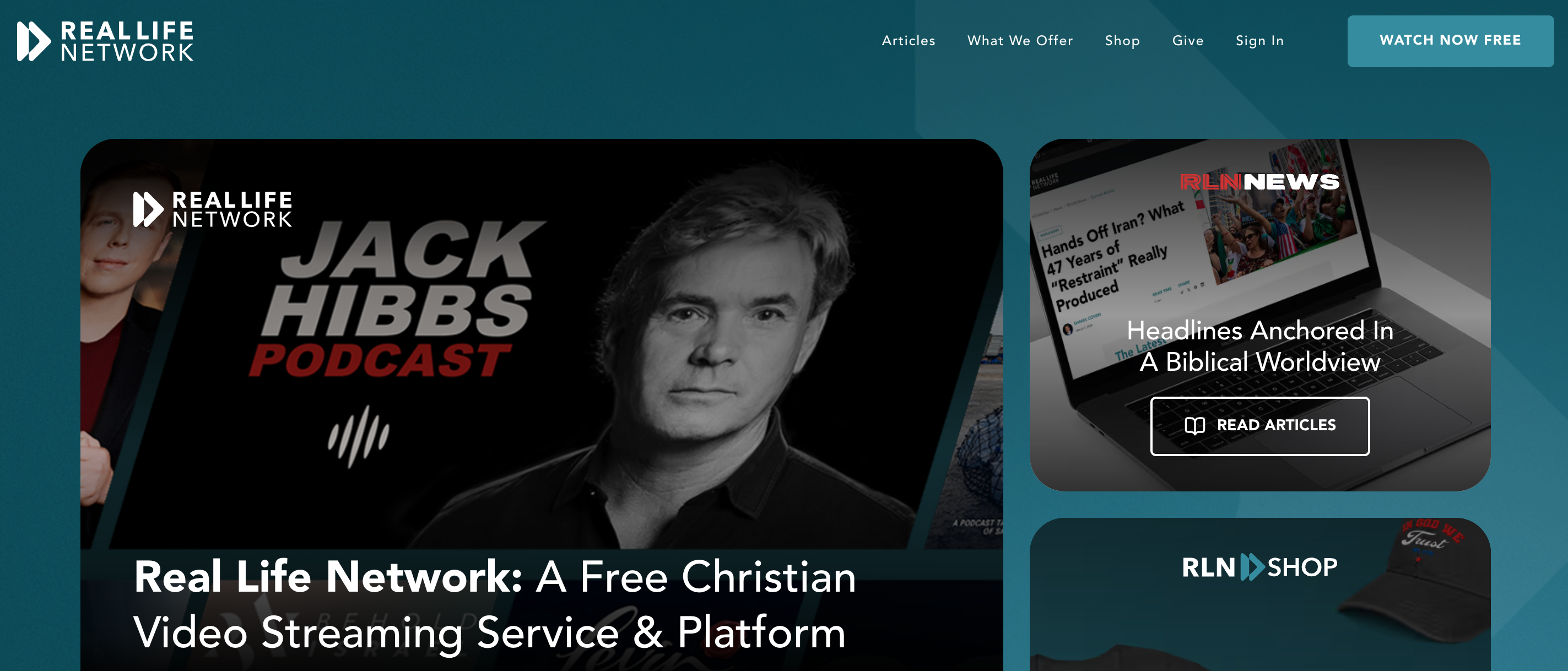
Real Life Network offers one of the broadest combinations of biblical programming available without a subscription fee. The donor-supported platform includes Bible teaching, Christian news, apologetics, documentaries, podcasts, kids’ programs, movies, cultural commentary, and live events.
Viewers can find programs such Real Life with Jack Hibbs, RLN News, The Daniel Cohen Show, Cross Examined, The Creation Today Show, Superbook, and many other offerings within one biblically curated environment.
Unlike services centered primarily on movies, RLN is particularly strong for viewers who want entertainment combined with biblical teaching and programs addressing faith, culture, current events, and worldview.
Best for: Christians looking for a broad, free streaming platform built around biblical truth.
2. Pure Flix: Best for Christian Movies and Family Entertainment
Cost: Paid subscription; plans begin at $9.99 per month
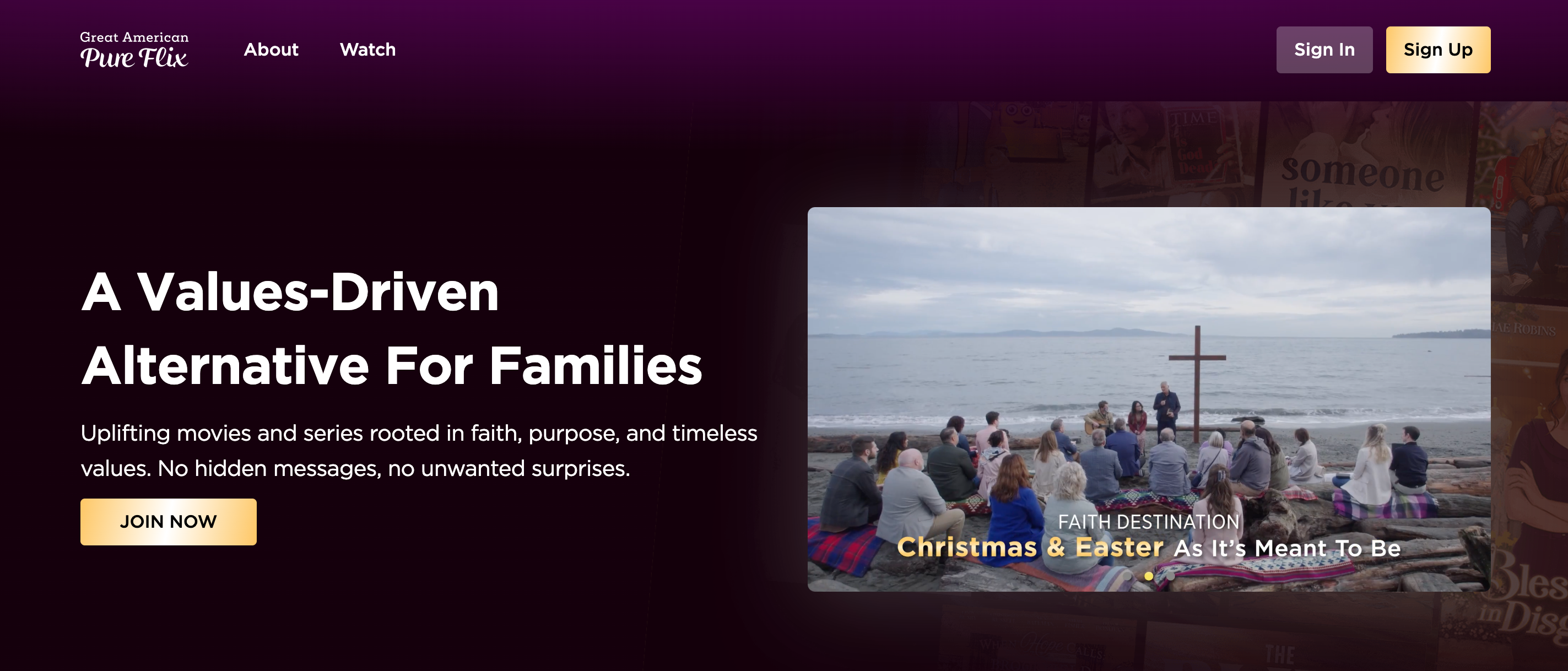
Great American Pure Flix is one of the best-known Christian streaming services for faith-forward movies and scripted entertainment.
Its catalog combines original series, Christian films, family dramas, Christmas programming, kids’ shows, and uplifting entertainment centered on faith, family, and traditional values. Multiple membership levels are available, with higher tiers adding features such as special screenings and early access.
For viewers who want a faith-oriented alternative to browsing mainstream movie libraries, Pure Flix remains one of the strongest options.
Best for: Christian movies, original series, family dramas, and faith-centered entertainment.
3. UP Faith & Family: Best for Wholesome Family Entertainment

Cost: $5.99 per month or $59.99 annually
UP Faith & Family offers thousands of hours of commercial-free family movies, dramas, series, and inspirational entertainment.
Its catalog is broader than explicitly Christian programming. Viewers will find faith-friendly movies alongside wholesome family dramas and popular series such as Heartland.
That distinction makes UP Faith & Family particularly useful for households looking for cleaner entertainment without requiring every program to function as Christian teaching.
Best for: Wholesome dramas, family movies, romantic stories, and uplifting entertainment.
4. Faith Channel: Best for Faith-Based Shows and Inspirational Content
Cost: Free
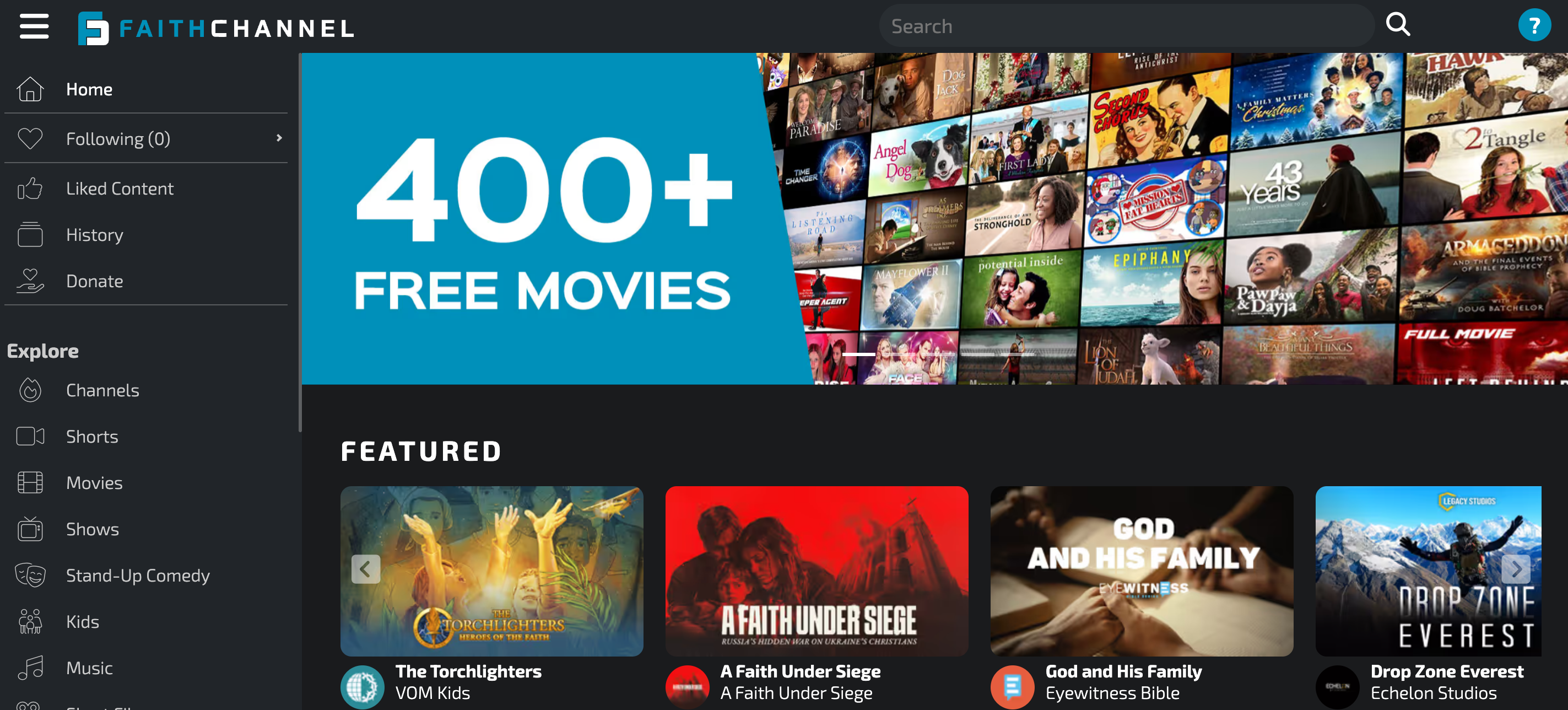
FaithChannel is a free Christian streaming service offering movies, television shows, documentaries, preaching, teaching, music, podcasts, children’s programming, and other inspirational content.
Its growing library includes programming from a variety of independent Christian ministries and content producers. Titles range from Heroic Faith and The Torchlighters to apologetics, Bible prophecy, family films, podcasts, and children’s shows.
Because much of its catalog comes from different creators and ministries, viewers can encounter a particularly wide variety of formats and perspectives.
Best for: Exploring free Christian films, independent programs, teaching, podcasts, and inspirational content.
5. Go Minno: Best for Christian Kids’ Shows and Bible-Based Content

Cost: $10.99 per month or $69.99 annually after a free trial
Minno is designed specifically for Christian families with younger children.
Its library includes more than 175 shows, including the classic VeggieTales collection, Bible stories, music, educational programs, and Christian children’s entertainment. Families can stream across multiple devices and download programming for offline viewing.
Because the service is built specifically for children rather than including kids’ programming as one category within a larger library, it gives parents a focused alternative to mainstream children’s streaming.
Best for: Preschool and elementary-age children, Christian cartoons, Bible stories, and faith-based learning.
6. Yippee: Best for Safe, Faith-Focused Kids’ Entertainment

Cost: $7.99 per month or an annual subscription after a free trial
Yippee combines Christian children’s television with the energetic creator-driven format kids often encounter online.
Its library includes thousands of episodes from hundreds of series and movies, including Superbook, Christian programming, music, educational shows, and parent-approved creators. Yippee emphasizes that its environment contains no ads and no recommendation algorithms.
That makes it especially attractive to parents whose children enjoy online video but who want more control over what appears next.
Best for: Families seeking a Christian alternative to children’s YouTube viewing.
7. RightNow Media: Best for Bible Studies and Church Groups

Cost: Access is generally provided through subscribing churches and Christian organizations
RightNow Media is less like Netflix and more like an enormous digital discipleship library.
It offers more than 25,000 video Bible studies covering Scripture, marriage, parenting, leadership, finances, recovery, Christian living, and other topics. The service also includes more than 2,000 children’s episodes and downloadable materials for many studies.
Rather than purchasing individual subscriptions, users generally receive access through a participating church, ministry, or organization.
Its combination of teaching videos and discussion materials makes RightNow Media particularly useful for small groups and church ministries.
Best for: Bible studies, small groups, church discipleship, leadership development, and Christian education.
8. RedeemTV: Best Free Christian Film Streaming Platform

Cost: Free
RedeemTV offers more than 2,000 faith-filled titles without subscription fees or advertising.
Its donor-supported library includes Christian movies, documentaries, animated programs, television series, and family entertainment. Titles include The Pilgrim’s Progress, Vindication, Fragments of Truth, Ryan Defrates, and many others.
RedeemTV is especially strong for viewers whose primary interest is films and entertainment. Real Life Network offers a broader mix of teaching, news, cultural programming, and entertainment, while RedeemTV concentrates more heavily on movies and series.
Best for: Free Christian movies and shows without commercials.
9. VidAngel: Best for Filtering Movies and TV Shows

Cost: $9.99 per month when billed directly; supported streaming subscriptions may also be required
VidAngel takes a completely different approach to family entertainment.
Rather than providing only a traditional catalog of Christian programming, VidAngel lets viewers apply customizable filters to supported movies and shows from other streaming services. Families can choose categories of language, sexual content, violence, and other material they would prefer to mute or skip.
That means parents do not necessarily have to reject an entire movie because of a handful of objectionable scenes.
VidAngel requires users to have their own subscriptions to compatible streaming services for much of its filtered content.
Best for: Families who want more control over mainstream movies and television shows.
10. Christian Cinema: Best for Renting and Buying Christian Movies

Cost: Individual rentals and purchases; optional subscription plans are also available
Christian Cinema is useful for viewers who do not necessarily want another monthly streaming subscription.
Movies can be rented individually and streamed for a limited viewing period or purchased and stored in a digital library for on-demand viewing. The service specializes in Christian and faith-based films rather than trying to compete as a broad general-entertainment platform.
Christian Cinema also offers optional subscription plans for additional movies and television programming, but its rent-or-buy model remains a major distinction.
Best for: Viewers who want specific Christian movies without committing to another full streaming subscription.
What Should You Look for in a Christian Streaming Service?
The best platform depends on what you want from it.
Start by considering biblical alignment. A platform described as “family-friendly,” “inspirational,” or even “faith-based” is not necessarily the same as a service intentionally grounded in Scripture. Families should consider who selects the programming and what worldview shapes the library.
Next, consider the type of content your household actually watches. Parents with young children may get more value from Minno or Yippee, while a small-group leader may find RightNow Media far more useful. Movie lovers may prefer Pure Flix or RedeemTV, while viewers interested in Bible teaching, apologetics, news, and culture may find Real Life Network a better fit.
Finally, consider cost, commercials, device compatibility, offline viewing, parental controls, and whether a service requires other subscriptions to function.
Are There Any Free Christian Streaming Platforms?
Yes.
Real Life Network is completely free and donor-supported, offering Christian teaching, news, movies, kids’ programs, apologetics, podcasts, and more without a paid tier. RedeemTV is also donor-supported and offers more than 2,000 titles free without ads. FaithChannel provides free faith-and-family programming as well.
Angel has selected titles available without a Guild membership, although most of its full catalog now requires paid access.
For families trying to reduce monthly subscription costs, the amount of Christian programming available free is substantial.
Which Christian Streaming Platform Is Best for Families?
There is no single answer for every household. For families seeking a platform the whole household can use, Real Life Network has an advantage because its free library extends beyond children’s entertainment to Bible teaching, movies, documentaries, current events, apologetics, podcasts, and family programming.
Families primarily concerned with younger children may prefer Minno or Yippee. Those wanting a traditional movie-and-series experience may choose Pure Flix, UP Faith & Family, or RedeemTV.
The best choice is the one that not only avoids objectionable material but also supports the values parents are working to build at home.
Frequently Asked Questions About Christian Streaming Platforms
What Is the Best Christian Streaming Platform?
The best platform depends on your priorities. Real Life Network is a strong all-around choice for viewers seeking free biblical teaching, Christian news, apologetics, kids’ programming, movies, documentaries, and cultural content. Pure Flix is particularly strong for Christian movies and scripted entertainment, while Minno and Yippee specialize in children’s programming.
What Is the Best Free Christian Streaming Service?
Real Life Network and RedeemTV are two of the strongest completely free options. RLN provides a broad mix of programming, while RedeemTV has a particularly large free library of Christian films and series. FaithChannel is another free option worth exploring.
Is There a Christian Alternative to Netflix?
Several services can function as Christian or family-oriented alternatives to Netflix. Pure Flix most closely resembles a traditional subscription movie-and-series platform, while Real Life Network combines entertainment with teaching, news, apologetics, and family programming at no cost.
What Is the Best Christian Streaming Platform for Kids?
Minno and Yippee are specifically built around Christian children’s entertainment. Real Life Network also offers free children’s programming within a larger platform designed for the whole family.
Do I Need to Pay for Christian Streaming?
No. While many Christian streaming services charge monthly or annual subscription fees, Real Life Network, RedeemTV, and FaithChannel offer free options.
Finding the Best Christian Streaming Platform for Your Home
Christian streaming is no longer a single category. Families can now choose platforms specializing in movies, Bible studies, kids’ shows, documentaries, teaching, news, apologetics, and wholesome general entertainment.
The right choice depends on what you want entering your home and what role you want media to play in your family.
For viewers who want to begin with a service built around biblical truth without adding another monthly expense, Real Life Network provides free access to Christian teaching, news, family programming, movies, documentaries, podcasts, apologetics, kids’ shows, and more.
Explore free Christian streaming today on Real Life Network.

7 Family Media Questions Every Christian Parent Should Ask
What children watch can shape what they admire, accept as normal, and learn to value. These seven questions can help Christian parents evaluate entertainment thoughtfully and teach their children lifelong biblical discernment.
Choosing what your family watches used to be relatively simple. Today, children can encounter movies, shows, videos, games, social media, podcasts, and other digital content across multiple devices throughout the day.
That makes media decisions about more than whether a particular movie contains bad language or an inappropriate scene. Stories communicate ideas. Characters model attitudes. Entertainment can reinforce beliefs about relationships, identity, success, morality, authority, and what makes life meaningful.
Christian parents don’t need to approach every screen with suspicion. But thoughtful questions can help families move beyond simply asking, “Is this allowed?” toward developing genuine biblical discernment.
Here are seven questions worth asking.
1. What Is This Teaching My Child to Admire?
Every story has heroes. Sometimes they’re obvious. Other times the audience is simply encouraged to sympathize with certain characters, choices, or lifestyles.
Ask what qualities the program presents as admirable. Is courage celebrated? Loyalty? Honesty? Sacrifice? Compassion? Or does the story consistently reward selfishness, dishonesty, disrespect, cruelty, or behavior that conflicts with what your family is teaching?
This doesn’t mean every protagonist must behave perfectly. Some of the best stories involve flawed people learning from mistakes.
The more important question is whether the story ultimately recognizes the difference between wisdom and foolishness, good and evil, truth and deception.
2. What Does This Program Treat as Normal?
Media doesn’t always persuade through direct arguments. Often, it influences simply by repetition.
When children repeatedly see particular attitudes, relationships, behaviors, or beliefs presented as normal, those ideas can gradually begin to feel ordinary. That is why parents should pay attention not only to dramatic objectionable moments but also to the assumptions underneath a story.
What does the program communicate about marriage? Parents? Faith? Sexuality? Authority? Success? Human worth?
Children may not consciously identify those ideas, but that doesn’t mean they aren’t noticing them.
Parents can help by occasionally asking, “What do you think that show is saying about this?” That simple question teaches children to watch actively rather than absorb everything passively.
3. Is This Appropriate for My Particular Child?
An age rating can be helpful, but parents know their children better than a rating system does.
Two children of the same age may react very differently to the same movie. One might handle a tense historical story well, while another has nightmares after mild suspense. One teenager may be ready to engage thoughtfully with difficult cultural questions while another isn’t.
Christian parenting requires more than finding the boundary of what is technically permitted.
Romans 14:19 encourages believers to “pursue the things which make for peace and the things by which one may edify another.”
A useful question, then, is not only, Can my child watch this? but Will this be beneficial for my child right now?
4. How Does My Child Feel After Watching It?
Sometimes the effect of media becomes clearer after the screen turns off. Does a child seem encouraged, curious, imaginative, or eager to talk? Or irritable, anxious, fearful, disrespectful, restless, or obsessed with watching more?
One viewing won’t necessarily reveal a pattern. But repeated reactions can tell parents something important.
The same is true for adults. Some entertainment leaves viewers refreshed. Other content leaves them angry, agitated, discouraged, or mentally exhausted.
Philippians 4:8 directs believers toward what is true, noble, just, pure, lovely, commendable, virtuous, and praiseworthy. That provides a useful biblical framework for considering not just what enters the mind, but what it produces there.
5. Is Screen Time Crowding Out Something Better?
A perfectly acceptable program can still become a problem if it consumes too much time.
The issue may not be what a child is watching. It may be what he or she is no longer doing. Is screen time replacing sleep? Outdoor play? Reading? Family conversation? Church involvement? Homework? Prayer and Scripture? Time with friends?
Sometimes the wisest media decision is not finding a better show but leaving the television off.
Healthy media habits recognize entertainment as one part of life rather than the center of it.
6. Can This Become a Conversation Instead of Just Consumption?
Parents don’t have to eliminate every story containing an idea they disagree with. Sometimes those moments provide valuable opportunities to teach.
Watching together allows parents to ask questions.
- Why do you think that character made that choice?
- Was it wise?
- What consequences followed?
- What does the Bible teach about that issue?
- How would following Jesus change the way someone responds?
Those conversations help children build discernment that will eventually matter far more than parental controls.
Christian media can provide especially natural opportunities for these discussions. A program such as LifeWise Academy can lead into conversations about bringing biblical truth into everyday life. Genesis Science Minute can introduce questions about creation and science in just 60 seconds. The Pilgrim’s Progress can start conversations about temptation, perseverance, and following Christ.
The goal isn’t to interrogate children after every episode. It’s to make talking about ideas a normal part of family life.
7. Does Our Entertainment Support the Kind of Home We’re Trying to Build?
This may be the most important question of all.
Parents spend years teaching children what is true, who they are, what relationships should look like, why Scripture matters, and what it means to follow Christ.
It makes sense to ask whether the family’s entertainment choices generally support those priorities or continually work against them. That doesn’t require every show to be overtly Christian. But intentionally including faith-based programming can help create a healthier balance.
Younger children might enjoy biblical programming such as Superbook, iBible, or Learn, Grow and Go! Older children and teens can explore apologetics through In Depth Apologetics for Kids or creation-focused content. Families can also choose movies, documentaries, Bible teaching, and programs built around Christian service, history, and worldview.
Real Life Network provides these kinds of options in one biblically curated streaming environment, giving parents a place to begin without having to sort through an enormous mainstream catalog first.
Teach Discernment, Not Just Rules
Parents cannot screen every piece of media their children will encounter forever.
Eventually, children become teenagers. Teenagers become adults. They choose their own movies, follow their own accounts, download their own apps, and decide which voices deserve their attention.
That’s why the long-term goal is bigger than creating a list of approved and prohibited programs. It is helping children learn to ask good questions themselves.
- What is this teaching me?
- Does it agree with what I know to be true?
- How is it affecting my thoughts and attitudes?
- Is this worth my time?
- Would I make this same choice if Jesus were sitting beside me?
Those questions turn media discernment from a parental restriction into a lifelong Christian practice.
The goal isn’t a home without screens. It’s a home where screens know their place, parents remain engaged, and entertainment doesn’t get the final word on what children learn to value.
Explore free, biblically curated kids’ shows, family programs, movies, Bible teaching, and more on Real Life Network.

How Personal Interviews Can Strengthen Faith, Reveal Truth, and Shape a Biblical Worldview
Personal interviews bring biblical truth into real life through stories of faith, hardship, testimony, and conviction, helping Christians grow in discernment and understand how Scripture applies to a complicated world.
Some truths become easier to understand when you hear them through another person’s experience. A sermon may explain forgiveness, while an interview with someone who has forgiven an enemy can show what forgiveness looks like when it costs something. A Bible study may teach about trusting God through hardship, while a conversation with someone who has survived persecution, addiction, grief, or war can bring that truth into everyday life.
That is part of what makes personal interviews so valuable in Christian media. They allow viewers to hear ideas explored through stories, questions, experiences, and honest reflection. When those conversations are grounded in biblical truth, they can strengthen faith while also helping Christians think more carefully about the world around them.
1. Personal Stories Make Biblical Truth Concrete
Christians often know important biblical principles long before they understand how those principles play out in difficult circumstances. It is one thing to read that believers should trust God. It is another to hear someone explain how he or she continued trusting God after losing a career, facing persecution, walking through serious illness, or experiencing personal tragedy.
Programs such as The Resilient Show, hosted by Chad Robichaux, can open conversations about trauma, recovery, purpose, and resilience through the experiences of people who have endured significant challenges. Stories like these help viewers see that biblical faith is not reserved for ideal circumstances. It is meant to shape how believers live when life becomes difficult.
2. Interviews Allow Important Questions to Be Asked
Strong interviews do more than provide inspiring stories. They ask questions: Why did you believe that? What changed your mind? How did your faith affect your decision? What would you say to someone who disagrees?
Those questions create space for ideas to be examined rather than merely stated. This can be especially valuable when discussing theology, culture, politics, science, or apologetics because viewers get to hear not only a conclusion but also some of the reasoning behind it.
Programs such as Small Talk Big Issues bring together conversations with faith leaders, journalists, entrepreneurs, political figures, and other guests to explore significant issues from a Christian perspective. The interview format makes room for nuance that is often missing from headlines or short social-media clips.
3. Testimony Can Strengthen Faith
Personal testimony has always had an important place in Christianity. The New Testament repeatedly records people describing what Christ had done in their lives. The man healed by Jesus in John 9 offered one of the simplest examples: “One thing I know: that though I was blind, now I see” (John 9:25 NKJV).
A testimony does not replace Scripture, but it can illustrate Scripture. Hearing how someone came to faith, overcame fear, remained faithful under pressure, or experienced God’s provision can encourage believers facing their own struggles.
Living Fearless with Hedieh, for example, draws in part from Hedieh Mirahmadi’s experience of leaving Islam and becoming a follower of Christ. Conversations shaped by experiences like hers can introduce viewers to questions involving religious belief, freedom, culture, fear, and the work of the Gospel.
4. Conversations Help Christians Understand Different Perspectives
It is easy to form opinions about people we have never heard speak for themselves. Interviews slow that process down by allowing viewers to hear how another person understands an issue, why someone holds a particular belief, or how circumstances shaped his or her perspective.
That does not require Christians to agree with everything a guest says. In fact, disagreement can be useful when viewers are learning to compare ideas with Scripture. A strong biblical worldview is developed as believers learn to identify assumptions, examine arguments, recognize truth, and test what they hear against God’s Word.
That kind of discernment is especially important in a culture where complicated issues are often reduced to slogans.
5. Interviews Can Connect Faith with Current Events
Christians do not live their faith in isolation from the world. Questions about government, education, technology, religious freedom, economics, international conflict, family, and culture all affect daily life.
Interview-based programs can help connect those developments with biblical principles. The Daniel Cohen Show, Rose Unplugged, Cure America, and The City of God each use conversations and interviews to engage cultural or public issues from faith-informed perspectives.
Rather than treating Christianity as something confined to church services, these discussions encourage viewers to consider how biblical truth relates to public life.
6. Real People Can Challenge Easy Assumptions
Some of the most valuable interviews are uncomfortable. A person who has experienced persecution may challenge a casual approach to religious freedom. A missionary may challenge assumptions about evangelism. A veteran may speak differently about courage or sacrifice than someone who has never faced danger. A Christian serving the poor may cause viewers to reconsider how they think about generosity.
Programs connected with ministries such as Samaritan’s Purse, Fred Jordan Missions TV, and Evangelism Explosion International can introduce viewers to Christians putting faith into action through service, outreach, disaster response, and evangelism. Those stories can move the question from “What do Christians believe?” to “What should Christians do because they believe it?”
7. Interviews Can Support Apologetics Without Becoming a Debate
Not every interview is an apologetics program, but interviews can still help Christians understand why they believe what they believe. A scientist can discuss evidence for creation. A former skeptic can explain objections that once kept him from Christianity. A historian can discuss the reliability of biblical accounts. A pastor or theologian can respond to difficult questions about suffering, morality, or the resurrection.
Programs such as Cross Examined and The Creation Today Show give viewers opportunities to hear Christian truth claims examined through questions and conversation. Sometimes a thoughtful interview can accomplish something a formal debate cannot because it lets viewers follow the reasoning at a more natural pace.
Hearing Truth Through Someone Else’s Story
Christian faith ultimately rests on the truth of God’s Word, not the personality or experiences of an interview guest. But personal conversations can help illuminate those truths in memorable and practical ways.
A good interview lets viewers encounter people they might never meet, hear perspectives they might never otherwise consider, and see biblical principles applied to real circumstances. It can encourage faith, expose assumptions, deepen understanding, and prompt better questions.
That is why interviews occupy an important place in Christian media. They remind us that faith is not merely a collection of ideas. It is lived out by real people facing real choices in a complicated world.
Explore personal interviews, Christian conversations, cultural discussions, testimonies, and more for free on Real Life Network.

World News
25 min
Remembering Charlie Kirk: A Life of Faith, Family, and Courage
One year after Charlie Kirk’s death, his commitment to Christ, family, courage, and America offers a lasting challenge to live faithfully, strengthen our homes, invest in the next generation, and stand courageously for our convictions.
One year after the death of Charlie Kirk, there is much worth remembering about a life that ended far too soon. He was known across the country as a conservative activist, speaker, and founder of Turning Point USA. But the convictions that increasingly defined his public life went deeper than politics. Kirk spoke openly about his faith in Jesus Christ, his love for his wife and children, and his belief that strong families were essential to the future of America.
When asked how he wanted to be remembered, Kirk pointed to courage and his Christian faith. Those who worked closely with him likewise described his relationship with Christ as the most important part of his life. He used an enormous platform not simply to discuss elections and public policy, but to encourage people to follow Jesus and take their faith seriously.
That priority deserves to be remembered.
Kirk also understood something increasingly countercultural: the future of a nation is inseparable from the health of its families.
He married Erika in 2021, and they had two children. Fatherhood became an important part of the message he shared with young Americans. He encouraged young adults to pursue marriage, welcome children, leave behind empty pursuits, and build something that could endure beyond themselves. His wife later recalled that marriage and family were among the greatest joys of his life.
That message mattered because Kirk spent much of his career speaking directly to young people. He founded Turning Point USA at only 18 and built an organization centered on engaging the next generation in the future of the country.
Yet preserving America was about more than winning elections. A country ultimately depends upon the character of its people, the strength of its homes, and the convictions parents pass to their children.
If we want to honor Kirk's life, admiration is not enough. We should imitate what was worthy of imitation.
Go to Real Life Network to watch great moments from the life of Charlie Kirk.
That means having the courage to profess Christ when doing so carries a cost. It means building strong marriages and treating parenthood as a calling rather than an inconvenience. It means investing in young people instead of surrendering the next generation to whatever ideas happen to dominate the culture. And it means being willing to enter conversations with people who disagree rather than retreating from difficult questions.
Kirk became famous in part because he was willing to walk onto college campuses, take questions, defend his convictions, and invite disagreement. His example should encourage Christians to develop convictions strong enough to withstand opposition without becoming afraid of the people on the other side.
Most importantly, his legacy should point beyond politics.
Political victories pass. Organizations change. Elections are won and lost. But faithfulness to Christ, love within the home, children raised with conviction, and lives invested in others carry significance far beyond an election cycle.
Charlie Kirk cared deeply about America's future. His life offered a reminder that the work of building that future begins with faithfulness to God, courage in the public square, and commitment to the family at home.
Go to Real Life Network to watch great moments from the life of Charlie Kirk.

Devotional
25 min
Created to Work, but Working under the Curse
Work is one of God’s good gifts, yet the Fall has made it difficult, frustrating, and fleeting. Scripture explains both our desire to find meaning in work and our longing for the lasting rest found in Christ.
One morning, I was riding my bicycle along Washington, D.C.’s Anacostia River when an egret glided over the trail. The pure-white wading birds have always fascinated me with their elegant stillness and regal grace. They look even more impressive on the rare occasions when they spread their wings and take flight, making them look even larger. Yet this impromptu bird-watching experience came to an abrupt and discordant end. The moment before the egret swooped into the brush and out of sight, he made like a bomber and dropped a load of ordnance worthy of an animal twice his size.
A graceful bird, caught in its least graceful position.
The minor incident nearly passed out of my mind until I realized that this un-constipated egret provided an apt example for man’s complex condition. From beginning to end, mankind’s creation is the gift of God. We are created in God’s image and likeness, given dominion over every living thing, and blessed with the good command to fill the earth with God’s image-bearers through procreation (Genesis 1:26-28). Yet our first parents squandered these divine blessings through disobedience and rebellion, for which they were cast out of God’s presence (Genesis 3:22-23) and condemned to die (Genesis 2:17).
Man is a graceful bird, caught in his least graceful position.
Christianity’s nuanced view of human nature becomes incomprehensible without the first three chapters of Genesis. This is why so many human philosophies veer into error on either one side or the other. Most human philosophies boil down to the opinion that man is basically good, or that he is basically bad. Only the Bible (and those influenced by the Bible) can explain how man is created good, but corrupted.
Mankind’s complex condition affects every aspect of our lives, even the way we work. Before anything had tarnished God’s “very good” creation (Genesis 1:31), we read that “The Lord God took the man and put him in the garden of Eden to work it and keep it” (Genesis 2:15). Work is not a consequence of the fall, but a basic function of man, which God created for good. Adam’s task was merely to imitate God’s own example in creative effort (Genesis 2:9), and it carries religious undertones, as the same verbs are used to describe service at the tabernacle in Numbers 3.
However, mankind’s work did not escape the Fall unscathed. Not only was Adam cast out of the lush garden into uncultivated land, but God also declared, “cursed is the ground because of you; in pain you shall eat of it all the days of your life; thorns and thistles it shall bring forth for you; and you shall eat the plants of the field. By the sweat of your face you shall eat bread, till you return to the ground, for out of it you were taken; for you are dust, and to dust you shall return” (Genesis 3:17-19).
The ground was Adam’s domain of work. By extension, this curse extends to all arenas of work. All work is toilsome, demanding, and sometimes fleeting, as the whole creation is “subjected to futility” (Romans 8:20).
Man is a graceful bird, caught in his least graceful position.
Again, the Bible’s complex theology of work has better power to explain the different attitudes people have towards their work than the fractured, individualistic worldviews dominant in America today. Some people love their jobs, while some people hate them. Why? Can individualism or critical theory offer a satisfying answer to this question? (Critical theory would blame group oppression, but that is not satisfying.)
The Bible has an answer. Some people love their jobs because work is a gift from God — a good gift that God created as part of his blessing on mankind. Even in a fallen world, the wise preacher concludes, “There is nothing better for a person than that he should eat and drink and find enjoyment in his toil. This also, I saw, is from the hand of God” (Ecclesiastes 2:24, see also Ecclesiastes 5:18-19 and 9:9). Yet some people also hate their jobs because work is cursed after the Fall.
Man is a graceful bird, but he is still caught in his least graceful position.
The very unseemliness of the aforementioned egret’s evacuation is what makes it an appropriate metaphor for fallen man under sin. “We have all become like one who is unclean,” Isaiah confesses, “and all our righteous deeds are like a polluted garment” (Isaiah 64:6). We need one who can wash our filth away, to achieve for us what we could never achieve by our own works.
Even though work is good, it is not ultimate. The Lord God engaged in his creative work for six days, “and he rested on the seventh day from all his work that he had done” (Genesis 2:2). Just as man was made to imitate God’s work, so man was also supposed to imitate God’s rest (Exodus 20:8-11). But, under the curse of sin, that rest became fleeting and far off.
From the earliest generations, Adam’s descendants sought one who would restore them to God’s rest. Thus, Noah’s father Lamech said in hope, “Out of the ground that the Lord has cursed, this one shall bring us relief from our work and from the painful toil of our hands” (Genesis 5:29). Yet Noah did not bring an end to toil, hard labor, or the futility of human industry. Nor did Moses, Joshua, David, or any human leader called by God throughout history. All were sinners, after all.
Yet painful toil under the curse is not man’s final condition, for “there remains a Sabbath rest for the people of God” (Hebrews 4:9). Those who are forgiven of their sins by the blood of Christ receive true grace. They are not only restored to right fellowship with God, but they also receive eternal life and enter into God’s rest.
For now, we recognize that all honest work is good. “In all toil there is profit, but mere talk tends only to poverty” (Proverbs 14:23). “Let the thief no longer steal, but rather let him labor, doing honest work with his own hands, so that he may have something to share with anyone in need” (Ephesians 4:28). “It is the hard-working farmer who ought to have the first share of the crops” (2 Timothy 2:6). But work is not ultimate, and one day our painful toil will come to an end.
Man is a graceful bird, and one day his graceless condition will be remedied in full. One day, those who are in Christ will enter into the glory and rest of their Redeemer.
This article was originally written by Joshua Arnold and published on The Washington Stand. For more content like this, visit Real Life Network.
Thank you! Your submission has been received!
Oops! Something went wrong while submitting the form.
Devotional
We live in a world drowning in information yet starving for truth. There has never been a generation with more access to data, opinions, facts, voices, teachers, influencers, and experts. People scroll for hours, read constantly, binge videos, chase insights, and collect information by the truckload. Yet despite all this knowledge, our culture is more confused, more deceived, and more spiritually blind than ever before.
Why? Because there is a difference between knowing things and knowing truth. There is a difference between education and revelation. There is a difference between filling your mind and transforming your heart. Biblical knowledge is not about storing information. It is about knowing God, obeying His Word, and living a life shaped by His truth.
Proverbs 1:7 says, “The fear of the Lord is the beginning of knowledge.” That means true knowledge does not start with you. It starts with God. It starts with recognizing who He is, who you are, and how desperately you need Him. The fear of the Lord is not dread or terror. It is reverence. It is awe. It is humility. It is surrender. And without it, everything else you know is meaningless.
This world applauds intelligence but ignores wisdom. It celebrates experts but rejects truth. It elevates knowledge but despises the God who created it. And because of that, people are lost. They are intelligent but empty. Educated but wandering. Informed but spiritually blind. The knowledge that matters most is the knowledge that draws you closer to God, strengthens your walk with Christ, and protects you from deception. That is the message of Scripture. That is the heartbeat of discipleship. And that is what this devotional will walk you through.
Below are five key truths that show what real, godly knowledge looks like and how it transforms the life of a believer.
True Knowledge Begins With the Fear of the Lord
The Bible is clear that knowledge has a foundation, and that foundation is not human achievement. The foundation of knowledge is the fear of the Lord. Without reverence for God, there is no true wisdom. Without humility before God, there is no real understanding. Without surrender, learning becomes nothing more than self-promotion.
The world defines knowledge as accumulation. God defines knowledge as application. The world says that the more you know, the smarter you are. God says that the more you know Him, the wiser you become. Knowledge that does not begin with God feeds pride. Knowledge that begins with God produces holiness.
Proverbs 1:7 warns us that fools despise wisdom and instruction. A fool is not someone who lacks intelligence. A fool is someone who refuses to acknowledge God. A fool is someone who thinks he can interpret life apart from the Creator of life. A fool is someone who believes his opinions are more trustworthy than God’s Word.When you fear the Lord, you realize that everything you need to know flows from Him. You begin to see the world through His truth instead of through culture. You begin to evaluate everything by His standard instead of by society’s shifting values. You begin to understand that wisdom is not about being right. It is about being righteous.
True knowledge begins with this confession: Lord, You are God and I am not. Teach me Your ways. Show me Your truth. Lead me in Your wisdom.
That posture is where learning begins. That posture opens your heart to the voice of the Holy Spirit. That posture leads you into a life shaped by truth instead of trends. And that posture turns knowledge into transformation.
Godly Knowledge Grows When You Surrender to the Holy Spirit
Many people assume that growing in knowledge is merely an academic exercise. But spiritual knowledge is not learned the same way earthly information is learned. You do not need a degree to grow in godly knowledge. You need the Holy Spirit. The Bible says that the Spirit is our Teacher. He reveals the deep things of God. He brings understanding. He illuminates Scripture. He convicts, guides, directs, and speaks to our hearts. Isaiah 11:2 prophesied that the Messiah would be anointed with the Spirit of knowledge, and that same Spirit now dwells inside every believer.
That means real learning begins with surrender. It begins with humility. It begins with dependence. Before you open the Bible, you pray. Before you study, you ask God to teach you. Before you learn, you yield your heart. Knowledge without surrender produces pride. Knowledge with surrender produces wisdom.
Hosea 4:6 contains one of the most sobering warnings in Scripture. It says, “My people are destroyed for lack of knowledge.” God was not talking to unbelievers. He was talking to His own people. They were destroyed not because the enemy was strong, but because they were spiritually ignorant. They did not know God’s Word. They did not understand His truth. They were vulnerable because they were biblically shallow.
The same danger exists today. The less you know God’s truth, the more easily you will be deceived. The less you know God’s Word, the more confused you will become. The more time you spend listening to culture instead of Scripture, the more your thinking will drift away from God. But when you walk in daily surrender to the Spirit, knowledge becomes a weapon. It becomes a shield against deception. It becomes clarity in a world of confusion. It becomes a light in a dark age. And it becomes strength for your walk with Christ.
Knowledge Becomes Wisdom Only When You Obey What God Reveals
Biblical knowledge always has a purpose, and that purpose is obedience. The goal of learning is living. The goal of truth is transformation. God teaches us so that He can lead us. He reveals truth so we can walk in it. Knowledge without obedience becomes pride. Obedience turns knowledge into wisdom.
James 1:22 warns us not to be hearers of the Word only. When we hear but do not obey, we deceive ourselves. We begin to think that learning alone is spiritual growth. But God says learning is only the first step. Obedience is the evidence.
You can memorize verses, study theology, read commentaries, and listen to sermons, but if those truths do not create repentance, obedience, conviction, and spiritual growth, they become useless. If your knowledge does not make you more like Jesus, then it is not godly knowledge. It is religious noise. Biblical knowledge always leads toward holiness. It always moves you away from sin. It always opens your eyes to deception. It always shapes your character. It always guards your heart. And it always strengthens your walk.
The Pharisees had knowledge. They lacked obedience. They could quote Scripture but did not know the God who wrote it. They could teach the Word but could not live the Word. That is the danger of knowledge without application. Spiritual growth is not about knowing more. It is about obeying what you already know. When you open the Bible, do not ask, “What information can I learn today?” Ask, “What transformation does God want to bring into my life today?”
That is how knowledge becomes wisdom. That is how truth becomes freedom. That is how learning becomes faith. And that is how your life begins to shine with the power of Christ.
True Knowledge Protects You From Deception and Anchors Your Life in Truth
We are living in a time of spiritual confusion. Lies are being packaged as truth. Sin is being marketed as progress. Deception is dressed in tolerance. Entire denominations are abandoning biblical truth. People are applauding what God condemns and condemning what God approves.
This is exactly why God calls His people to grow in knowledge. The more you know Scripture, the more clearly you will see the world. The more you know God’s truth, the less vulnerable you become to deception. The more you study the Word, the easier it becomes to discern good from evil.
Colossians 2:8 warns believers not to be taken captive by philosophy and empty deceit. There are many voices in this world, and not all of them are speaking truth. There are false teachers, counterfeit gospels, corrupted ideologies, and spiritual distractions everywhere. That is why you must be discerning. That is why you must guard your heart and mind. The Bereans in Acts 17:11 give us the perfect example. They listened with an open heart but tested everything against Scripture. They did not accept teaching blindly. They searched the Scriptures daily to confirm the truth. They were hungry to learn, but they were anchored in the Word.
That is what godly knowledge produces. It builds a wall of protection around your mind. It embeds truth into your thinking. It helps you spot deception before it takes root. It equips you to stand firm when culture demands compromise. And it gives you the clarity to navigate a world that is becoming more confused every day. Knowledge protects you. Truth stabilizes you. Scripture grounds you. And when you commit to growing in biblical knowledge, you become unshakable in a world that is shaking.
The Goal of Knowledge Is Not Information. The Goal Is Knowing God.
At the end of the day, the purpose of knowledge is not to make you smarter. The purpose of knowledge is to make you closer to Christ. You were not saved so you could collect information. You were saved so you could know God. Everything you learn should lead you deeper into worship, obedience, and relationship with Him.
Second Peter 3:18 tells us to grow in the grace and knowledge of our Lord and Savior Jesus Christ. That is not a suggestion. It is a command. Spiritual growth is not automatic. It requires discipline. It requires time in the Word. It requires prayer. It requires humility. It requires a heart that says, “Lord, teach me. Change me. Shape me.” The more you know God, the more you will trust Him. The more you understand His promises, the more you will rely on them. The more you study His character, the more you will worship Him. And the more you walk with Him, the more your life will overflow with His truth.
Knowledge is not the goal. Knowing God is the goal. And when your pursuit of knowledge becomes a pursuit of Christ Himself, everything in your life changes.
Your decisions change.
Your relationships change.
Your priorities change.
Your desires change.
Your worldview changes.
Your character changes.
The more you know Him, the more you love Him. And the more you love Him, the more your life becomes a reflection of His truth.
Let’s Pray
Father, thank You for the gift of truth. I want to grow in knowledge, not just so I can know more, but so I can walk closer with You. Teach me by Your Spirit. Fill my heart and mind with wisdom from above. Keep me from pride and help me apply what You show me. Let everything I learn draw me into deeper worship and greater obedience. In Jesus’ name I pray. Amen.
For more content to grow your faith, visit Real Life Network.
25 min

December 30, 2025
Jack Hibbs
Devotional
In a culture filled with appearances and performance driven faith, Scripture reminds us that God is not impressed by what looks polished on the outside. True Christianity is revealed under examination. In this devotional, Pastor Jack Hibbs calls believers to sincere faith that can withstand the heat of God’s refining light.
A Faith That Can Be Examined
We are all at our best when we’re in the company of other Christians. But it’s who we are at home that defines the person we truly are. The question is, are you and I sincere?
Our English word “sincere” is a translation of the Greek word eilikrinēs, which means pure, unsullied, without wax, and able to bear full examination in the sun. That type of examination was essential because it wasn’t uncommon for first-century craftsmen to use wax as putty to hide cracks in their slightly damaged pottery.
When the Heat Reveals the Truth
Say you were a worshipper of the goddess Diana, and you purchased an idol to take to her temple. But as you held the statue in the warm sun, her arm fell off. What happened? When the heat was turned up, your idol was revealed for what it was—with wax and insincere. Likewise, when God turns up the heat in our lives through fiery trials, His purpose is to expose falsehood within us. We may deceive others, and even ourselves, but we cannot hide the truth from God. Our relationship with Him must be sincere. We cannot “putty” ourselves up and put on a show of Christianity. We must, as Paul prayed, “approve the things that are excellent.”
It’s time to get real—time to allow the full splendor of the light of God’s Word to examine us. That we might have a single eye to the very best things with a pure and sincere heart until the day of Christ.
Watch and Grow on Real Life Network
For more from Pastor Jack Hibbs and trusted biblical teaching that strengthens your faith, watch on Real Life Network. Stream free, faith filled content anytime at RealLifeNetwork.com or download the Real Life Network app today.
25 min
Sincere in the Sun: When God Turns Up the Heat

December 15, 2025
Jack Hibbs