
Stream Real Life Network Now

WATCH NOW
Christian Media

Faith & Culture
25 min
The Wisdom of Ecclesiastes for the Age of Superintelligence
As AI safety researchers warn about the risks of superintelligence, questions about the industry's priorities are growing. Discover why technological advancement must be guided by wisdom, and how Scripture calls Christians to trust God rather than fear the future.
The artificial intelligence community just waved goodbye to yet another top safety and regulation official — and he offers a unique angle in his warning to the world.
David Robinson had been leading safety reports for OpenAI, the maker of ChatGPT. Robinson resigned in the first week of October, stating that the industry’s approach to safety has been stemming from a broken culture. He penned the following words in a piece for The Atlantic, which contain more truth than perhaps he even knows: “The future depends on wisdom that Silicon Valley lacks.”
We’ll come back to that.
His departure comes on the heels of several other prominent AI safety researchers abandoning the industry. Their exits have paired with dreadful public warnings about the future of this technology, leaving the American people to grapple with the headlines and the unknown.
Take Jacob Coxon, for example. After leaving Claude developer Anthropic in September, he wrote on X that top tech labs are “gambling with our lives” by racing toward self-improving superintelligence. He went on to reveal that the people building AI “earnestly believe that it could kill us all by the end of the decade.”
Comforting.
For clarity, the industry term “superintelligence” refers to a hypothetical AI system that developers believe could surpass humans in overall knowledge and capability. This could happen through recursive self-improvement (RSI) in which AI models design and continually improve their own successors.
While the Trump administration has taken to using the term as a reference to AI more broadly, Coxon used it as the industry intends: the potential nightmare of AI evolving beyond our ability to contain.
Let’s go back to David Robinson for a second. Beyond diagnosing the issue of a “lack of wisdom,” he went on in his article to describe the kind of wisdom that is desperately needed — the kind that shows us “how to handle dangerous technology and, more fundamentally … what it means to care for people.”
This kind of wisdom has only one source.
Proverbs 4:7 states, “The beginning of wisdom is: Acquire wisdom; And with all your acquiring, acquire understanding.” The natural question is, how can true wisdom be acquired? Well, it is not gained by happenstance or by any means of passivity.
The word of God teaches that wisdom is found only, “if you look for it as for silver and search for it as for hidden treasure” (Proverbs 2:4).
That same proverb states that when wisdom enters the human heart, it bears fruits of knowledge, discretion, and understanding. Knowledge is pleasant, discretion brings protection, and understanding guards the one who finds it.
If those spearheading AI labs begin searching for wisdom with the same fervency as they do innovation, capital gain, and victory in the arms race, perhaps we might reap the benefits of honing a brilliant technology for human flourishing, rather than threatening it entirely.
In the absence of wisdom, we ought not to expect flourishing. Thus, the need for appropriate guardrails toward that end is becoming increasingly dire.
Whistleblowers coming forward to expose carelessness in the industry is a good thing. Speaking up when danger is on the horizon is profitable. What is not profitable, however, is responding in fear.
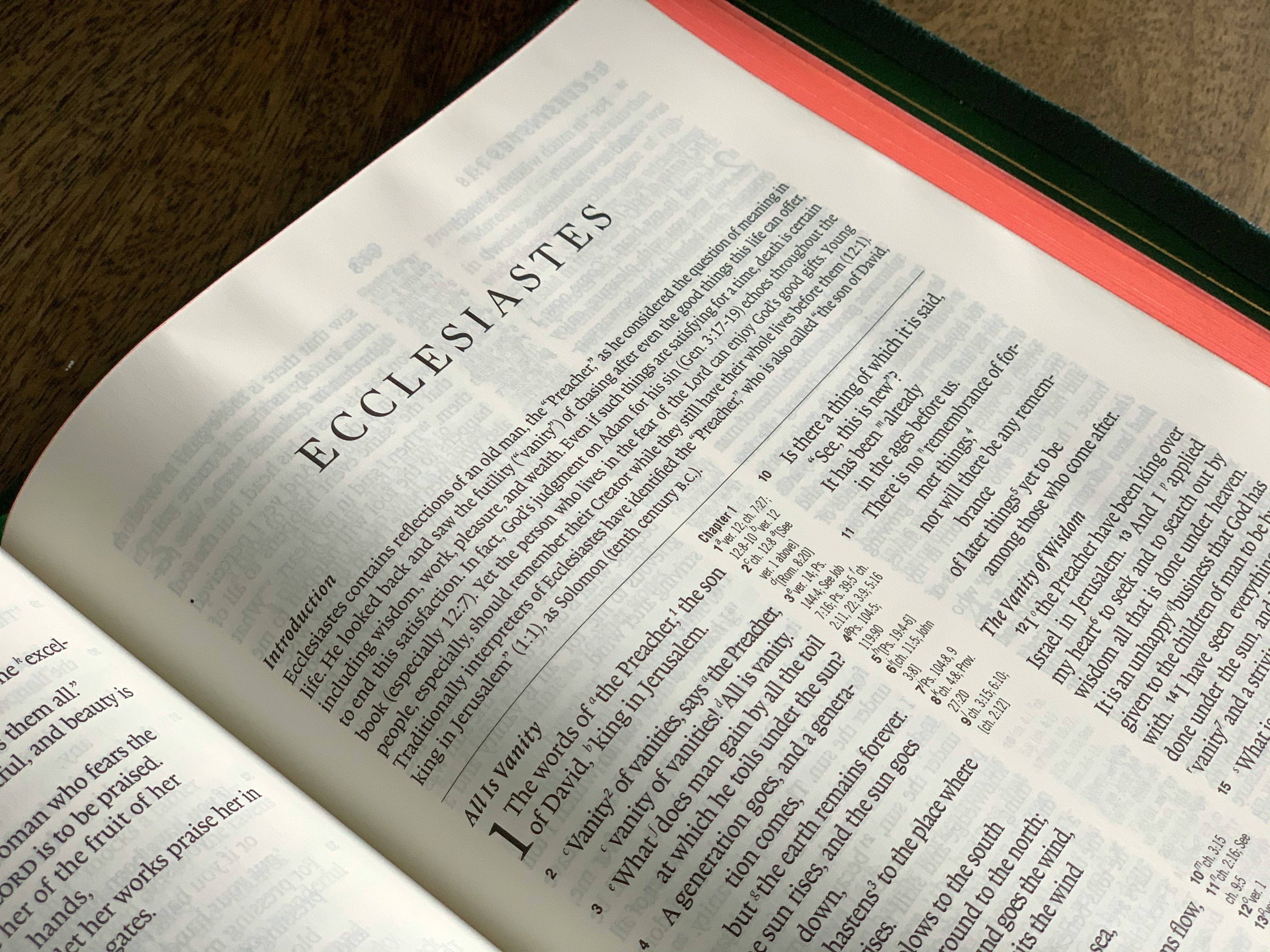
The wisest man in history, King Solomon, tells us, “There is nothing new under the sun” (Ecclesiastes 1:9).
The pride of man has reared its head through the latest technology and means of production before. As soon as human beings had the chance, they took brick and mortar and built the tower of Babel, aiming to reach as high as heaven to make a name for themselves — not for the God who gave them clay, water, and sun in the first place.
Today, we are seeing the latest expression of that sinful pride: men thinking they can hold infinite knowledge without it destroying them. Casting wisdom aside, they trust in their own minds and technical ability rather than in God.
In the Garden of Eden, Adam and Eve fell to the temptation of wanting to be all-knowing, like God. He judged that decision then, and He will not be mocked now (Galatians 6:7).
There is nothing more urgent for the unbeliever than to humble themselves, fall on their knees, and cry out to the Creator for salvation. There is, likewise, nothing more urgent for the believer than to refuse every temptation to fear in these times — to live the joyful, abundant life offered to them in Christ.
It is not a suggestion to be unafraid. It is a commandment given us by God, time and time again throughout the Scriptures.
Do not stifle your witness to the watching world.
The book of Ecclesiastes warns us that there are many dark days in this life under the sun, and that we will encounter circumstances which are difficult, perplexing, and often don’t make sense. Yet, there are a few things that author King Solomon found to be good: “Behold, what I have seen to be good and fitting is to eat and drink and find enjoyment in all the toil with which one toils under the sun the few days of his life that God has given him, for this is his lot” (Ecclesiastes 5:18).
New threats to our livelihood may come at alarming rates, but our responsibility as Christians remains the same: Do not dread the future or fear the potential of “superintelligence.” Rather, “fear God and keep his commandments, for this is the whole duty of man” (Ecclesiastes 12:13).
So, keep breaking bread with those you love. Keep enjoying the toil and the lot that God has given you with a grateful heart. Regardless of the news cycle, and whatever may come out of Washington and Silicon Valley — rejoice in what you have been given.
Our lives are but a vapor, a mist, Solomon says. The years go by quickly, and soon, we will return to dust.
That need not be depressing — in fact, let it be motivating as you live the most upright, joyous, and noble life possible along the way. Be encouraged, for we have all the instruction we need to please God in every circumstance, including the ones out of our control.
God says, “I am the Alpha and the Omega, the first and the last, the beginning and the end” in Revelation 22:13. If God is the Omega just as much as He is the Alpha, what is there to fear?
At the end of all things, just as much as at the beginning — He is there. And He rules and reigns at every point in between.
Human history was born from and ends in perfect wisdom, and God will tie the final bow on our story.
Not Sam Altman, or Dario and Daniela Amodei, or Donald Trump, or Xi Jinping — but Jesus Christ will do it, who is the same “yesterday, today, and forever” (Hebrews 13:8).
This article was written by Erica Mendel and originally published on The Washington Stand. For more content like this, visit Real Life Network.

Is It Time to Replace Noisy Entertainment with Faith-Based Family Media?
Is your family’s entertainment adding value or just noise? Discover how faith-based movies, documentaries, and programs can help Christian families make intentional media choices, encourage meaningful conversations, and create a more Christ-centered home.
Entertainment has never been more accessible. A television, phone, or tablet can provide an endless stream of movies, shows, short videos, news, games, and social media without ever reaching the bottom of the screen.
But having more to watch doesn’t necessarily mean families are better served by what they’re watching.
For many households, entertainment has become noisy in more ways than one. Programs compete for attention with faster pacing, stronger language, darker storylines, sexualized content, graphic imagery, and increasingly provocative themes. Algorithms encourage one more episode or video, while families can end an evening having consumed hours of media without feeling particularly rested, encouraged, or connected.
That raises a worthwhile question: Is it time to replace some of that noise with faith-based family media?
For Christian families, the answer may have less to do with watching less and more to do with choosing better.
What Does “Noisy Entertainment” Really Mean?
Noise isn’t necessarily about volume.
Media can be noisy when it constantly demands attention without giving anything meaningful in return. It can be entertainment built around shock, conflict, outrage, anxiety, or relentless stimulation. It can also be content filled with ideas and assumptions that compete with what parents are trying to teach their children.
Even material that isn’t overtly inappropriate can leave viewers feeling distracted or spiritually empty.
Philippians 4:8 gives Christians a useful standard for what deserves sustained attention, directing believers toward things that are true, noble, just, pure, lovely, and praiseworthy. That doesn’t mean every program needs to quote Scripture. But it does challenge families to think about what repeatedly occupies their minds.
Your Family’s Media Diet Matters
The phrase “media diet” is useful because entertainment has something in common with food: what is consumed occasionally matters less than what becomes normal.
One movie is unlikely to define a child’s worldview. Hundreds of hours of stories, characters, values, jokes, and messages over many years can have a much greater influence.
Children learn from stories. They notice which behaviors are rewarded, which relationships are celebrated, which beliefs are mocked, and what characters consider normal.
Adults aren’t immune either. Constant exposure to cynicism, fear, anger, or sexualized entertainment can gradually make those things feel ordinary.
Choosing faith-based media gives families an opportunity to put more spiritually nourishing material into that mix.
Replacing Is Often Easier Than Restricting
Parents can spend enormous energy saying no.
No, you can’t watch that show. No, that movie isn’t appropriate. No, we’re skipping this episode.
Boundaries are sometimes necessary, but they become much easier when there is also a good answer to, “What can we watch instead?” Faith-based streaming provides that replacement.
A family movie night could feature C.S. Lewis: The Most Reluctant Convert, opening conversations about doubt, reason, and conversion. A documentary such as The Listening Road can introduce thoughtful conversations about how people from different backgrounds think about faith. 7 Days in the Holy Land can help families visually connect places in Israel with biblical events.
The goal isn’t simply to remove entertainment. It is to replace some of it with stories and ideas worth carrying into the next day.
Faith-Based Media Can Start Conversations
One of the greatest advantages of watching Christian content together is what happens afterward. A program can naturally lead to questions that might otherwise feel forced:
- What would you have done?
- Why do you think that person responded that way?
- What does Scripture say about this?
- Do you agree with what was said?
Those conversations help turn viewing into family discipleship.
A documentary such as The Call, for example, can lead to discussion about the Great Commission and what evangelism looks like in ordinary Christian life. Way of the Master can prompt older children and adults to think about how they would talk about Jesus with someone who doesn’t share their beliefs.
The screen becomes the beginning of the conversation rather than the end of it.
Not Everything Has to Feel Like Bible Study
Replacing noisy entertainment with Christian media doesn’t mean turning every evening into a classroom. Families still need stories, laughter, discovery, music, and relaxation.
Faith-based media can include movies, animation, travel programs, interviews, biographies, documentaries, podcasts, and conversations. Some content teaches Scripture directly. Other programs simply tell compelling stories shaped by faith, courage, forgiveness, or hope.
That variety matters because healthy family media should still be enjoyable.
The distinction is that entertainment doesn’t need to undermine a family’s beliefs in order to hold its attention.
A Quieter Media Environment Can Help Families Slow Down
Another benefit of intentional viewing is simply reducing the constant demand for stimulation. Mainstream digital media often encourages viewers to keep going. Finish one episode and another begins automatically. Watch one short video and dozens more appear. Attention itself has become valuable currency.
Faith-based streaming can help families establish a different rhythm.
Choose one documentary. Watch a devotional together. Listen to a meaningful conversation. Then turn the television off and talk.
Programs such as Groundworks with Steve Wiggins are particularly suited to this approach because brief, Scripture-centered episodes can provide meaningful input without consuming an entire evening. Living Fearless with Andy and Hedieh can similarly encourage thoughtful conversation about faith and everyday challenges.
The objective isn’t to fill every available minute with Christian programming. It’s to make more intentional choices about which voices receive the family’s attention.
Parents Set the Tone
Children eventually make their own media choices. Before that happens, parents have an opportunity to model discernment. That includes more than policing what children watch. Kids also notice what their parents consume.
If adults spend hours immersed in angry commentary, dark entertainment, or endless scrolling while telling children to make healthier choices, the message can become confusing.
Christ-centered leadership in the home means asking the same questions of adult entertainment that parents ask about children’s programming.
- Is this helping or hurting?
- What is this normalizing?
- Is it worth the time being given to it?
- What could take its place?
Those questions can gradually reshape a family’s media habits without requiring an overnight purge of every mainstream platform.
Real Life Network Offers an Alternative
Real Life Network was created to provide a different kind of streaming environment.
Rather than placing biblical programming beside an enormous catalog of conflicting content, RLN carefully curates its library around Christian faith and biblical truth. Viewers can move between films, documentaries, podcasts, Bible teaching, cultural discussions, devotional programs, kids’ content, and live events without leaving that foundation.
That gives families something increasingly difficult to find in modern entertainment: a place where they can discover rather than constantly defend.
Parents still decide what fits the age and needs of their particular family. But the starting point is very different.
Replacing noisy entertainment doesn’t require rejecting technology, storytelling, or even every mainstream show. It means becoming more intentional about what receives a family’s limited time and attention.
Some entertainment merely fills a room. Better media can fill conversations, reinforce truth, encourage faith, and give families something meaningful to carry with them after the screen goes dark.
For Christian households, that makes faith-based family media more than an alternative. It can become one practical way to cultivate a home in which entertainment supports, rather than competes with, what matters most.
Explore biblically curated movies, documentaries, family programs, devotionals, and more anytime on Real Life Network.

World News
25 min
New California Law Requires Churches to Implement Pro-LGBT ‘Anti-Hate Speech’ Training
California’s new workplace anti-hate speech training law is raising religious liberty concerns. Christian advocates warn that vague language could pressure churches and religious employers to provide training that conflicts with their biblical beliefs.
A newly enacted law in California that requires virtually all employers to give employees “anti-hate speech” training is raising red flags, as experts say that the mandate could force churches to provide training that conflicts with sincerely held biblical beliefs regarding sexuality, gender, and marriage.
Late last month, California Governor Gavin Newsom (D) signed into law AB 1803, a measure that requires all employers with five or more workers, including all churches and other nonprofit religious organizations, to provide employees with “anti-hate speech” instruction. But as observers like the California Family Council (CFC) are pointing out, the legislation does not define “hate speech,” instead handing the job to the state’s Civil Rights Department. The bill mandates that the training must confront workplace speech that “vilifies, humiliates, or incites hatred” against individuals based on what the state has already deemed a protected characteristic, which includes sex, gender identity, gender expression, and sexual orientation.
The CFC goes on to observe that the statute, which will go into effect on January 1, 2028, never mentions churches or religious nonprofits and their First Amendment rights to hold sincerely held religious beliefs about sexuality and gender. It also “fails to separate protected expression from unlawful conduct,” noting that the Supreme Court held in 2017 that “the First Amendment has no hate speech exception.”
Greg Burt, who serves as vice president of CFC, further pointed out the problems with AB 1803’s vague language regarding key terms that it says constitute “hate.”
“What does it mean to vilify? What speech actually humiliates?” he wondered during “Washington Watch with Tony Perkins” Tuesday. “[M]any times legislators consider many Christian beliefs when they’re expressed — especially regarding sexuality or gender — they accuse us of hating people. That’s [the] farthest thing from my mind. But we are simply advocating for our view that sex is determined by biology, and God created us both male and female. Well, to many people that is humiliating and that incites hatred. And so that’s the problem with this legislation.”
Burt went on to clarify that AB 1803 is being folded into a previously enacted statute that mandates sexual harassment training, which already specifies that using accurate biological pronouns constitutes “harassment.” “[Businesses are] already required to go through sexual harassment training, and we found out several years ago they redefined what sexual harassment means to include gender identity,” he explained. “… [The] California Civil Rights Department says misgendering is harassment, and so this training is on top of that already egregious training.”
As for how employers can fulfill the required training, Burt noted that hiring outside trainers is allowed, but the state-provided training that includes pro-LGBT messaging is free. “Right now, the state puts together a free curriculum — that’s how they do it with sexual harassment training, but you’re not required to use that training. You can come up with your own. But we don’t know exactly what ‘anti-hate’ is going to include, right? [Their] definition of speech that ‘humiliates’ — what does that mean? It really depends on the person who’s receiving the language.”
Burt further urged churches and other religious organizations in the Golden State to push back vigorously against the mandate. “What I think the state is doing is it’s trying to intimidate churches into following through with this,” he lamented. “They should not be receiving any kind of ideological training from the state on any moral issue. That’s why what churches need to be doing is asking for religious accommodations. The federal law and the state law already require businesses to accommodate people’s faith if they’re being required to do something that violates their faith. … [T]his is one of those points in history here in California where civil disobedience is going to be necessary.”
Burt concluded by emphasizing that state officials in California are counting on churches to kowtow to their demands instead of standing up for the constitutional freedoms, which has already proven to be a winning strategy.
“I’m sure they’re already thrilled that they get to retrain the entire population to believe what they believe regarding gender identity,” he reflected. “And so once we get accustomed to this and say, ‘Well, this is just what California requires, I guess we have to do it.’ No, you don’t. Folks, you’ve got to resist, and that includes individual employees. That’s what we are encouraging people to do. And we are having success. We have some attorneys we’re working with, and when people have been asking for religious accommodations, they have been accommodated.”
This article was written by Dan Hart and originally published on The Washington Stand. For more content like this, visit Real Life Network.

World News
25 min
The FlyDubai Attack and the Warning Signs That Were Missed
An attempted attack aboard a FlyDubai flight exposed troubling security failures and overlooked warning signs, raising broader questions about radicalization, discernment, and the responsibility to recognize credible threats before they become crises.
Some disasters arrive without warning. Others are preceded by signs that, in hindsight, seem impossible to miss.
The attempted attack aboard a FlyDubai flight bound for Tel Aviv belongs in the second category. A co-pilot attacked the captain with a cockpit crash axe as the aircraft descended rapidly toward the region. The wounded captain managed to unlock the cockpit door, passengers and crew subdued the attacker, and off-duty pilots ultimately helped bring the aircraft safely to the ground.
It was an extraordinary rescue. It was also an extraordinary security failure.
The investigation has revealed concerns about the alleged attacker that existed before he entered that cockpit. Those revelations should prompt serious questions about aviation security, information sharing, radicalization, and what happens when institutions fail to act on warnings already in front of them. The transcript places that failure within a broader theme: the responsibility of a watchman is not merely to recognize danger after it arrives, but to pay attention while something can still be done.
For more biblical perspective on the news shaping Israel, America, and the world, Real Life Network brings together current events and the good news of the gospel.
A warning is only valuable when someone is willing to act on it.
The Warning Signs Before FlyDubai Flight 1073
The attack aboard FlyDubai Flight 1073 on September 30 immediately raised questions about how the alleged attacker was allowed into the cockpit.
Authorities identified the co-pilot as Hamam al-Hammami, an Omani national. According to reporting from the Wall Street Journal and Associated Press, Oman Air had previously removed him from flying duties because of concerns about extremist views. FlyDubai later hired him after conducting standard background checks, but apparently did not receive or uncover that history.
That was not the only breakdown.
Oman does not have diplomatic relations with Israel, and questions have emerged over how an Omani pilot was cleared to operate a Tel Aviv-bound flight. Israel has acknowledged gaps in its vetting procedures and is reviewing the screening of foreign flight crews. Investigators have also examined al-Hammami’s employment and educational history as authorities in several countries try to determine what was known about him before the attack.
The most remarkable part of the story is what happened after the attack began.
Captain Smit Machchhar described being struck repeatedly from behind. Despite severe injuries and impaired vision, he managed to reach and unlock the cockpit door. That action allowed others to intervene before the aircraft could be destroyed. Prime Minister Benjamin Netanyahu later praised Machchhar as a hero and invited him and Indian Prime Minister Narendra Modi to participate in Israel’s Independence Day celebrations.
The precise motive and whether anyone else assisted al-Hammami remain subjects of investigation. Early reporting indicates investigators have not established ties to a terrorist organization and are examining the possibility that he acted alone.
Those distinctions matter. Serious journalism cannot transform suspicion into fact simply because it makes a compelling story.
But uncertainty about every detail does not erase the security failures already apparent.
The lesson is not that every possible threat can be prevented. It is that institutions cannot afford to ignore credible warning signs and then act surprised when those warnings become a crisis.
Europe Was Warned About Radicalization
The concern extends beyond one airline.
In 2017, United Arab Emirates Foreign Minister Sheikh Abdullah bin Zayed delivered a warning to Western leaders about radicalization in Europe. Speaking in English, he predicted that Europe would eventually produce more extremists and terrorists because of indecision, political correctness, and a mistaken belief that Western governments understood extremism in the Middle East better than governments confronting it directly.
Nearly a decade later, the warning is worth revisiting, but it also requires an important distinction.
Islamist extremism cannot be treated as synonymous with Islam or with Muslims generally. Millions of Muslims reject terrorism and radical ideology. Governments have a responsibility to distinguish between peaceful religious practice and individuals or organizations advocating violence.
But refusing to make sweeping judgments does not require refusing to make judgments at all.
The challenge for free societies is to protect religious liberty while confronting genuine extremism. Those commitments are not contradictory. A government can defend the right of Muslims to worship peacefully while aggressively investigating terrorist networks. It can protect immigrants from unjust discrimination while enforcing immigration and criminal laws. It can welcome peaceful citizens while recognizing that ideological radicalization is real.
Pretending those distinctions cannot be made leaves societies vulnerable from both directions.
The FlyDubai investigation illustrates the stakes. An individual reportedly flagged for extremist views eventually obtained access to the controls of a commercial aircraft headed toward Israel. Whatever additional facts investigators uncover, that sequence deserves scrutiny.
It should also remind Christians that discernment is not fear.
Fear assumes the worst about everyone. Discernment examines evidence, distinguishes truth from speculation, and responds appropriately when genuine danger appears.
A Watchman Has to See Clearly
Ezekiel 33 gives the image of a watchman standing guard. When the watchman sees danger approaching, his responsibility is to sound the alarm.
That image is powerful precisely because the watchman must do two things correctly.
He must remain awake, and he must see clearly.
A watchman who sleeps through an approaching threat has failed. But so has a watchman who constantly sounds false alarms until nobody believes him anymore. Christian vigilance therefore requires both courage and truth.
That principle reaches beyond terrorism.
Researchers are currently conducting new tests on the Durupınar formation in eastern Turkey, a boat-shaped geological formation that some believe could contain remains associated with Noah’s Ark. Recent work has included ground-penetrating radar, soil sampling, digital modeling, and core drilling. Researchers involved with the project have reported subsurface anomalies, including linear and angular features.
The location is intriguing because it lies in the broader Mount Ararat region associated with the Genesis account. The formation’s dimensions and reported subsurface features have fueled decades of interest.
But the evidence has not established that the formation is Noah’s Ark.
The research team itself has acknowledged that radar anomalies do not prove an archaeological origin, and laboratory analysis of recent samples remains underway. Some researchers believe the formation is artificial; other geologists have long argued that it is natural. More testing is necessary.
Christians should be comfortable saying that.
Biblical faith does not depend upon exaggerating archaeological discoveries before the evidence arrives. If compelling evidence eventually emerges, examine it. If the formation turns out to be geological, Genesis does not suddenly disappear.
The Dead Sea Scrolls offer a helpful contrast. Their discovery provided actual ancient manuscripts that scholars could compare with later biblical texts. The Great Isaiah Scroll, dating roughly a millennium earlier than previously available complete Hebrew manuscripts of Isaiah, demonstrated remarkable continuity while also containing textual variants.
The Christian does not need sensationalism when truth is already compelling.
Biblical discernment means refusing to ignore evidence that is uncomfortable and refusing to exaggerate evidence that is convenient.
That may be one of the most important habits Christians can develop in an age of breaking news, viral videos, political advertising, polling, social media, and constant claims of unprecedented discoveries.
The FlyDubai attack deserves investigation without conspiracy theories. Radicalization deserves attention without treating an entire religion or population as guilty. Archaeological discoveries deserve excitement without announcing conclusions before the evidence supports them. Political claims deserve examination regardless of which party benefits from them.
The watchman does not determine what is true.
The watchman pays attention to what is actually there.
Captain Machchhar reportedly had only moments to act. Severely wounded, he reached the cockpit door and opened it, giving everyone else aboard the aircraft a chance to survive.
Most people will never encounter anything remotely comparable. But everyone faces smaller moments when recognizing reality matters: deciding what information to trust, what warnings deserve attention, what claims require more evidence, and what principles should remain firm when cultural pressure makes them inconvenient.
Stay informed with The Daniel Cohen Show on Real Life Network, where faith, current events, Israel, and the stories shaping the world come together.

10 Best Christian Streaming Platforms in 2026
Christian streaming platforms now offer everything from Bible teaching and apologetics to movies, kids’ shows, and family entertainment. This guide compares streaming options to help families find the service that best fits their needs.
Christian families have more streaming choices than ever. Alongside mainstream services, a growing number of platforms now offer Christian movies, Bible teaching, children’s programming, documentaries, inspirational series, apologetics, and family-friendly entertainment.
But the best Christian streaming platforms serve very different purposes. Some are built around biblical teaching. Others focus on movies, children’s programming, Bible studies, or simply giving families cleaner entertainment options.
Here are 10 Christian and faith-oriented streaming platforms worth considering.
1. Real Life Network: Best for Christian Teaching and Faith-Based Programming
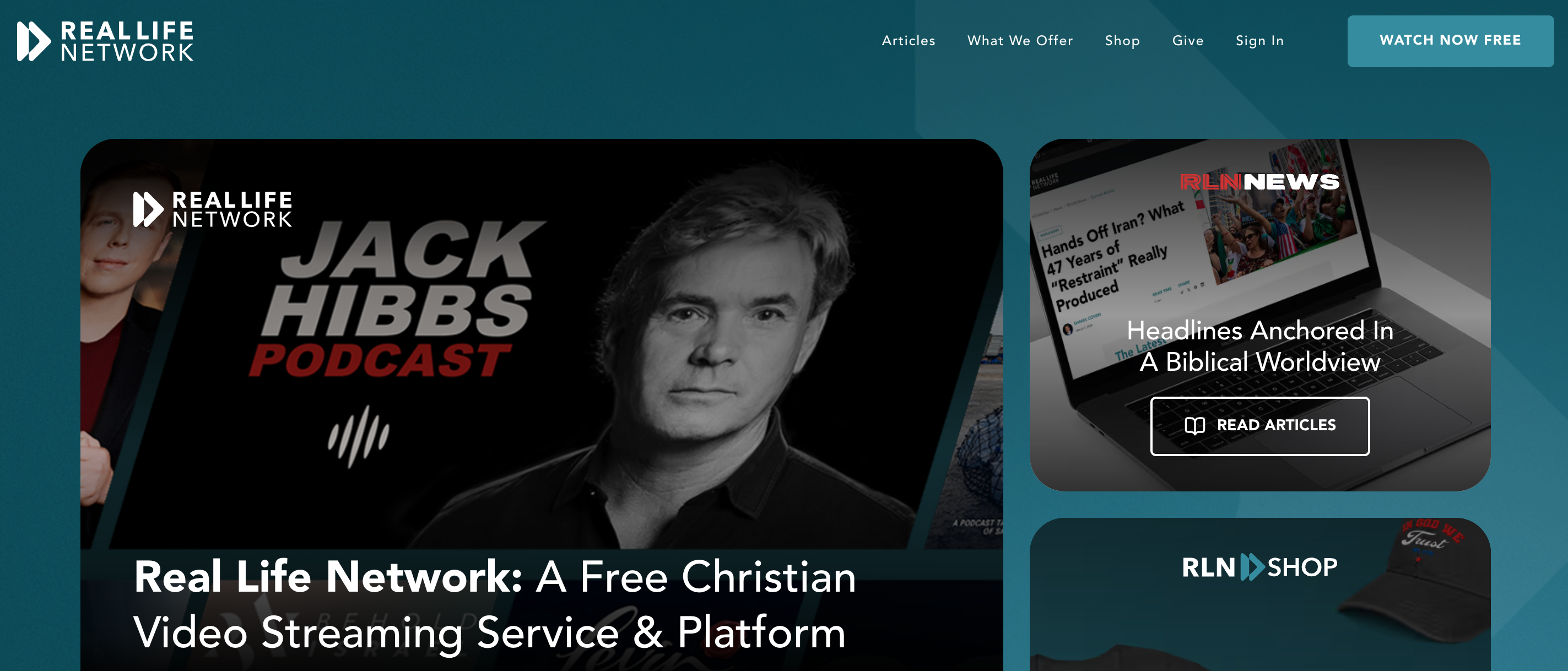
Cost: Free
Real Life Network offers one of the broadest combinations of biblical programming available without a subscription fee. The donor-supported platform includes Bible teaching, Christian news, apologetics, documentaries, podcasts, kids’ programs, movies, cultural commentary, and live events.
Viewers can find programs such Real Life with Jack Hibbs, RLN News, The Daniel Cohen Show, Cross Examined, The Creation Today Show, Superbook, and many other offerings within one biblically curated environment.
Unlike services centered primarily on movies, RLN is particularly strong for viewers who want entertainment combined with biblical teaching and programs addressing faith, culture, current events, and worldview.
Best for: Christians looking for a broad, free streaming platform built around biblical truth.
2. Pure Flix: Best for Christian Movies and Family Entertainment
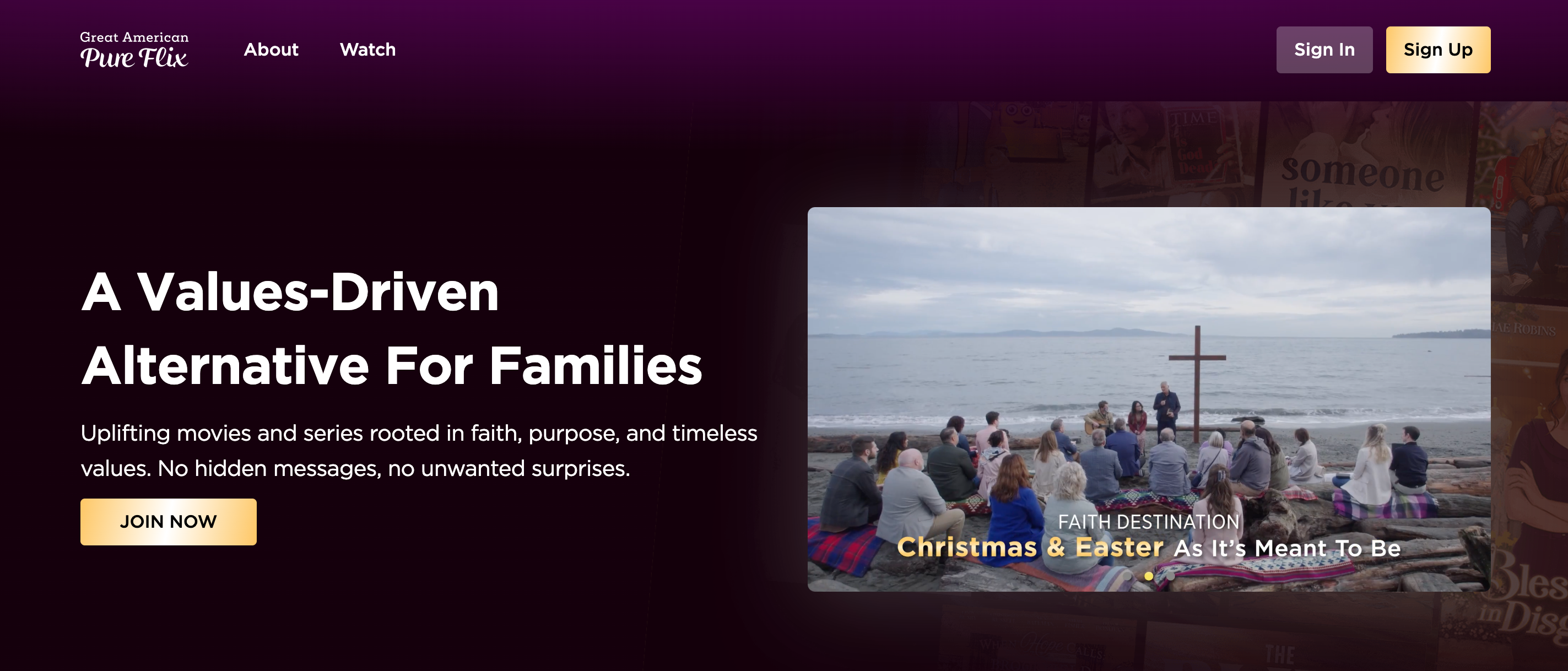
Cost: Paid subscription; plans begin at $9.99 per month
Great American Pure Flix is one of the best-known Christian streaming services for faith-forward movies and scripted entertainment.
Its catalog combines original series, Christian films, family dramas, Christmas programming, kids’ shows, and uplifting entertainment centered on faith, family, and traditional values. Multiple membership levels are available, with higher tiers adding features such as special screenings and early access.
For viewers who want a faith-oriented alternative to browsing mainstream movie libraries, Pure Flix remains one of the strongest options.
Best for: Christian movies, original series, family dramas, and faith-centered entertainment.
3. UP Faith & Family: Best for Wholesome Family Entertainment

Cost: $5.99 per month or $59.99 annually
UP Faith & Family offers thousands of hours of commercial-free family movies, dramas, series, and inspirational entertainment.
Its catalog is broader than explicitly Christian programming. Viewers will find faith-friendly movies alongside wholesome family dramas and popular series such as Heartland.
That distinction makes UP Faith & Family particularly useful for households looking for cleaner entertainment without requiring every program to function as Christian teaching.
Best for: Wholesome dramas, family movies, romantic stories, and uplifting entertainment.
4. Faith Channel: Best for Faith-Based Shows and Inspirational Content
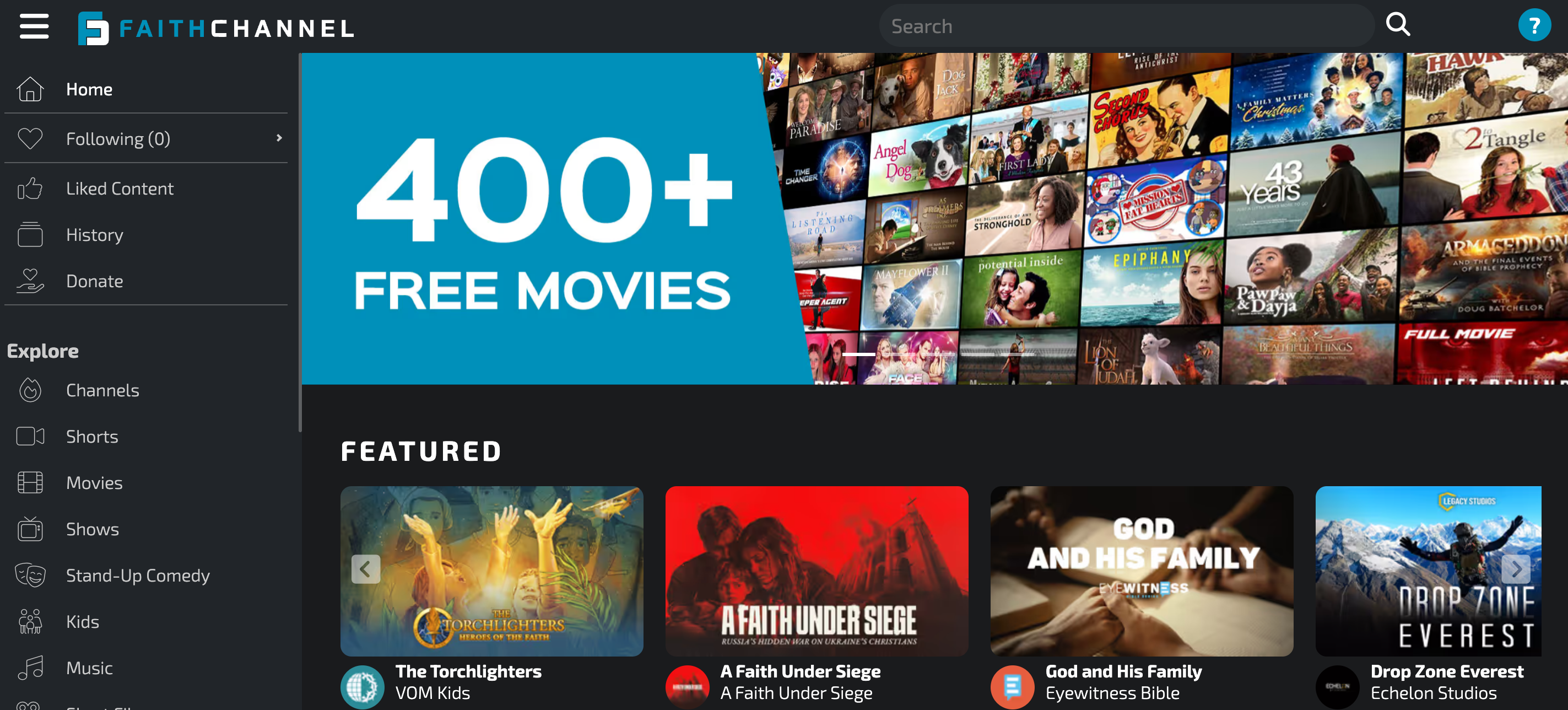
Cost: Free
FaithChannel is a free Christian streaming service offering movies, television shows, documentaries, preaching, teaching, music, podcasts, children’s programming, and other inspirational content.
Its growing library includes programming from a variety of independent Christian ministries and content producers. Titles range from Heroic Faith and The Torchlighters to apologetics, Bible prophecy, family films, podcasts, and children’s shows.
Because much of its catalog comes from different creators and ministries, viewers can encounter a particularly wide variety of formats and perspectives.
Best for: Exploring free Christian films, independent programs, teaching, podcasts, and inspirational content.
5. Go Minno: Best for Christian Kids’ Shows and Bible-Based Content

Cost: $10.99 per month or $69.99 annually after a free trial
Minno is designed specifically for Christian families with younger children.
Its library includes more than 175 shows, including the classic VeggieTales collection, Bible stories, music, educational programs, and Christian children’s entertainment. Families can stream across multiple devices and download programming for offline viewing.
Because the service is built specifically for children rather than including kids’ programming as one category within a larger library, it gives parents a focused alternative to mainstream children’s streaming.
Best for: Preschool and elementary-age children, Christian cartoons, Bible stories, and faith-based learning.
6. Yippee: Best for Safe, Faith-Focused Kids’ Entertainment

Cost: $7.99 per month or an annual subscription after a free trial
Yippee combines Christian children’s television with the energetic creator-driven format kids often encounter online.
Its library includes thousands of episodes from hundreds of series and movies, including Superbook, Christian programming, music, educational shows, and parent-approved creators. Yippee emphasizes that its environment contains no ads and no recommendation algorithms.
That makes it especially attractive to parents whose children enjoy online video but who want more control over what appears next.
Best for: Families seeking a Christian alternative to children’s YouTube viewing.
7. RightNow Media: Best for Bible Studies and Church Groups

Cost: Access is generally provided through subscribing churches and Christian organizations
RightNow Media is less like Netflix and more like an enormous digital discipleship library.
It offers more than 25,000 video Bible studies covering Scripture, marriage, parenting, leadership, finances, recovery, Christian living, and other topics. The service also includes more than 2,000 children’s episodes and downloadable materials for many studies.
Rather than purchasing individual subscriptions, users generally receive access through a participating church, ministry, or organization.
Its combination of teaching videos and discussion materials makes RightNow Media particularly useful for small groups and church ministries.
Best for: Bible studies, small groups, church discipleship, leadership development, and Christian education.
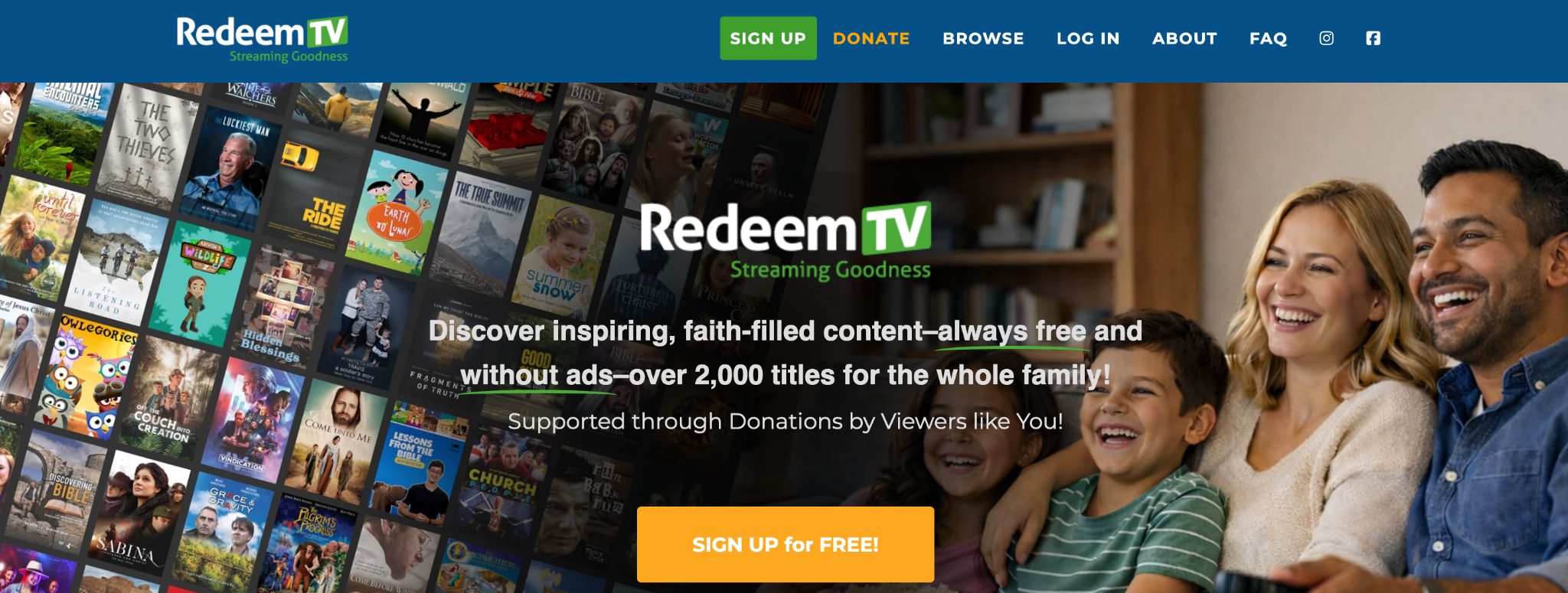
8. RedeemTV: Best Free Christian Film Streaming Platform
Cost: Free
RedeemTV offers more than 2,000 faith-filled titles without subscription fees or advertising.
Its donor-supported library includes Christian movies, documentaries, animated programs, television series, and family entertainment. Titles include The Pilgrim’s Progress, Vindication, Fragments of Truth, Ryan Defrates, and many others.
RedeemTV is especially strong for viewers whose primary interest is films and entertainment. Real Life Network offers a broader mix of teaching, news, cultural programming, and entertainment, while RedeemTV concentrates more heavily on movies and series.
Best for: Free Christian movies and shows without commercials.
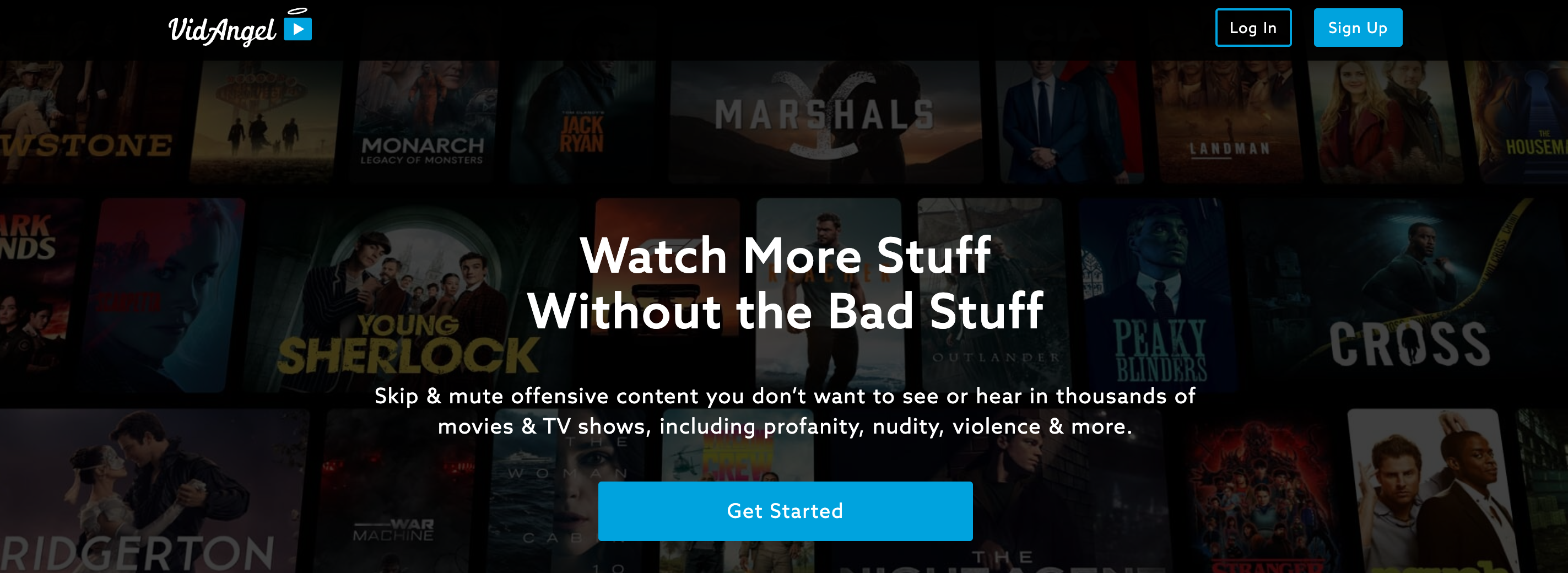
9. VidAngel: Best for Filtering Movies and TV Shows
Cost: $9.99 per month when billed directly; supported streaming subscriptions may also be required
VidAngel takes a completely different approach to family entertainment.
Rather than providing only a traditional catalog of Christian programming, VidAngel lets viewers apply customizable filters to supported movies and shows from other streaming services. Families can choose categories of language, sexual content, violence, and other material they would prefer to mute or skip.
That means parents do not necessarily have to reject an entire movie because of a handful of objectionable scenes.
VidAngel requires users to have their own subscriptions to compatible streaming services for much of its filtered content.
Best for: Families who want more control over mainstream movies and television shows.
10. Christian Cinema: Best for Renting and Buying Christian Movies

Cost: Individual rentals and purchases; optional subscription plans are also available
Christian Cinema is useful for viewers who do not necessarily want another monthly streaming subscription.
Movies can be rented individually and streamed for a limited viewing period or purchased and stored in a digital library for on-demand viewing. The service specializes in Christian and faith-based films rather than trying to compete as a broad general-entertainment platform.
Christian Cinema also offers optional subscription plans for additional movies and television programming, but its rent-or-buy model remains a major distinction.
Best for: Viewers who want specific Christian movies without committing to another full streaming subscription.
What Should You Look for in a Christian Streaming Service?
The best platform depends on what you want from it.
Start by considering biblical alignment. A platform described as “family-friendly,” “inspirational,” or even “faith-based” is not necessarily the same as a service intentionally grounded in Scripture. Families should consider who selects the programming and what worldview shapes the library.
Next, consider the type of content your household actually watches. Parents with young children may get more value from Minno or Yippee, while a small-group leader may find RightNow Media far more useful. Movie lovers may prefer Pure Flix or RedeemTV, while viewers interested in Bible teaching, apologetics, news, and culture may find Real Life Network a better fit.
Finally, consider cost, commercials, device compatibility, offline viewing, parental controls, and whether a service requires other subscriptions to function.
Are There Any Free Christian Streaming Platforms?
Yes.
Real Life Network is completely free and donor-supported, offering Christian teaching, news, movies, kids’ programs, apologetics, podcasts, and more without a paid tier. RedeemTV is also donor-supported and offers more than 2,000 titles free without ads. FaithChannel provides free faith-and-family programming as well.
Angel has selected titles available without a Guild membership, although most of its full catalog now requires paid access.
For families trying to reduce monthly subscription costs, the amount of Christian programming available free is substantial.
Which Christian Streaming Platform Is Best for Families?
There is no single answer for every household. For families seeking a platform the whole household can use, Real Life Network has an advantage because its free library extends beyond children’s entertainment to Bible teaching, movies, documentaries, current events, apologetics, podcasts, and family programming.
Families primarily concerned with younger children may prefer Minno or Yippee. Those wanting a traditional movie-and-series experience may choose Pure Flix, UP Faith & Family, or RedeemTV.
The best choice is the one that not only avoids objectionable material but also supports the values parents are working to build at home.
Frequently Asked Questions About Christian Streaming Platforms
What Is the Best Christian Streaming Platform?
The best platform depends on your priorities. Real Life Network is a strong all-around choice for viewers seeking free biblical teaching, Christian news, apologetics, kids’ programming, movies, documentaries, and cultural content. Pure Flix is particularly strong for Christian movies and scripted entertainment, while Minno and Yippee specialize in children’s programming.
What Is the Best Free Christian Streaming Service?
Real Life Network and RedeemTV are two of the strongest completely free options. RLN provides a broad mix of programming, while RedeemTV has a particularly large free library of Christian films and series. FaithChannel is another free option worth exploring.
Is There a Christian Alternative to Netflix?
Several services can function as Christian or family-oriented alternatives to Netflix. Pure Flix most closely resembles a traditional subscription movie-and-series platform, while Real Life Network combines entertainment with teaching, news, apologetics, and family programming at no cost.
What Is the Best Christian Streaming Platform for Kids?
Minno and Yippee are specifically built around Christian children’s entertainment. Real Life Network also offers free children’s programming within a larger platform designed for the whole family.
Do I Need to Pay for Christian Streaming?
No. While many Christian streaming services charge monthly or annual subscription fees, Real Life Network, RedeemTV, and FaithChannel offer free options.
Finding the Best Christian Streaming Platform for Your Home
Christian streaming is no longer a single category. Families can now choose platforms specializing in movies, Bible studies, kids’ shows, documentaries, teaching, news, apologetics, and wholesome general entertainment.
The right choice depends on what you want entering your home and what role you want media to play in your family.
For viewers who want to begin with a service built around biblical truth without adding another monthly expense, Real Life Network provides free access to Christian teaching, news, family programming, movies, documentaries, podcasts, apologetics, kids’ shows, and more.
Explore free Christian streaming today on Real Life Network.

World News
25 min
Right to Life Is ‘Most Foundational of all Rights,’ New ‘Declaration For Life’ Proclaims
Sen. Josh Hawley and Christian leaders are calling on Americans to sign a new Declaration for Life and urging Congress to ban mifepristone for abortion, placing chemical abortion at the center of a renewed national debate over abortion policy.
More than 50,000 Americans from across the country signed a new “Declaration for Life” within hours of its public release that calls on them and their fellow citizens “to stand for life” and for Congress “to ban the chemical abortion drug mifepristone,” Senator Josh Hawley (R-Mo.) told reporters during an impromptu news conference in a Senate office building Wednesday.
“We think this declaration, written by pastors, is calling on spiritual leaders and everyday Christians across America to stand for life and to confront the scourge of chemical abortion. It is so critical on this the 250th anniversary of America,” Hawley said, referring to the four-page declaration he and a committee of pastors and other spiritual leaders from multiple denominations drafted.
The Declaration for Life was officially unveiled Wednesday during the first annual Missouri Prayer Breakfast hosted by the Show-Me State’s senior senator. The document is being circulated nationwide by multiple pro-life groups, including Family Research Council, and millions of Americans are expected to sign the document in the coming days.
“The Declaration of Independence gives us three examples of ‘inalienable rights:’ life, liberty, and the pursuit of happiness. Life is the first of those rights because it is the condition of the others. It is thus the most foundational of rights,” the document proclaims at its outset.
“We believe we have an obligation as Christians and spiritual leaders to remind our countrymen of what Scripture and conscience together proclaim: That every human being from the moment of our knitting together in our mothers’ wombs, was fearfully and wonderfully made. The divine image each human being bears was not earned. It cannot be forfeited. And it is the first duty of the Church to defend human dignity where it is denied,” the document states.
The declaration continues, noting that “what is at stake on this anniversary is nothing less than the conviction on which every flourishing society finally rests: That each and every member of the human family, as a creature fashioned in the image of the divine Creator and Ruler, is the bearer of profound dignity. Where that conviction is honored, civilizations flourish. Where it is forgotten, cultures decline and fall.”
The declaration explains that while in the four years since the Supreme Court’s Dobbs decision “returned the abortion question from courts to legislatures,” that decision “did not end abortion in America. Far from it. More abortions are performed in this country today than when [Roe v. Wade] was still the law of the land — over one million abortions in 2025 alone.”
Three-fourths of those abortions are carried out using the chemical drug mifepristone, and, the declaration points out, “thanks to recent changes in government regulations, mifepristone can now be mailed into every state and city in America, regardless of local rules. The abortion drug is nearly always fatal to the unborn child and frequently injurious to the mother. Recent studies indicate the drug puts more than one in 10 women who take it at risk of serious, life-threatening complications, including hemorrhaging, infections and sepsis.”
Hawley told reporters he believes “the time has come to ban mifepristone abortions, and I want to emphasize this is something only Congress can do. … Only Congress can act to take mifepristone off of the Food and Drug Administration’s [approved drug] schedule, only Congress can say it will not be available for abortions. That’s something that Congress should do. Congress should stop passing the buck to other people. Congress should stand up and act.”
As long as Congress fails to act, Hawley emphasized, state actions such as those in Louisiana, Missouri, and others that have banned chemical abortions carried out by medical professionals in those jurisdictions will continue to be rendered meaningless so long as the drug can be mailed across state lines and administered in private by the mother with a cup of water.
Hawley added that “when it comes to elected officials in Congress, there hasn’t been much of anything [done] to protect the innocent unborn, and I think we’ve got to change that. One of the things we want to do with this Declaration for Life is call on candidates for public office in both parties to sign this declaration, to say ‘We support it, we support protecting human life.’”
Earlier this year, Hawley introduced S. 4066, the Safeguarding Women from Chemical Abortion Act that would outlaw chemical abortions. On the House side of the Capitol, the same legislation was introduced as H.R. 7902 by Rep. Diana Harshbarger (R-Tenn.). The Senate bill has seven co-sponsors, all Republicans, while the House bill has 11 co-sponsors, also all GOPers. Neither proposal has been advanced to committee hearings, as Republican leaders focus on other issues.
Another major obstacle for such reforms includes the lack of action from President Donald Trump, whose administration approved in October 2025 a second generic version of mifepristone for abortion use and has delayed a promised FDA study of the drug.
In addition, as Family Research Council President Tony Perkins told reporters during the Hawley news conference, the Republican Party at its 2024 convention abandoned its long-standing defense of the right to life, and its congressional leadership has since failed to act vigorously on the issue.
“Unfortunately, the Republican Party has lost its voice on the right to life issue, and in that vacuum, there are leaders who are stepping forward like Senator Hawley calling upon the church, communities, and the country to step up on behalf of the unborn,” Perkins said.
“We have made great progress,” FRC’s president continued, “but there has been a tremendous setback, and we’ve reached a point where I think we have to call upon the faith community, Christian pastors, to step into this vacuum and speak unequivocally about the sanctity of human life and hold elected officials accountable to the standard. This declaration is a starting point for establishing a standard for what we should be aspiring to as a nation.”
When asked by The Washington Stand if he would initiate legislative action in response to a Government Accounting Office (GAO) study released earlier this week that found thousands of abortions are being paid for annually with federal tax dollars through the Obamacare health insurance program, Hawley replied, “100 percent, and the other thing that is happening is that Planned Parenthood is getting funded right now. The ban on Planned Parenthood funding has expired, [and] it’s being funded with taxpayer dollars.”
The Hyde Amendment — named after former Rep. Henry Hyde (R-Ill.) who authored the measure — was approved by a Democrat-controlled Congress and signed into law by Democratic President Jimmy Carter in 1977. That law bars the use of federal tax dollars to pay for abortions except in a tiny class of exceptions.
This article was written by Mark Tapscott and originally published on The Washington Stand. For more content like this, visit Real Life Network.
Thank you! Your submission has been received!
Oops! Something went wrong while submitting the form.
Entertainment & Lifestyle
For decades, Christian movies occupied a narrow corner of the entertainment world. Many early productions were created with minimal budgets, small casts, and limited distribution. These projects were sincere and often carried strong messages, but they rarely matched the production value audiences had come to expect from mainstream Hollywood films.
Today, that landscape has changed dramatically. Christian films and faith-based television have experienced a notable rise in quality, cultural influence, and commercial success. What was once a niche category now includes cinematic releases that draw national attention, perform well at the box office, and earn respect from viewers.
Understanding how this shift occurred helps explain why more studios are investing in faith-driven content and why platforms like Real Life Network are committed to producing and curating media that is meaningful, excellent, and grounded in biblical truth.
A Brief Look at Early Christian Film
Early Christian movies were created primarily for church audiences or small evangelical circles. These films often had:
- Amateur or volunteer actors
- Limited budgets
- Simple scripts
- Minimal or no special effects
- Local or direct-to-DVD distribution
While these productions had heartfelt intentions, they rarely broke into mainstream entertainment. Many believers appreciated the message but still longed for films that combined strong storytelling with technical excellence.
The Turning Point: When Christian Films Stepped Into the Spotlight
About twenty years ago, a shift began. A handful of filmmakers and churches dared to dream bigger, believing that Christian stories deserved high-quality production and a national stage.
A few key titles helped change perceptions:
1. The Passion of the Christ (2004)
Though not produced by a traditional “Christian studio,” this film changed the conversation overnight. With a worldwide gross in the hundreds of millions of dollars, it showed that biblically rooted stories could draw enormous audiences and stir conversation far beyond church walls.
2. Sherwood Pictures and the Surprise of Small-Budget Success
Sherwood Baptist Church in Georgia helped launch a new era of grassroots Christian filmmaking:
- Facing the Giants (2006) was produced on a very small budget (around $100,000) and went on to earn over $10 million worldwide.
- Fireproof (2008) followed with a budget of about $500,000 and grossed more than $33 million.
- Courageous (2011) continued the trend, made for about $2 million and earning more than $35 million worldwide.
These films weren’t just “good for a church movie.” They demonstrated that faith-driven storytelling, even with modest budgets, could connect with audiences across the country.
3. War Room, I Can Only Imagine, and Beyond
The momentum didn’t stop:
- War Room (2015) was produced for about $3 million and went on to make around $74 million worldwide. It even reached the number-one spot at the North American box office during its second weekend in theaters.
- I Can Only Imagine (2018), based on the story behind the MercyMe song, was made for about $7 million and earned more than $85 million worldwide.
- Jesus Revolution (2023), telling the story of the Jesus Movement in Southern California, had a budget of about $15 million and went on to make more than $54 million worldwide.
These and other faith-based films showed that Christian stories could be both impactful and commercially successful, often delivering remarkable returns compared to their budgets.
Why Christian Films Are Improving
Several significant shifts explain why Christian movies now often come much closer to Hollywood’s production quality.
1. Higher Budgets and Better Technology
As studios and investors recognized real audience demand for faith-based content, more funding became available. At the same time, advances in digital filmmaking make high-quality cameras, editing tools, and visual effects more affordable. The result: better cinematography, sharper sound, and stronger overall polish.
2. Experienced Talent in Front of and Behind the Camera
Over time, more experienced actors, writers, directors, and crew members have chosen to work on faith-based projects. That professional expertise shows up in:
- Stronger scripts
- More nuanced performances
- Better pacing and editing
- More intentional visual storytelling
3. Audience Demand for Meaningful, Clean Content
Millions of viewers are weary of entertainment that feels dark, graphic, or hopeless. Parents and grandparents in particular are looking for movies that:
- Uphold family, forgiveness, and moral responsibility
- Avoid graphic violence and explicit content
- Offer genuine emotional and spiritual depth
Faith-based films consistently provide that kind of experience. This demand has encouraged more careful craftsmanship and opened doors for wider distribution.
4. Studio Support and Faith-Focused Divisions
Many major studios and distributors have taken notice of the consistent performance of faith-based films. Some have created dedicated divisions or partnerships focused on this space, giving Christian projects access to:
- Larger marketing campaigns
- Professional distribution networks
- Wider theatrical releases
Faith-driven entertainment is no longer an afterthought. It is now a recognized category with a strong and reliable audience.
Why Audiences Are Turning Toward Faith-Based Content
It isn’t only Christians who are watching. Many viewers who may not identify as religious still appreciate films that feel hopeful, honest, and emotionally grounded.
Faith-based films tend to provide:
- Clear moral stakes
- Stories of redemption and second chances
- Characters who grow and change for the better
- Endings that offer hope instead of cynicism
At a time when many mainstream stories lean into despair or shock value, that kind of storytelling is a welcome change.
How Christian Television and Streaming Have Grown
The growth isn’t limited to films. Faith-based television, documentaries, and streaming content have also expanded dramatically in both quality and reach. Today, Christian media offers:
- Thoughtful documentaries and docuseries
- Professional teaching and discipleship series
- Podcast networks featuring pastors, apologists, and Christian thinkers
- Children’s content with strong biblical themes
- Worldview and cultural-analysis programs that help believers think biblically about current events
Streaming has opened the door for this content to reach global audiences. Viewers who once had to wait for a DVD or special broadcast can now access high-quality faith-based programming at any time.
What Still Sets Faith-Based Films Apart
Even as Christian films have improved technically, they remain distinct in important ways. Faith-based productions typically offer:
- Purpose-driven storytelling anchored in biblical truth
- Themes centered on grace, forgiveness, and hope
- A commitment to avoid graphic or exploitative content
- A focus on the value of every person before God
This combination is increasingly rare in mainstream entertainment and is one reason faith-based content continues to find new fans.
Why Real Life Network Is Committed to Quality
Real Life Network exists to provide families and individuals with uplifting, biblically grounded, and thoughtfully produced content without the moral concerns often woven into mainstream entertainment.
RLN’s mission includes:
- Offering programming that aligns with a Christian worldview
- Avoiding graphic violence, explicit sexuality, and sensationalism
- Highlighting films, series, and conversations that encourage spiritual growth
- Giving families a trusted place to find both entertainment and discipleship content
As faith-based media continues to grow in excellence, RLN is committed to being part of that growth—curating and producing content that is both engaging and rooted in truth.
Christian filmmaking has come a long way. What began as a small, low-budget corner of the industry has grown into a respected and influential space. Many titles now approach or match Hollywood-level quality, proving that when Christian stories are told with skill and care, they resonate deeply with audiences.
For viewers who are looking for films and shows that speak to the heart without compromising their convictions, this is very good news.
Explore thoughtfully produced Christian films, teaching, and series anytime on Real Life Network.
25 min

February 12, 2026
Real Life Network
Entertainment & Lifestyle
In recent months, more parents have begun paying closer attention to changes within Disney’s streaming ecosystem. Articles discussing Disney’s deeper integration of Hulu into Disney+ have raised new questions for families who once viewed Disney+ as a largely predictable, family-oriented platform.
As the lines between Disney+, Hulu, and broader general-market entertainment continue to blur, many Christian parents are asking a thoughtful question: What streaming options best support the values we’re trying to cultivate at home?
What’s Happening With Disney+ and Hulu
Disney has been steadily moving toward a more unified streaming strategy. Hulu content is now increasingly visible within the Disney+ experience for bundled subscribers, and Disney has announced plans to fully integrate Hulu into Disney+ in the coming years.
This matters because Disney+ and Hulu were originally designed with different audiences in mind. Disney+ emphasized family entertainment, while Hulu built its library around general entertainment, including more mature programming.
Although Disney provides parental controls and profile settings, the broader concern for many parents is not simply access, but exposure. Thumbnails, recommendations, promotions, and search results all shape what children see first, even when restrictions are in place.
Why Christian Parents Are Reassessing Streaming Choices
Christian parenting isn’t driven by fear, but by responsibility. Scripture calls parents to be intentional about what shapes the hearts and minds of their children. Entertainment is not neutral; it forms habits, expectations, and values over time.
As content libraries expand and shift, many parents are realizing that managing restrictions across multiple platforms can become exhausting. Rather than constantly reacting, families often prefer to choose environments where the default content already aligns with their convictions.
This reassessment isn’t about rejecting culture altogether. It’s about recognizing that leadership in the home includes guiding media choices with wisdom and purpose.
Streaming as a Discipleship Decision
Every household disciples in some way—intentionally or unintentionally. Media consumption plays a role in that formation.
Christ-centered leadership in the home often includes:
- Choosing content that reinforces biblical truth
- Reducing exposure to themes that contradict Scripture
- Creating space for meaningful conversation
- Prioritizing content that points children toward the Gospel
When parents treat streaming decisions as part of discipleship, they move from constant policing to purposeful replacement, offering better options rather than simply saying no.
Why Real Life Network Is a Meaningful Alternative
For families looking beyond Disney+ and Hulu, Real Life Network offers a distinctly different approach. RLN is curated around biblical conviction, not mass-market appeal.
Rather than mixing family content with mature general entertainment, RLN provides a consistent environment built to support faith, learning, and discipleship.
Families will find:
- Kids’ programming rooted in Scripture, including Superbook, iBible, Ryan Defrates: Secret Agent, Star-Spangled Adventures, and more.
- Apologetics resources for growing minds, such as In Depth Apologetics for Kids, The Creation Today Show, and Cross-Examined with Frank Turek.
- Documentaries and teaching that encourage biblical thinking and cultural discernment, including titles like Truth Rising.
This kind of content doesn’t just avoid objectionable material; it actively promotes faith, truth, and hope.
Reducing Friction for Parents
One of the greatest benefits families mention when switching to a faith-based platform is simplicity. When the entire library is curated with Christian values in mind, parents spend less time filtering and more time engaging.
Instead of worrying about:
- Unexpected recommendations
- Shifting content standards
- Mature themes appearing alongside children’s titles
Parents can focus on conversations, shared viewing, and spiritual growth.
A Healthier Media Environment at Home
Choosing Real Life Network over general-market streaming isn’t about isolating children from the world. It’s about shaping the environment in which they grow.
A healthier media environment:
- Supports biblical teaching already happening at home and church
- Encourages curiosity rooted in truth
- Helps children develop discernment over time
- Reinforces Gospel-centered values through story and teaching
When children regularly engage content that aligns with faith, those messages quietly but powerfully shape their worldview.
Choosing With Intention
Disney+, Hulu, and other mainstream platforms will continue evolving. Parents can choose to adapt endlessly, or they can choose platforms designed from the start to support their values.
For families seeking an alternative that prioritizes faith, discipleship, and Christ-centered leadership in the home, Real Life Network offers a clear and trusted option.
As families navigate changing media landscapes, choosing content that promotes the Gospel and supports intentional parenting has never mattered more.
Explore Christ-centered, family-safe streaming anytime on Real Life Network.
Related Articles:
- Are Christian Streaming Platforms Available on Roku, Apple TV, and Fire TV? By Real Life Network
- Where Can I Find Clean Cartoons for My Kids? By Real Life Network
- Why Choose a Christian Streaming Platform Instead of Netflix? By Real Life Network
25 min
Disney+, Hulu, and Choosing a Better Streaming Option for Christian Families

February 9, 2026
Real Life Network